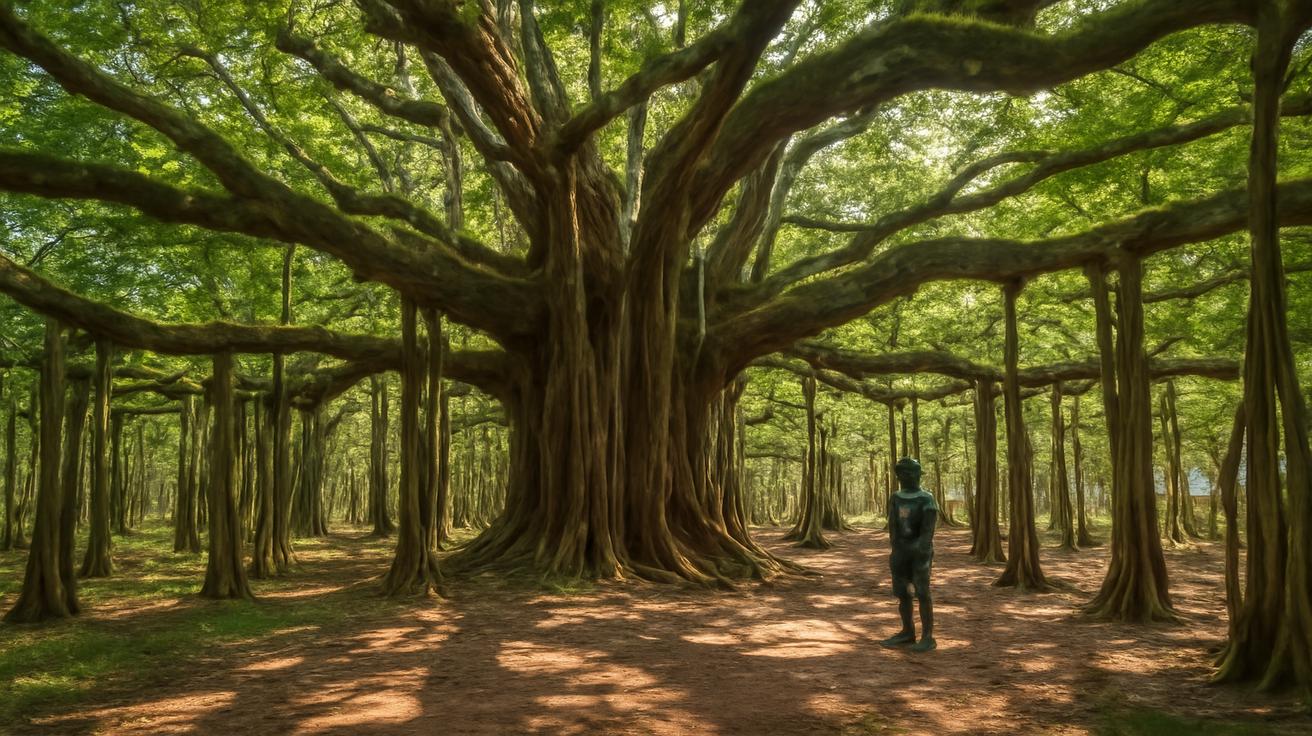
The first time you see it, your brain quietly refuses to cooperate. Your eyes say “forest,” your senses say “grove,” but somewhere in the back of your mind a quiet voice insists: This is one single living being. You’re standing on the edge of a green universe that stretches for 8,500 square meters, a canopy 20 meters high, dappled light flickering across your face, birds weaving between branches that all, somehow, belong to the same tree. When harvest comes, this one organism will swell with 80,000 fruits, each one a small, shining testament to something almost unbelievable: a forest that is, in truth, just one tree.
The Forest That Isn’t: Stepping Into a Giant
Walk a little closer and listen. Leaves murmur against each other in a wind that has traveled far to get here. The air is warmer under this living roof, gently humid, faintly sweet. The earth is soft where decades of fallen leaves have returned to soil, and each step carries a muffled crunch. You tilt your head back and the sky fractures into a mosaic of green—thousands upon thousands of leaves catching the light, filtering it down in faded gold.
It looks, in every possible way, like a forest. Thick columns that feel like trunks stand shoulder to shoulder. The canopy is layered and complex, with branches looping over branches in tangled arcs. Birds have claimed different levels as if choosing floors in an airy apartment building: warblers up high in the sun, ground-feeders skimming just above the leaf litter, something with a sharp call rattling from somewhere in between.
Yet beneath your feet, something extraordinary is happening. All those “trees” around you, all those trunks that seem to be individuals standing in a crowd, are not separate at all. They are a single genetic individual, a network of branches and roots emerging from one tree that has, over the decades, reached outward and upward until it covered an area larger than a football field. You could walk for minutes under its shade and never truly leave it.
To your right, a path curves around what looks like the boundary of the grove. You can’t see where the tree begins or ends. That is part of its illusion, part of its magic. This is what it means when people say: it looks like a forest, but it’s a single tree.
The Secret Architecture of One-Tree Forests
To understand how a single tree can become an entire landscape, you need to imagine time not as a straight line, but as a series of expanding circles. Many of these colossal trees begin in a way that’s deceptively simple: a seed sprouts, grows, and becomes a seemingly ordinary tree. For years, maybe decades, there’s nothing especially remarkable about it. Then something quiet and slow begins to happen.
Some giant trees expand by rooting their own branches. A limb grows long and heavy and arcs toward the ground. In rainstorms, water runs along its length, dripping from the tip like a patient metronome. One particularly wet season, the tip of the branch touches soil long enough to take hold. It sends down roots. What was once a branch is now both branch and trunk—a new column rising from the earth but still genetically identical, still part of the same living system.
Multiply that small miracle by a hundred seasons. Branch after branch, limb after limb, root after root. A circle grows around the original trunk, then another circle outside that one. A ring of new “trees” forms, each of them actually the same tree, the same life force. To anyone passing by, it looks like a stand of many. Only when you step inside, only when you trace the curves of those woody limbs, do you realize it is all one sweeping gesture of growth.
The result is not just large—it’s immersive. You can walk between what feel like independent trunks, tracing fingers over rough bark interrupted by patches of smooth new growth. Up above, branches crisscross and knit together, creating a living ceiling. On the forest floor, roots braid into each other like ropes buried just beneath the soil. The tree does not grow up so much as it grows out, building a green cathedral with countless pillars all connected to one another.
In some cases, the original trunk becomes almost irrelevant. It may die back or rot away, leaving behind a living ring of descendants that are, paradoxically, not descendants at all but extensions of a single original self. The “forest” continues even if the point of origin vanishes from sight.
Living With Giants: A Day Under the Canopy
Spend a full day inside one of these tree-forests and you start to notice its rhythms. At dawn, the light comes in low and angled, staining the air with the yellow-pink hues of early morning. Mist hangs in the spaces between trunks, briefly turning each ray of sun into a visible shaft. Spiders, already awake, have drawn silver lines from branch to branch, dew beading along them like strings of tiny lanterns.
As the sun rises, the canopy deepens in color. Leaves unfurl and reposition themselves. Some tilt to catch more light; others fold slightly, conserving moisture. Insects emerge in waves, each species attuned to its own preferred hour. The first birds of the day call from near the outer edges, where the sunlight hits first. Their cries echo under the canopy, bouncing softly off the layered leaves.
By midday, the interior of the tree feels like a secret world. Outside, the light is hot and possibly harsh, but here it’s tempered, mellowed, almost kind. Air moves gently through the branching corridors; even on a windless day, you feel a faint breath of movement, as if the giant organism itself were exhaling around you. The soil smells alive—earthy, loamy, with the faint sour-sweet tang of decomposing leaves returning their nutrients to the roots beneath.
Ants cruise along the bark highways, vanishing into cracks and reappearing meters away. Lizards sun themselves on wide, horizontal limbs, slipping back into shadow when a shadow of a hawk passes over. In the cool pockets near the base of trunks, mushrooms claim the damp. Some are the color of bone. Others flare orange or rust-red, like embers that forgot how to burn.
As daylight ebbs, the forest-tree transforms yet again. The air cools first at the edges, then deeper inside. Leaf surfaces shed the day’s heat with a quiet sigh. Night insects begin their chorus—scrapes, hums, and trills layering into a background music that feels both familiar and uncannily intricate. Above, the canopy turns from green to nearly black, punched through with glimpses of stars.
Standing there, you feel something that’s hard to name. It’s not just awe, though awe is surely part of it. It’s a sense of being tolerated inside another being’s body—moving along its skeleton, breathing under its skin of leaves, sharing, for a few moments, its space in the world.
8,500 Square Meters of Life: A Tree That Feeds Thousands
If its size and shape challenge your sense of what a tree can be, its productivity might completely upend it. Imagine the branches around you heavy with fruit—tens of thousands of them, glowing in shades of yellow, orange, green, or purple depending on the species. When harvest season peaks, workers weave through the lattice of trunks with baskets and sacks, calling to one another, their voices bobbing like bright birdsong under the leaves. By the time they are done, they will have gathered around 80,000 fruits from this single organism in one cycle.
That number is easier to grasp when you break it down. Picture a rough mental map of this giant:
| Feature | Approximate Value | What It Feels Like |
|---|---|---|
| Area covered | 8,500 m² | Larger than a football field of shade |
| Height | ~20 meters | Like a 6-story building of leaves |
| Fruits per harvest | ~80,000 | Enough to fill trucks or feed a town |
| Trunk-like columns | Dozens to hundreds | Feels like walking through a small woodland |
Now imagine each fruit as its own story. Hands reaching for them. Knives cutting them open. Children leaning over bowls, juice on their chins. Markets piled high with their colors. Every fruit contains sugar born from sunlight—the energy of distant days concentrated into edible form.
This tree is not just a spectacle; it’s a provider. In many places where such giants grow, they are woven into the local economy and culture. A single harvest can support livelihoods for pickers, sellers, transporters, and processors. The shade beneath hosts informal markets, gatherings, even impromptu celebrations at the close of a successful season. Elders might sit near the oldest trunks, telling stories about the “year the fruits were as big as your head” or the storm that nearly broke the western side of the canopy but didn’t.
You can walk the same path at different times of the year and feel the phase of the tree’s life in your bones. When fruits are young, there’s a faint, green scent—sharp, not yet sweet. At peak ripeness, the air becomes almost thick with fragrance, a perfume of sugar and flesh and the subtle bitterness of skins. After harvest, the tree feels lighter, more open. Here and there, fallen fruits left for birds and animals split on the ground, feeding not just people but the entire ecosystem pulsing under the leaves.
Roots, Memory, and the Slow Intelligence of a Giant
It’s easy to look at size and yield and think in terms of quantity: more wood, more leaves, more fruit. But the deeper story of a one-tree forest is about connection—how a single living body processes a deluge of information from its environment and responds, inch by patient inch.
Drop to your knees near one of the trunks and scrape gently at the soil. Beneath the surface, roots fan out in tangled, deliberate lines. Some are thick and sinewy, anchoring the giant against storms and drought. Others are as fine as hair, reaching into impossibly small pores in the earth, sampling moisture and nutrients grain by grain. In the darkness of the soil, they link with fungi that weave their own white threads between particles of sand and clay.
Through these fungal partners, the tree can trade: carbohydrates for minerals, sugars for phosphorus and nitrogen. Some scientists describe this as a kind of economic negotiation—both plant and fungus benefiting from a partnership that has been refined over millions of years. For a tree that sprawls across 8,500 square meters, this network becomes a sensory organ as much as a digestive one, gathering data from a wide swath of territory.
A drought in one corner of the canopy may send signals through the root system that affect leaf behavior meters away. Insects chewing on leaves can trigger chemical changes not only in the attacked branch but also across distant parts of the tree, preparing them with bitter defenses. When the soil becomes suddenly rich—after a flood melts into the ground, for instance—the organism can redirect growth to take advantage of the temporary abundance.
Standing under such a tree, it’s tempting to think of it as a slow-thinking being, not thinking in words or images, but in gradients: of moisture, of light, of stress, of opportunity. The tree remembers in wood. Each ring and knot tells of a season of hardship or abundance. A broken branch becomes a scar, a site of new growth that will one day thicken into another trunk-like column. The canopy shifts over years, following the path of the sun, the pattern of prevailing winds, the subtle contour of the land.
Humans weave themselves into this memory too. The places where children climb become polished and smooth. The spots where villagers gather wear hollows into the earth. Old pruning scars mark decisions made by hands long gone, yet still quietly shaping how the tree lives and grows today.
Why These Giants Matter in a Changing World
In an age when landscapes are fraying under the pressures of climate change and industrial expansion, a single tree that can shelter and feed so much life becomes more than a curiosity. It becomes a symbol of what long-term care can create—and what neglect can destroy.
The vast canopy moderates temperature, offering a refuge from heat that grows more intense each year. Its roots help hold soil in place, resisting erosion in storms that come harder and faster than they used to. The tree stores carbon in its wood and in the soil it enriches, quietly locking away what the atmosphere has too much of. Under its branches, countless other species find microclimates that suit them: a moss here, a beetle there, an orchid clinging to a high limb where mist lingers.
These giants are fragile in their own way. Their sheer size can make them vulnerable to lightning, to invasive pests, to careless development. A single road cut too close, a change in groundwater use, a fire that runs unchecked—any of these can damage not just an individual trunk, but the integrity of the whole organism.
Yet standing within one, you can feel how resilience is built into their very design. They do not stake everything on a single towering trunk. Their many columns share the burden. If one section falters, another may take over. They are both single and many; both unified and distributed.
Such trees invite a different way of thinking about our relationship with nature. Not as something separate from us, but as a long-term collaboration. Communities that live near these organisms often treat them with a blend of practical respect and quiet reverence. Seasonal harvest rules, informal taboos about cutting certain branches, communal decisions about watering or protecting the area during drought—these are all forms of negotiated coexistence, carried out not in treaties and legal documents, but in habits and stories.
Learning to See the Forest and the Tree
Once you’ve spent time inside a one-tree forest, something subtle shifts in how you look at the world outside it. A line of street trees no longer feels like a random row of decorations—they become individuals with their own invisible territories of roots and fungi. A small sapling behind a building no one notices begins to look like a possibility, a future giant if given enough time and space.
More than anything, these vast trees are a physical reminder that scale can be deceptive. From far away, this organism is a patch of color on a satellite image, a polygon on a map. From the ground, it is a forest. Up close, it is rough bark beneath your hand, the sound of leaves whispering to each other, the sudden clatter of wings as a bird takes off above you. All of these perspectives are real; none of them tells the whole story on its own.
We live in a time that loves sharp boundaries: this species, that species; this property, that property; nature over there, people over here. But the single tree that looks like a forest does not care about those lines. It is, all at once, food and shelter, landscape and organism, history and possibility. It’s a host for fungi, a scaffold for nests, a marketplace for insects, a gathering place for humans.
If you ever find yourself lucky enough to stand under such a canopy, pause before you touch the bark. Notice the temperature difference between sun and shade. Listen for the small lives moving in leaves and soil. Then, lay your hand against the trunk and remember that you are, in that moment, in contact with something that stretches for thousands of square meters around you and years—decades, maybe centuries—behind you.
It looks like a forest. It is a single tree. And for a brief moment, standing there between root and leaf, you are part of its story too.
Frequently Asked Questions
Is it really possible for one tree to cover 8,500 square meters?
Yes. Some tree species naturally spread outward by rooting their branches or sending up new trunks from the same root system. Over many decades, this process can create a huge canopy that covers thousands of square meters while still being a single genetic individual.
How can I tell if a “forest” might actually be one tree?
Look for trunks that are unusually close together with intertwined branches forming one continuous canopy. If many trunks appear connected by low, arching limbs or share a clear center of growth, it may be a single organism rather than many separate trees.
Do these giant trees need special care?
They usually thrive when their surrounding ecosystem is healthy. Protecting groundwater, preventing soil compaction, avoiding fire, and not cutting major structural branches are key. Local communities often develop traditional practices to care for such trees over generations.
Why do some trees produce so many fruits at once?
Mass fruiting is a strategy to ensure successful reproduction. By producing tens of thousands of fruits in a short window, the tree attracts many animals to disperse its seeds while also overwhelming potential seed predators.
Can a single huge tree support a whole community?
Economically, culturally, and ecologically, yes. A large fruiting tree can provide food, shade, income from harvests, and a gathering place. Ecologically, it supports birds, insects, fungi, and other plants, acting as a small ecosystem all on its own.