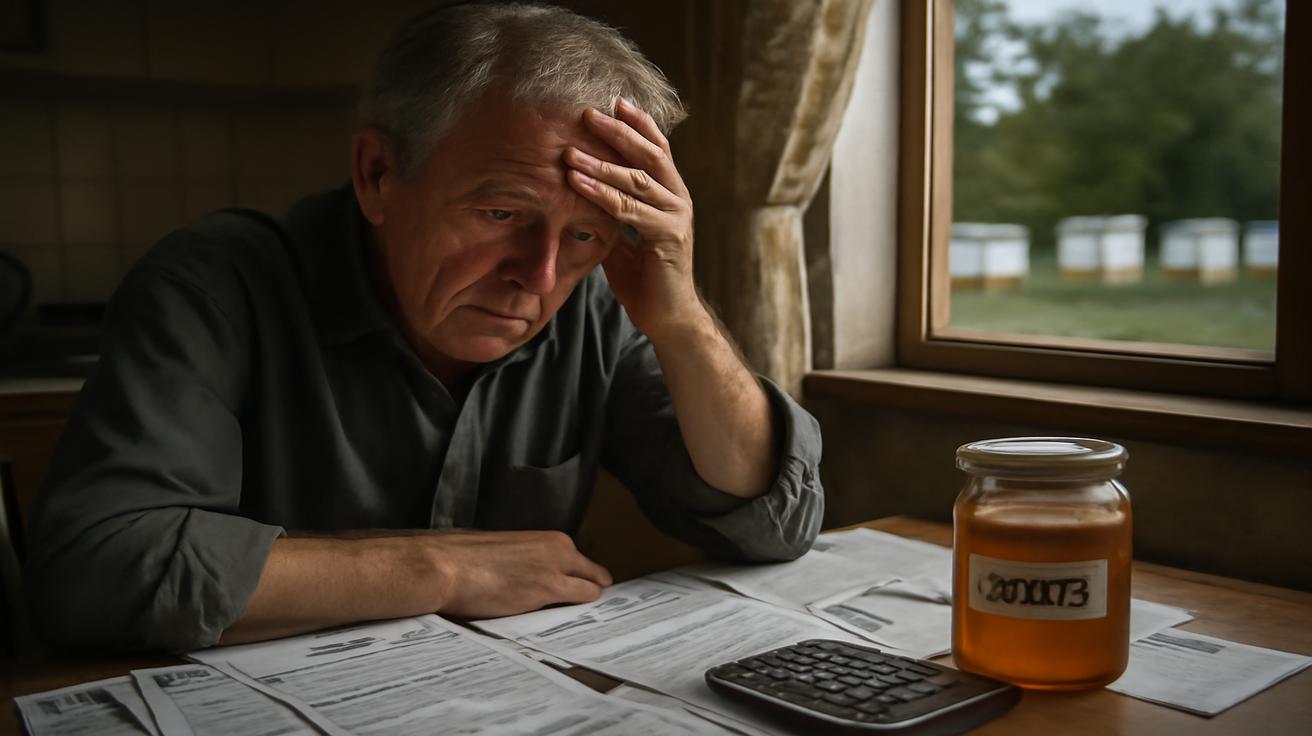
The first thing you notice when you step onto Harold Lawson’s land isn’t the house or the soft sag of the old porch swing. It’s the hum. A deep, velvety vibration, like distant traffic or a low cello, drifting from the far corner of the field. On summer mornings the sound rolls in waves, woven through the smell of clover and wild mint. That’s where the hives sit—white, weathered boxes lined up like a small, orderly village on the edge of his worn‑out pasture.
Harold never planned on becoming “a man with bees.” He doesn’t own them. He doesn’t work them. He doesn’t wear the suit or crack open the frames or sell a single jar of honey at the Saturday market. All he did was say yes.
“It felt like the right thing,” he tells me, standing with his thumbs looped through his belt, the sun flattening his shadow across the grass. “He needed a place. I had the space. That was all.”
But the hum of the hives has brought something else, less visible and far less welcome: a tax bill labeled “agricultural assessment” that’s grown larger and sharper each year—something Harold insists he can’t afford, and never knew he was inviting in.
How a Favor Turned into a Bill
The story starts the way many quiet rural stories do: with a knock at the door and a man with a polite smile and a cap turned backward.
“Name’s Miguel,” he’d said, standing on Harold’s porch one afternoon three summers ago. “I keep bees—about a dozen hives. I heard you might have some open field you’re not using? I’m trying to expand a bit, but land is expensive, and folks are nervous about bees near their houses.”
Harold’s land used to be busy. For decades he ran cattle across these acres, working sunup to sundown until his knees demanded a different kind of life. After his wife passed, the cows were sold off, the fences left leaning, and the hay fields went soft with weeds and wildflowers. The place felt too quiet now, too empty.
So when Miguel offered a small stipend and the promise of helping “the pollinators,” it sounded, to Harold, like a chance to do something that mattered without having to pick up where his knees had left off.
“He said bees were struggling, that the world needed more of them,” Harold recalls. “I liked the idea. And I figured a couple hundred bucks a year for the trouble wasn’t bad either. Mostly, though, I thought—why not help?”
They signed a simple agreement: Miguel could keep his hives on the back five acres, away from the house. He would carry his own insurance, take care of the bees, and make sure gates were closed behind him. Harold would let the clover grow and, occasionally, stand at the field’s edge and watch the beekeeper at work like someone peeking through the curtain of another life.
Then the tax notice came.
A Letter in an Unfamiliar Language
The envelope looked like all the others from the county—off‑white with a small black window, the kind you never open with excitement. Harold sat at the kitchen table, ran a butter knife along the edge, and pulled out a sheaf of paper crammed with phrases that made his eyes skip: “agricultural use,” “production activity,” “reclassification,” “special assessment,” “rollback.”
He turned it over, then turned it over again, as if the sense might appear on the other side. What he did see, clear and unavoidable, was the number: his property taxes had jumped. Not by a ruinous amount if you’re working full-time or jointly paying a mortgage, perhaps—but for a man living on a fixed retirement income, it was the kind of increase that nudges the budget from “tight” to “something has to give.”
“At first I thought it was a mistake,” he says. “I don’t farm anymore. Haven’t in years. I called the number at the bottom and sat on hold, listening to that awful music.”
When he finally reached someone, the explanation felt like being dropped midway into an unfamiliar novel.
Because Miguel’s operation was a business, and because the hives constituted agricultural use on Harold’s land, a different set of tax rules now applied to part of his property. A portion had been reclassified under an agricultural assessment program—one that came with benefits in some cases, but also with conditions, paperwork, and potential penalties if something wasn’t done correctly.
“She kept saying, ‘Sir, it’s standard. Sir, you’re now considered to have agricultural activity on your parcel.’ I said, ‘No, I have a young man with bees.’ She said that’s agricultural activity.”
The hum in the back field hadn’t changed, but suddenly, the land beneath it had.
The Hidden Fine Print of “Helping Out”
Harold’s story isn’t a glitch in the system—it’s a symptom of how the system is built. Across many regions, tax codes treat land based not only on who owns it, but what happens on it. The moment it shifts from “residential” to “productive”—even partially—different rules may apply.
Sometimes this is a blessing. Many small farmers rely on agricultural classifications to keep their land taxes manageable. Without those breaks, it would be nearly impossible to grow food on a small scale and still pay the bills. But the rules that support farmers don’t always distinguish between those who are truly in the business and those who are merely trying to help.
In practice, that means a retiree who lets a neighbor graze a few sheep, a teacher who allows a market gardener to use a corner for vegetables, or a widow who says yes to a young beekeeper can suddenly find themselves entangled in a web of:
- Assessment changes
- New reporting requirements
- Potential “rollback” taxes if the agricultural use stops
- Unexpected jumps in their annual tax bill
None of this was spelled out when Miguel stood on Harold’s porch with his cap in his hands. To Miguel, this was the most modest kind of expansion: a few more hives, a bit more forage, a chance to build a small business in a tough market. To Harold, it sounded like companionship for the land and a quiet good deed.
Yet buried in that handshake was a question neither of them had the tools—or frankly, the time—to fully consider: Should saying yes to supporting a local producer expose a private citizen to financial risk?
Harold spreads his tax notice and his Social Security statement side by side on the table now, a kind of unsought balancing act.
| Item | Before Bees | After Bees |
|---|---|---|
| Annual Property Tax | $2,150 | $2,780 |
| Stipend from Beekeeper | $0 | $300 |
| Net Change to Harold’s Budget | Baseline | –$330 per year |
| Monthly Impact on Fixed Income | N/A | About –$27.50 per month |
Twenty‑seven dollars and fifty cents a month doesn’t sound like catastrophe, on paper. But when your income arrives in precisely the same amount, on precisely the same day, every month, and everything from heating oil to groceries quietly inches upward, that extra drain is not academic. It’s the difference between filling the tank once more before winter ends and “just keeping the thermostat a little lower this year.”
The Emotional Cost of an “Innocent Mistake”
What makes Harold’s situation sting isn’t just the extra line in his budget. It’s the feeling that he stepped into a trap he couldn’t see.
“If I’d been trying to make money off this, that would be one thing,” he says. “If I’d gone into farming again, or started some big operation, I’d expect to deal with all the rules. But I said yes to helping a local fellow with bees. I thought I was doing something good.”
The good is still there, of course. On warm days, the hives pulse with life. Miguel’s bees drift across the pasture, dipping into clover and goldenrod, floating past the old apple trees Harold planted with his wife. The neighborhood gardens have more cucumbers than they know what to do with. The wild blackberries along the ditch are fat and plentiful.
But next to that quiet environmental abundance sits a new kind of scarcity driven by fear. Fear of the next tax bill. Fear of unknown liabilities. Fear that the safest way to move through retirement is to say no to anything that might complicate the balance.
“When my neighbor asked if her niece could graze a couple of goats on my lot for a summer, I told her I couldn’t,” Harold admits. “Didn’t even want to think about it. I hated saying no. But once you get burned, you don’t put your hand back on the stove.”
This is the hidden social cost when systems built for commercial agriculture brush up against ordinary people. A culture that depends on small producers—beekeepers, gardeners, grazers, specialty crop growers—simultaneously sends a silent message to the landowners they rely on: if you’re not careful, helping might hurt you.
Where Responsibility Really Belongs
It’s tempting to look for a villain in Harold’s story. The county tax office, with its dense letters and cheerful on‑hold music. The beekeeper, with his hopeful expansion and small‑print understanding of agricultural classification. The retiree himself, for signing anything without asking a lawyer to look it over first.
But focusing on individual blame misses the bigger, more uncomfortable question: why is the default design of our rules so unforgiving to ordinary acts of cooperation?
If communities truly want more local food, more pollinators, more resilient rural economies, then the laws that govern land use should distinguish between:
- Commercial operators with clear profit motives and risk planning, and
- Private citizens offering modest, low‑impact support with no real economic upside.
Harold did not become a farmer again when the bees arrived. He became a host. Yet legally, the land didn’t necessarily see that difference. In the tidy logic of the tax code, land in productive agricultural use is land in productive agricultural use—regardless of whether the owner ends the year richer, poorer, or simply more bewildered.
There are ways to fix this. Some jurisdictions already carve out exemptions for small‑scale, low‑revenue operations or clarify that certain types of limited use won’t trigger reclassification of the land. Others set revenue thresholds, acreage minimums, or clear caps below which the state is essentially saying: “We’re not going to penalize you for being generous.”
But where those guardrails don’t exist—or are written so opaquely that only professionals can safely interpret them—honest, well‑intentioned neighbors like Harold and Miguel become accidental test cases in a system they never had a say in building.
When Generosity Needs Guardrails
As word of Harold’s tax trouble drifted across the community—small towns have their own kind of pollination—neighbors started sharing their own close calls.
The retired nurse who let a young couple plant a half‑acre of vegetables and barely dodged a similar reclassification. The mechanic who agreed to host a tiny flock of heritage sheep and discovered his homeowner’s insurance had questions about “livestock activities.” The teacher who almost signed a lease for a hoop house before a cousin warned her to check the zoning first.
Each story held the same pattern: eagerness to help, a fragile budget, and an aftertaste of “I had no idea it could be like this.”
What might it look like if generosity came with built‑in protections?
- Clear, plain‑language disclosures from local agencies about what does and doesn’t change your property classification.
- Simple, low‑cost consultation options for landowners on fixed incomes who want to help but can’t risk surprises.
- Thresholds that treat very small‑scale, low‑revenue arrangements as community support rather than full agricultural conversion.
- Model agreements that spell out who is responsible for taxes, insurance, and compliance, so that “We’ll figure it out” doesn’t become “You’re on your own.”
None of these solutions are flashy. They won’t make headlines the way a new grant program or a big farm bill might. But they’re the kinds of quiet structural changes that can turn precarious goodwill into stable, long‑term support.
Because the reality is: small producers need land. And more and more of the people who own that land are retired, asset‑rich on paper but cash‑poor in practice, living month to month on modest checks and careful math. If the cost of saying yes is even a small threat to that fragile balance, many will default to no.
The Beekeeper’s Side of the Fence
On a clear afternoon, Miguel parks his pickup by the gate and moves slowly between the hives, working methodically. Bees stitch the air around him, but he moves with the casual focus of someone who knows their patterns—the way they pour out in a lazy spiral when he cracks the lid, the low growl that means a queenless colony, the stunned heaviness before a thunderstorm.
When I ask about Harold’s tax bill, he looks stricken.
“I never meant for that to happen,” he says. “I told him I’d take care of anything that was my responsibility. I just didn’t know using his land would change his taxes. I thought if anything, I was helping him qualify for lower agricultural rates, like some folks get.”
He’s not wrong: in some places, that’s exactly how it works. Productive use—especially for small operations—can unlock tax relief rather than added burden. The trouble is, those rules vary by state, by county, sometimes even by township, and they’re often written in a language closer to law school than kitchen table.
For a young beekeeper trying to keep his business alive, paying for legal advice on every new yard is a non‑starter. For a retiree trying to be kind, the idea of hiring a tax consultant before agreeing to let bees breathe life into an empty field feels absurd.
“I offered to pay the difference,” Miguel says quietly. “I told him I’d increase the rent. But he said then it would feel like I was taking advantage of him. He doesn’t want charity from the kid with the bees.”
So they’re stuck in a strange moral geometry: both men feeling responsible, neither fully at fault, both paying in different currencies—Harold in dollars and anxiety, Miguel in guilt and the weight of knowing his success came with an unintended cost.
What We Owe People Like Harold
At dusk, the bees quiet. The field softens into a blur of mauve and gray, the hives turning from white to shadow. Harold stands at the edge of the yard, hands in his pockets, listening to the last faint threads of the day’s hum.
“I still like having them here,” he says. “I like thinking I’m part of something alive. But I can’t pretend this hasn’t made me nervous. At my age, nervous is expensive.”
He laughs at his own joke, but it lands heavy. Because beneath the numbers and policies and what‑ifs is a larger truth: a society that depends on the quiet cooperation of its citizens—especially its elders—owes them clarity, protection, and respect.
We ask people like Harold to help stitch together the frayed edges of local food systems, pollinator pathways, and small‑scale agriculture. We celebrate their generosity in glossy articles and community awards. Yet too often, the fine print trails behind them like a shadow, waiting to prove that in our current system, even kindness can carry hidden fees.
It doesn’t have to be this way. With thoughtful policy, clearer communication, and a willingness to see landowners not just as tax parcels but as human beings with limits, we can build a world where the hum of bees behind a retiree’s house is a simple, unburdened good.
Until then, every time a landowner weighs a neighbor’s hopeful knock against the weight of an unknown bill, we’re asking them a question we rarely say out loud: How much of your own security are you willing to risk for the common good?
For Harold, the answer came in the form of a shaky yes that turned into an unexpected invoice. The bees stayed. The bill did too. And somewhere between the two lies a challenge for all of us: if helping small producers is truly in the public interest, then no one should have to choose between doing the right thing and keeping the heat on through winter.
Frequently Asked Questions
Can letting a small producer use my land really change my property taxes?
Yes, in some areas it can. If your land is considered to be in agricultural or commercial use—whether for bees, livestock, or crops—it may trigger different tax classifications, assessments, or reporting requirements. The impact can be positive or negative depending on your local rules.
How can I find out if hosting bees or animals will affect my taxes?
Contact your local tax assessor or county property office before agreeing to any arrangement. Ask specific questions about “agricultural use,” “special assessments,” and whether a limited, small‑scale activity could change your property’s classification.
What should be in an agreement with a small producer using my land?
At minimum, address who is responsible for:
- Property tax changes or penalties
- Liability and insurance
- Maintenance and access
- Compliance with zoning and agricultural regulations
Whenever possible, have the agreement reviewed by someone familiar with local land‑use laws.
Are there protections for landowners who just want to help?
Some regions offer exemptions or clear thresholds for small, low‑revenue activities that prevent full agricultural reclassification. Others do not. Because it varies widely, local advice is essential. Advocating for clearer, fairer policies is also an important community step.
What’s the safest way for retirees on fixed incomes to support small producers?
Consider short‑term or very limited arrangements that stay clearly within residential use, support through direct purchases (like buying their honey or vegetables), or working with land trusts and cooperatives that can help manage legal and tax complexity. If you do host production on your land, get written clarity about risks before you say yes.