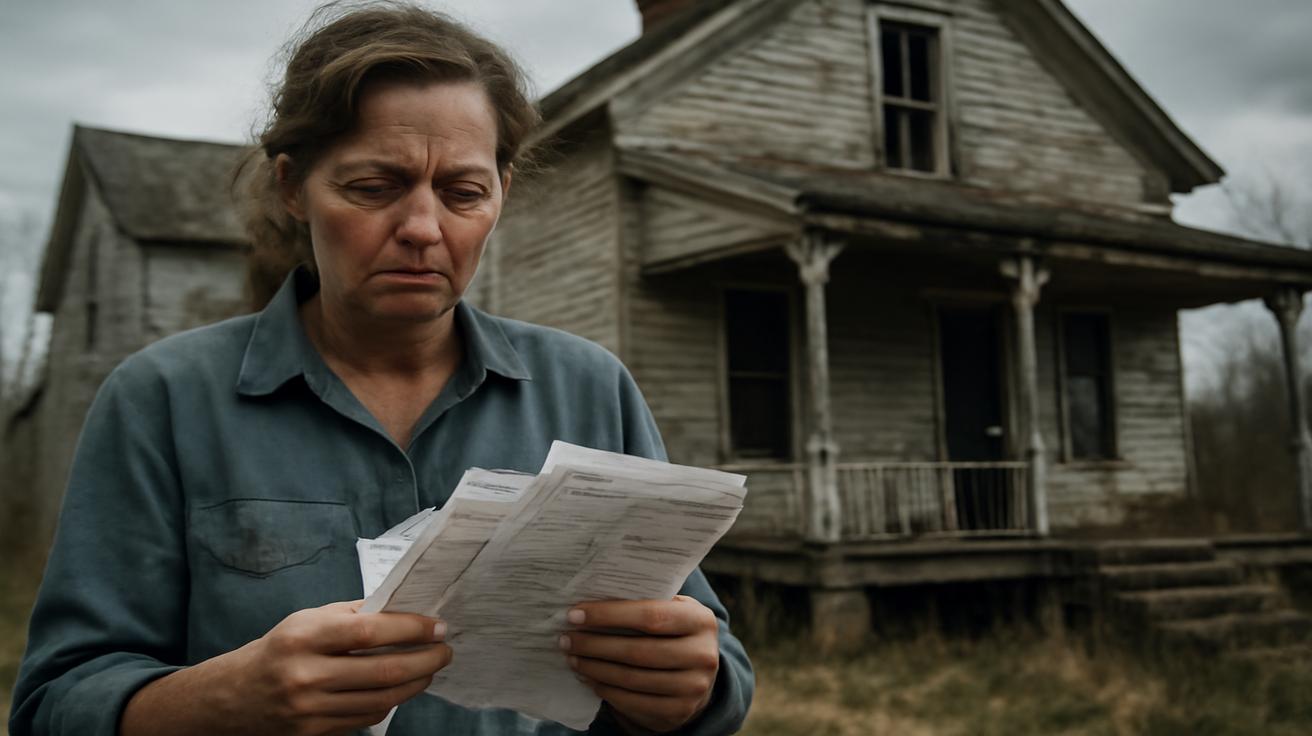
The farmhouse sagged a little more each winter, like an old man shrugging into himself against the wind. When Emily turned the key in the stiff, paint-clogged lock the night she moved back, the whole place seemed to exhale—dust, cold, and the faint smell of engine oil and dried lavender. This was not an investment. It was not a “portfolio asset.” It was the house where her father had taught her to bait a hook in the kitchen sink, where her mother had canned peaches lined like suns along the pantry wall. It was the only place he wanted to die.
The Long Drive Home
The road to the farmhouse ran like a spine across the fields—patches of frost-hardened mud, broken asphalt, and puddles that remembered every rain. Emily drove it alone in a ten-year-old hatchback that hummed anxiously whenever she shifted above third gear. In the back were three duffel bags, a box of her father’s medical records, and a potted basil plant she’d grabbed at the last minute “to make the place feel alive.”
Her father had called two months earlier, his voice thin but stubborn.
“Doc says I should think about a facility,” he’d muttered, as if naming a shame. “But I told him, I’ve got a house. I’ve got a daughter. That ought to count for something.”
It had been ten years since she’d left. Ten years of rented apartments with thin walls and fire alarms that blinked all night. Ten years of city jobs and crowded trains and occasional late-night guilt when she’d let his calls ring through. But now the cancer had threaded everywhere, stitching itself into his bones, his lungs, the soft spaces behind his eyes.
“You shouldn’t be alone,” she said, the answer already forming into a plan she hadn’t discussed with anyone. “I’ll come home.”
The farmhouse waited like a question no one wanted to ask twice. The porch steps were hollowed in the middle from decades of boots and bare feet, the paint curling away in thin strips like fingernails. Inside, the house held its breath between eras: faded wallpaper patterned with roses, a microwave from the 90s, an oxygen tank rising like a metallic tree beside her father’s recliner.
“You didn’t have to,” he said when she walked in that first evening, cheeks burning from the early spring wind.
“I know,” she answered, meaning every difficult thing that sentence held—and all the ones it left out.
The Quiet Math of Sacrifice
Caring for him was not dramatic. It was tedious, cyclical, and heartbreakingly ordinary. The days lined up like fence posts: medication at six, porridge at seven, gentle walks to the end of the driveway when he was strong enough, visiting nurses twice a week. She slept in her childhood bedroom, the posters long gone but the thumbtack scars still patterned across the walls.
Money became a quiet problem no one wanted to name. She put her city job “on pause” at first, then quit entirely when the commute and the care schedule tangled into an impossible knot. She did freelance work at the kitchen table while her father napped, laptop screen reflecting in the window like a second, ghostly room beyond the glass. On good days, he’d sit nearby in his chair and complain about the internet being slow or the radio playing the wrong kind of country music.
“You should rent out the back field,” a neighbour suggested one day over the fence, halfway through a conversation about the price of fuel. “Or that old barn. People are paying crazy money to store boats and trailers. Make the place work for you.”
Make the place work for you. The phrase lodged somewhere behind her ribs. The land wasn’t supposed to “work” for her; it was supposed to be where life happened, where seasons turned and crops either cooperated or didn’t. But hospital bills stacked like paper towers. Heating oil climbed. The roof dripped into a bucket in the hallway every time it rained.
In the end, she rented the field to a neighbouring farmer for a small grazing fee. Enough to cover winter fuel, the patching of a broken window, a new mattress so her father’s bones wouldn’t press screaming against the springs. The agreement was informal, scribbled on a page of lined paper at the kitchen table, witnessed by two chipped mugs of coffee.
“You’re a landlord now,” the neighbour joked, signing his name with a callused flourish.
“Hardly,” Emily replied, glancing instinctively toward the room where her father slept.
The Letter That Changed Everything
It arrived in a plain, official envelope about six months after her father died. By then, the farmhouse felt emptier than any vacant building she’d ever entered. Grief had a way of hollowing even the furniture; his chair sat like a question mark that would never find its answer.
She assumed it was another final bill, or some bureaucratic closure to a life that had been measured in appointments and prescriptions. Instead, it was a reassessment.
The letter was written in that strangled language of administrations, where human lives become “use classifications” and “adjusted valuations.” According to the property office, the old family home was no longer just a residence. Her “rental arrangement” for the field—combined with her documented freelance work done from home and the presence of a deteriorated outbuilding “suitable for commercial storage”—meant that the farmhouse was to be retroactively reclassified as a “commercial property with landlord activity.”
Along with that reclassification came a decade of backdated property taxes at commercial rates, plus penalties and interest for “undeclared commercial use.” It did not matter that she had only moved back two years before. The logic leapt across time: the old barns and sheds, deteriorating but technically rentable; the occasional storage of a neighbour’s trailer during winter; the grazing agreement. All of it stitched together into a narrative of profit.
The total owed was larger than anything she had ever seen outside of a mortgage contract. Her hands shook as she read the final figure, the numbers flaring like sirens on the page.
“There must be some mistake,” she told the woman at the county office when she finally got through on the phone.
“If you derive income from the property, and parts of it are used for non-residential purposes, the classification changes,” the woman replied, tone tired but not unkind. “It’s standard. You’re a commercial landlord under the code.”
“I took care of my dying father,” Emily said, voice cracking. “I rented a field to keep the heat on. That doesn’t make me a commercial anything.”
“I’m sorry,” the woman said, more softly now. “You can appeal, of course. But the system treats use, not intention.”
When Caring Looks Like Profit on Paper
Word spread quickly. In small communities, news moves faster than any official notice—through grocery aisles, farm gates, church steps, the corner table at the diner where coffee is both too hot and somehow never warm enough.
At first, the town divided cleanly in two.
“It’s outrageous,” one neighbour fumed to anyone who would listen. “What’s next, charging us commercial rates because we sell a dozen eggs at the roadside?”
Others were less sympathetic.
“Look, rules are rules,” said a man who owned a string of rental properties in town. “I’ve been paying the higher rate for years. Why should she be special because she calls it ‘helping out her father’? Income is income.”
The word landlord became a wedge. To some, it conjured images of absentee owners, profits skimmed off the top of other people’s paychecks. To others, it meant anyone—like them—who was forced to patch their lives with side hustles and small arrangements, who rented out a room to make ends meet or sold firewood from the back of a pickup truck.
In the county council chambers, the debate was more clinical but no less fierce. Younger councillors, scarred by housing crises and their own struggles with rent, argued that the tax code needed to be stricter, not looser, on property-based income.
“If we start creating exceptions,” one said, adjusting his glasses, “everyone will claim their rental activity is ‘just helping out family’ or ‘just covering costs.’ We’ll lose revenue we need for schools, roads, clinics.”
Older councillors, many of whom had cared for their own parents at home, pushed back.
“We’re not talking about a corporate landlord buying a dozen units,” a silver-haired woman replied. “We’re talking about a daughter who gave up her job to move into a crumbling house because that’s where her father wanted to spend his last days. Are we really comfortable treating that the same way?”
How Law Turns Blood into Paper
On paper, the case was simple: income plus multi-use structures equalled commercial classification. But lives are not paper. They are messier, layered, full of obligation and memory.
From an administrative view, Emily’s story slotted neatly into a growing pattern. Across the country, more and more adult children were moving back into aging family homes to care for parents. At the same time, those families were under pressure to “unlock value” from their properties—renting out a field, parking space, spare room, or shed.
Tax codes written decades earlier for a world of clear-cut boundaries—home over here, business over there—were now encountering blurred realities. The system did not ask why someone rented out a portion of their property; it only recorded that they did.
The unintended result was that sacrifice and opportunism looked almost identical in a ledger.
Consider how the numbers might appear in a tax file:
| Situation | On the Ground | How It Looks on Paper |
|---|---|---|
| Daughter moves home, rents field | Quits job, cares for father, small grazing lease to pay heating bills | Owner-occupied property with rental income from land |
| Investor buys farm, rents everything | Lives elsewhere, leases fields and buildings for maximum return | Owner-occupied property with rental income from land and buildings |
| Retired couple rents barn for storage | Fixed pension, rent barn corner to neighbour for his tools | Residential property with accessory commercial use |
To the system, all three cases wore the same labels. To the people living them, they could not have been more different.
Neighbours, Families, Generations
The fallout from Emily’s case rippled far beyond her own kitchen table. In living rooms and over shared fences, the conversations turned sharp.
“If we make an exception for her,” some whispered, “won’t that just help the rich find loopholes too?”
“If we don’t,” others replied, “we’re telling our kids not to come home. That caring is just a taxable event.”
The arguments mapped almost cleanly onto generational lines. Older residents, who had grown up in multigenerational homes where grandparents slept in the room at the end of the hall, saw the reclassification as a betrayal of an unwritten social contract. Younger people, whose adult lives had been defined by runaway housing costs, saw any property-based leniency as suspect.
Families were split too. In Emily’s own extended clan, some cousins urged her to fight.
“This is wrong,” one said, pounding the table. “We’ll write letters, get the newspaper involved. You shouldn’t have to choose between debt and selling the house.”
Others were more cautious.
“It’s just how things are now,” another muttered. “You can’t expect to get special treatment. Cut your losses. Sell the place before the roof caves in and you’re left with nothing but mold and memories.”
Memories, she thought, were the only part that felt non-negotiable. The house held them in its beams: laughter echoing up the stairwell, late-night arguments in the kitchen over college choices, her father falling asleep in front of the TV with a half-finished crossword balanced on his chest.
Yet memories did not pay tax bills. She took extra freelance work. She sold her car and bought a cheaper one. She contemplated renting out a room, even though the idea of a stranger sleeping in her father’s house made her throat tighten.
Each option seemed to confirm, in the system’s eyes, that she was exactly what they had called her: a commercial landlord squeezing value from an asset. The more she struggled to keep the home of care, the more it looked like an enterprise of profit.
What Do We Reward?
Beneath the paperwork and legal codes lies a deeper question: In our towns, our countries, our overlapping stories, what do we reward, and what do we quietly punish?
We say we value family. We praise the daughter who goes home, the son who builds a ramp for his mother’s wheelchair instead of moving her to a facility, the neighbour who checks in on the old man at the end of the road. But systems speak a different language. They reward what they can quantify: revenue, classification, consistent categories.
Emily’s story is not about a single outrageous tax bill, though it is that too. It is about a clash of ways of seeing. To the people who loved her father, the farmhouse was a place of duty and devotion. To the tax office, it was a multi-use property with underreported income potential. To some neighbours, she was a symbol of what care should look like. To others, she was an uncomfortable reminder that any leniency might further tilt an already unfair system.
When sacrifice is made to look like profit, everyone loses. The daughter is left with debt or displacement. The community is left arguing among itself rather than asking why the rules are so blunt. And the next person who considers moving home to care for a parent might think twice, calculating not only the emotional cost but the financial rebranding of their life.
At the heart of the matter is an uneasy truth: it is easier to tax a field than a feeling. Easier to measure square footage than nights spent on the floor beside a hospital bed. Easier to flag “undeclared rental income” than to acknowledge that sometimes, what looks like a business decision is just a desperate attempt to keep the heat on in a house where someone is dying.
Finding a Different Story
In the end, Emily appealed. She gathered letters from neighbours, records from hospice care, handwritten notes from the family doctor explaining how her presence had allowed her father to die at home. She argued not that she should be exempt from all responsibility, but that the law should recognize the difference between industrial-scale landlordism and the tangled, loving economies of care.
The process was long, draining, and confusing. Hearings were postponed. Paperwork was sent and re-sent. At one point, an official asked her if she had “considered monetizing the property more proactively” to meet the tax obligations.
“I moved here to spend my father’s last months with him,” she replied. “Not to optimize my return on investment.”
In a small, partial victory, some of the backdated penalties were reduced. The classification remained. The debt shrank but did not disappear. She took on more work. She delayed replacing the broken oven, cooked on a single functional burner. She held on.
The farmhouse still leans a little more each winter. The porch still sighs under new boots and returning ones. Some evenings, when the wind moves just right through the eaves, it sounds like someone slowly exhaling—relief, or resignation, it’s hard to tell.
What remains clear is this: Emily is not alone. Across fields, across suburbs, even in city apartments where parents take the spare room on a fold-out couch, people are performing unpaid, uncounted acts of care within spaces that used to be simple “homes” but now double as tax categories and revenue generators.
We could call them all landlords. Or we could learn a new vocabulary—one that can hold both a ledger and a life, that can tell the difference between the hand that collects rent and the hand that changes an IV bag at three in the morning.
A society is revealed not in its slogans, but in its small print. Somewhere in those pages, between the lines that decide what is income and what is shelter, what is asset and what is haven, we are quietly answering a question that will shape how we live and how we die: Does sacrifice count as profit?
For the daughter standing alone in a creaking farmhouse with a tax bill in her hand, the answer came stamped in official ink. For the rest of us, it is still being written—in council meetings and kitchen-table arguments, in revised laws and the private choices of the next person who gets that phone call: “Doc says I should think about a facility…”
When that call comes, will coming home feel like an act of love—or a financial risk classified as commerce?
Frequently Asked Questions
Why was the daughter classified as a “commercial landlord”?
Because she received rental income from part of the property (the field) and the property included structures that could be interpreted as having commercial use, tax authorities applied rules designed for income-generating real estate. These rules rarely consider the caregiving context or the motivations behind using the property that way.
Is this kind of tax reclassification common?
Cases like Emily’s are becoming more frequent as people blur the line between home and income source—through renting rooms, fields, storage, or working from home. When older tax codes meet modern, mixed-use living, reclassifications can happen in ways that surprise and sometimes harm ordinary families.
Could the situation have been prevented?
In some jurisdictions, clear guidance or early consultation with tax authorities or legal advisors can help homeowners understand the consequences of any rental or commercial use. However, not everyone has access to that advice, and many people make small, informal agreements without realizing they may change the property’s status.
Why do some neighbours support the reclassification while others oppose it?
Views often depend on personal experience and economic pressure. Those struggling with high rents and corporate landlords may see strict enforcement as necessary fairness. Those familiar with caregiving at home see such enforcement as punishing compassion. Both are responding to real injustices, but they focus on different parts of the problem.
What larger issues does this story highlight?
The story exposes tensions between housing justice and tax fairness, between generational expectations of family care and modern economic realities. It raises questions about how laws treat mixed-use homes, how we value unpaid caregiving, and whether our systems can distinguish genuine sacrifice from profit-seeking in the way they tax and regulate property.