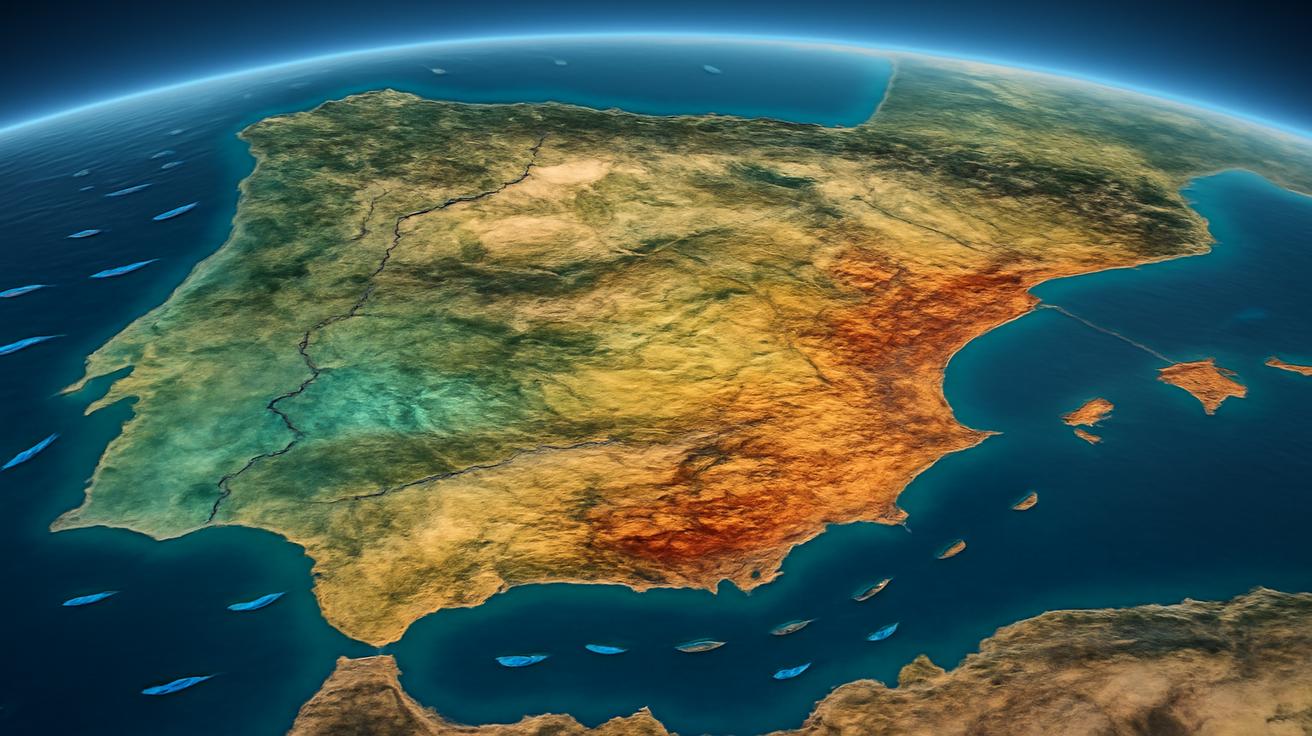
The morning mist over northern Portugal looks perfectly still from the hilltop. Vineyards lie in orderly green rows, white villages are folded into valleys, and the air is so quiet you can almost hear the dew sliding off the leaves. Nothing here seems like it’s moving. And yet, deep below the soil and stone, geologists say this landscape is slowly, silently turning—as if the Iberian Peninsula were a massive, ancient gear, rotating in place at a pace your body will never feel.
The Continent That Won’t Sit Still
Imagine standing barefoot on a tiled courtyard in Seville or Porto, the ground warm from the sun. It feels solid, dependable, unshakeable. Now imagine that same courtyard as part of a giant platform, almost the size of a small continent, quietly twisting a fraction of a millimeter each year. Not sliding dramatically north or south, not colliding in a cinematic crash, but rotating—very slowly—like a boat pivoting on a calm sea.
That, in essence, is what a growing body of geophysical research is suggesting about Spain and Portugal. The Iberian Peninsula, which includes most of Spain and Portugal and a tiny fragment of France and Andorra, is believed to be undergoing a subtle clockwise rotation relative to the rest of Europe and Africa. To the naked eye: nothing. To the instruments buried in bedrock and orbiting in space: motion.
The numbers are almost comically small. We are talking about rotation rates on the order of fractions of a degree over geological time scales, and ground displacements of a few millimeters per year in certain regions. Your fingernails grow faster than this continent turns. Still, for geologists, such movements are the whispers that reveal the deeper conversations inside Earth’s crust.
At the heart of this slow spin is a messy, ongoing negotiation between tectonic plates. Iberia sits at the boundary where the African Plate nudges the Eurasian Plate, a slanted handshake that runs roughly from the Azores in the Atlantic to the Mediterranean Sea. The forces at work are like a very slow tug-of-war with no clear winner: compression here, stretching there, and, somewhere in between, a block of crust adjusting not by simply marching forward, but by turning ever so slightly in place.
The Science of a Turning Peninsula
To understand how scientists can claim that a landmass the size of Spain and Portugal is rotating, it helps to picture the Earth not as a static globe, but as a puzzle of plates floating on viscous rock. These plates—huge slabs of crust and upper mantle—collide, separate, and grind past each other at about the speed your hair grows.
In the case of Iberia, geologists piece together its current behavior from several lines of evidence. Modern GPS stations pinned into bedrock measure tiny changes in position over years; seismic networks record the shivers of earthquakes; and satellite data track subtle shifts in the shape of the land surface. When researchers stitch all this together, a pattern emerges: parts of the peninsula closest to the plate boundary, particularly in the southwest and along the western Mediterranean, appear to be shifting differently from the regions deeper inland.
The motion is not perfectly uniform. It’s more like a slightly warped vinyl record turning on a dusty player than a precision-engineered gear. The “pivot” is not a single, fixed point that you could tap on a map, but a broad, diffuse zone where the overall pattern of motion suggests rotation rather than simple translation. Over millions of years, these small angular changes add up, subtly reorienting coastlines and mountain chains.
To make such claims, geologists must work with timescales that dwarf our daily lives. Rocks in Spain’s Pyrenees and Portugal’s ancient massifs carry signatures of past tectonic wrenching going back tens of millions of years, when Iberia itself broke away, rotated, and then welded onto Europe. In that sense, what we’re seeing today may be just the latest act in a very long-running play: the peninsula has turned before, and it is still turning now—only this time we have the tools to watch.
How Slow Is “Slow” When You’re a Continent?
It can be hard to emotionally grasp motion that you can’t feel. So geologists often translate their findings into more relatable units. If Iberia is rotating at a rate that causes certain points to move, say, 2–4 millimeters per year relative to stable Europe, then in a century that adds up to a few tens of centimeters. In the lifetime of an old olive tree, maybe a couple of meters. Over the age of human civilization, perhaps a few tens of meters.
To a homeowner in Lisbon, this is negligible; to an engineer designing a century-long dam project, it’s a minor note; to a scientist studying earthquakes and long-term mountain building, those millimeters are the heartbeat of a planet that never truly rests.
| Timescale | Approximate Surface Shift | Human Perspective |
|---|---|---|
| 1 year | A few millimeters | Less than the width of a grain of rice |
| 100 years | Several centimeters | About the length of a hand |
| 10,000 years | Tens to hundreds of meters | A stroll across a small field |
| 1 million years | Tens of kilometers or more | Enough to redraw coastlines and mountain belts |
The Fault Lines Beneath the Postcard Views
Somewhere off the quiet beaches of the Algarve, beneath the Atlantic’s glimmering surface, the African and Eurasian plates are nudging each other. You don’t see it as you watch the sun sink into the sea, but the traces are in the record of ancient earthquakes and warped seabed sediments. The same slow tectonic squeeze that helps turn Iberia has also produced some of Europe’s most intriguing seismic puzzles.
The 1755 Lisbon earthquake, for instance, was so powerful it rattled church chandeliers as far away as northern Europe and generated a tsunami that battered the Portuguese capital. The exact fault responsible is still debated, but many scientists point to complex structures offshore in the Atlantic, where the plate boundary is evolving in ways that may one day look more like a classic subduction zone—the kind associated with big, destructive quakes.
In southern Spain, the Betic Cordillera curves like a question mark along the Mediterranean, its folded rocks a frozen record of millions of years of tectonic struggle. Across the Strait of Gibraltar, the Rif mountains in Morocco tell a mirror story. Together, these arcs hint at deep, contorted slabs of lithosphere sinking under the region—a sort of slow conveyor belt dragging pieces of crust downward and tugging on the surface plates in response.
This is where Iberia’s story becomes truly three-dimensional. It’s not just sliding sideways or bumping head-on; it’s being pulled and twisted by forces that originate hundreds of kilometers down. Like the wooden deck of a ship being warped by currents and tides you can’t see, the peninsula feels stresses from below that guide its subtle rotation.
A Landscape Written by Motion
If you drive from the flat plains of Castilla-La Mancha into the dramatic ranges of the Pyrenees or the craggy coasts of Galicia, you are reading, in cross-section, the history of this movement. The Pyrenees rose as Iberia once collided more directly with the rest of Europe, their jagged peaks a reminder that the peninsula has never been entirely settled into place.
Rivers, too, betray the slow turn. Over geologic time, drainage networks can be bent, captured, or reversed as land tilts and warps. Though you won’t see a river swinging like a weather vane in your lifetime, look at enough ancient river deposits, and you can trace these subtle, gradual reorientations. The rotation of Iberia is not just a sterile calculation on a GPS graph; it’s etched into cliffs, terraces, and buried sandstones.
Alarm or Shrug? The Split Reactions
When news stories break with phrases like “Spain and Portugal are slowly turning in place,” reactions tend to fall into two camps. On one side are those who hear “moving continent” and think of looming catastrophe: mega-earthquakes, tsunamis, cities crumbling. On the other side are those who shrug. The motion is minuscule, they say; continents have always moved. Why worry now?
Both reactions have a kernel of truth—and both miss some of the nuance.
The alarmed observers are right that tectonic motion and rotation are intimately tied to earthquakes. When plates stick and then lurch, the stored energy is what we feel as a quake. The Iberian region has a long and very real seismic history, especially around its southern and western margins. Any better understanding of how the peninsula moves is, in theory, helpful for assessing earthquake risk, particularly over the long term.
But rotation alone does not mean a sudden spike in danger. The rates involved are extremely slow, and much of the accumulated strain gets released in a sequence of many small- to moderate-sized earthquakes over centuries. Large events can and do happen, as history shows, but the fact that Iberia is gently turning now doesn’t set a specific countdown clock for the “big one.”
The indifferent camp is correct that this kind of tectonic behavior is normal on a restless planet. Continents have drifted, rotated, split, and collided for billions of years. If the Iberian Peninsula were perfectly static in a dynamic plate system, that would be far stranger than the slow pivot scientists are describing.
Yet to simply dismiss the motion as trivial misses why geologists care. These millimeter-scale shifts inform models of how the entire Mediterranean-Atlantic gateway is evolving, how stress migrates over time, and how plate boundaries initiate and reorganize. For coastal planners, engineers, and hazard mappers, such details help refine the probabilities and patterns of future earthquakes and tsunamis, even if they do not predict exact events.
Living on a Moving Stage
Perhaps the most useful attitude lies somewhere in between alarm and indifference: an informed respect. Recognizing that the ground beneath Spain and Portugal is not perfectly still encourages better building codes, smarter coastal planning, and more realistic expectations about risk. It also invites a kind of humility—an acknowledgment that the stage on which Iberian history has played out is itself an actor, slowly changing its posture.
Stand in a centuries-old plaza in Madrid or Coimbra and look around. The stones underfoot have seen empires rise and fall, languages evolve, borders redraw. Through it all, the land itself has been shifting too, almost imperceptibly, as though the theater of history were very gently turning its head.
Why This Subtle Motion Matters
It might be tempting to file Iberia’s rotation under “curious but irrelevant,” a geological fun fact. But zoom out, and the story connects to bigger questions about how our planet works and how we choose to live on it.
For one thing, the Mediterranean region is a tectonic crossroads in flux. The African Plate is inching north, the Eurasian Plate is adjusting, microplates and broken fragments shuffle between them. The Iberian Peninsula is both a participant and a witness in this slow-motion rearrangement. Understanding its movement helps scientists forecast the long-term evolution of the western Mediterranean: Will a more defined subduction zone form southwest of Portugal? Will new mountain belts rise? How might future plate shifts influence sea level locally, or reshape ocean gateways that affect global currents?
On more immediate timescales, this research fine-tunes our sense of where stress is accumulating. It reveals which faults might be more active, which coastal slopes might be more prone to subtle warping, and how cities align with hidden weaknesses in the crust. No one can say “this particular crack will rupture on this date,” but by mapping the slow dance of Iberia, geologists can say, with increasing confidence, “these areas will be more seismically lively over centuries; these others, relatively quieter.”
Beyond risk and prediction, there is something quietly profound about recognizing this motion in our everyday landscapes. The cobblestones of Lisbon, the tiled courtyards of Granada, the cliffs of the Basque coast—all of them are part of a moving puzzle piece, sculpted and steered by forces that began long before our species existed and will continue long after we are gone.
Seeing Stillness Differently
If you return to that misty Portuguese hillside in your mind, nothing there is obviously changing. The vineyard rows are still straight, the village still snug in the valley. But knowing the science adds a second layer of perception. The quiet becomes relative, the stillness not absolute but slow. You might imagine, superimposed on the view, faint arrows marking the subtle drift and rotation—a choreography too gradual for the eye, yet relentless over deep time.
This is perhaps the greatest gift of the discovery that Spain and Portugal are slowly turning in place. It doesn’t need to send us scrambling for the exits, nor does it deserve a bored shrug. Instead, it offers an invitation: to feel ourselves briefly as part of a larger, older movement; to recognize that even the ground we trust the most is engaged in a cosmic kind of patience.
Between alarm and indifference lies wonder. And in that narrow space, a continent keeps turning.
Frequently Asked Questions
Are Spain and Portugal really rotating, or is this just a theory?
The rotation is inferred from multiple, independent measurements: GPS stations, satellite data, and seismic records all suggest that the Iberian Peninsula is moving and gently rotating relative to surrounding plates. While details of the rate and exact pattern are still being refined, the broad idea of slow rotation is widely accepted in the geoscience community.
Can people feel this continental turning?
No. The motion is far too slow for humans to perceive directly. We are talking about millimeters per year—much smaller than everyday movements caused by tides, atmospheric pressure changes, or even heavy traffic. Only sensitive instruments and long-term monitoring can detect it.
Does this rotation increase the risk of big earthquakes in the region?
The rotation itself is part of the broader tectonic forces that create earthquakes, but it does not mean that a specific large earthquake is imminent. Iberia already has a known seismic history, particularly in the south and offshore regions. Understanding the rotation helps refine long-term seismic hazard assessments rather than predicting precise events.
Could this motion eventually change the shape of Spain and Portugal?
Over millions of years, yes. Even tiny annual movements add up over geological time, potentially altering coastlines, river paths, and mountain belts. However, these changes are so gradual that they are essentially invisible on human timescales like decades or even centuries.
Is this kind of continental rotation unique to Iberia?
No. Many crustal blocks and microplates around the world show evidence of slow rotation, especially in complex plate boundary zones. Iberia’s case is particularly interesting because of its location between Africa and Eurasia and its role in the evolving tectonics of the Mediterranean and North Atlantic, but the phenomenon itself is not unique.
Should people in Spain and Portugal change how they build or live because of this?
People in seismically active regions, including parts of Spain and Portugal, should already be following modern building codes and preparedness guidelines that account for earthquake risk. The knowledge of Iberia’s rotation supports and refines those measures, but it does not fundamentally change everyday life. The main impact is improved scientific understanding and better-informed long-term planning.