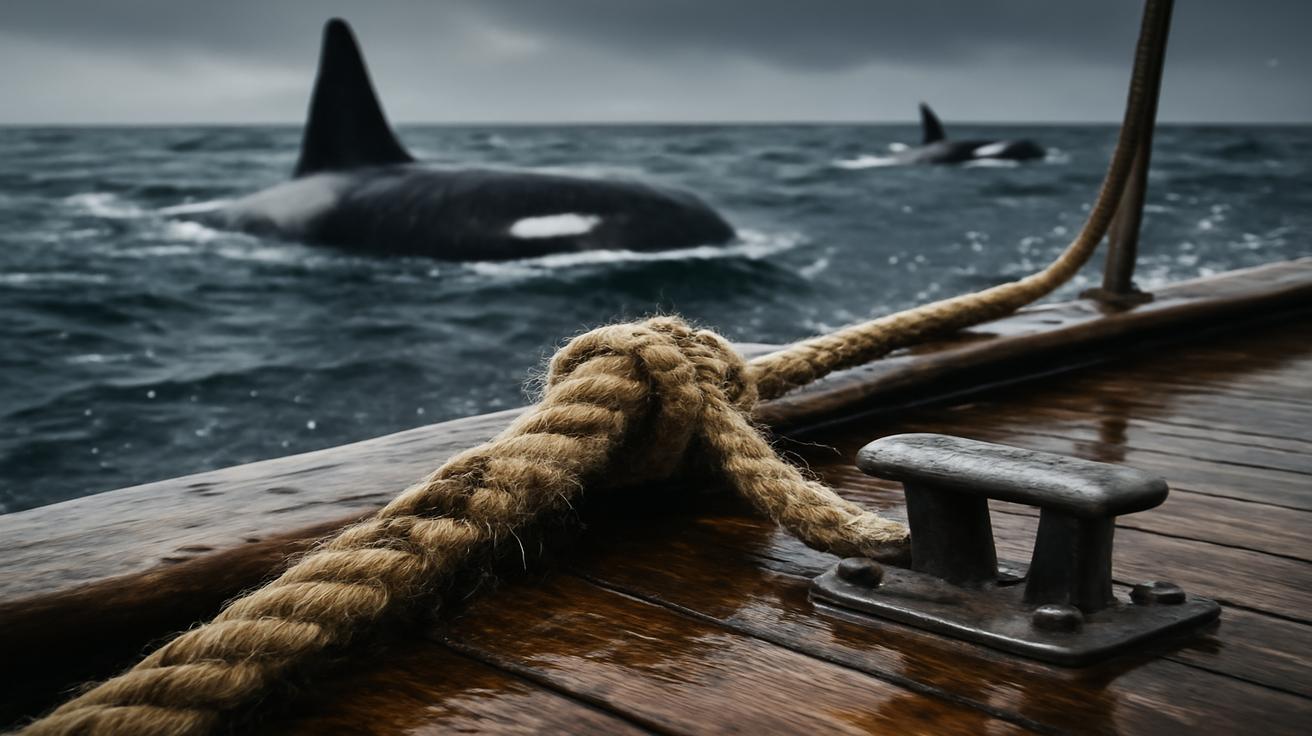
The first thing they remember is the sound—that strange, hollow knocking that traveled up through the hull. Not a wave. Not the rattle of gear. Something deliberate, something alive. The boat rolled in the swell, the air thick with diesel and salt, and three men leaned over the rails, listening to the sea turn suddenly, unnervingly, personal.
The Night the Ocean Looked Back
By midnight the sky had lost all color, a flat, velvety black pressing down on a strip of restless water. The cabin lights of the small fishing boat, the Marlin Star, spilled a soft cone onto the deck, drawing in swirls of moths and tiny, bewildered baitfish. Everything beyond that warm circle disappeared into ink.
Lars, the skipper, hunched at the wheel, shoulders squared to the slow heave of the swell. Behind him, the low murmur of the engine and the faint scrape of boots on fiberglass set a familiar rhythm. It had been a steady night—hauls of snapper and a few good-sized grouper chilled in the hold. The kind of shift that leaves a quiet satisfaction smoldering behind the ribs.
Then the radio crackled.
“Pods moving north… any vessels off the point, keep an eye open. Orca activity close to shore tonight,” came the distant, fuzzy voice of another skipper, maybe twenty miles down the coast.
Orcas. Killer whales. After a long season of chasing fish in these waters, the word no longer carried just awe—it carried logistics and risk. Gear lost. Lines shredded. Fish scattered. These were powerful, curious hunters that could turn a tidy night into a mess in minutes.
Lars gave a short nod, more to himself than to his crew, and eased back the throttle just a touch. The engine’s pitch softened, the boat settling deeper into the water. The men exchanged glances. There was no need for a speech. Out here, information was a kind of weather—noticed, respected, folded quietly into the body.
The Orcas Arrive
It was Christian who saw the first fin. He was coiling a length of rope when something long and dark carved a pale scar through the water off the stern, just at the ragged edge of the light. A triangular fin, tall and straight as a blade, slipped past and vanished. Christian froze, rope hanging slack between his fingers.
“Skipper,” he said, his voice low. “You’d better come look at this.”
Lars stepped out of the wheelhouse, eyes adjusting to the darkness. The men waited, listening. Only the usual night sounds answered—the slap of small waves against the hull, the hiss of the wind shivering across the surface. Then, as if on cue, a burst of breath cut the air. A sharp, explosive exhale. Then another. Closer this time.
Out in the gloom, silhouettes surfaced like ghosts. Black backs, smooth and glistening, rolling in long arcs before slipping away again. The white patches around their eyes flashed pale under the starlight, eerie and almost human from a distance.
“They’re right on us,” muttered Goran, the youngest of the three, gripping the rail until his knuckles whitened.
Orcas sometimes followed fishing boats, drawn by easy meals—scraps, bycatch, the silver chaos of fish disturbed by nets and lines. Other times, they simply passed by, a traveling council of apex hunters ignoring the human skiff in their path.
Tonight, though, they didn’t pass. They circled.
The pod fanned out silently around the Marlin Star, their dark bodies knifing under the hull, surfacing one after another in slow, deliberate arcs. One large male, his dorsal fin tall and slightly hooked, rose so close to the stern that Christian could see the scars raking along its back—white, jagged, like lightning frozen in skin.
“He’s a big one,” Lars said quietly, though no one had asked. His voice was careful, even. “Count at least six out there. Maybe more.”
The men stayed still, as though any sudden movement might change the rules. The sea felt suddenly small, the boat suddenly fragile, like a toy set adrift in a world of heavy, patient muscle.
High Tension on a Small Boat
The pod made another slow circuit. This time, they seemed closer. A head broke the surface amidships, just yards away, and hovered there for three heartbeats too long. Teeth flashed in the faint cabin light as the animal opened its mouth—not in a snap, but in an almost lazy, exploratory way. A gust of fish-scented breath wafted over the deck.
“They’re checking us out,” Christian whispered. “Like we’re the strange ones.”
The radio hissed softly in the cabin, a neutral background noise that suddenly felt absurdly human and small. The boat rocked as a swell met an unseen body beneath the surface. Somewhere deep below, the anchor line stretched taut, holding the vessel in place over the fishing grounds, a single, fibrous tether between men and the unseen terrain of the seafloor.
Lars weighed their choices. He could pull anchor and idle away, but pulling gear with curious orcas around was like waving a lit match in a dark room—you never quite knew what you’d ignite. Orcas sometimes snatched fish from lines, sometimes investigated props and rudders. Other times, they vanished as mysteriously as they arrived.
“We hold for now,” he said, keeping his eyes on the water. “We don’t have their attention more than usual yet.”
Yet. The word hung there, unspoken, but present in every tight jawline and restless glance over the side.
The men returned to their stations with the slow, exaggerated calm of people trying not to startle a wild animal at close range. No clattering, no raised voices, just the soft shuffle of boots and the creak of rope. Above them, stars peered through thinning clouds, as if pressing in to see how this would play out.
Then came the first knock.
A sharp, resonant thunk rose up through the belly of the boat, more felt than heard. The deck vibrated under their boots. All three froze. Another knock followed, a heavy, reverberating pound.
“What in—” Goran started, but his question dissolved as the boat shuddered again. This time, the anchor line groaned like a living thing.
When Sharks Enter the Story
At first, they thought it was the orcas striking the hull. But when Lars lunged to the rail and looked down, the scene flickered into view in snatches: a swirl of pale bellies, flashes of gray, white-slashed jaws opening and closing around the anchor rope.
Sharks.
Three of them, maybe four, bodies thick and blunt-headed, circling tight around the bow where the line disappeared into the black. Their movements were abrupt, jittery, urgent. One lunged forward and bit down on the rope, thrashing its head side to side with fierce, almost frustrated energy.
“You’re seeing this?” Christian’s voice snapped up an octave. “They’re chewing the anchor!”
The line trembled, fibers straining audibly. The men watched, transfixed, as another shark darted in, bumping the first aside with a solid thud that vibrated through the hull. Its teeth sank into the rope with a tearing sound that was all too clear. Each bite seemed less like feeding and more like an attack on the one thing tethering the boat to stability.
Out beyond this chaos, the orcas were still there. Their black fins sliced the water in wide, controlled arcs, as though they’d orchestrated the entire scene and were now watching from a careful distance. One slid under the bow, its white eye patch ghosting through the water like a distant lighthouse, then vanished beneath the sharks.
Lars felt his throat go dry. Orcas and sharks in the same tightening ring around a 40-foot fishing boat. Anchor line under siege. Engine idling. The math of risk rose like a fast tide.
Predators in Each Other’s Shadow
Later, over coffee in the harbor, they would talk about that sequence like a strange kind of relay race. Orcas first—majestic, unsettling, measuring the boat with the slow curiosity of something that knows it sits at the top of the food chain. Then sharks, slipping in like shadows, keyed up by scent and opportunity, churning the water at the exactly vulnerable point: the anchor rope.
On the Marlin Star that night, there was no time for poetic framing. Only decisions.
“If they cut that line, we drift,” Lars said. “And we drift in the middle of this.” He nodded toward the circling fins—the sharp, jagged ones near the bow and the taller, black triangles farther out.
“Can we haul it?” Christian asked. “Get the anchor up before they—”
Another savage shake of the line answered for him. The boat jolted forward a few inches and swung slightly, the hull yawing around the wounded rope. The air carried the thick, coppery tang of blood now—the fish in the hold, the smeared scales on deck, tiny molecules of scent traveling down the rope like an invitation.
The sharks seemed fixated, their attention glued to the point where human hardware met the ancient darkness below. Metal, fiber, knots—none of it mattered. To them, it was just something in the water that didn’t belong. Something to test with their teeth.
A Rope Between Worlds
For a long, thin moment, everyone on board moved as though underwater themselves. Slow, deliberate, as if speed alone might snap the tension like glass. Lars slipped into the wheelhouse and rested one hand on the throttle, feeling the steady thrum of the engine through the metal casing.
He heard the sharks before he saw them again. The impacts came as dull booms, then scraping vibrations, like sandpaper on bone. He imagined the fibers of the rope fraying one by one—a hidden countdown under the surface.
“We can’t just sit here and let them chew through it,” he called out. “Christian, get ready on the bow. If I give power, we try to ease some slack, maybe shake them off. If the line goes, it goes—but I want it on my terms.”
Christian swallowed and nodded, already moving. Goran hovered between them, eyes flicking from the backlit glow of the instrument panel to the inked water outside.
The first push of the throttle sent a shiver through the deck. The bow lifted slightly, the boat’s posture changing from passive float to intentional movement. The anchor rope stretched even tighter, humming like a plucked string.
Down below, the sharks reacted. The boat’s nudge translated into an invitation to struggle—a hooked thing, resistant, worth biting harder. One shark lunged in and clamped down on the rope again. The line jerked, and for an instant the bow dipped, as though something far heavier than an anchor had suddenly grabbed hold and pulled back.
“Easy, easy…” Lars muttered, easing the throttle forward another hair’s breadth. The engine growled, impatient, ready to leap if asked.
Through it all, the orcas remained eerily collected. Now and then an enormous black-and-white body surfaced, exhaling in forceful puffs that echoed off the night. They seemed to be holding a perimeter, their loops around the boat smooth and unhurried. Whatever drama played out at the rope, they watched it from just beyond arm’s reach.
The Moment Everything Let Go
The snap, when it came, was strangely delicate. No cannon blast of fiber, no catastrophic lurch. Just a sharp ping and a sudden slackening, as if someone had cut the tension in the air itself.
Christian staggered back from the rail, nearly losing his balance as the bow popped free of its invisible anchor. The boat swung wide, freed from its tether, rolling over the spot where the rope once vanished into the deep. For a second, it felt like falling, like the hull had stepped off a cliff.
“Line’s gone!” Christian shouted. “They bit clean through it!”
Lars didn’t hesitate. He pushed the throttle, sending the boat forward in a cresting surge. The smell of exhaust thickened. Water foamed white along the hull as the Marlin Star began to move with purpose for the first time since the encounter began.
Behind them, the chaos they left in their wake boiled with life. Sharks thrashed in confused, darting circles around the sinking remainder of the rope and anchor. One of them snapped at thin air, as if unwilling to admit its meal had escaped. The orcas adjusted their formation, their dark bodies pivoting to track this new pattern of motion.
For one long, breathless minute, it was impossible to tell if the predators would follow.
Leaving the Hunt Behind
Lars steered on instinct, angling the boat toward open water, away from both the shallows of the fishing grounds and the unseen topography that seemed to funnel predators together. The men watched the wake, eyes always drawn back to the fins.
An orca surfaced parallel to their course, matching speed for a handful of seconds. From the wheelhouse window, it felt close enough to touch—a black eye glinting in the cabin light, the smooth arch of its forehead rising and falling. It turned slightly, as if considering them, then peeled away, slipping under the surface in a long, calm glide.
Within minutes, the fins began to shrink in the distance. First the sharks, those nervous, darting shadows near the bowline, then the taller, confident orca dorsals farther out. The night returned to its usual scale: waves, stars, the steady pulse of the engine, and the soft clatter of unsecured gear finding its resting places again.
Only then did the men start talking.
Stories Told in Coffee and Salt
Back in harbor the next day, they sat at a small table stained with years of spilled coffee and fish scales, reliving the encounter in staccato bursts. The details overlapped, then separated, settling into a shared memory that each man would carry in his own way.
| Aspect | What Fishermen Noticed | How It Felt On Board |
|---|---|---|
| Orca Behavior | Circling slowly, staying just beyond arm’s reach, surfacing in deliberate patterns. | Like being inspected by something intelligent and patient. |
| Shark Behavior | Frenzied strikes on the anchor rope, bumping the hull, biting repeatedly at the same spot. | Sudden, jolting impacts that turned the boat into a sounding board for panic. |
| Anchor Rope | Frayed and finally bitten through, releasing the boat. | A lifeline that became a target, then disappeared in an instant. |
| Crew Response | Held position, then powered away once the line snapped. | A mix of calculated decisions wrapped in very real fear. |
| Lasting Memory | Predators overlapping in one tense encounter—orca first, sharks next. | Proof that the ocean writes its own rules, with humans as brief participants. |
“They went for the rope like they hated it,” Goran said, miming the thrashing bites with his hands. “Not like they thought it was food. Like they wanted to make it not-there anymore.”
“Maybe they smelled the fish on it,” suggested Christian. “All that scent washing down along the line.”
Lars shrugged, his gaze drifting past the harbor wall to where the horizon wore its usual calm mask. “Or maybe the orcas pushed them in closer,” he said. “Predators spook each other, same as anything. You get that much power concentrated in one patch of water, something’s going to break. This time it was our rope.”
In the telling, an odd kind of gratitude threaded through their fear. The sharks had bitten through the line, yes—but that sudden release might have saved them from a stranger, tighter entanglement between boat, anchor, and the circling weight of muscle and teeth. There were worse ways to lose gear than as the price of leaving a crowded hunt behind.
The Sea’s Quiet Reminders
Long after the nerves settled, the memory of that night stayed close. Tension swam in recollection: the knock of impact through the hull, the eerie calm of orcas gliding along the edges of the floodlights, the frantic energy of sharks hammering at something humans had mistaken for permanent.
Stories like this threaded through the coastal communities—passed from wheelhouse to dock, from galley table to late-night bar stool. Fishermen in other ports began sharing their own accounts: anchors bitten or frayed, ropes that came back with clean, unsettling cuts. Some swore the sharks were reacting to leftover bait or bleeding fish hooked near the bottom. Others insisted it was the sudden convergence of apex predators—orca pressure driving sharks to strange decisions in the tight geometry of boat, line, and quarry.
What bound these stories together wasn’t just the adrenaline of the moment, but the humbling aftermath. Humans like to believe in clear categories: here is our gear, here are our rules, here is our place atop the food web when we bring engines and electronics to bear. But out there, under starlight on a half-swallowed horizon, the lines blur.
An anchor rope isn’t just a tool. It’s a message, a scent trail, a new object in the water that other creatures will taste, test, and sometimes tear apart. A boat isn’t just a workplace; it’s an intruder, a drifting island whose presence compresses space in ways no sonar can fully explain. Orcas and sharks, each powerful in their own right, are never just background wildlife. Their choices ripple through every human calculation made on deck.
On the night the Marlin Star watched sharks bite their anchor rope while orcas closed in, the ocean offered one of its quieter lessons. It didn’t roar. It didn’t break the boat or drag anyone overboard. Instead, it gently rearranged the familiar. It turned a dependable, trusted lifeline into something fragile—a thread between worlds easily severed by a single, determined bite.
In the end, the encounter shrank the men just enough that they could feel their proper scale. Not as masters of the sea, but as guests. As temporary visitors in a place where stories are written mostly in shadows and currents, in the unseen paths of animals gliding miles below the keel.
And somewhere out there, on another dark night, another rope is humming with tension. Another pod is circling. Another shark is veering close to the bow, its world narrowed down to scent and pressure, unaware that a handful of humans on a painted hull are about to realize, again, how thin their anchors truly are.
Frequently Asked Questions
Do sharks really bite through anchor ropes?
Yes, fishermen in various regions have reported sharks biting anchor ropes or lines. It can be triggered by the scent of fish, blood, or bait traveling along the rope, or simply by curiosity. Their powerful jaws and serrated teeth are more than capable of cutting through many types of rope.
Why would sharks target the rope instead of fish?
Sharks don’t always “target” in the way humans think. They investigate objects with their mouths, especially when scent is involved. A rope soaked in fish smell, blood, and slime can easily become an accidental focus for biting and testing, especially in a high-energy situation near feeding opportunities.
How do orcas influence shark behavior around boats?
Orcas are apex predators that can push other predators, including sharks, into odd patterns of movement. In some documented cases, sharks abandon feeding grounds when orcas arrive. In crowded situations around a boat, the presence of orcas may increase stress and agitation, leading to more erratic shark behavior.
Is it dangerous for fishermen to be surrounded by orcas and sharks?
While direct attacks on boats are rare, the situation is risky. Entangled gear, severed anchor lines, sudden shifts in the boat’s orientation, and potential collisions can all pose real dangers. The main risk often comes from the unpredictable interaction between large animals and human equipment, rather than from deliberate attacks.
What can crews do to reduce these encounters?
Crews can limit fish waste in the water, move away from known predator hotspots when possible, avoid staying anchored for long periods in active feeding zones, and be ready to cut or release gear if it compromises safety. Ultimately, though, working at sea always means accepting some level of unpredictable wildlife interaction.