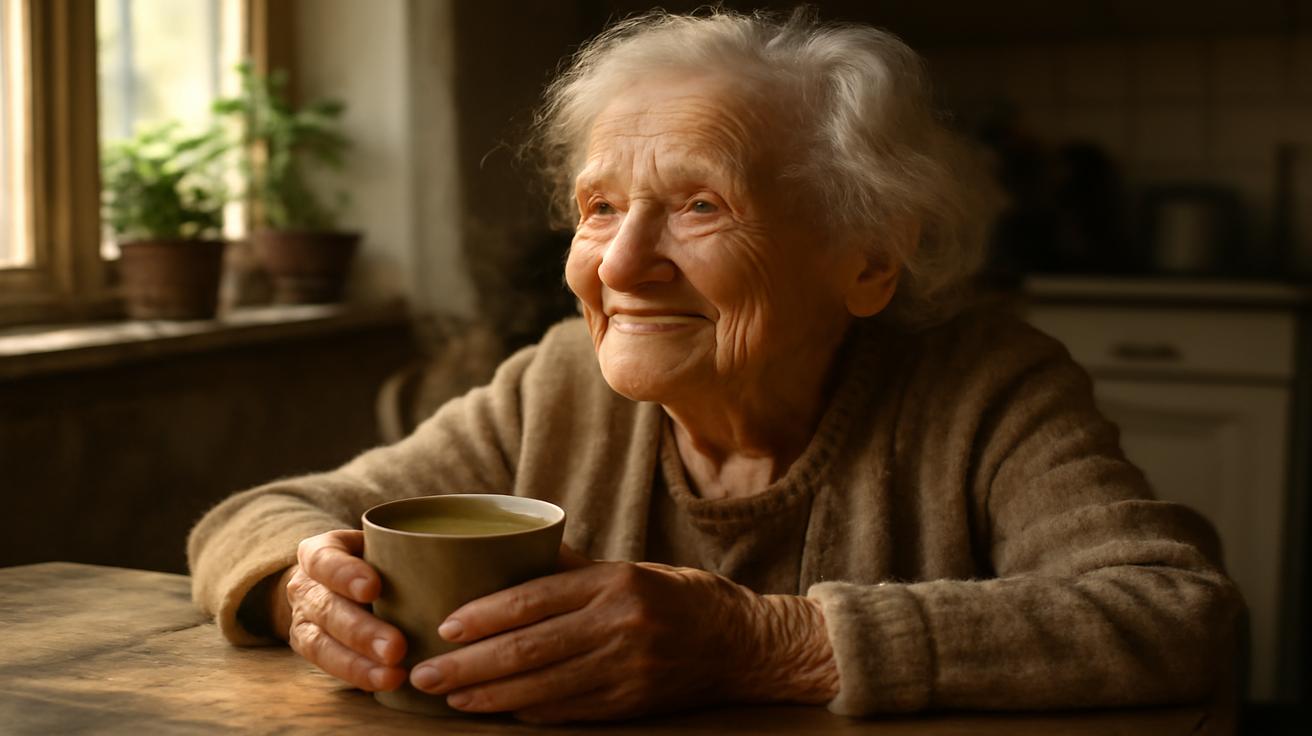
The old man’s hands shook a little as he poured the drink, but not from weakness. It was more like a kind of reverence. Outside, the morning in the mountain village was still blue and cool, roosters just beginning to argue with the light. Inside, the kitchen smelled like damp wood, citrus peel, and something warm and earthy rising with the steam.
“Every day,” he said, sliding the small ceramic cup across the table toward me. “Before the sun is high. Eighty years now.”
The liquid was a pale gold, almost green at the edges, with a delicate fragrance: a hint of flowers, a trace of grass after summer rain, and, beneath it all, something toasty and comforting. I took a sip. It was brighter than I expected, smooth and sweet at first, then gently bitter, like the honesty of an old friend. My shoulders dropped. I hadn’t realized how tense they were.
“What is it?” I asked.
The old man smiled like I had told a small, endearing joke. “Tea,” he said. “What else?”
The Quiet Ritual Hiding in Plain Sight
If there is a secret drink that centenarians quietly swear by, it isn’t a neon-colored energy elixir or a complicated smoothie with ingredients you can’t pronounce. It is, more often than not, a cup of tea: green, oolong, herbal infusions, or the roasted barley brews of mountain villages and coastal towns. Simple leaves and hot water, repeated with almost religious consistency, day after day, year after year.
Of course, not every person who lives to 100 drinks tea, and drinking tea alone won’t earn you a telegram from the president. But when researchers visit those scattered places we like to call “longevity hotspots”—the quiet, obscenely ordinary corners of the world where people routinely live past 90 in good health—tea is there, like a calm friend sitting in the corner of the room. Not flashy, never the main event, but always present.
Ask a centenarian to explain why they drink it and the answers are disarmingly simple:
- “It makes my body feel clean.”
- “I sleep better when I have it in the evening.”
- “My mother drank it. I do what she did.”
- “It gives me something to look forward to when I wake up.”
Underneath those humble answers sits a quiet mountain of science: antioxidants like catechins and polyphenols that soothe inflammation; gentle caffeine that nudges, rather than shoves, your nervous system; amino acids that take the sharp edges off your stress. But that’s not really the whole story. The secret isn’t just in the leaves. It’s in the ritual, in the tiny repeated act that turns boiling water into a daily pause button.
The Drink That Wakes Up All Your Senses
Watch someone in their nineties make tea, and you notice something: they don’t rush. Even if they move slowly because of age, there’s an ease to it. A kind of competence carved by years of practice.
The kettle rumbles, then sings. Steam climbs in pale ghosts, curling toward the ceiling. The cup warms their palms. The scent rises—grassy from green tea, nutty from roasted barley, floral from jasmine, smoky from old, well-aged leaves. Before you even taste it, your body starts to respond.
The first sip is rarely dramatic. There are no fireworks, no sugar buzz. Instead, it’s a kind of re-orientation: shoulders softening, jaw unclenching, breath lengthening. Mild caffeine wakes you up, but the amino acid L-theanine, abundant in tea, quietly whispers to your nervous system to stay calm. It’s like stepping outside after a long meeting and realizing the sky is bigger than the spreadsheet that held your attention all day.
Many of the elders who swear by their daily cup don’t talk about antioxidants or polyphenols. They talk about how it makes them feel:
- “My hands stop trembling.”
- “My thoughts get clear.”
- “My stomach thanks me.”
Science mostly agrees. Studies connect regular tea drinking with improved heart health, better blood sugar control, reduced inflammation, and even sharper thinking in old age. But the body doesn’t experience “data points.” It experiences warmth in your throat, the smooth slip of liquid across a dry tongue, the quiet satisfaction of a well-worn routine.
The Surprisingly Delicious Types Centenarians Love
Not all teas are created equal, and not all of them feel or taste the same. In longevity regions, a few types turn up again and again—not because they’re trending, but because they’ve been around longer than the concept of “trending” itself.
| Type | What It Tastes Like | Why Elders Love It |
|---|---|---|
| Green Tea | Fresh, grassy, lightly bitter, sometimes sweet | Gentle caffeine, rich in antioxidants, feels “clean” and light |
| Roasted Barley Tea | Nutty, toasty, coffee-like aroma, no bitterness | Caffeine-free, soothing on the stomach, great all day |
| Oolong Tea | Between green and black; floral, fruity, or roasted | Complex flavor, sipped slowly, aids digestion after meals |
| Herbal Infusions | Depends on herbs—minty, floral, earthy | Caffeine-free, tailored for sleep, digestion, or relaxation |
Many centenarians don’t just have one “favorite.” They shift with the day:
- Green tea or light oolong in the morning to wake up gently.
- Roasted barley tea or mild herbal blends through the afternoon.
- Soothing herbs—chamomile, lemon balm, lavender, fennel—toward evening.
One woman in her late nineties in a hillside town keeps three jars on her shelf. In the morning: a jar of bright, twisted green leaves. After lunch: a deep brown grain that smells like roasted nuts when it hits hot water. Before bed: a loose, fragrant mix of dried flowers and leaves from her own garden. “Each one speaks to a different part of my day,” she told me. “And to a different part of me.”
The Small Daily Ritual That Changes Everything
Ask a centenarian what matters more: what’s in the cup, or the fact that they drink it every day, without fail—and many of them will shrug and say, “Both.” But watch them closely, and you can see that the ritual itself is doing heavy lifting.
There is the movement: rising, filling the kettle, measuring the leaves, pouring carefully. Even with a walking stick, this is a small act of independence, of usefulness. It says, “My body still serves me.”
There is the timing: many drink their tea at roughly the same hour each day. Morning tea marks the start of the day, an anchor. Evening tea signals a gentle slowing down, a soft closing of the curtain. A simple drink becomes a way of telling time without numbers.
There is the attention: good tea, even cheap tea well-prepared, punishes hurry. Scald it, and the bitterness will remind you to slow down next time. Use a cooler water, wait the right number of breaths instead of watching a timer, and the sweetness emerges. This kind of attentive slowness is increasingly rare—and, perhaps for that reason, increasingly precious.
Many longevity experts point out how powerful “micro-routines” can be: small, repeatable actions that require little willpower but accumulate massive benefits over time. A daily 15-minute walk. Five minutes of stretching. A glass of water before each meal. Tea fits perfectly into this category. The barrier is low. The pleasure is high. The habit, once formed, is stubborn in the best possible way.
And the beauty of it is that you don’t need a hillside village or a wood-fired kettle to join in. You can do it in a cramped city apartment, under fluorescent lights in a break room, in the quiet corner of a shared kitchen. What matters is that you give the moment to yourself, again and again, until your days quietly rearrange themselves around that pause.
Building Your Own Longevity Cup
The centenarian drink isn’t a brand or a product line. It’s more like a template—leaves (or grains, or herbs) plus hot water plus unhurried attention. You can shape it to your tastes and your body’s needs. Start simple, and let curiosity lead you.
Step 1: Pick Your Starting Point
If you like a little lift: choose a gentle green or lightly oxidized oolong tea. Look for descriptions like “sweet,” “nutty,” or “floral,” rather than “strong” or “bold,” especially if you’re used to coffee and want something smoother.
If you’re sensitive to caffeine: try roasted barley tea or a well-made herbal blend. Barley tea in particular surprises many people—it has a toasty, almost coffee-like aroma, but it’s naturally caffeine-free, cools you in summer, and comforts you in winter.
If your stomach is fussy: look for mint, ginger, fennel, or chamomile infusions. Many elders sip these after meals to help digestion and avoid that heavy, sluggish feeling.
Step 2: Create a Time and Place
Decide when your “longevity cup” belongs. Morning is classic, but not mandatory. What matters is regularity. Right after you wake up. Right after lunch. Right before the evening news. Choose a time you can usually protect.
Then pick a place. It can be as simple as the same chair by the window, or the same corner of your balcony, or the same spot at the kitchen table where the light hits just right. When you return to that place with your cup, your body starts to recognize it as a calming cue.
Step 3: Make It With All Your Senses
Don’t just press a button and forget about it. Even if you’re using a basic kettle and a cheap teabag, there’s sensory richness available if you look for it.
- Listen: to the water heating, the soft clink of cup and spoon.
- Smell: the leaves before and after the hot water hits.
- Watch: the color deepen, the steam twist and vanish.
- Feel: the warmth move from cup to hands to chest.
- Taste: not just “bitter” or “good,” but what exactly—grass, nuts, flowers, smoke?
That attention turns the act from a habit into a ritual. The difference is subtle, but you feel it. One checks a box; the other touches something deeper.
Step 4: Keep It Simple and Consistent
Centenarians are not typically making elaborate matcha lattes with six add-ins and a blender. Their daily drink is humble and repeatable. Build yours the same way.
You can always experiment—try a new tea, switch from morning to afternoon, add a slice of lemon—but don’t underestimate the power of staying with one simple thing long enough for it to shape the rhythm of your day.
What Makes It “Surprisingly” Delicious
Many people think of tea as watery, bitter, or boring. That’s understandable—most of us first meet it as a dusty bag dunked in water that’s either too cold or boiling hot in a chipped office mug. But properly made, even very basic tea can be a quiet revelation.
Lower the water temperature a little and the bitterness fades. Shorten the steeping time and sweetness emerges. Switch brands or types and you suddenly find yourself in a different landscape: flower fields, roasted nuts, sun-warmed grass, autumn leaves. The flavors can be delicate, yes, but not faint—more like a soft-spoken person with interesting things to say if you lean in.
What also makes this daily drink “surprisingly delicious” is how it pairs with life’s small moments. A green tea with early sunlight and a piece of toast. Roasted barley tea with a simple lunch and the sound of distant traffic. Chamomile with an old book and a blanket over your legs. It doesn’t demand the spotlight; it gently sharpens the edges of everything around it.
For a centenarian whose days have had time to simplify, this drink becomes both a flavor and a frame. It’s the taste of the lives they’ve actually lived—war and peace, love and loss, children and silence—distilled into something they can still hold in two careful hands.
More Than a Drink, Less Than a Miracle
It’s tempting to say that tea, or any daily drink, is the “secret” of a hundred-year life. The truth is less glamorous, and far more interesting.
Centenarians usually have a whole constellation of quiet habits: walking almost every day, eating mostly simple foods close to the earth, staying socially entangled in the lives of neighbors and family, sleeping when the sun tells them to, not a screen. Their daily drink is not an isolated hack; it is stitched into this larger fabric.
But that doesn’t make it trivial. When you zoom in on a single day, the drink is one of the things that gives the day shape. A beginning, a middle, a soft closing. A reason to get up, to move, to notice the temperature of the air and the light in the room. A way of saying, “I am here, in this body, in this moment,” even when the body is old and the moments are fewer.
You may never live in a mountain village or a fishing town or a hillside farm where time moves differently. But you can borrow this one small habit from those who do: choose a simple, nourishing drink and come back to it, again and again, until it begins to anchor you.
Maybe one day, long from now, someone will sit at your table, watching as your hands—steady or shaking, it won’t matter—pour hot water over leaves. They’ll ask how you’ve made it this far, what your secret is. You might shrug, the way elders often do.
“I don’t know,” you’ll say. “I just had my tea.”
Frequently Asked Questions
Is there one “best” tea for longevity?
No single tea has a monopoly on longevity benefits. Green tea is the most studied for heart and brain health, but roasted barley tea, oolong, and herbal infusions all offer different advantages. The best tea is the one you enjoy enough to drink daily without forcing yourself.
How many cups a day do centenarians usually drink?
It varies, but many drink between 2 and 5 cups spread throughout the day. Often there is one “anchor cup” they never miss—usually in the morning or early afternoon.
What if I’m sensitive to caffeine?
Choose naturally caffeine-free options like roasted barley tea or herbal infusions (chamomile, lemon balm, mint, rooibos). Avoid heavily caffeinated black teas late in the day, and start with small amounts to see how your body responds.
Do I need expensive tea or special equipment?
No. A basic kettle, a simple mug, and reasonably fresh tea are enough. Quality helps, but the ritual—the regular, attentive act of making and drinking—is more important than fancy tools.
Can I add sugar, honey, or milk?
You can, but many longevity drinkers take their tea plain or with minimal additions. Try gradually reducing sweeteners so your palate adjusts to the natural flavors. If you enjoy a little honey or milk, keep it modest and consistent with your overall health goals.