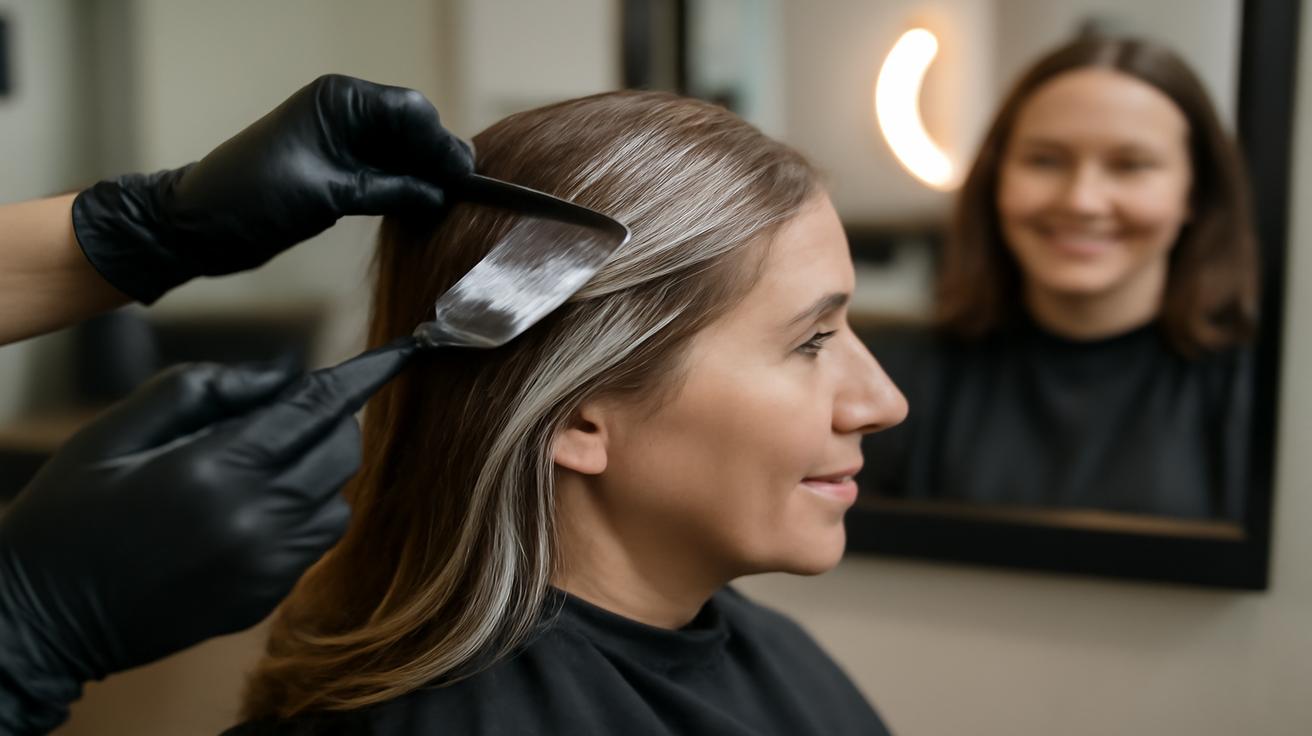
The woman in the salon chair hasn’t spoken for a full minute. Her fingers, still dusted with flour from the sourdough she left proofing on her kitchen counter, grip the ends of the black cape. In the mirror, under the flat, unforgiving ceiling lights, she stares at the same thing she always stares at: the glint of silver along her parting, a quiet shimmer of rebellion at her temples. The stylist catches her eye in the reflection and smiles the kind of smile that says, I see it too, and I know what to do about it. But today, there’s something different in her voice when she says, “We’re not doing balayage this time. I want to show you something new.”
The Day We Fell Out of Love with the Grow-Out Line
Balayage arrived like a miracle at first, a painterly answer to the blocky stripes of old-school highlights. Stylists talked about it with reverence: hand-painted color, soft as sunset on a beach, low-maintenance, natural. For a while, it felt like freedom. Roots could show. Shadows were chic. That soft gradient from deep at the crown to bright at the ends looked like something grown, not installed.
Then the greys came.
At first, it was a single silver thread catching the light near your temple, an odd visitor instead of a resident. Balayage could blur it, distract the eye with caramel ribbons and beachy ends. But grey hair is patient. It moves slowly and consistently, a quiet tide. Eight weeks later, those “soft roots” didn’t look effortless anymore. They looked like what they were: a split reality—youthful color mid-length and ends, a full-blown takeover at the scalp.
In the stark honesty of the bathroom mirror, under the cold light of Monday mornings, something in many of us shifted. The magic of balayage began to feel like a trick from the wrong angle. Yes, the ends were beautiful. But the parting had turned into a negotiation, every few weeks, between who you felt you were and what your hair insisted on broadcasting.
There’s a point where “low maintenance” becomes “high emotional effort.” The salon visits spread farther apart. Hats did more heavy lifting. Dry shampoo became a texture spray and a psychological crutch. We told ourselves we didn’t mind the greys, that we were fine “embracing them… soon.” Just not yet. Not quite yet.
Enter the New Obsession: Micro-Illusion Grey Blending
Deep in the hum of urban salons and tucked-away studios, colorists have been quietly working on a different language, one that doesn’t treat grey hair as an enemy to be covered or a trend to be fetishized, but something to be translated. They call it different things depending on where you go—shadow veiling, micro-blending, invisible grey diffusion—but the heart of it is the same: a method designed to make grey hair visually disappear into a tapestry of tone.
Let’s call it what it feels like: micro-illusion grey blending.
This isn’t balayage 2.0. It doesn’t rely on sunlit ends and dark roots. Instead, it moves closer to the scalp, into the territory where traditional foils and permanent dyes once ruled. But instead of a hard regrowth line or a block of single-process color, this technique works with dozens—sometimes hundreds—of tiny, strategically placed shifts in shade. Think of it as a watercolor wash instead of broad brushstrokes.
Grey hair, after all, isn’t a color. It’s a lack of pigment. That absence shows most loudly when it’s sitting next to dense, uniform color: deep brown against clear white, rich black beside frosted strands. Micro-illusion blending softens this contrast by introducing a whole spectrum of near-greys and muted highlights within your natural base. It doesn’t hide your grey so much as it invites it to belong.
From a distance, and even up close, the effect is startling: the eye can’t find the tell-tale line of demarcation. There’s no obvious starting point where the grey begins and the color ends. It just looks like hair—glossy, dimensional, surprisingly natural. As it grows, the illusion holds, because the new growth has already been accounted for in the design.
What Actually Happens in the Chair
The appointment doesn’t start with a color swatch—it starts with a conversation.
The stylist studies your parting, the way your greys map your head. Some people sparkle mostly at the front hairline, others scatter silver throughout like static, some have a near-solid halo at the crown. The new technique is obsessed with this cartography. It understands that your grey pattern is as personal as your fingerprint.
Instead of choosing just one color, the stylist builds a palette: your natural depth, one or two shades lighter, and a whisper of tones that echo silver—soft ash, muted pearl, pale mushroom. Then the fine work begins. Micro-sections of hair near the scalp, near-invisible slices and weaves, are tinted, glazed, or gently lifted and toned. Not everything is colored. In fact, the power of the technique lies in its restraint. Some greys are left fully natural; others are softened, cooled, or warmed ever so slightly so that they blend into the neighboring strands.
From above, it can look almost surgical: fine tapers of color placed exactly where the light is most likely to land. The parting, the whorl at the crown, the stubborn front fringe that insists on falling forward—these become the focal points of the design. The rest of the hair is toned and glossed to create coherence, but the heavy lifting happens where your eyes—and everyone else’s—naturally go first.
When the stylist rinses, applies a final gloss, and rough-dries your hair, the mirror experience changes. You lean forward, automatically searching for the familiar glint of silver right at the base. It’s not “gone” in the sense of being eradicated; it’s gone in the way a single cloud disappears into an overcast sky. You can’t point to it anymore. Color and non-color are finally speaking the same language.
Why “Eliminating” Grey Is Less About Color and More About Perception
The promise sounds almost too bold: a technique that eliminates grey hair for good. But the trick is this: it doesn’t necessarily remove the grey; it removes the argument between the grey and the rest of your hair.
Grey hair becomes intolerable—emotionally, visually—when it arrives as an interruption. A jagged, high-contrast line of new growth that shouts over the styled story of the rest of your head. Balayage failed you here because it focused its softness away from the scalp. Traditional root touch-ups failed you by making you a prisoner of four-week appointments and stark grow-out.
Micro-illusion blending changes the battleground. It assumes the greys will keep coming, steadily, like a season, and designs the entire color strategy around that inevitability. The goal isn’t to create a perfect moment that collapses in six weeks; it’s to create an environment where more grey can arrive without being noticed.
This means:
- No hard root line as the color grows out.
- A base tone that already contains the whispers of coolness or softness that naturally grey hair brings.
- Strategic brightness that mimics the light-bouncing quality of silver, instead of fighting it with flat darkness.
The result? You stop clocking your hair in weeks-since-color. You stop taking photos of your parting under harsh bathroom light and zooming in. At some point, the anxiety around “how grey I’ve gotten” goes quiet because you’re no longer seeing grey as a separate thing. You are seeing hair, full stop.
A Quick Look at How It Compares
| Technique | Grey Coverage Style | Grow-Out Visibility | Maintenance Rhythm |
|---|---|---|---|
| Traditional Root Color | Full coverage, uniform shade | High – clear line at roots | Every 3–5 weeks |
| Balayage | Softens mid-lengths and ends, minimal root work | Moderate to high once greys increase | Every 10–16 weeks |
| Micro-Illusion Grey Blending | Diffuse, layered tones that integrate grey | Low – no obvious demarcation line | Every 8–12 weeks |
The Sensory Shift: How It Feels to Live with “Invisible” Grey
There is a quiet but unmistakable before-and-after to this kind of color journey, and it doesn’t live on Instagram. It lives in the mornings.
Before: you bend over the sink to wash your face and catch your reflection from above, the angle you forget the mirror has. The stripe of silver through your part jumps out at you. The day starts with a negotiation—do you have time today to book an appointment? Can you get away with dry shampoo and a zig-zag part to distract from the line? You tilt your head, trying to find the least unforgiving angle, then move on, slightly diminished.
After: you bend over the same sink, under the same harsh light. Your part is a soft field now, depths and lights moving in a pattern that doesn’t have a clear border. It looks intentional. You feel a mild, surprising disorientation—the absence of that familiar jolt. You realize it’s been three, maybe four weeks since your last appointment, and yet there is nothing to fix in a hurry.
It changes how you move through public light: the butcher’s shop fluorescents, the sun streaming through the car window at a red light, the overhead lamps at dinner. You’re less guarded with your hair, less attached to strict parts and careful positioning. Wind stops being a threat. You tuck pieces behind your ear without thinking. You reach for your hat for weather, not camouflage.
Even the texture often shifts. Grey hair tends to be drier, coarser, sometimes wiry. Because micro-illusion techniques often center around glosses, acidic toners, and less-aggressive lightening, the hair can end up feeling smoother, more reflective. You run your hand through it at your desk and notice that it doesn’t snag in quite the same way. It behaves more like one head of hair instead of two types in constant disagreement.
Saying Goodbye to Balayage (Without Betraying It)
This isn’t about vilifying balayage. For many, it was—and still is—a revelation. It gave us dimension and softness at a time when hair color had gone flat, both literally and metaphorically. It taught stylists to paint, not just fold foils, and it elevated hair into something light could play with.
But every technique has a season, and balayage was invented for sun-kissed illusion, not for the relentless honesty of grey. The very thing that made it so beautiful—the contrast of shadowed roots and bright ends—became the thing that made grey hair feel louder than ever. Those soft, lived-in shadows around the crown? They turned into the world’s most flattering spotlight for new white growth.
Letting go of balayage when your first greys come in can feel like a small heartbreak. You might miss the way the light caught your ends in photographs, or the way a ponytail looked casually lit from within. But the truth is, micro-illusion blending can offer a different kind of beauty—less coastal postcard, more subtle woodland shade. A realism that doesn’t feel like settling, but like aligning with where you are now.
You’re not giving up on pretty hair. You’re giving up on pretending your hair exists in a permanent midsummer afternoon. You’re making peace with overcast days and finding, to your surprise, that they can look stunning too.
Choosing a Colorist Who Speaks This New Language
Not every salon is fluent in micro-illusion grey blending yet. It’s a technique that demands patience, an artist’s eye, and humility—the willingness to work with what’s there rather than overwrite it. You’ll want to look, more than anything, at healed work: what clients look like at six, eight, ten weeks out.
When you sit down for a consultation, listen for certain phrases. A colorist tuned into this method will ask:
- How quickly do you see your greys when they grow in now?
- Do they bother you more at the front, the part, or the crown?
- How often are you willing to come in—realistically?
- Do you want to see some grey, or feel like it’s fully diffused?
They’ll talk about translucency, about diffusion, about enhancing rather than erasing. They might suggest moving your part slightly, not as a gimmick but as a long-term part of the plan. They may recommend an initial, slightly longer appointment to lay down the first “map” of your new color environment, followed by shorter maintenance visits to adjust and refine.
Most of all, they won’t promise you that you’ll “never see grey again.” They’ll promise you that you’ll never see it in the same way again. Which, in the end, may be an even more radical offer.
Living in a World Where Grey Isn’t a Deadline
Once the micro-illusion work is done, life doesn’t become a montage of perfect hair days. Some mornings, your hair will still flatten on one side. Some days, you’ll still throw it into a messy bun and forget about it. But what quietly disappears is that ticking countdown between color appointments, the low-grade hum of urgency.
You start stretching your visits not because you’re avoiding cost or time, but because your hair genuinely looks fine for longer. Maintenance becomes a choice instead of a rescue mission. You book an appointment because you want to refine tone for the new season, or add a touch more brightness around your face, not because you’re panicking about a two-centimeter root line.
There’s a deeper shift, too, in how you relate to aging. You’re no longer stuck at the extremes of “hide it all” or “go fully silver overnight.” You’re in a liminal space where time changes you, and your hair reflects that, but not in a way that feels jarring or involuntary. Your grey is not banished, and it’s not fetishized. It’s integrated, like laugh lines that somehow suit you.
One day, maybe a year or two down the line, you might notice that a higher percentage of your hair is naturally silver than before. You may choose, then, to lean into it further, to let the micro-illusion work become more about enhancing the silver than minimizing it. Or you may hold this delicate equilibrium for another decade. The point is: you have options, real ones, that don’t involve starting from scratch every few months.
Goodbye balayage doesn’t mean goodbye beauty. It means goodbye to a single, narrow definition of it. It means welcoming in a different kind of artistry, one that’s quietly radical in its refusal to treat time as a flaw to be fixed.
FAQs
Does micro-illusion grey blending completely cover grey hair?
Not in the traditional “every strand is the same color” sense. Instead of masking all grey, it diffuses and integrates it so that it’s no longer visually obvious. The overall effect is that grey stops standing out, even though some of it may still be present.
How often will I need to get this technique refreshed?
Most people find they can go about 8–12 weeks between appointments, depending on how fast their hair grows and how dense their grey is. Because there’s no harsh root line, you’re less locked into rigid timing than with traditional root touch-ups.
Is this technique suitable for very dark or very curly hair?
Yes, but it needs to be customized. On very dark hair, the colorist may work with softer, subtle lifts and translucent tones to avoid harsh contrast. With curls, placement is adapted to the curl pattern so that the color moves naturally with your texture.
Will this damage my hair more than balayage?
Not necessarily. In many cases, micro-illusion grey blending uses gentler formulas, more glosses, and targeted lightening instead of aggressive global bleach. As with any color service, the health of your hair depends on the products used and the skill of your colorist, as well as your at-home care.
Can I transition from existing balayage to this new technique?
Absolutely. A skilled colorist can soften harsh contrasts, add depth back where needed, and begin building the micro-illusion pattern near your roots. It may take a couple of sessions to fully transition, but you don’t have to “start over” or cut off all your old color.
Is this the same as simply letting my hair go natural?
No. Letting hair go natural is a full surrender to your existing grey pattern and base shade. Micro-illusion blending is an active design process that reshapes how your natural and grey tones appear together, making the overall look softer, more dimensional, and more intentional.
How do I describe this to my stylist if they haven’t heard the term?
You can say you want “very soft, diffused grey blending at the roots, with no harsh line of regrowth,” and ask for a mix of micro-highlights, lowlights, and translucent toners that integrate your grey instead of fully covering it. Bringing photos of hair with subtle, undetectable grey is also very helpful.