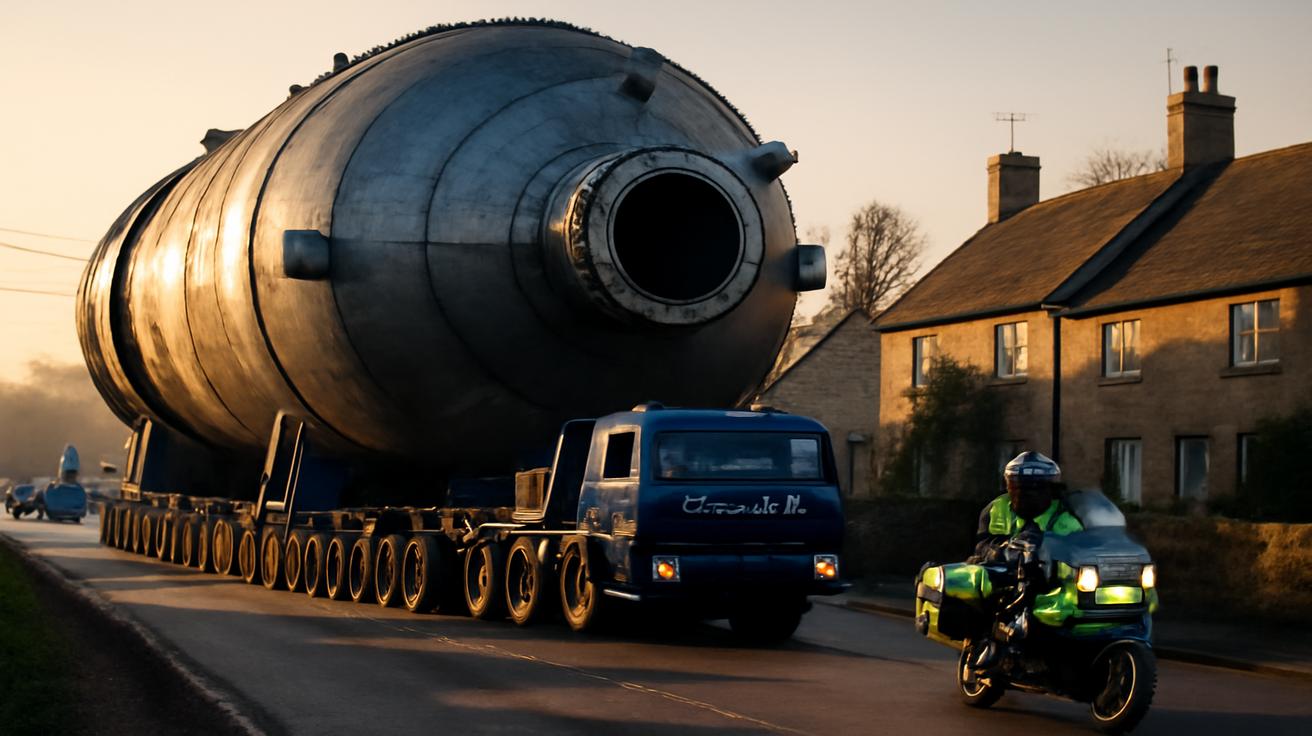
The news broke not with a whisper, but with the low, steady growl of heavy engines making their way out of northern France in the blue-grey light of early morning. On a misted dockside in the port of Dunkirk, workers in fluorescent jackets watched as a 500-tonne steel giant – a nuclear reactor pressure vessel, a colossus of the atomic age – was nudged slowly, almost delicately, towards the waiting ship. Somewhere beyond the horizon, across the chop of the Channel, its future home was already taking shape in concrete and cranes: Hinkley Point C, the United Kingdom’s flagship generation III nuclear power station, and perhaps the most symbolically charged construction site in Europe.
The Colossus Leaves France
It is hard to imagine 500 tonnes until you stand next to it. The reactor pressure vessel looks less like a piece of machinery and more like a small building laid on its side – a vast, cylindrical shell of precisely engineered steel, thick and implacable, punched with perfectly aligned nozzles and flanges. In the cool air of the French port, it gleams dully under floodlights, the surface beading with a faint haze of condensation. Weld lines, almost imperceptible to the eye, trace along its length like quiet scars.
This is the beating heart of Hinkley Point C’s first nuclear unit, forged and machined in the workshops of Framatome in France – a country whose identity has long been intertwined with nuclear power. For months, teams of metallurgists, welders, and inspectors have coaxed this singular object into existence: layers of steel treated, stressed, and tested until they meet standards so demanding they hover on the edge of perfection. Its task, once installed, is deceptively simple and unimaginably complex: to cradle the nuclear core, to hold the intense heat and fury of controlled fission, and to do it safely, hour after hour, year after year, for decades.
Now, at the dockside, the pressure vessel lies on a multi-axle transporter – a centipede of wheels and hydraulics that itself seems like a marvel of engineering. The air smells of salt and diesel and wet metal. Seagulls wheel overhead, unaware of the historic choreography taking place below them. A supervisor raises his arm, radios crackle, and the vast load begins to inch forward. To onlookers, it feels like watching a cathedral being moved.
The Channel crossing will be short, only a matter of hours, but symbolically it spans a far greater distance. It bridges an era of hesitation, power crises, and political argument with an era in which governments are being forced to answer a difficult question: how do you keep the lights on in a world that wants decarbonisation without compromise?
The Long Journey to Hinkley Point C
Far to the west, tucked against the crumbling Jurassic coastline of Somerset, Hinkley Point has been a quiet fixture of Britain’s nuclear story for generations. Two older stations, Hinkley Point A and B, have watched the sea for decades, their concrete shapes softened by weather and history. Now, next door, a new landscape rises: Hinkley Point C, a construction site of almost mythic scale, where steel and rebar twist skyward and tower cranes stand like giant white herons against the sea.
Into this living organism of a site, the French-built pressure vessel will soon be absorbed. But getting it there from the shoreline is a feat in itself. At the chosen port of entry, it will be unloaded with the same slow precision that began its journey – lifted, shifted, and settled onto a specialised transporter that can creep along reinforced roads and purpose-built bridges.
The route has been rehearsed to the millimetre. Overhead cables raised, junctions reconfigured, tarmac reinforced to handle a weight most roads were never designed to bear. Drivers along the Somerset lanes may one day pause their cars to watch a convoy glide past at walking pace, blue lights guarding its progress, the vast dark cylinder cocooned under protective cover. For a brief moment, the quiet English countryside will share the same sense of awe that rippled through that French dockside: this is what a turning point looks like in solid form.
At the edge of the Hinkley site, the world shrinks to clearances and tolerances, radio calls and hand-signals. Construction workers, hard hats speckled with concrete dust, will line up along railing and scaffold, curious to glimpse the component that has dominated design meetings for years. Here, the pressure vessel’s journey turns vertical. It will be hoisted by one of Europe’s most powerful cranes, swung – with breathtaking slowness – over a yawning circular pit of reinforced concrete, and then lowered into the reactor building that will be its permanent home.
A New Generation of Nuclear Power
Words like “generation III+ reactor” often float around in energy debates like cold, abstract jargon. But standing in the shadow of the pressure vessel, the idea becomes almost disarmingly tangible. This particular colossus is part of an EPR (European Pressurised Reactor), a design that sits on the cutting edge of civilian nuclear technology. It is not science fiction; it is simply the product of unglamorous, incremental learning: what worked, what didn’t, what safety systems can be thickened and multiplied until risk is whittled down like a piece of steel under a lathe.
The EPR at Hinkley Point C is designed to generate around 3.2 gigawatts of electricity from its two reactor units – enough, once fully operational, to supply roughly seven million homes. It will hum away quietly regardless of the weather, its output unbothered by still air or clouded skies. Where wind turbines and solar farms trace the moods of wind and sun, a reactor like this sits at the reliable centre of the system, a kind of steady heartbeat behind the more variable rhythms of renewables.
Generation III reactors are a response to the stories the world would prefer never to repeat: Three Mile Island, Chernobyl, Fukushima. Designers took those names, those failures, and encoded them into layers of defence – double containment, multiple independent cooling systems, more rigorous shutdown pathways, stronger materials. The steel of the pressure vessel is not just thick; it is carefully alloyed and treated to resist the slow, invisible stresses of neutron bombardment. Every weld is traced, documented, inspected, not once but many times, by people and by machines.
Yet for all the technological sophistication, there is something almost oddly human about the logic underlying it: anticipated failure, backed up by backup, backed up by backup of the backup. Where an earlier age of nuclear design sometimes flirted with the heroic, generation III designs are unapologetically conservative. They assume that humans make mistakes, that systems can break, that nature does unexpected things. And then, line by line, they try to plan for it.
France, Britain, and a Shared Nuclear Story
For France, the departure of this 500-tonne reactor vessel is more than a commercial transaction. It is an export of expertise, a physical embodiment of a national choice made decades ago when the country embraced nuclear power with unusual conviction. While other nations hesitated, France built, and built again, until most of its electricity came from reactors humming away along rivers and coasts. The manufacturing chain that produced Hinkley’s colossus – the forges, the machining shops, the design offices – exists because that decision was not half-hearted.
Britain’s story is more jagged, full of pauses and reversals. After an early lead in civilian nuclear technology, investment slowly thinned. Reactors aged, confidence wavered, policy shifted with the political weather. Coal still burned long after climate scientists called for its retirement, and gas stepped forward to fill the gaps. Talk of new nuclear never quite died, but it lingered in the realm of committees and white papers, always slightly out of reach.
The sight of a French-built reactor vessel sailing to British shores changes that in an oddly visceral way. Energy policy, usually trapped in graphs and parliamentary debate, becomes steel and seawater and the careful geometry of bolts. The Hinkley Point C project, led by EDF – majority-owned by the French state – is a bridge not just of trade, but of industrial culture. It says, in effect: we will share our machines, our methods, our confidence that this technology still has a place in a decarbonising world.
For workers at Hinkley, that collaboration is not an abstract geopolitical concept. It’s a daily reality of bilingual technical drawings, joint safety standards, French engineers adjusting to English weather and English pubs, British apprentices learning their trade on components designed in Lyon or Paris. The reactor vessel, once lifted into place, will be tended by people whose accents and passports differ but whose responsibilities are precisely the same: keep it safe, keep it working, keep the electrons flowing.
The Climate Clock and the Nuclear Debate
Beyond the ports and construction sites, another backdrop frames this voyage: the steadily ticking climate clock. Each year the headlines blur into a pattern – heatwaves, drought, unseasonable storms. Each winter, energy grids grind through their own trials: cold snaps, gas price spikes, anxious articles wondering if supply will hold.
Into this uneasy landscape, nuclear power walks like an unwelcome but necessary guest at a family gathering. Some greet it with relief – finally, something that can deliver large-scale, always-on, low-carbon electricity. Others eye it with suspicion, remembering waste debates, decommissioning costs, and the lingering ghosts of past accidents. Hinkley Point C, with its French-built core, stands in the middle of that argument like a physical question mark.
What is undeniable is the scale of its potential contribution. Unlike a single wind farm or rooftop solar programme, a project of this size can tilt national statistics. When both of Hinkley’s reactors are online, they will shoulder a significant slice of the UK’s electricity demand with negligible direct emissions. Against the background of net-zero targets, that matters. It buys breathing space for other transitions: electrifying heating, decarbonising industry, building out more renewables, strengthening storage.
But the trade-offs are starkly real. The cost of Hinkley Point C has climbed over time, and its construction timeline has stretched. Critics argue that the same money could have built more flexible, modular systems, or that future technologies – small modular reactors, advanced storage, grid interconnections – could have delivered better value. The pressure vessel sliding across the Channel feels in some ways like a bet placed years ago, before today’s options were fully on the table.
Yet the climate crisis tolerates few experiments in hindsight. The UK’s existing nuclear fleet is ageing, with several reactors scheduled to retire. Simply holding ground while coal and high-emission gas fade requires new, firm low-carbon capacity. Wind and solar will carry much of that load; interconnectors with mainland Europe will help; demand management will play its part. Still, for a country set on net-zero, the absence of any large-scale nuclear component would make the maths painfully tight.
Inside the Steel: What the Colossus Will Do
Strip away the drama of ship, crane, and coastline, and we arrive at the quiet core of the story: what actually happens inside that 500-tonne vessel once it is bolted in place and brought to life. The process, described plainly, sounds almost modest. Uranium fuel, shaped into ceramic pellets and stacked in metal rods, is arranged into assemblies. Those assemblies sit within the core, submerged in pressurised water that never quite boils, held at around 155 bar and over 300 degrees Celsius.
Inside that pressurised world, atoms split. Neutrons wander, collide, slow, and trigger further fissions. Heat flows into the water, but the water itself remains liquid, trapped under pressure. That hot, dense coolant is then sent to steam generators – separate loops where heat is passed to another body of water that finally does boil, racing through turbines that spin generators, sending power humming out along transmission lines.
The pressure vessel’s role in this dance is almost paternal: containing, shaping, and moderating an energy release that, without boundaries, would be catastrophic. Its steel walls, the thickness of a person, do not merely hold pressure; they shield, protect, and stand as barriers between the violent micro-world of fission and the larger, fragile world outside. Around it, concrete domes and further containment shells wait, nested like Russian dolls, just in case something goes wrong.
In the control room, hundreds of miles of cabling and ranks of digital systems will translate the vessel’s invisible interior life into data: temperatures, pressures, fluxes, flows. Operators will make decisions based not on intuition but on procedures refined by decades of study and international standard-setting. The romance of the giant steel cylinder gives way, in daily operation, to something more mundane yet more important: reliability.
The Future Written in Steel
By the time the French-built pressure vessel is fully installed at Hinkley Point C, the spectacle of its journey will have faded into memory: another news cycle, another timelapse film of heavy transport snaking along coastal roads. What remains will be quieter, but in many ways more profound – an enduring change in how the UK makes its electricity, encoded in the daily, unremarkable act of switching on a kettle, charging a bus, or lighting a hospital corridor.
Whether one views nuclear power with enthusiasm or unease, it is hard to stand in the imagined presence of that 500-tonne colossus and feel nothing. It is an object that speaks simultaneously of human audacity and human caution, of our hunger for energy and our fear of the forces we harness to obtain it. The fact that it crosses a national border on its way to work only deepens the symbolism. In a warming, interconnected world, energy sovereignty and interdependence are no longer opposites; they are two sides of the same coin.
In the years ahead, debates over the role of nuclear power will not quieten. Other technologies will surge forwards; some will stumble. Yet for the generation that will grow up with Hinkley Point C already humming in the background, the question may not be whether nuclear should exist at all, but what kind of nuclear future feels acceptable, safe, and just. Advanced reactors, smaller modular units, perhaps even fusion someday – all will be measured, consciously or not, against the great steel vessels that went before them.
For now, somewhere between the French coast and the Somerset shore, a ship has carried more than just metal. It has borne across the water a statement about the present and a wager on the future. In its hold, an immense, silent cylinder has listened to the slap of waves against the hull and the lonely calls of seabirds, as if absorbing, for just a few hours, the wider world it is being built to help protect.
Key Facts About the Nuclear ‘Colossus’ and Hinkley Point C
| Component | Reactor Pressure Vessel (Unit 1) |
| Approximate Weight | 500 tonnes |
| Origin | Manufactured in France by Framatome |
| Destination | Hinkley Point C, Somerset, UK |
| Reactor Type | Generation III+ EPR (European Pressurised Reactor) |
| Total Station Output | Around 3.2 GW from two reactor units |
| Homes Powered (Approx.) | Around 7 million homes when fully operational |
| Primary Role | Houses the nuclear core and primary coolant under high pressure |
Frequently Asked Questions
Why is the reactor pressure vessel so heavy?
The vessel must withstand high temperatures, enormous pressure, and decades of neutron bombardment. To do this safely, it is made from thick, specially treated steel, which pushes its weight into the hundreds of tonnes. The mass is a direct expression of safety margins built into the design.
What makes Hinkley Point C a “generation III” nuclear plant?
Generation III (and III+) reactors incorporate enhanced safety features compared with earlier designs. These include multiple redundant cooling systems, stronger containment structures, improved fuel technology, and systems designed to either prevent or significantly mitigate severe accidents, even in extreme scenarios.
How much electricity will Hinkley Point C generate?
Once both EPR units are operational, Hinkley Point C is expected to produce about 3.2 gigawatts of electricity. That is roughly enough to meet the needs of around seven million homes, providing a sizeable portion of the UK’s low-carbon baseload power.
Is nuclear power really low carbon?
While building a plant like Hinkley Point C requires energy and materials, the emissions from construction are spread over decades of operation. Over its lifetime, the electricity produced has a carbon footprint comparable to wind power and significantly lower than fossil fuel plants, even when gas is used efficiently.
What happens to nuclear waste from Hinkley Point C?
Spent fuel and other high-level waste are stored securely on site in robust containers designed to prevent radiation release. The UK plans to place this material eventually in a deep geological facility, engineered to isolate it from people and the environment for the timescales required. Until then, it is managed under stringent regulatory oversight.
Why is France supplying such a crucial component to the UK?
France has a long-established nuclear industry and manufacturers with the capability to fabricate very large, high-specification components like EPR pressure vessels. The Hinkley Point C project is led by EDF, majority-owned by the French state, making cross-Channel collaboration a natural choice for design, engineering, and manufacturing.
When will the reactor start producing power?
The exact schedule can shift due to construction, testing, and regulatory milestones. After installation of the pressure vessel, a long period of assembly, inspection, and commissioning follows. Only once all systems have passed extensive safety and performance tests will the reactor be allowed to go critical and begin feeding electricity to the grid.