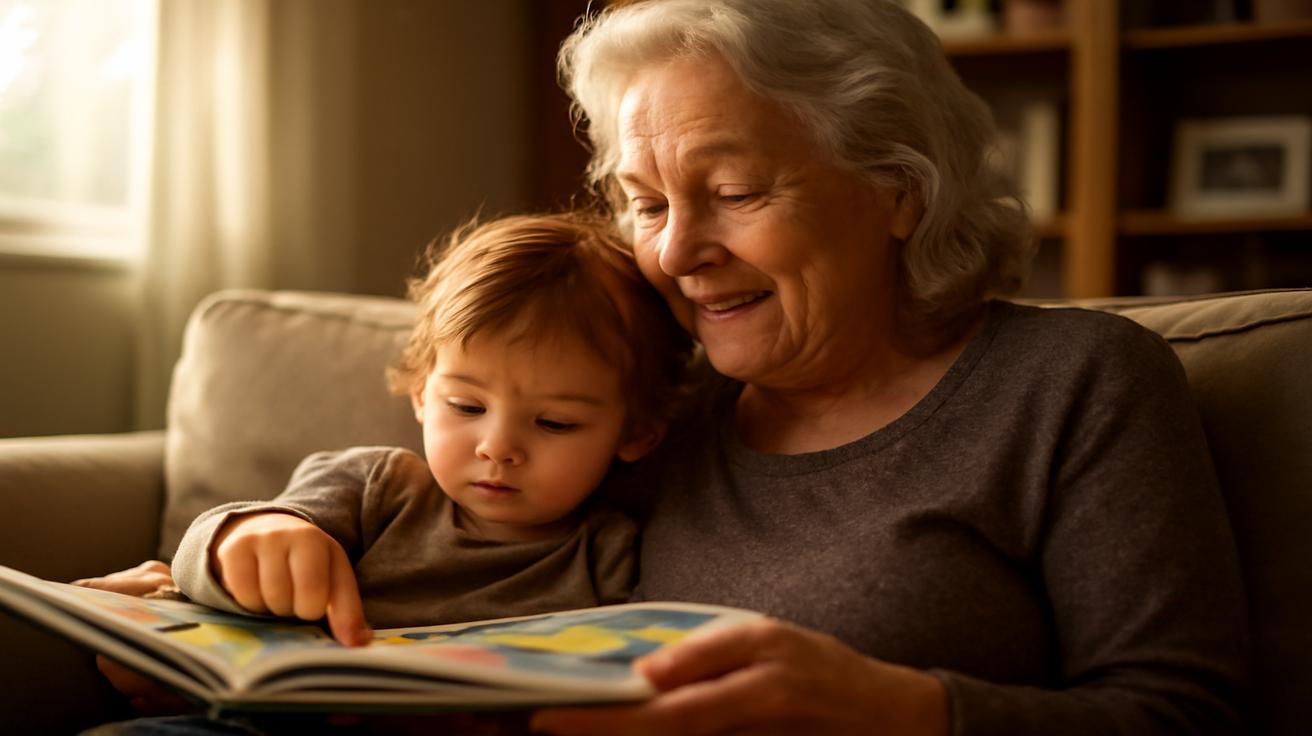
The first time Mara’s grandson wrapped his tiny fingers around her thumb, something ancient and electric moved through her. The hospital lights were too bright, the room smelled faintly of antiseptic and coffee, but all she remembers clearly is the weight of him—barely seven pounds—settling into her arms as if they had been waiting for each other a very long time. Her daughter, exhausted, laughed through tears. The nurse said, “Grandma’s got you,” and Mara felt the word land somewhere deep in her chest. Later, she would say it felt not like meeting someone new, but like recognizing someone she’d been missing without knowing it.
The Quiet Science Hiding in a Grandparent’s Hug
In living rooms, playgrounds, and video calls across the world, there is a particular kind of grandparent–grandchild bond that almost glows. You’ve seen it. The grandfather whose face lights up the second a toddler waddles into the room. The grandmother who somehow remembers every small obsession—dinosaurs this week, rockets next week—and leans all the way in.
Psychologists have been paying attention to this glow. For a long time, the grandparent role was treated as a soft-focus background character in family research: present, often loving, but not central to child development. That’s changing. Newer studies suggest that some grandparents function almost like “bonus attachment figures,” shaping everything from emotional resilience to social skills. What’s surprising is that these unusually strong bonds are not just about who spends the most time babysitting or who gives the best gifts. There are patterns beneath the stories—patterns of brain chemistry, personality traits, and even family history.
When researchers sit down with grandparents and grandchildren, record conversations, track stress hormones, and watch interactions closely, they find a constellation of factors that line up in quietly powerful ways. In other words: the science is beginning to catch up with what Mara felt in that antiseptic hospital room—this connection is not an accident.
The Attachment Echo: How Old Patterns Shape New Love
Attachment theory, born in the mid-20th century from observing babies and their mothers, has expanded like a tree, sending roots into almost every branch of psychology. One of the newer twigs on that tree asks: what happens when attached babies grow into grandparents?
It turns out that the way a person bonded with caregivers in their own childhood can echo into how they bond as grandparents. Those with what psychologists call “secure attachment” tend to be more emotionally available and predictably supportive when they themselves grow old. They are often better at tuning in to a child’s needs without overwhelming them. These grandparents are the ones who don’t panic when a preschooler melts down; they stay close, calm, and interested, without demanding that the child “be good” or “stop crying.”
But here’s the twist that fascinates researchers: some of the most fiercely connected grandparents are those who had difficult or inconsistent attachments themselves. You’ll hear it in the way they talk: “I didn’t have anyone like this when I was little, so I’m going to be that person for my grandkids.” Sometimes, the grandparent–grandchild bond becomes a kind of healing project, an attempt—conscious or not—to rewrite the emotional script of a family line.
In home interviews, psychologists notice how often these grandparents speak in terms of second chances. There’s a softness in the way they listen, a patience grown from knowing exactly what it feels like not to be understood. For the child, this can feel like standing in a beam of steady, unconditional attention—one that’s not as tangled with the daily pressures of parenting.
Why Some Grandparents Feel “Magnetic” to Their Grandkids
Not every grandparent radiates that same quiet magnetism. Some children drift more naturally toward one grandparent than another, even in the same family. To casual observers, it can look like simple personality chemistry, but beneath it, research keeps returning to three themes: presence, play, and perception.
Presence: Being There in More Than Body
You can’t form a deep bond with somebody who’s never around. But frequency of contact is only the starting point. Psychologists talk about “emotional presence”—the quality of attention offered when you are together. Some grandparents have a way of putting their phone down, slowing their speech, and making a child feel like the most interesting person in the room.
In lab settings, when grandparents and grandchildren are given simple tasks—build something with blocks, tell a story together—researchers notice that strongly bonded pairs display more eye contact, more shared laughter, and more “serve and return” interaction. The child says something, the grandparent responds in a way that shows they not only heard the words, but felt the weight behind them.
Play: The Secret Language of Closeness
Then there is play—the native tongue of children. Some grandparents never stop being playful. They crawl under tables, invent elaborate characters, or turn walks into expeditions. When psychologists observe these interactions, they often find higher levels of oxytocin, the so-called “bonding hormone,” released in both grandparent and child.
What matters is not how silly or energetic the play is, but whether the grandparent is responsive and flexible. When the child shifts the rules mid-game—as they so often do—the attuned grandparent bends with them, letting the child steer. This flexible playfulness communicates a powerful message: “Your ideas matter. I trust you to lead sometimes.” That message is a strong foundation for intimacy.
Perception: Feeling Seen, Not Managed
Another recurring ingredient is the feeling of being deeply seen. Strongly bonded grandparents often specialize in noticing small things: the way a child lines up their toys; the way they hover on the edge of a group; the spark that appears when they talk about a favorite topic. Rather than trying to shape the child into something, they move in closer to who the child already is.
To researchers, this looks like “mentalizing” or “reflective function”—the ability to imagine the inner world of another person. To the child, it simply feels like this: “Grandma gets me.” “Grandpa knows what I mean.” That sense of being understood, especially when a parent is stressed or distracted, can make a grandparent feel like emotional home base.
Grandparents as Emotional Shock Absorbers
Modern family life is bristling with strain: financial pressure, long work hours, complex co-parenting arrangements, and the hum of constant digital noise. In the midst of all this, some grandparents function as emotional shock absorbers, taking in some of the impact so children don’t bear it alone.
Psychological studies of children in high-conflict families or going through parental separation often highlight the protective role of grandparents. When parents are overwhelmed, inconsistent, or physically absent, a steady grandparent can become a crucial buffer against anxiety and behavioral problems. In families where one parent is struggling with addiction or mental illness, the presence of a reliable grandparent often predicts better outcomes for the child—better school engagement, fewer risky behaviors, greater emotional stability.
This is not about grandparent as savior; it’s more subtle than that. Think of it as relational padding. The harsh edges of adult problems don’t cut as deep when there is someone older, calmer, and less entangled in day-to-day battles who can say, “You’re safe with me. This isn’t your fault. Let’s bake cookies and talk about that dream you had.”
Interestingly, some research suggests that grandparents who have weathered their own storms—divorce, loss, financial hardship—may be especially equipped for this role. They have lived long enough to see that crises end, losses soften, and children can grow strong in imperfect soil. That long view can be soothing to a child whose life currently feels chaotic.
When Caregiving Becomes a Second Parenthood
In some families, grandparents move beyond emotional buffering and become primary or near-primary caregivers. This is happening more frequently than many people realize. Economic strain, migration for work, health crises, or incarceration can all lead to what researchers call “skipped-generation households,” where children live mainly with grandparents.
These arrangements can forge incredibly powerful bonds. They also come with their own psychological complexity: grief for the missing parent, role strain for the grandparent, confusion for the child about who is “in charge.” Studies show that when these caregiving grandparents receive social support and are treated with respect by extended family and institutions, the children do remarkably well. When they are isolated or undermined, the stress can fray even the strongest connection.
The common thread remains the same: where there is consistent care, honest communication, and a sense that “we are facing this together,” the grandparent–grandchild relationship often deepens into something almost like co-authorship of a shared survival story.
The Biology of That Warm, Familiar Lap
It’s tempting to explain these relationships entirely in terms of personality and circumstance, but biology hums underneath the stories. When a grandparent holds a baby or even looks at their picture, brain scans can show activation in regions linked to empathy and reward. One study found that grandmothers, in particular, showed stronger activation in areas associated with emotional empathy when viewing photos of their grandchildren compared to their adult children.
That doesn’t mean grandfathers are less attached; rather, it hints that grandparental love has its own distinct neural signature. The mix of hormones involved—oxytocin, dopamine, and a dampened stress response—creates a cocktail that encourages patience, fondness, and the urge to protect.
This might help explain the peculiar softness many people notice in their own parents once they become grandparents. The same father who was rigid about bedtimes becomes the granddad happily reading “just one more story” at 10 p.m. Part of that is perspective, part is reduced responsibility, and part may simply be that the brain, seasoned by age and experience, is now optimized for savoring rather than controlling.
Psychologists also point to genetic distance: grandchildren share less direct responsibility than children did. A grandparent can love intensely while feeling less personally judged by the child’s every success or misstep. This can reduce anxiety and leave more space for curiosity and delight—which, circling back, strengthens the bond.
Why One Grandchild Sometimes Feels “Chosen”
In many families, there’s a whisper of this: “Grandpa and Mia have something special.” Sometimes, that “special” connection lives quietly; other times, it swells into overt favoritism that can sting cousins and siblings.
Research suggests that perceived similarity plays a large role. A grandparent may feel especially drawn to the grandchild who shares their temperament—shy or exuberant, dreamy or analytical—or mirrors a younger version of themselves. They may also gravitate toward a grandchild whose life circumstances match something they once longed for or lost. A grandmother who never finished school might pour particular energy into the bookish granddaughter. A grandfather who always felt misunderstood at home might find deep resonance with the sensitive boy who prefers drawing to soccer.
Another predictor of closeness is simple access. The grandchild who lives closest, whose parents facilitate visits, shared holidays, and spontaneous drop-ins, has more opportunities for the little rituals that weave strong ties. Over time, those rituals—Saturday pancakes, post-school phone calls, the shared ritual of watering plants—harden into emotional architecture.
Yet, in interviews, many grandparents insist they don’t choose a favorite deliberately. The bond feels organic, inevitable. Psychology helps unpack why it feels that way, but for the people living it, the experience is more like gravity: you simply find yourself pulled toward each other again and again.
A Quick Look at Key Factors Behind Strong Bonds
When psychologists step back from the stories and run the numbers, certain themes keep resurfacing. The table below summarizes some of the consistent findings:
| Factor | What Research Observes | How It Feels to the Child |
|---|---|---|
| Consistent presence | Regular contact, predictable availability | “I can count on them being there.” |
| Emotionally secure grandparent | Higher likelihood of warm, stable interaction | “They stay calm when I’m upset.” |
| Playful engagement | More shared laughter, creative play, and flexibility | “Being with them is fun and free.” |
| Support during family stress | Protective effects on mental health and behavior | “They make things feel less scary.” |
| Perceived similarity | Stronger reported identification with particular grandchildren | “They really ‘get’ someone like me.” |
What This Means for Families Right Now
Knowing all this changes how we might look at that quiet figure on the park bench, patiently watching a child attempt the monkey bars again and again. It also invites a new tenderness for our own family histories. The grandparent–grandchild connection is not merely a sweet extra; it is one of the underappreciated emotional systems holding many families together.
If you are a grandparent, the research offers encouragement more than instruction. You don’t have to be perfect, endlessly energetic, or constantly entertaining. The strongest bonds grow less from fireworks than from steady embers: showing up, listening deeply, staying curious about who this small person is becoming. Letting yourself be changed by them, just a little.
If you are a parent, it may be worth pausing over the small decisions that can either open space for that bond or quietly close it off. The extra drive across town for Sunday lunch. The patience to navigate generational differences in discipline or screen time. The willingness to let your child build a relationship that is not identical to your own with your parents—sometimes warmer, sometimes more complex, but uniquely theirs.
And if you are a grown grandchild, you may find that the odd, powerful pull you still feel toward a certain kitchen table, a certain garden path, a certain old hand in yours is not childish nostalgia but something sturdier: an attachment that shaped your nervous system, steadied your earliest fears, and taught you something wordless about love.
One day, Mara’s grandson, now eight, asked her, “How long will you be my Grandma?” They were sitting on the back step, the air sweet with cut grass, a distant lawnmower droning like a lazy bee. She felt the question like a crack in time. Psychology could have offered a dozen ways to interpret his worry about loss, his growing sense of mortality. Instead, she pulled him close and answered the only way that mattered in that moment.
“For all the days you remember,” she said, “and probably some you don’t. It’s already in you.”
In him, in her, in the quiet circuitry of their brains, in the stories they’re still telling each other on back steps and hospital rooms and park benches everywhere, that truth is being written: some bonds do more than connect two people. They repair old wounds, steady new lives, and carry families forward, one unhurried afternoon at a time.
FAQ
Do grandchildren usually feel closer to one grandparent than another?
Often they do, and research suggests it can depend on time spent together, personality fit, perceived similarity, and how emotionally present the grandparent is. This doesn’t mean other grandparents are unloved—just that one relationship may feel especially intense or “magnetic.”
Can a grandparent make up for difficult parenting?
A grandparent can’t erase a child’s painful experiences, but studies show that a stable, loving grandparent can significantly buffer the effects of family stress, conflict, or inconsistency. They can’t replace a parent, but they can become another crucial attachment figure that supports resilience.
Is it ever harmful for grandparents to be too involved?
Problems usually arise when roles are unclear or when grandparents undermine parents’ authority in front of the child. Strong bonds are healthiest when there is clear communication, mutual respect, and agreement about boundaries between all adults involved.
What if we live far away from the grandparents?
Closeness is still possible with distance. Regular video calls, voice messages, shared rituals like reading the same bedtime story across screens, and occasional longer visits can help. The key is consistency and emotional presence, not just physical proximity.
Can a grandparent build a strong bond later in a child’s life?
Yes. While early childhood is a powerful bonding window, research and lived experience both show that meaningful, secure relationships can form in later childhood, adolescence, and even adulthood. Honest interest, reliability, and time together can deepen connection at any age.