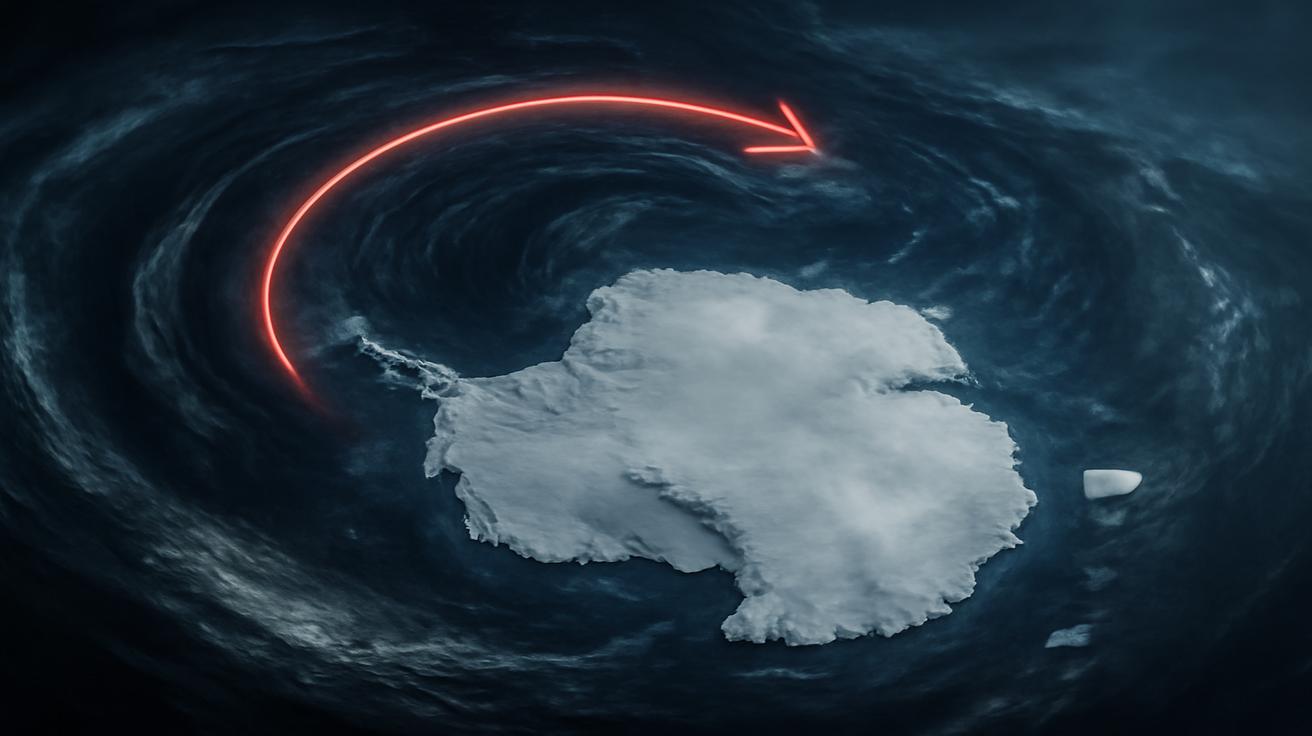
The first sign was a line on a screen—thin, blue, almost shy. Then, over the course of a few days, it bent. Dipped. And finally, it flipped. In a dim control room carved out of an ice-bright world, a small team of oceanographers watched a Southern Ocean current, one that had flowed stubbornly in the same direction for as long as science has known it, reverse. Not slow, not merely weaken—reverse. A river of cold water in the planet’s wildest ocean had turned back on itself.
When the Ocean Turns Around
Imagine standing on the deck of a research vessel in the Southern Ocean, a place that feels less like part of Earth and more like the rough sketch of another planet. The air tastes metallic and sharp. Wind claws at any exposed skin, and waves rise like dark hills, tipped in white. Around you, the water is a charcoal swirl, restless and full of secrets.
Beneath that surface, invisible to the eyes but unmistakable to instruments, runs one of the most powerful engines of the global climate system: the circumpolar currents and deep-water flows that wrap around Antarctica. These currents are not just lines on a map; they are moving architecture—layers and ribbons of water that carry heat, carbon, oxygen, and life across the globe.
For decades, oceanographers have tracked one particular branch of this vast machinery: a deep, cold current that sinks near Antarctica and slides northward like a slow, underwater avalanche. It is part of the “overturning circulation,” the planetary conveyor belt that helps stabilize temperatures, lock away carbon, and feed surface currents that touch the shores of every continent.
Then, one austral winter, the instruments anchored thousands of meters down began whispering a different story. Flow rates shifted. Velocities shrank. And slowly, against every expectation, the current began to creep in the opposite direction—water that should have been moving away from Antarctica was now curling back toward it.
The first reaction among scientists was disbelief. Currents like this do not simply change their minds. They are built by gravity, winds, ice, and the density of water itself. To reverse such a flow is to tug at the spine of the climate system.
What It Means When a Giant Stumbles
To understand what this reversal means, it helps to zoom out—far beyond the white chaos of Antarctic waves—to see the planet as a slow-breathing, water-covered organism.
The Southern Ocean, circling Antarctica like a belt, is one of Earth’s major lungs. Here, water from the surface—cold, dense, and often stirred by ferocious winds—sinks into the deep. As it sinks, it carries with it heat and dissolved carbon dioxide from the atmosphere. This is not a minor side job of the ocean; it’s one of the most important ways our planet stores excess heat and greenhouse gases.
The overturning circulation that this sinking drives is like a deep, slow-moving river system that links all the world’s oceans. Water dives down around Antarctica, flows northward through the abyss, then eventually rises thousands of kilometers away, bringing with it cold, nutrient-rich water that fuels fisheries and marine ecosystems. It is, in many ways, the planet’s hidden climate infrastructure.
Now imagine one section of this interconnected machinery simply slowing, stuttering, and slipping into reverse. It’s not as dramatic to the eye as a hurricane or wildfire. There are no time-lapse videos, no orange skies. But in terms of Earth’s long-term habitability, it might be far more consequential.
The reversal of a major Southern Ocean current suggests that the water is losing its old density-driven behavior. Warmer, fresher water from melting Antarctic ice shelves is flooding into places that once birthed some of the coldest, saltiest, heaviest water on Earth. And heavy water wants to sink. If it becomes lighter, it hesitates. If it becomes too light, it stops sinking altogether—and the deep river that carried it away can slow, warp, or even turn around.
The Quiet Signals No One Wanted to See
Scientists have warned for years that the Antarctic overturning circulation was at risk. Climate models projected that as the planet warmed and Antarctic ice melted, the deep formation of cold, dense water would weaken. Those warnings were often framed in the language of “end of the century” or “later this century,” comfortably distant for most of us scrolling the news between meetings and errands.
But data arriving from moored instruments, gliders, and research cruises are whispering a different timeline. The reversal of a major current is not a hypothetical; it is a measured event. It is happening now, while we are still talking about the future.
Inside the data are clues: the water is slightly fresher than it was a decade ago, a fingerprint of meltwater from ice shelves. Temperatures, even at depths that never see the sun, are ticking upward by tenths of a degree—tiny shifts in human terms, but enormous in the tightly balanced world of ocean density. Salinity patterns are rearranging. The water feels different, even if it looks the same from a ship’s rail.
At first, the reversal was seen in a single line of instruments—a possible anomaly. Maybe a storm had twisted the flow, or an eddy had flared and collapsed. But then other stations, other measurements, began to echo the same story. This was not a glitch. It was a pivot.
The Dominoes Along the Thermohaline Highway
When an ocean current reverses, what exactly is put at risk? To most of us, currents are abstract lines on a map, not something we feel brushing past our daily lives. But their influence is everywhere.
The current that changed direction in the Southern Ocean is part of the deeper layers of the global “thermohaline circulation”—thermo for heat, haline for salt. Together, temperature and salinity decide whether a parcel of water will rise or sink, and that dance drives some of the largest flows on Earth.
Below is a simplified view of how this system—often called the global ocean conveyor—works and what’s at stake as it falters:
| Process | What Normally Happens | What a Reversal Signals |
|---|---|---|
| Deep Water Formation | Cold, salty water near Antarctica sinks and spreads northward. | Water is too warm or fresh to sink effectively—circulation weakens or flips. |
| Heat Storage | Oceans absorb and hide a large fraction of global warming heat at depth. | Less deep storage; more heat remains near the surface and in the atmosphere. |
| Carbon Uptake | Surface waters take in CO₂ and carry it to the deep ocean for centuries. | Carbon burial slows; more CO₂ stays in the air, accelerating warming. |
| Nutrient Cycling | Deep, nutrient-rich water eventually resurfaces, feeding plankton and fisheries. | Ecosystems can starve in some regions and be over-fertilized in others. |
| Climate Stability | Currents distribute heat relatively evenly, moderating extremes. | Regional climates can swing: harsher storms, shifting rains, marine heatwaves. |
What makes this reversal so unnerving is not just that one current changed direction, but what it tells us about the underlying physics. It means the Southern Ocean is crossing thresholds that models have long warned about. And because all oceans are joined, this is not a local problem. It is the kind of change that ripples outward, touching monsoon systems, storm patterns, and the stability of ice far from Antarctica itself.
The Human Shape of an Invisible Shift
It is easy to leave this story in the realm of numbers and remote seas—far-off coordinates, color-coded graphs. But the consequences of a misfiring Southern Ocean current can find their way into things as humble and human as a kitchen table.
On a humid summer afternoon in a coastal town half a world away, a fish market opens as it always has. Crates of shimmering silver-blue bodies arrive on the backs of trucks, ice melting into salty puddles on the pavement. But year by year, the species in those crates are changing. Some once-abundant fish have retreated to cooler, deeper water. Others have arrived from warmer regions, unfamiliar to local cooks and unsettling to those whose identities are braided to a particular catch.
These shifts are not random. Marine life has always followed the ocean’s invisible isotherms—the lines of equal temperature and nutrient richness. When deep currents falter, the upwelling of cold, nutrient-rich water that feeds plankton can weaken or move. The entire food web responds. What begins as an anomaly in the Southern Ocean can, over time, change how much protein is available to a fishing village thousands of kilometers away.
Or consider a farmer standing next to a cracked field in a region that once depended on reliable rainy seasons. Global circulation patterns—of both air and water—are intertwined. A disrupted ocean conveyor can reshape the belts of storms, monsoons, and droughts. Some areas may receive more rain, others much less. The climate system does not change everywhere in the same way; it redistributes extremes.
This is the quiet violence of a reversing current. It does not arrive with sirens. It arrives as a string of “unusual” seasons, failing harvests, unfamiliar fish, and insurance policies that suddenly cost more than a family can pay.
Listening to an Ocean on the Edge
Back in the Southern Ocean, the scientists who first watched the current reverse are not just detached observers. They are, in many ways, translators—decoding what this remote, icy world is trying to tell us.
Onboard research ships, days blur into each other: the thud of waves against the hull, the creak of cables lowering instruments into black water, the faint chemical smell of preserved samples. On a good day, a wandering albatross might follow the ship, its wings barely moving as it rides the wind like a thought. On a bad day, storms lash the deck, and equipment must be lashed even tighter.
The data they gather—temperature profiles, salinity layers, current velocities—are stitched together with satellite records and autonomous floats drifting silently thousands of meters below the surface. Together, they form a rough diary of the ocean’s moods and motions.
That diary now contains an entry that will be studied for decades: the first recorded reversal of a major Southern Ocean current. Was it a temporary buckle in a stressed system, or the early phase of a long-term reorganization? The honest answer is that we do not yet fully know. But in climate science, “we do not yet fully know” rarely means “we can relax.” It usually means “we are crossing into territory our models only sketch.”
What is clear is that the Southern Ocean is absorbing more heat than it once did, that Antarctic ice shelves are thinning from beneath, and that the density patterns that drive deep currents are changing fast. The current’s flip is not an isolated accident; it is part of a story of accelerated warming and delayed human action.
What We Do With the Warning
The ocean is often framed as victim and buffer—absorbing our excess heat, our carbon, our runoff. But the reversal of a deep current is a reminder that the ocean is also a limit. It can only soak up so much before its internal wiring begins to change in ways that amplify, rather than cushion, our impact.
So what do we do with this warning, now that it has arrived not as a projection but as a measurement?
First, we understand that mitigation—cutting greenhouse gas emissions aggressively—is no longer an abstract moral stance but a direct intervention in the physics of currents. Every fraction of a degree of warming avoided reduces the pressure on the Southern Ocean’s delicate density structure. Rapidly phasing out fossil fuels, protecting carbon-rich ecosystems, and rethinking how we use energy are not separate from what is happening under Antarctic ice; they are causally linked.
Second, we invest in listening. The ocean is vast and still only patchily observed. Maintaining and expanding networks of deep ocean sensors, floats, and satellites is not a luxury for a wealthy world; it is how we track the health of the system that feeds, cools, and stabilizes us. Cutting ocean research in an age of reversing currents is like turning off the smoke alarm because we don’t like the sound.
Third, we prepare. Some changes are now baked in. Communities that live close to coasts, depend on fisheries, or farm in climate-sensitive regions will need support, not platitudes. Adaptation—rethinking coastal infrastructure, diversifying livelihoods, rebuilding with future sea levels and storms in mind—becomes a form of respect for what the ocean is telling us.
And finally, we remember that the ocean is not a stranger. Its waters flow through our blood as rain, food, and breath. Half the oxygen in every inhale begins as tiny floating plants in sunlit surface waters. The fate of a current in the Southern Ocean is, in a very real sense, entangled with the fate of the cities, forests, and futures we care about.
Standing at the Turning Point
Some climate stories feel like endings, full of loss and damage already done. The reversal of a major Southern Ocean current is, undeniably, a grave warning. It signals that one of Earth’s fundamental stabilizers is wobbling. But it is also a beginning—a moment of clarity in which the planet is speaking plainly, if we are willing to listen.
In that control room, far south of where most of humanity will ever stand, the scientists who watched the line on the screen turn back on itself did not cheer. They adjusted their glasses, checked their calibrations, emailed colleagues, and sat for a moment with the weight of what they were seeing.
They were among the first humans to witness, in real time, a piece of the planet’s deep machinery falter. But what happens next is not their story alone. It belongs equally to those in coastal apartments deciding whether to support climate policies, to fishers mending nets while the catch shifts beneath them, to teenagers reading about faraway ice and wondering what kind of world they will inherit.
The ocean has turned a page. A current that once flowed faithfully in one direction has, under the pressure of our warming world, changed its mind. Whether this becomes a brief, troubling paragraph or the first chapter of a more radical reordering of the climate system depends on what we choose to do—now, while the signal is still fresh, and the currents have not yet forgotten entirely the paths they once carved through the dark.
Frequently Asked Questions
What exactly reversed in the Southern Ocean?
A major deep current that is part of the Antarctic overturning circulation changed direction. Instead of dense, cold water consistently flowing away from Antarctica into the deep global ocean, measurements show that in some regions this flow briefly or persistently turned back toward Antarctica—an unprecedented sign that the underlying density-driven circulation is destabilizing.
Does this mean the entire global ocean conveyor has stopped?
No, the entire global conveyor has not stopped. However, the reversal indicates a significant disruption in one of its key branches. Such a change can weaken the overall circulation and increase the risk of broader slowdowns or structural shifts in the coming decades, especially if warming and ice melt continue.
How does Antarctic ice melt affect these currents?
When ice shelves and glaciers around Antarctica melt, they pour fresh, relatively warm water into the surrounding seas. This fresher water is less dense than the cold, salty water that usually sinks to form deep currents. As the surface becomes lighter, less water sinks, weakening or even reversing the deep flow that depends on that sinking motion.
What are the main climate risks of a reversing Southern Ocean current?
Key risks include reduced ocean heat and carbon uptake (leaving more in the atmosphere), changes in where and how nutrients rise to the surface (affecting marine ecosystems and fisheries), altered storm tracks and rainfall patterns, and potential feedbacks that speed up ice melt and sea-level rise. Over time, these changes can make regional climates more extreme and less predictable.
Is this change permanent?
It is not yet clear whether the reversal is permanent or part of a transitional phase. The worry is that continued warming and ice melt will lock in a weaker or fundamentally altered overturning circulation. The more we limit greenhouse gas emissions and warming now, the better the chance that the system can stabilize rather than crossing irreversible thresholds.
Can human action still make a difference?
Yes. The physics of the ocean are sensitive to how much and how quickly the planet warms. Rapid reductions in greenhouse gas emissions, protecting natural carbon sinks, and investing in ocean monitoring can limit further destabilization. We cannot reset the clock, but we can still strongly influence how far these changes go—and how survivable they are for both human and natural systems.