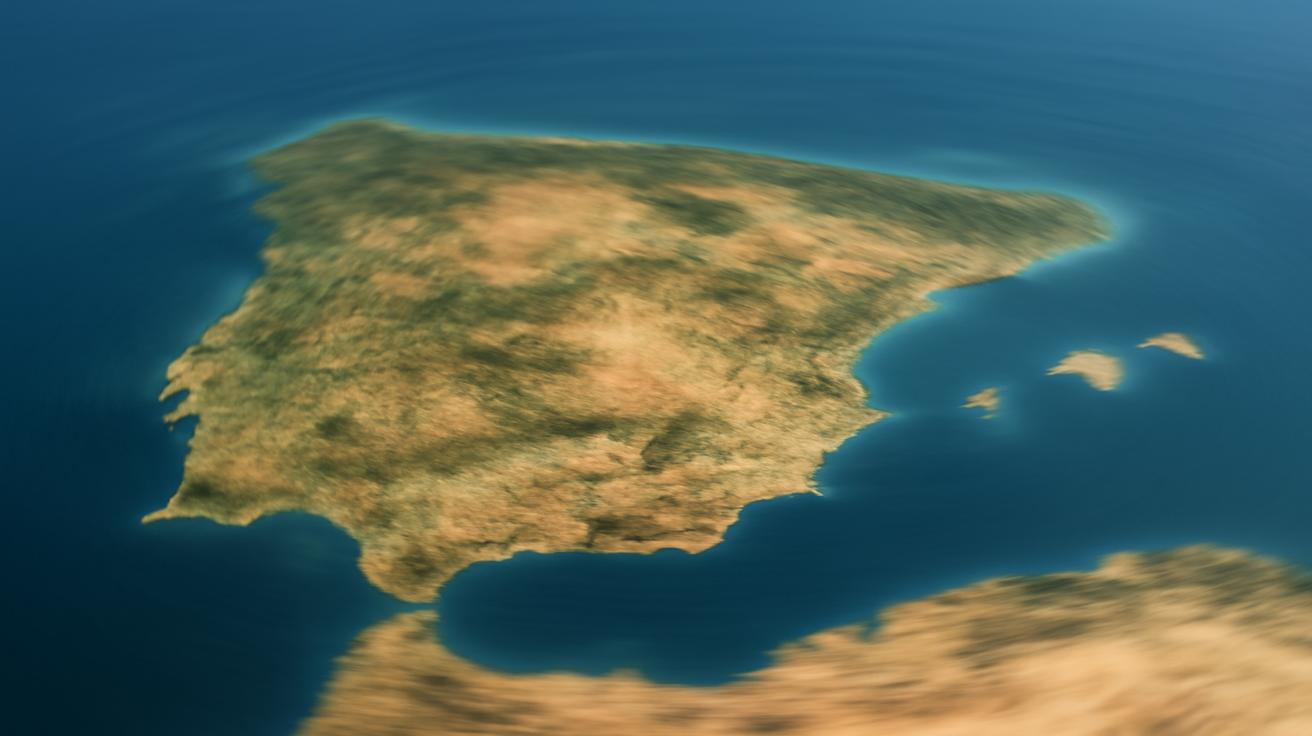
The first time you hear it, it sounds like a joke told over coffee: “Portugal and Spain are slowly spinning.” You picture the Iberian Peninsula like a lazy carousel in a children’s park, turning so slowly that no one notices. The streets of Lisbon tilt a hair’s breadth, the vineyards of Rioja creep a fraction of a degree, and somewhere under the Atlantic, rock groans with the pressure of continents in motion. Then a geologist looks you in the eye and says, “No, really. They’re rotating.” And suddenly the ground under your feet feels a little less certain, a little more alive.
The Peninsula That Won’t Sit Still
On a sun-struck afternoon in southern Portugal, the air smells of salt and eucalyptus. Waves arrive from the Atlantic in patient, polished sets, as if they have all the time in the world. Cliffs rise in ocher and rust, their faces etched with lines that look like wrinkles in ancient skin. To most people, this is a picture of stillness, of permanence. Yet, deep below the sandals and surfboards and sun-baked roads, the Iberian Peninsula is shifting—ever so slightly—like a sleeping giant rolling over in its bed.
According to geologists who listen to the slow language of rock and time, Portugal and Spain are not only drifting, they are rotating on themselves, pivoting as a single, massive block of crust. This motion is so subtle that it’s measured not in degrees you could see on a compass, but in fractions of millimeters, traced by satellites and GPS stations that never blink. It is a kind of planetary whisper, and yet, over millions of years, whispers can carve mountains and reshape oceans.
The Iberian Peninsula sits at a complicated crossroads of Earth’s tectonic puzzle. To the north lies the vast Eurasian Plate. To the south, the restless African Plate pushes and nudges. Iberia is a stubborn fragment of crust nestled between these giants, feeling their pressure, absorbing their shoves. Instead of simply sliding north or south, the peninsula responds with a twist—a very, very slow pirouette on the stage of geological time.
The Slow Pirouette of Continents
Imagine placing your palm flat on a table and pushing gently from one side. Your hand doesn’t just move straight; it may turn a bit, pivoting toward a new angle. Something similar is happening to Portugal and Spain. Forces from the African Plate are pressing against the southern edges of Iberia, particularly off the coasts of Portugal and the Strait of Gibraltar, and that pressure is not evenly distributed. The result is a tiny rotational motion, like a great stone wheel turning on an axis buried deep within the crust.
Scientists track this by pinning down the land with invisible nails: precise GPS stations anchored in bedrock. These instruments quietly record their positions day after day, year after year. If a point on the coast of Portugal shifts a millimeter eastward in a year, they know. If a hilltop in northern Spain edges a fraction north, they know. When the data from dozens of these stations are stitched together, a pattern emerges: the whole peninsula isn’t just translating—it’s rotating, like a rigid raft on a churning sea of mantle.
The numbers are nearly absurd in their smallness. A few millimeters a year doesn’t sound like motion at all. Stand on a plaza in Madrid and stare at the horizon; you will not feel a thing. Buildings don’t creak. Rivers don’t slosh out of their banks. Yet the Earth has always worked on a different calendar than ours. Add those millimeters across thousands, even millions of years, and the quiet rotation of Iberia becomes a sweeping reorientation, the kind that redraws maps, reforms shorelines, and reshapes the stories we tell about where we live.
A Table of Tiny Movements
To grasp how subtle this motion is, it helps to see it in plain numbers—simple, almost laughable, and yet relentless.
| Location | Approx. Horizontal Motion | Direction Trend | What That Means Over 1 Million Years* |
|---|---|---|---|
| Southern Portugal (Algarve) | 2–4 mm/year | Northeastward | 2–4 km of overall shift |
| Western Spain (Extremadura) | 1–3 mm/year | Slightly eastward | 1–3 km of overall shift |
| Northern Spain (Cantabrian region) | 1–2 mm/year | East-northeastward | 1–2 km of overall shift |
| Gibraltar & South Coast | 3–5 mm/year | Complex, compressive | 3–5 km of overall shift |
*These are conceptual, order-of-magnitude values that illustrate long-term effects of tiny annual motions.
On a mobile screen, the numbers might look small enough to ignore, but the Earth is patient. What matters is not the size of each step, but the fact that the land never stops walking.
Listening to Rock: How Geologists Know
In a quiet laboratory, far from the roar of the Atlantic or the clatter of city streets, a geologist peers at a thin slice of Portuguese sandstone under a microscope. Within the grains are clues: minerals twisted, cracks healed, layers bent and folded. Each tells a story of stress, pressure, and motion—of a crust that has been squeezed, stretched, and rotated over eons. The rock is an archive, and Iberia’s rotation is just the latest chapter.
To uncover that chapter, scientists combine several lines of evidence. GPS data, collected from stations scattered across the peninsula, reveal real-time motion on the scale of decades. Seismic studies—those careful analyses of how earthquake waves travel through the Earth—show where the crust is thickening, warping, or fracturing. Offshore surveys map the seafloor, tracing fault lines that snake along the edges of Iberia. Each piece is like a thread; woven together, they sketch the peninsula’s slow, turning path.
You can almost imagine geologists as translators, interpreting the subtle shivers of the Earth into human language. A cluster of small earthquakes off the Portuguese coast hints at a stubborn fault being loaded with stress. Slight uplift in a mountain range suggests ongoing compression from the south. Tiny changes in GPS coordinates form arrows that show the direction of drift and rotation. When plotted on a map, these arrows align into a graceful, spiraling pattern, proof that Iberia is not simply sliding but also turning.
The conclusion is not wild speculation but a careful reading of consistent clues. Over and over, the data whisper the same thing: the ground beneath Portugal and Spain is engaged in a long, unhurried spin, responding to tectonic forces that have shaped the Atlantic and the Mediterranean for tens of millions of years.
Earthquakes, Coasts, and Future Landscapes
It’s tempting to jump straight to dramatic questions: Will this rotation cause massive earthquakes? Will cities sink or coastlines warp in our lifetimes? The reality, like most geological truths, is subtler and less cinematic—but no less fascinating.
The forces that drive Iberia’s rotation are also the ones that build its seismic story. The boundary between the African and Eurasian plates—fuzzy, braided, and complex—runs not far from the southwest coast of Portugal. This region produced the infamous Lisbon earthquake of 1755, one of the most powerful quakes in European history, followed by a devastating tsunami. That event was a reminder that the intersection of plates is never truly quiet.
Today, the rotation of Iberia is part of a broader tectonic ballet between Africa and Eurasia. As Africa pushes northward, Iberia absorbs some of the stress by twisting. This doesn’t mean that every creak in the crust becomes an earthquake you can feel. Many adjustments happen silently, as rocks bend rather than break. But where the crust is brittle, where old faults lie sleeping, the slow reorientation can load them with stress until they snap—sometimes in modest tremors, sometimes in larger jolts.
Over human timescales—decades, centuries, even a few thousand years—the rotation is unlikely to redraw the map in ways we can see with the naked eye. Coastlines won’t suddenly curve into new shapes. Mountains won’t leap skyward. Instead, changes accumulate like dust on a shelf. Seafloor basins deepen by meters, river valleys adjust their paths by subtle degrees, and the stress patterns that govern earthquakes shift almost imperceptibly.
Yet if you zoom out—far out—to the scale of millions of years, Iberia’s rotation becomes a sculptor. The peninsula that once was welded to the heart of supercontinents, that once opened to form the Atlantic, will keep drifting and pivoting. The narrow gateway of Gibraltar may widen or crumple. The weight of mountains may feed new basins. Future coastlines will not match the postcards we send today.
A Conversation with Deep Time
Standing on a headland in northern Spain, where the Cantabrian Mountains meet the sea, the cliffs look like pages in a book that has been dropped and bent. Layers of ancient sediment—once flat, once the floor of forgotten oceans—have been folded into arcs and chevrons, tilted upright, sliced by faults, lifted thousands of meters. Fossils of marine creatures stare out from rocks now high above the waves. The land itself seems to lean toward you, eager to tell its story.
In that story, motion is the constant. Iberia has rotated before—dramatically. In deep geological time, the peninsula has swung like a door as oceans opened and closed. What geologists are detecting now is the latest movement in a long sequence, part of a conversation that the crust is having with the mantle, with gravity, with the heat bleeding from Earth’s interior.
To humans, who plan lives and cities on the scale of years and decades, this slow spin can feel almost abstract. But to deep time, it’s significant. A degree of rotation here, a kilometer of drift there, and over eons, climates shift, rainfall patterns change, and ecosystems must adapt to new coastlines and mountain shadows.
It’s humbling to realize that the stable ground you stand on is actually a momentary arrangement, a passing snapshot in an ongoing, fluid experiment. The rivers you know trace temporary paths. The bays you sail in are chapters, not final drafts. The story of Iberia is still being written, line by quiet line, in the language of plate tectonics.
Living on a Moving Stage
So what does it mean, in daily life, to live on a rotating piece of continent? On most days, nothing at all. Children still race across plazas. Grapes still ripen on sun-warmed slopes. Trains still run from Lisbon to Madrid without anyone having to adjust the rails for the peninsula’s slow spin.
And yet, knowing changes how you see. A cobblestone street in Porto, slick with rain, becomes more than just a charming route downhill; it’s a thin, human layer draped over rock that has been pushed and twisted and nudged by vast, invisible forces. A quiet tremor that rattles dishes in a village might be felt differently once you understand it as a tiny adjustment in a grand, ongoing tectonic negotiation.
Scientists, planners, and engineers do pay attention. Understanding Iberia’s rotation and the stress patterns in the crust helps refine seismic hazard maps. It guides how and where to build resilient structures, especially in regions near active faults or along vulnerable coasts. Long-term planning for infrastructure—dams, bridges, nuclear plants, ports—quietly incorporates the recognition that the ground is not fixed, but moving on geological timescales.
There’s also a subtler, psychological impact. To know that your homeland is turning, inch by inch, under the influence of deep Earth forces is to be invited into a larger perspective. Human borders and histories, though important to us, are written on a surface that refuses to stay still. Spain and Portugal, with all their languages, cultures, and cuisines, ride on an ancient tectonic raft that is both our foundation and our reminder of impermanence.
Feeling the Planet Breathe
On a still night in rural Spain, away from the glow of cities, the sky opens like a cathedral. Stars hang in the blackness, unmoving to our eyes, though each of them is in motion. Below, the land seems even more solid, more final, the dark outline of hills pressed against the horizon. It’s natural to think of the Earth as the fixed point in a universe of moving parts.
But the slow rotation of Iberia tells another story—one where the ground itself is as restless as the stars, just moving on a timescale so vast that our senses can’t track it. Satellites orbiting overhead, however, can. Their signals bounce off receivers fixed to rock and return with numbers that betray the truth: the peninsula is not a pedestal but a participant.
To feel the planet breathe is mostly an act of imagination. Picture the mantle flowing, solid rock behaving like an ultra-slow liquid under immense heat and pressure. Envision plates as rafts, their edges colliding, submerging, grinding, and occasionally locking. Somewhere in that grand, slow motion, Iberia turns—just a little—each year. Your home, your street, your favorite café on a Lisbon corner are all hitchhiking on that spin.
You may never sense the rotation in your bones, but you can hold it in your mind. And once you do, the everyday experience of standing on Earth changes. The ground becomes less a backdrop and more a living actor, quietly shaping and reshaping the stage on which our stories unfold.
FAQs About the Rotation of Portugal and Spain
Are Portugal and Spain really rotating, or just drifting?
Both. The Iberian Peninsula is slowly drifting relative to other tectonic plates and also rotating as a relatively rigid block. The rotation is extremely small each year, but measurable with precise GPS instruments.
Can people feel this rotation?
No. The motion occurs at a rate of millimeters per year—far too slow and too small for humans to feel. You will never sense it directly under your feet the way you can feel an earthquake or a passing truck.
Does this rotation increase the risk of big earthquakes?
The rotation itself is a symptom of larger tectonic forces between the African and Eurasian plates. Those forces are responsible for seismic activity in the region. Understanding the rotation helps scientists refine where stress is building, but it does not mean that giant earthquakes are suddenly more likely than before.
Will the coastlines of Portugal and Spain change because of this?
Over human lifetimes, the changes from rotation alone are negligible. Coastlines are more immediately shaped by erosion, sea-level rise, and storms. Over millions of years, however, ongoing tectonic motion—including rotation—can gradually alter the shape, elevation, and position of coasts.
How do scientists measure such tiny movements?
They use high-precision GPS stations anchored in bedrock. These stations continuously receive satellite signals and can detect changes in their position on the order of a few millimeters per year, allowing scientists to map how different parts of Iberia are moving.
Is the rotation unique to Iberia?
No. Many tectonic blocks and microplates around the world rotate slowly as they interact with larger plates. Iberia is a particularly interesting example because it sits between major plates and has a complex geological history, making its slow spin scientifically important.
Will Iberia eventually collide fully with another region?
On very long timescales—tens of millions of years—ongoing convergence between Africa and Eurasia suggests that the Mediterranean region will continue to close and deform. Iberia’s rotation is part of this broader process. The exact future configuration is still a matter of scientific research and modeling.