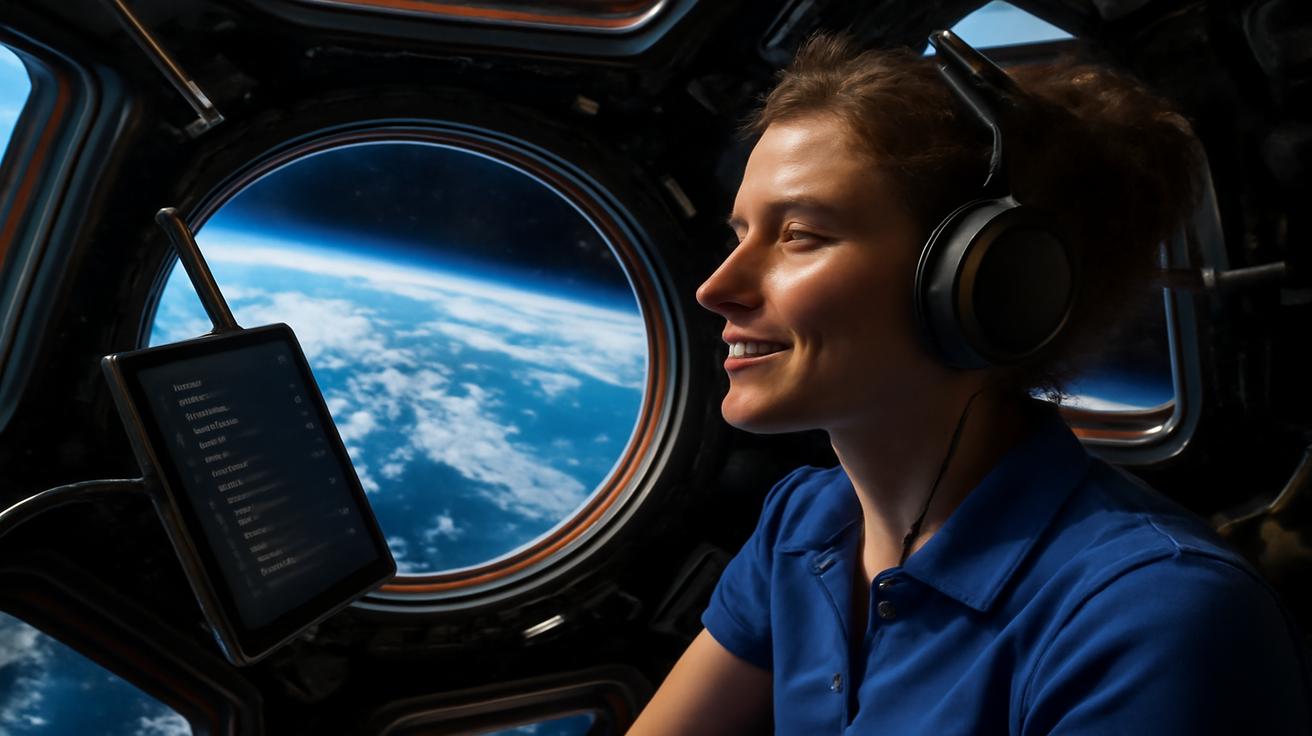
The playlist is already waiting for her when the rocket doors close. Out there, beyond the pale blue halo of Earth, the silence is older than language, older than memory. But inside Sophie Adenot’s headset, the first notes rise—a human heartbeat disguised as melody—and for a moment the roar of engines turns into rhythm. As the ground falls away and gravity loosens its grip, she is not leaving home alone. She is carrying an invisible crew of voices, instruments, and songs that have traveled with her long before she ever strapped into a launch seat.
A soundtrack for leaving the world
Sophie Adenot, test pilot, engineer, and now European Space Agency astronaut, did what many of us secretly do before major life moments: she made a playlist. The difference is that hers isn’t for a road trip, a breakup, or a marathon. It’s for crossing the boundary between atmosphere and infinite night.
Music in space is never just background noise. Up there, in the thin hum of the International Space Station, where days and nights flicker past the window every 90 minutes, a song can be a lifeline. It can call you back to Earth, or let you drift in wonder a little further away. Sophie’s space playlist is a careful, almost tender mix of both.
By the time her spacecraft settles into orbit, the adrenaline is ebbing. The planet below becomes a living map: a swirl of oceans, bronze deserts, and hushed snowfall blinking in faint northern lights. It is here, in that stretch of time when everything feels both impossibly distant and oddly intimate, that her chosen songs begin to do their real work.
She has said in interviews that sound and silence are equally important to her. But when you’re hundreds of kilometers above the ground, sealed inside an aluminum shell, silence can edge into something close to loneliness. Music softens that edge. It reminds her body how to feel, even when gravity is gone.
The quiet physics of a space song
Inside the station, the acoustics are different. Sound doesn’t float, exactly, but the way it wraps around you changes. Fans whir constantly. Pumps murmur. There is no “outside” to step into for a moment of fresh air. Music, piped through elastic headsets or small speakers velcroed to the wall, weaves into that mechanical chorus.
Sophie chooses artists who understand both propulsion and pause. Rhythms that can match the staccato of experiment schedules and system checks, and then dissolve into something spacious and slow as she drifts toward the cupola window after a long day.
Her playlist isn’t about a single genre. It’s about building a bridge: between Toulouse and orbit, between the person she is on Earth and the one she’s still becoming in microgravity. The artists she’s bringing with her are, in a way, her personal ground crew.
Voices from home: French artists in orbit
When your horizon is suddenly the whole planet, “home” becomes a complicated word. For Sophie, a French astronaut flying on a European mission, home lives inside language, accent, and the melodies that filled her early years. Several French artists make up the emotional backbone of her playlist—some widely celebrated, some more intimate, almost secret.
There’s the raspy warmth of Francis Cabrel, guitar lines like sun across a kitchen table. His songs carry slow Sundays and small towns, the kind of everyday Earthly details you don’t see from 400 kilometers up. In orbit, listening to him, she can almost smell coffee and rain on a stone patio.
Then there’s Stromae, the Belgian maestro of pulse and paradox. His tracks fold sharp social observation into irresistible beats. On the station, Stromae is both a workout ally and a mental reset button. Floating tethered to a bike that goes nowhere, Sophie can close her eyes and let the syncopated rhythms drag her back to sweaty, crowded concert halls and street corners humming with life.
She keeps room for Christine and the Queens, too—voice like electric velvet, unafraid to bend gender and genre at will. Under neon synths and tight percussion, there’s a restless searching that mirrors what spaceflight is at its core: a question flung into the dark, waiting to see what answers come back in the radio static.
And in the quieter corners of the playlist, you can find Yann Tiersen, whose piano feels like walking alone at dusk through a half-empty city. Soft, repeating motifs that fit perfectly with the slow ballet of tools, screens, and water droplets drifting like glass beads inside the station. That minimalism echoes the utilitarian beauty of space hardware: every screw and circuit exactly where it needs to be, nothing extra.
Synths, stars, and the echo of the 80s
Space and synthesizers have been dancing partners for decades. Long before Sophie was chosen as an astronaut, the sound of space, in the public imagination, was scored by arpeggiators and electronic swells, from science-fiction soundtracks to early concept albums about distant galaxies.
Her playlist leans into that lineage, not out of nostalgia alone, but because some music simply feels engineered for orbital flight. There’s Jean-Michel Jarre, of course—the French pioneer whose albums painted cosmic landscapes in analog circuitry. Up here, with Earth spinning lazily beneath, the layered synths of his work no longer feel like metaphor. They feel like documentary: carefully arranged, humming, full of blinking light.
Between experiments, when she floats near a porthole and watches sunrise smear across the edge of the world like liquid metal, the atmospheric build of Jarre’s tracks matches what her eyes are seeing. Electronic tones rise and fall like the faint auroras snaking over the polar regions. Machine-made sound, human-made orbit, planet-made light—all woven together into a single sensory thread.
Beside Jarre sit modern heirs to that cosmic sound: artists who grew up with one foot in digital production and one in aching human vulnerability. M83 might swirl into the queue, wave after wave of reverb and synth brass, the kind that makes you want to run across a field at midnight with your arms flung wide. Except here, there is no running. There is only floating, hands tapping gently against handrails as distant thunderclouds blossom silently below.
In those expansive tracks, Sophie can let her thoughts drift to the scale of what she’s doing. How a girl who once looked up from a dark French backyard to find Orion’s belt is now living, for a while, among the same stars that once seemed unreachable. The engine of a rocket and the oscillation of a synthesizer have this in common: both take something tiny—a spark, a signal—and amplify it into a journey.
Gravity for the heart: songs for homesickness
Even astronauts who train for years can’t fully prepare for what it feels like to see the world and not be able to touch it. Below, continents sweep past in 15-minute cameos: the old stone cities of Europe in one glance, the jagged blue teeth of the Andes in the next. You recognize places you’ve known all your life, turned into maps without street names.
On those days when Earth feels especially far away, Sophie reaches for songs that are, unapologetically, about longing. She has admitted that she’s sentimental about certain classic French ballads. Maybe a track by Édith Piaf slips into rotation, her voice thick with grain and ache, stretching across time and atmosphere. It’s hard not to imagine the contrast: Piaf singing of lost love while, outside, continents glow silently in the dark, entire cities held inside a single small curve of light.
She might tap into the grounded poetry of Alain Souchon or the reflective melancholy of Zaz. These artists don’t sing about rockets or galaxies. They sing about buses and beaches and gazes held too long or not long enough. That’s precisely the point. Their songs remind Sophie of the texture of Earth: crowded metro platforms, overheard laughter in cafés, the faint smell of metal and dust in a train carriage at dawn.
There are international voices here as well. Maybe Adele draws breath in her earbuds, a slow piano chord lining up with the curve of a river slipping out of view. Or Sam Cooke croons through decades with a promise that, eventually, change is going to come. It’s difficult to stand at a window in orbit, watching the thin shell of the atmosphere flicker with stray lightning, and not think about the fragility of everything that music tries so hard to defend: love, justice, the simple right to grow old in peace.
The playlist becomes a kind of emotional gravity. When the day’s tasks are done—sample tubes labeled, laptops stowed, cables looped and secured—Sophie can slip on her headphones and feel pulled gently back toward the human scale of things, even as her body continues to fall endlessly around the world.
Beats for the body: training, work, and orbital workouts
Life on the space station is not all windows and wonder. The schedule is dense, and the body is constantly renegotiating its contract with physics. Muscles that no longer have to fight gravity begin to slacken; bones quietly surrender density. To counter this, every astronaut must become a disciplined athlete, strapping into resistance machines and treadmills that tug them back toward an invisible floor.
Music is essential here. Sophie’s playlist needs power—artists who can coax an extra set of reps from tired arms, or another ten minutes of cardio from a brain that would rather be floating in the window bay. Picture her, tethered to the station’s exercise equipment, rubber bands and vacuum cylinders hissing faintly as she curls against non-existent weight. In her ears, Daft Punk kick in, all clipped funk and robotic swagger. The steady 4/4 beat is something reliable in a world where even your own limbs can feel like they’re drifting away from you.
There’s room for David Guetta or Calvin Harris, high-energy pop anthems that feel like flashing club lights even under the flat LED glow of the station’s modules. She might switch to Imagine Dragons or Coldplay when she wants drums that sound like they could punch through atmosphere, the kind of songs that make even the most repetitive motion feel grand, cinematic.
During concentrated work—adjusting a delicate experiment, monitoring a slow chemical reaction—she may pivot to more intricate, word-light tracks: perhaps the mathematical elegance of Aphex Twin at his gentler, more ambient moments, or the glitchy calm of Bonobo. These are songs that don’t demand attention, but reward it if offered. They fit the mental state of someone who must always be alert to subtle anomalies while floating through a maze of cables, switches, and screens.
In the interplay between task and tempo, Sophie builds rhythms into her day that don’t depend on sunrises or sunsets. The station experiences 16 of each every 24 hours; circadian clocks need help. Music—loud, bright, energizing—becomes one of the ways she tells her body, “Now we move. Now we rest.”
Orbits of calm: ambient tracks for the cupola
Every astronaut who has flown to the International Space Station talks about the cupola as though it’s something alive. The panoramic window module, with its multiple portholes overlooking Earth, is often compared to a ship’s prow, or the bay window of an impossible house hung in the sky. From there, Sophie can watch weather systems muscle their way across oceans, see the thin, burnt-orange smear of atmosphere cling stubbornly to the planet’s edge.
For those moments, the playlist slows. She chooses ambient and neoclassical tracks that feel almost transparent. Maybe the piano meditations of Nils Frahm, each note a soft footstep on untouched snow. Or the drifting guitars of Explosions in the Sky, where crescendos bloom slowly, like storm cells.
As Europe spins into view, its cities pricking the dark like scattered embers, she might find herself listening to Max Richter, his strings and subtle electronics wrapping the whole view in a feeling that is hard to name: awe, yes, but also a strange, sharp tenderness. That is where the playlist becomes less about entertainment and more about translation. How do you process the sight of your entire world, fragile and luminous, rushing past beneath your feet? You borrow the language of composers who have spent their lives trying to turn big feelings into sound.
In the cupola, with the lights dimmed and the station’s hum softened by distance, the combination of music and view can be overwhelming. Sophie may catch flashes of her own childhood—nights when she lay in bed listening to the faint muffled sounds of a radio down the hall, staring out at a smaller patch of sky. That girl could never have imagined that one day, the song and the sky would meet like this, hundreds of kilometers above everything she knew.
The playlist as a personal constellation
Every selection on Sophie Adenot’s space playlist is a point of light in a private constellation. The artists don’t just accompany her through orbit; they trace, in their own way, the path that brought her here. Each track is linked to a memory: a first flight in a glider, a grueling exam week, a late-night drive back from an air base, the quiet moment after receiving the call that she had been chosen for ESA’s new astronaut class.
Music, like starlight, travels. It leaves a studio or a bedroom or a rehearsal space and crosses borders, languages, oceans. Now, with Sophie as its astronaut courier, it crosses something more. When she presses play in orbit, she completes a loop that began on Earth. Somewhere, a kid in a small apartment is listening to the same track through tangled headphones, staring at a ceiling splashed with city light. They have no idea that the same song is bouncing gently around a high-tech outpost above them, keeping another human tethered to herself amid the vacuum.
Which artists, exactly, are riding along with her will evolve over time—playlists are living things, after all—but the roles they play are clear. Some keep her focused. Some let her grieve the temporary loss of being able to stand barefoot on grass. Some amplify the staggering beauty outside the window. All of them whisper the same quiet, crucial message: wherever you go, you’re still human. You still feel. You still belong to the little blue world spinning below.
In that sense, Sophie’s playlist is more than entertainment; it is a compact portrait of humanity’s relationship with exploration. We build machines to take us farther than our bodies can go, and then we fill them with stories, songs, and small reminders that we are, at heart, soft creatures built for a planet with sky and weather and birds. We bring our art with us so we don’t forget what we’re doing this for.
There is something profoundly moving about the idea of a single astronaut, drifting in the dark, earbuds in, listening to a track recorded in a crowded studio years ago. As the bassline unfolds, some city street where it was mixed is passing far below, just out of sight. The distance between studio and station is measured in altitude, but the connection is intimate, immediate.
One day, Sophie will come back. She’ll feel the weight of her body return, suddenly and completely. She’ll stand outside at night, look up, and maybe hear, echoing in the back of her mind, the same artists who watched the world with her from above. The songs that once made the station feel like home will now make Earth feel newly strange and miraculous.
And somewhere, perhaps years from now, another astronaut will be packing for orbit, scrolling through potential tracks. Maybe they’ll add a few of Sophie’s favorites, passing them forward like a torch. Human voices, woven into data, riding rockets, crossing night. A playlist is a small thing, but in the great quiet of space, small things can carry an entire world.
Key moods from Sophie Adenot’s space playlist
| Mood | Typical Moments in Orbit | Representative Artists |
| Homesick & reflective | Evenings after work, messages from family, looking down at Europe | Francis Cabrel, Édith Piaf, Zaz |
| Focused & technical | Experiments, delicate procedures, data monitoring | Bonobo, Aphex Twin (ambient), Yann Tiersen |
| Workout & energy | Daily exercise sessions, maintenance tasks, reconfiguration days | Daft Punk, Stromae, David Guetta |
| Cosmic awe | Watching auroras and sunrises from the cupola | Jean-Michel Jarre, M83, Max Richter |
| Late-night drifting | Quiet moments before sleep, floating in darkened modules | Nils Frahm, Explosions in the Sky, Christine and the Queens |
FAQ: Sophie Adenot’s space playlist
Do astronauts really listen to music in space?
Yes. Astronauts often bring personal music collections and also have access to digital libraries on board. Music helps regulate mood, fight stress, mark time, and create a sense of personal space in a very confined environment.
How does Sophie Adenot choose which artists to take into orbit?
While the precise track list is personal, her choices reflect key needs in orbit: energetic songs for workouts and demanding tasks, calm and ambient music for looking out the window or winding down, and emotionally resonant tracks from French and international artists that remind her of home and her path to space.
Can sound travel outside the spacecraft?
No. Space is a near vacuum, and sound needs a medium like air or water to travel. All the music astronauts hear is inside the spacecraft, through air, speakers, or headphones. Outside, in a spacewalk, the only sounds they hear are transmitted through their suit and communications system.
Do space agencies limit what music astronauts can bring?
There is no strict artistic censorship for personal listening, but there are practical limits: storage space, file formats, and bandwidth. Astronauts usually prepare playlists in advance, and mission control can sometimes uplink new tracks during a mission if resources allow.
Has music ever been played live from space?
Yes. Several astronauts have taken instruments with them—guitars, flutes, even a keyboard—and played live in orbit. These performances are often shared with audiences on Earth, underlining how strongly music and exploration are intertwined.
Why are French artists so important in Sophie Adenot’s playlist?
As a French astronaut, language and cultural memory are powerful anchors for Sophie. French artists carry the voices, stories, and sounds of the world she grew up in, providing emotional continuity between her life on Earth and her time in orbit.
Will Sophie Adenot’s exact playlist ever be made public?
Details may emerge through interviews and mission coverage, but a personal playlist is just that—personal. What we can glimpse are the themes: a blend of French chanson, electronic and synth-driven music, international pop, and contemplative ambient tracks, all chosen to keep a human heart steady while the world turns silently below.