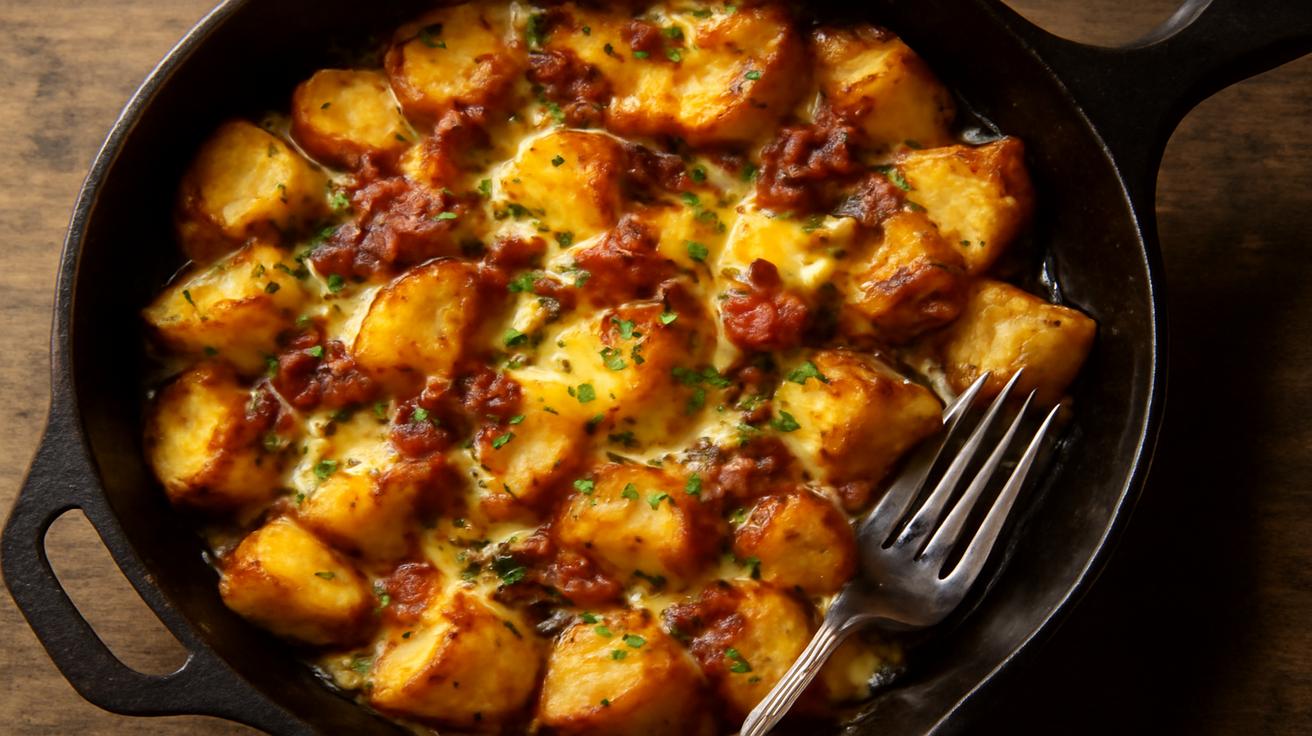
The skillet hit the burner with a soft clang, and the kitchen shifted. Outside, late light slipped through the blinds in warm stripes, but in here everything narrowed to the smell of butter, the sizzle of onions, and a little pile of potatoes waiting to become something bigger than the sum of its humble parts. You’d walked in hungry, maybe just thinking about a baked potato—something simple and familiar. But tonight, we’re going a different way. Tonight is about Mississippi Mud Potatoes: a one-pan, bubbling, cheese-draped, bacon-studded wonder that eats like a loaded baked potato that went off on a joyful, slightly rebellious road trip.
What Exactly Are Mississippi Mud Potatoes?
If you’ve never heard the name before, it sounds a little mysterious—like something you’d discover at a church potluck along the back wall, the casserole dish already half scraped clean by the time you get there. Mississippi Mud Potatoes are one of those dishes that live in the overlapping world of comfort food and community cooking. It’s familiar yet fresh, straightforward yet over-the-top in all the right ways.
At its simplest, it’s a one-pan potato bake: diced potatoes tossed with butter, sour cream or creamy dressing, cheese, bacon, and whatever extra flavors you feel like throwing in. The “mud” part isn’t about mess; it’s about richness. Think of a loaded baked potato that melted down into a skillet—creamy, smoky, salty, and crisp around the edges. Every bite is soft in the middle, crackling slightly on top, laced with pockets of cheese, green onion, and bacon.
In the way of many great Southern-inspired recipes, there’s no one official version. Families tweak it, stretch it, and fold it around what they have on hand. One household swears by using ranch dressing instead of sour cream. Another insists on smoked paprika. Someone in your friend group probably insists on adding jalapeños “for personality.” That’s part of the beauty: Mississippi Mud Potatoes are more of a canvas than a law.
The Story in the Skillet
Picture this: a well-used cast-iron skillet, blackened by years of Sunday breakfasts and weeknight dinners. It warms under your hand as you swirl in a spoonful of butter. The first fragrance hits—a nutty, warm promise that something good is on its way. Then come the potatoes, cut into small, uneven cubes. They fall in like tiny white stones in a shallow pond, the butter hissing in surprise.
There’s a moment when the kitchen goes a little quiet except for that sound. No notifications, no to-do lists—just the low, patient sear of starch meeting heat. You stir slowly, watching edges turn translucent, then golden, then spotted with crispness. Bacon waits nearby on a paper towel, already cooked, glistening proudly as if it knows it’s about to become a co-star. Shredded cheese sits in a loose pile, a snowy drift of cheddar or Colby Jack that will soon collapse into molten ribbons.
This is where Mississippi Mud Potatoes really differ from the classic loaded baked potato. You’re not babysitting a single big potato in the oven, hoping it’s cooked evenly through. You’re building something communal—every potato cube a potential carrier for flavor, every stir an act of generosity. Everything cooks together, melts together, and comes out in one glorious, shareable pan.
Building the Base: Potatoes, Fat, and Fire
Like any good story, Mississippi Mud Potatoes start with a foundation. The potato itself matters more than you might think. Russets will give you that fluffy interior and soft crumble; Yukon Golds bring a buttery richness even before you add anything else. Some cooks go half-and-half for contrast—a little rustic, a little refined.
You want to dice them into small cubes, somewhere between the size of a sugar cube and the tip of your thumb. Too small and they disappear into mush; too big and you’re back to waiting like you would for a baked potato. Those little cubes are what make this dish cook quickly and soak up everything around them: butter, seasoning, smoky drippings.
Then there’s the fat. Butter alone gives a deep, browned flavor and a classic comfort-food aroma. Some people stir in a bit of bacon grease or neutral oil to help prevent burning, but butter is the soul. As it foams and settles, it carries spices—salt, pepper, garlic powder, maybe a pinch of onion powder—around every surface of every potato cube. The pan becomes its own mini ecosystem, where every ingredient touches every other, constantly.
The Loaded Baked Potato, Reimagined
You know the ritual of a loaded baked potato: crack open the steaming shell, fluff the inside with a fork, add butter until it glistens, then a scoop of sour cream, then shredded cheese, then bacon bits, then chives. Each topping lands like a layer in a story, stacked and visible.
Mississippi Mud Potatoes flip that script. Instead of building on top, you fold everything right into the dish. Bacon doesn’t simply crown the potato—it gets tucked deep into the mix so that little crispy pieces surprise you in almost every bite. Cheese doesn’t just sit on the surface—it threads through the whole pan in melty pockets.
And then there’s the creamy element. Some cooks reach for sour cream, others for a tangy, herby ranch dressing, still others for mayonnaise or a mix. Whatever you choose, it doesn’t just sit on top like a dollop; it gets stirred in, lightly coating every potato until the whole thing looks like it’s wearing a velvet jacket. As it bakes or finishes on the stove, that cream base cooks into something thicker and more unified—like the sauce you didn’t realize you needed.
Layering Flavors: Bacon, Cheese, and a Little Green
When the potatoes are nearly tender and the edges show their first signs of crisping, that’s when you start the real fun. You crumble bacon into the pan, scattering it like you’re throwing confetti. A handful of shredded cheese follows, then maybe another. You watch the strands collapse, go shiny, and finally disappear between the potatoes as you stir.
A spoonful of sour cream or a slick of ranch dressing joins the party, turning the whole skillet glossy and thick. This is where the dish earns its “mud” name. It looks like a delicious, savory landslide: potatoes sliding over each other, smoothed by cream, caught in a net of melted cheese.
Just when it threatens to become too rich, too heavy, you add green onion or chives. Their brightness cuts through like a squeeze of lime on a taco or lemon on fish. You smell that mild sharpness rise with the steam. Some cooks add a bit of fresh parsley, others stick with the onion, but either way, that green note brings the whole thing back into balance.
A One-Pan Hero for Busy Nights
Part of what makes Mississippi Mud Potatoes so irresistible isn’t just the flavor—it’s how easy it is to get from hungry to “oh, wow” in not much time and with only one main pan to wash. You’re not juggling a baking potato here, a skillet of bacon there, and a cutting board full of toppings you only use once. Everything collapses into a single, satisfying equation.
The method is simple. While the oven preheats (if you’re choosing to bake), you dice potatoes. While those start to brown in a skillet with butter, you cook bacon in another pan or in the oven. Then you mix everything together, slide the skillet into the oven if you want deeper browning and even cooking, and walk away for a bit. When you come back, the kitchen smells like a roadside diner in the best possible way—only you’re still in your socks, and there’s no line for a table.
What makes this dish ideal for weeknights is its flexibility. Have smoked sausage instead of bacon? Slice it thin and toss it in. Got a handful of leftover rotisserie chicken? Shred it and fold it through for a protein-packed dinner. Have half a bell pepper about to give up in the crisper drawer? Dice it in with the potatoes for sweetness and color.
Mississippi Mud Potatoes vs. Loaded Baked Potatoes
If you’re wondering whether this dish truly rivals a loaded baked potato, it might help to see them side by side. Think of it like two siblings with the same roots but very different personalities:
| Feature | Loaded Baked Potato | Mississippi Mud Potatoes |
| Cooking Method | Whole potato baked, then topped | Diced potatoes cooked and mixed in one pan |
| Texture | Fluffy center, intact skin | Crispy edges, creamy coating, melty pockets |
| Topping Style | Ingredients layered on top | Ingredients mixed through every bite |
| Best For | Individual servings | Sharing, potlucks, family-style meals |
| Make-Ahead Potential | Limited—best fresh | High—can be prepped and baked later |
Both are comforting. Both deliver the holy trinity of potato, cheese, and bacon. But Mississippi Mud Potatoes weave those elements together in a way that feels a bit more generous, a bit more shareable—like a potluck dish that somehow tastes of neighbors and late-night stories.
How to Make Them Your Own
Once you’ve made Mississippi Mud Potatoes once or twice, you start to realize how forgiving and playful the recipe can be. It’s less a strict formula and more a roadmap through familiar territory, with plenty of scenic routes available.
You might start classic: russet potatoes, butter, salt, pepper, bacon, cheddar, sour cream, green onions. Then, the next time, curiosity kicks in. What happens if you add a spoonful of smoked paprika or chipotle powder? Suddenly, there’s a campfire note, a whisper of barbecue drifting through the steam. What if you swap cheddar for pepper jack? Now you’ve got a mild heat that lingers, a bit of tingle on the tongue.
For some, this dish slowly morphs into a full meal: toss in cooked ground beef or crumbled breakfast sausage, a handful of corn kernels, maybe some black beans, and you’re veering toward a Tex-Mex skillet. Others lean in a different direction, adding sautéed mushrooms and caramelized onions for something a little earthier, deeper, almost steakhouse-adjacent.
There’s also the question of crispness. Some cooks like to finish the dish under the broiler for a few minutes, letting the top layer of cheese form a golden, bubbling crust. Others keep it gentler, low and slow, for a softer spoonful that could almost be called a casserole. Both options have their charms; one crackles, the other melts.
A Rough Blueprint for Your First Batch
You don’t need exact measurements to get started, but a simple blueprint can calm the nerves if this is your first time wandering off the baked potato path. Think in loose handfuls and spoonfuls rather than exact grams or ounces:
- Potatoes: enough to mostly fill your skillet in an even layer—usually 4–6 medium potatoes, diced.
- Fat: 3–4 tablespoons of butter to start, with the option to add a bit more if the pan looks dry.
- Creaminess: about 1/2 to 1 cup of sour cream, ranch dressing, or a mix of the two.
- Cheese: at least 1 cup shredded, plus extra for topping if you love that stretchy, gooey pull.
- Bacon: 4–8 slices, cooked and crumbled, depending on how indulgent you’re feeling.
- Seasonings: salt, black pepper, garlic powder, onion powder, and any favorite spices.
- Fresh finish: 2–3 sliced green onions or a small handful of chopped chives.
From there, you just listen to the skillet. If it’s hissing angrily, lower the heat. If the potatoes look pale and stubborn, give them more time. When a fork slides in easily and the edges pick up that first alluring crisp, you know you’re ready to fold in the creamy elements and cheese, then give it all a final kiss of heat.
Serving Moments That Stay With You
Dishes like this have a way of anchoring themselves to memories. Maybe you set the skillet in the center of the table on a cold night, steam rising in thick clouds as everyone leans in with spoons and plates. Someone says, “What is that?” with a mixture of suspicion and delight. You shrug. “Mississippi Mud Potatoes. Trust me.”
The first scoop comes out slow, almost reluctant, stretching strings of cheese that refuse to let go. Potatoes tumble over each other, leaving behind little bacon bits and streaks of melted cheddar. On the plate, it doesn’t look fancy. It looks like honesty—like that kind of food that doesn’t try to pose, doesn’t need a garnish to prove its worth.
It pairs easily with almost anything: roast chicken, grilled steak, seared fish, or just a big bowl of leafy greens on the side. On some nights, it’s the main event, backed up by a couple of fried eggs or a pile of sautéed greens. On others, it’s the side that steals the show from whatever polite protein you planned.
Later, as the pan cools on the stovetop, someone might wander back through the kitchen and take a quiet forkful straight from the skillet, thinking no one’s watching. That’s how you know a dish has done its job—when it lingers, when it pulls people back for just one more bite.
Frequently Asked Questions
Can I make Mississippi Mud Potatoes ahead of time?
Yes. You can par-cook the diced potatoes until just tender, mix in the bacon, cheese, and creamy elements, then transfer to a baking dish or leave in the skillet. Cover and refrigerate for up to a day. When ready to serve, bake until hot and bubbly, adding a fresh sprinkle of cheese and green onion at the end.
What kind of potatoes work best?
Russets give a fluffy, soft interior and soak up flavors beautifully. Yukon Golds hold their shape better and taste naturally buttery. Mixing the two can give you a nice balance of tender and structured.
Can I make a lighter version?
You can lighten the dish by using less butter, swapping sour cream for Greek yogurt, choosing turkey bacon or lean ham, and reducing the amount of cheese. The dish will be less rich but still comforting, especially if you lean on herbs and spices for extra flavor.
Do I need a cast-iron skillet?
Cast iron is ideal because it heats evenly and can go from stove to oven, but it’s not mandatory. Any oven-safe skillet or baking dish will work. If you cook the potatoes on the stovetop in a nonstick pan, you can always transfer them to a baking dish for the final bake.
How do I reheat leftovers?
For best texture, reheat in the oven at a moderate temperature until hot, stirring once or twice to help everything warm evenly. You can use the microwave in a pinch, but a quick pass under the broiler at the end will help revive some of the crisp edges.
Can I add meat and make it a full meal?
Absolutely. Cooked chicken, sausage, ham, or even ground beef can be folded in with the potatoes and cheese. Just make sure any added meat is fully cooked and well-seasoned before it goes into the skillet so it doesn’t water down the flavor.
Is this dish kid-friendly?
Most kids love the creamy, cheesy potato base and bacon’s familiar saltiness. If you’re cooking for sensitive palates, skip spicy additions at first. Later, you can offer hot sauce, jalapeños, or chili flakes on the side so each person can dial up the heat as they like.