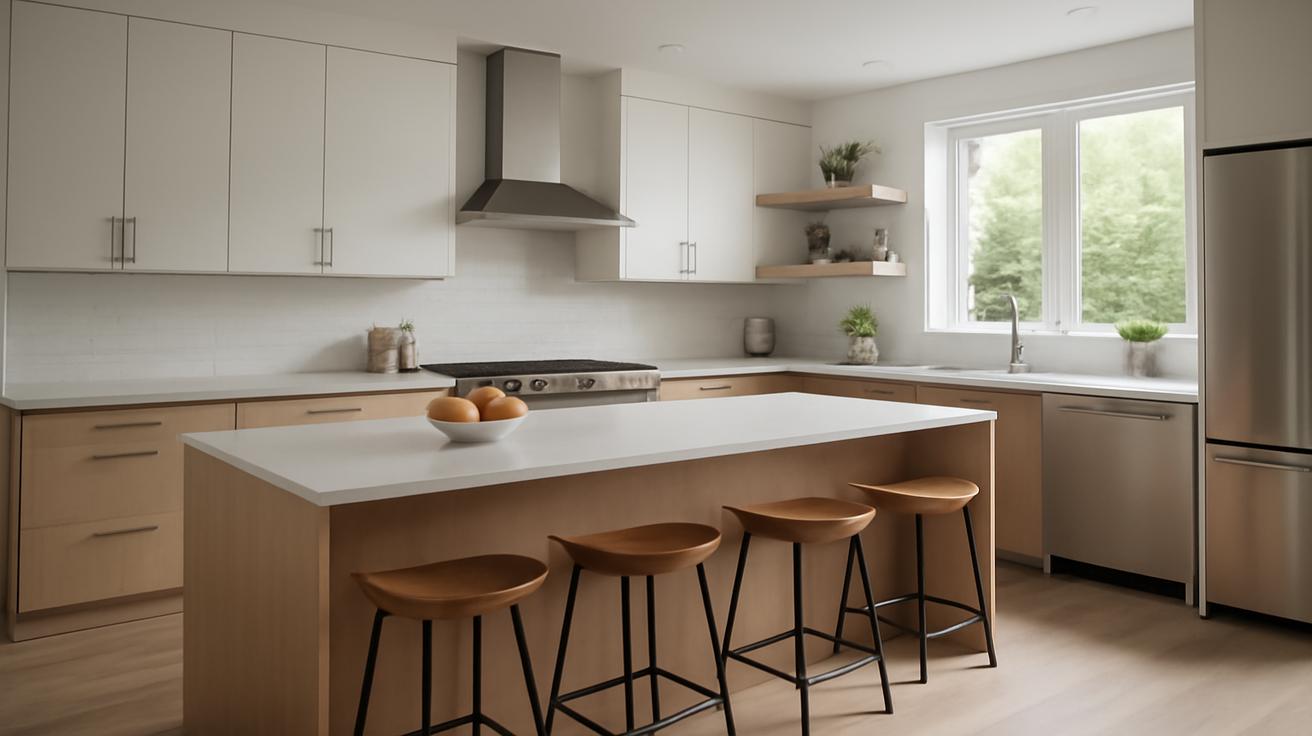
The first thing you notice is the quiet. No clanging stools, no clumsy traffic jam around a hulking block of stone in the center of the room. Just light, spilling across a long, elegant surface that seems to grow out of the wall and stretch toward the garden like a calm horizon line. You can walk straight through the kitchen now—no detours, no sharp corners to clip your hip on, no “excuse me” loop around an island that suddenly feels like a relic from another era.
The moment we fell out of love with kitchen islands
For nearly two decades, the kitchen island was the undisputed hero of the modern home. It hosted children’s homework, after-work drinks, holiday buffets, and Sunday pancakes. It was where laptops opened, dough was kneaded, and life, we insisted, “happened.”
But somewhere between 2020 and 2024, that love affair started to fracture. Our homes had to shapeshift—into offices, classrooms, sanctuaries—and the island revealed its darker side. It chopped rooms in half. It blocked sightlines. It anchored us when we needed fluidity. It collected clutter like a magnet: unopened mail, half-finished craft projects, crumb trails, abandoned mugs.
Designers noticed something else too: the island had become visually loud. Big block in the middle. Heavy stone on top, thick cabinetry below, pendant lights overhead shouting, “Look at me!” in an era when many of us were craving calm, softness, and subtlety.
So, as 2026 approaches, a quiet revolution has already started slipping into renovated apartments and new builds. The big central block is leaving. In its place? A new centerpiece that’s more practical, more elegant, and somehow makes the entire room exhale.
The new star: the kitchen peninsula & integrated social counter
The trend that’s taking over from the kitchen island isn’t a single rigid object. It’s more like a family of related ideas—peninsulas, wall-connected counters, and “social bars” that skim along windows or face living spaces. They’re all variations on one theme: anchored, not obstructive.
Imagine your main worktop running along a wall. Instead of stopping abruptly, it curls outward into the room—like the beginning of a gentle wave. It doesn’t stand in the center demanding attention. It quietly defines the edge of the kitchen while still allowing space to move freely around it.
Or picture a slim, beautifully detailed counter that extends out from a wall of cabinetry, parallel to your living space. It’s just wide enough for laptops, coffee cups, a shared plate of bread and olives. It faces the conversation, but doesn’t cut the room in half. This is the new social heart of the kitchen: part table, part bar, part quiet desk.
These new forms still offer a place to gather, sit, cook, work, and linger. But they answer a question that islands never really solved: how do we create connection and function without sacrificing flow?
From obstacle to invitation
Where the island once acted like a traffic cone in the middle of the room, these new counters behave like open arms. There’s usually just one way into the traditional U-shaped kitchen with an island: you squeeze around one side. With a peninsula or integrated social counter, the room feels more intuitive. You naturally drift toward the work zone, not crash into the furniture blocking it.
There’s a small but astonishing shift that happens when you remove something from the middle of a room: your shoulders drop. Light travels farther. Conversations feel less shouted across a block and more shared around a surface that’s gently oriented toward whoever’s speaking.
Why 2026 belongs to anchored counters, not oversized blocks
Trends rarely shift because something suddenly becomes unfashionable. They change when enough people quietly want something different from their homes. And right now, we’re asking our kitchens to be softer and smarter, not just bigger.
1. They make small and medium spaces feel luxuriously open
Most of us don’t live in cavernous suburban homes with endless square footage. In city apartments and compact townhouses, an island can feel like dropping a boulder into a stream—it interrupts everything. A peninsula or slim social counter, attached at one end, makes better use of space you already have.
By connecting to a wall or cabinetry, these new designs open up the center of the room. That center becomes a generous walkway, a play space for kids, a path straight out to a balcony or garden. You feel the whole room at once, instead of navigating around a fixed block.
2. They carve clear roles without hard borders
One of the quiet triumphs of the island was its ability to zone the home: “this side is kitchen, that side is living.” The 2026 versions keep this zoning, but soften the lines. A peninsula or integrated counter suggests boundary without building a wall.
You still know where the cooking happens versus where the lounging does. But because these surfaces hug a wall or cantilever outward without dominating the middle, visual and physical flow remain uninterrupted. Rooms feel connected, yet gently defined—like different currents within the same river.
3. They’re multitaskers in an age of blended life
If the early-2010s island was about entertaining and open-plan bravado, the new counter is about quiet everyday usefulness. The same surface that holds a chopping board in the morning can host a Zoom meeting at noon and a board game at night, without the formality of sitting “at the island.”
Designers are building in power outlets, hidden charging strips, and niche shelves into these anchored surfaces. Instead of clutter piling onto a broad island top, storage tucks neatly under or alongside, often within arm’s reach of both kitchen and living room. The piece becomes a natural link between cooking, working, and relaxing rather than a stage for visual chaos.
The sensory shift: how these new kitchens actually feel
Numbers and layouts can only tell part of the story. The real revolution is sensory—how your body and brain experience the room.
Lighter on the eyes, softer on the mind
Islands are visually heavy by design. A big block in the middle demands attention, even when all you want is a quiet cup of coffee. The new trend leans into lighter structures: thinner countertops, open leg frames instead of chunky bases, surfaces that float rather than stomp.
With less mass in the middle, your sightline stretches farther. Your eye moves from floor to window to tree outside without slamming into a block of stone. In the evenings, under softer light, the anchored counter becomes a line of warmth rather than a center-stage object. You feel less like you’re orbiting furniture and more like you’re moving within a single, cohesive space.
Flow you can feel under your feet
Walk into a kitchen without an island and notice what your body does. You drift. You meander. You move where the light is, where the conversation is. Children race through. Pets circle your feet. Nothing feels like a dead end.
With a wall-connected counter, there’s usually one generous, obvious path from every entry point to the heart of the room. Movement feels natural, not negotiated. In homes where accessibility matters—wheelchairs, walkers, strollers—this isn’t just a design preference; it’s a transformation of possibility.
What’s replacing islands in real homes: three emerging layouts
You can already see the 2026 trend quietly showing up in magazines, showrooms, and renovation plans. Here’s how it’s taking shape in real spaces.
| Layout Type | Best For | Key Benefits |
|---|---|---|
| Wall-anchored peninsula | Small to mid-size open-plan homes | Zoning without blocking; extra storage; generous counter space |
| Slim social counter | Apartments, long narrow spaces | Visual lightness; flexible seating; doubles as desk or bar |
| Hybrid table-extension | Families, multi-use rooms | Kitchen+dining in one; warm, informal feel; easy to reconfigure |
1. The wall-anchored peninsula
This is the spiritual successor to the island, but smarter. The countertop extends from your main kitchen run at a right angle or gentle curve, creating an “L” or partial “U” without occupying the center of the room. Underneath you might find drawers facing the kitchen on one side, and open shelves or stools facing the living room on the other.
People can sit along the outer edge, facing into the space, joining the conversation without standing in your way. You can chop vegetables with one hand and reach for a glass tucked into the living-room-facing shelf with the other. It feels like one piece of furniture gracefully serving two worlds.
2. The slim social counter
Here, the focus is less on heavy-duty cooking and more on everyday living. A narrow, elongated surface runs along a wall or window, usually deeper than a shelf but slimmer than a traditional island. A couple of stools tuck underneath. A laptop opens. A candle flickers. You lean your elbows on it at midnight and talk to someone you love.
Because it’s visually light and often supported by slender legs or a minimal bracket, the room reads as open and airy. In smaller apartments, this might be the only “table” you need—breakfast spot, remote office, cocktail bar, and quiet corner all in one line.
3. The hybrid table-extension
This is where the kitchen counter simply keeps going, but slowly transforms into a table. The material might shift—from stone to wood, from thick to thin. Cabinets underneath give way to open legs and chairs. The message is clear: work zone becomes gathering zone, without a hard break.
In families, this layout is gold. Children can sit at the table-extension doing homework while you cook, sliding their projects safely away from splashes but close enough for help. Dinner can move from stove to table with a short turn of the body. The rituals of “setting the table” and “clearing the counter” start to overlap in gentle, practical ways.
Materials and details: the elegance of less
The 2026 kitchen isn’t shouting. It’s whispering in textures, edges, and proportions. And these new anchored counters are where that whisper becomes most audible.
Slimmer, softer, more human
Where islands often flaunted thick stone slabs and chunky edges, the new counters embrace slimmer profiles. Think 2-centimeter stone, rounded corners, beveled edges your hand naturally wants to follow. Seats are usually a notch lower or softer, more like café chairs than bar thrones. You don’t climb onto this surface; you settle into it.
Timber, linen-textured laminates, honed stone, even tactile ceramics are making a comeback. The effect is less “show kitchen” and more “place you want to sit barefoot with a book and a cup of tea.” It’s elegance, yes—but an elegance that invites, not intimidates.
Hidden utility, visible calm
Power outlets slip into the underside of ledges. Wireless chargers hide beneath thin countertop sections. Shallow drawers hold pens, notepads, device chargers, and all the other little pieces of 21st-century life that once sprawled visibly across the island.
This is where the new trend quietly solves one of the greatest sins of the old one: clutter. When the central block disappears, so does the temptation to drop everything on it. The anchored counter, with its more deliberate size and built-in organization, becomes a surface you respect rather than bury.
Is it really goodbye to kitchen islands?
Not everywhere. Not all at once. Some large homes will still benefit from a beautifully composed, well-proportioned island. Some cooks truly love a central stage, and some floorplans almost ask for it. But the cultural center of gravity is shifting.
What’s dying is not the island as an object, but the assumption that it is the pinnacle—something every “good” kitchen must have. In its place is a more thoughtful question: What does this particular room, this particular life, actually need in the middle—or not in the middle—of it?
For many of us, the answer is a surface that feels like an extension of the architecture, not an interruption. A piece of the room that connects rather than divides. Somewhere you can work, talk, cook, and rest without navigating around a monolith.
As 2026 approaches, more homeowners are choosing that option. The big central block is quietly wheeled offstage. In its place, a slimmer, calmer, more adaptable character steps out from the walls and windows. Not shouting, not demanding applause—just doing its job with a quiet kind of grace.
You may not notice the trend at first glance. You’ll feel it instead: in the ease of your movement, the softness of the room, the way your dinner conversations seem to flow a little easier when there’s nothing in the middle standing between you.
FAQ
Are kitchen islands completely going out of style?
Not entirely. Islands still work beautifully in larger homes with generous floor space. What’s changing is the idea that every kitchen must have one. In 2026, many designers are favoring peninsulas and integrated social counters for their better flow, flexibility, and lighter visual impact.
Is a peninsula more practical than an island?
In small and medium-sized spaces, often yes. A peninsula uses wall space efficiently, provides similar counter area and storage, and leaves the center of the room open. That usually means easier movement, clearer sightlines, and fewer awkward traffic jams.
Can these new counters still be used for seating and entertaining?
Absolutely. Most peninsulas, social counters, and hybrid table-extensions are designed with stools or chairs in mind. You can still gather for drinks, breakfast, or casual dinners—just without a bulky block in the middle of the room.
Will removing an island hurt my home’s resale value?
Buyers are increasingly drawn to homes that feel open, calm, and flexible. If your replacement adds smart storage, comfortable seating, and better flow, it’s more likely to help than hurt. A well-designed peninsula or integrated counter is now seen as just as desirable as an island—sometimes more.
Can I transform my existing island into this 2026 style?
In many cases, yes. A designer or contractor can often reconfigure an island into a peninsula, slim it down, or connect it to a wall or cabinet run. You might also replace part of the island with a lighter table-extension or social counter, preserving function while unlocking more openness and elegance.