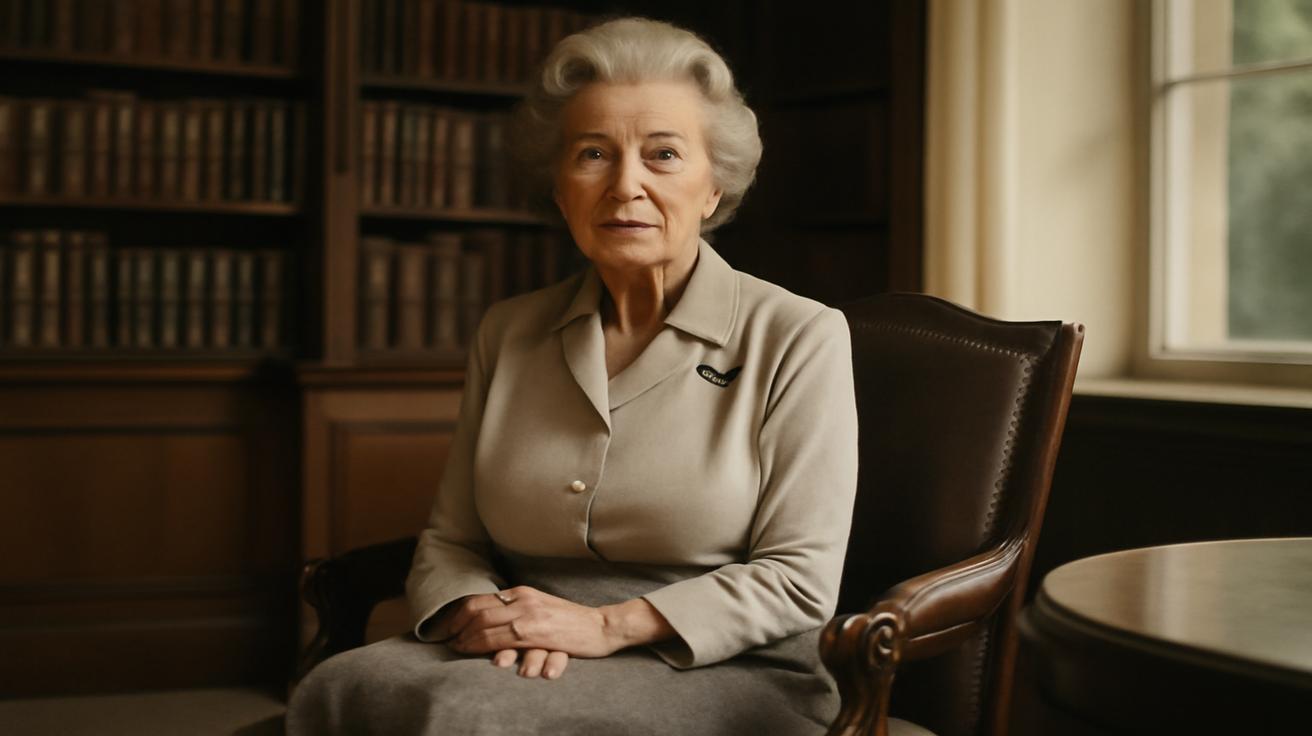
On a damp November evening in 1980, in a quiet room in Kensington Palace, an elderly woman with bright, curious eyes sat by a window and watched the London drizzle turn streetlights into halos. Her hearing was fading, her step unsteady, but her memory still moved like quicksilver across almost a century of upheaval. She remembered horse-drawn carriages—and jet planes. Drawing rooms lit by gas—and cities lit up by neon. A grandmother who wore black for forty years—and the first moon landing on television.
Her name was Princess Alice, Countess of Athlone, and she was Queen Victoria’s granddaughter who lived long enough to see punk rock flicker across British television screens. In a royal family obsessed with the young, the glamorous, and the scandalous, this woman—born in 1883, gone in 1981—became a kind of living bridge across vanished worlds. History walked around inside her until she was almost one hundred.
The Last Victorian Princess
If you had walked into the nursery at Windsor Castle in February 1883, you might have seen a new baby bundled in white, barely bigger than her nurse’s forearm. Outside the windows, the royal grounds lay cold and still, winter light slanting across frost-laced lawns. Inside, the baby’s grandmother—small, plump, and perpetually in black—hovered like a storm cloud and a sunbeam in one: Queen Victoria, Empress of India, sovereign over more than a quarter of the world’s population.
The child was Princess Alice Mary Victoria Augusta Pauline. Even her name sounded like a family tree: “Alice” for her mother, “Victoria” for the grandmother who ruled an empire, other names weaving in relatives from the German courts. Her parents were Prince Leopold, Duke of Albany—Queen Victoria’s youngest son—and his wife, Princess Helena of Waldeck and Pyrmont. For a brief, golden moment it looked like a fairly ordinary royal childhood lay ahead.
Then the curse of the family blood appeared. Prince Leopold was a haemophiliac. A minor fall that would have left another man with a bruise could threaten his life. Just a year after Alice’s birth, he slipped, hit his head in Cannes, and died at thirty. Alice would grow up as a posthumous daughter, her father present only in stories, portraits, and the melancholy strain that ran quietly through family talk.
Still, for a child in the 1880s, her world looked almost securely unshakable. The British Empire blazed red on the map. Trains stitched the countryside together; London glowed with gaslight and thick coal smoke. And in the background of everything, there was always “Grandmama” Victoria, solid as a mountain and just as unmovable. Alice’s earliest memories were steeped in the smells and textures of late Victorian life: polish on heavy oak furniture, wool and silk rustling in endless corridors, wet horse on cold mornings, hot candle wax in winter evenings. She was a princess of the old world, before that world cracked.
A Princess Between Worlds
From an early age, Princess Alice learned what it meant to be both visible and invisible. In the formal photographs of the era, she appears as a carefully arranged figure in starched dresses, expression serious beyond her years, hair brushed into compliance. Yet the real girl behind those eyes was quick, observant, sometimes mischievous. She loved music, conversation, and—unfashionably for some royals—work.
Her family was at once British and German. Like many of Victoria’s descendants, their lives zigzagged across borders, languages, and dynasties. German cousins stayed in English palaces; English relatives married into minor German principalities. As a child, Alice heard English and German as easily as nursery rhymes. She grew up with the unsettling sense that the world was not just one country but a network of interconnected drawing rooms and palaces, stitched together by blood and occasional hostility.
By the time she was a young woman, the era of horse-drawn state carriages was already flickering at the edges. Motor cars snorted like impatient animals along London streets. Telegraph wires sagged between poles, carrying news far faster than horses ever could. Alice, with her earnest face and clear eyes, watched the modern world muscle its way through the heavy velvet curtains of tradition.
In 1904, she married into yet another branch of the tangled tree: Prince Alexander of Teck, a member of the extended royal family who would later, in one of history’s tidier ironies, shed his German title and become Earl of Athlone. They were not one of those tragic, mismatched royal couples you read about in dusty biographies. By all accounts they were affectionate, companionable, quietly devoted to one another. They shared not only a life but a sensibility: a sense of duty that was less about pomp than about being useful.
From Drawing Rooms to Front Lines
War arrived like a thunderclap in a stuffy room. In 1914, Europe’s tightly laced world of royal cousins and ceremonial uniforms exploded. Suddenly the Teck and Athlone branches, with their German roots and English loyalties, became tangled in suspicion and politics. Anti-German feeling on British streets was fierce and sometimes violent; German-sounding names drew anger. It was anything but abstract for Alice.
The family made a decision that still sounds astonishingly practical: they gave up their German titles. Prince Alexander of Teck became simply the Earl of Athlone. Princess Alice became the Countess of Athlone. A princess, stepping sideways into an earl’s wife—on paper it looked like a demotion. In reality, it was a deft move into safer territory, closer to the people they served.
War stripped away some of the ornate surfaces of royal life. Alice threw herself into work that carried real weight: supporting hospitals, visiting wounded soldiers, engaging in the kinds of quiet tasks that never make headlines but hold societies together when they’re under strain. Imagine her, in a plain but well-cut coat, walking through wards that smelled of carbolic and blood, bending close to men whose faces were half-swallowed by bandages, offering the small mercies of presence: a hand squeezed, a letter carried home, a joke at the right moment.
She was no nurse fairy-tale; she was a woman with a lifetime of etiquette and court training, learning to use that discipline to steady herself amid horror. The old corridors of palaces had prepared her for something, after all: how to keep moving, how to keep talking, when grief hung in the air like a storm.
Across an Empire of Contradictions
Between the two world wars, Alice’s life stretched outward across the map. The imperial world into which she had been born was changing, but still alive. In 1923, her husband was appointed Governor-General of South Africa, and Alice found herself transplanted from foggy London to the bright, hard light of the southern hemisphere.
Here was a different sensory world altogether: dust and jacaranda blossoms instead of London rain; cicadas humming instead of carriage wheels on cobblestones; the tang of eucalyptus and sun-baked earth. As viceregal consort, she was at the center of a colonial society already vibrating with racial tension and political complexity. Yet she tried, in ways limited and shaped by her time, to reach beyond the brittle theater of white drawing rooms.
She visited hospitals, schools, remote settlements. She met people whose lives bore little resemblance to the polished spaces she’d grown up in. Accounts of her travels mention her willingness to listen, to appear without excessive fuss, to address people in their own languages where she could. Within the constraints of empire—constraints she benefited from, but did not entirely choose—she tried to be attentive rather than aloof.
Later, as Viceregal couple in Canada from 1940 to 1946, Alice and Alexander found themselves in a new crucible. World War II raged across oceans; Canada, vast and cold and resource-rich, became a critical ally. The Athlones arrived just as Britain stared down the possibility of invasion. The Atlantic winds around Ottawa carried the same sharpness Alice had known as a child in Windsor, but the mood was different: Canadian, distinctly its own.
In Canada, the Countess became more than a decorative figure. She visited military camps, war factories, and Red Cross units. The cold bite of northern winters, the rumble of new machines in factories, and the press of ordinary citizens wanting connection to the distant war all became part of her sensory landscape. She moved through them with the poise of someone who’d seen one war already—and knew how high the stakes could rise.
A Life Spanning Three Centuries of Change
Sometimes history feels distant because it’s parceled into tidy eras. Victorian. Edwardian. Interwar. Cold War. Princess Alice’s life cuts across those neat boxes like a river ignoring property lines. Her timeline alone is a kind of astonishment:
| Year | Age | World Around Her |
|---|---|---|
| 1883 | 0 | Born in Victorian Britain; carriages, gaslight, empire ascendant. |
| 1901 | 18 | Queen Victoria dies; the long Victorian age ends. |
| 1914–1918 | 31–35 | World War I; imperial certainties begin to crumble. |
| 1920s–30s | 40s–50s | Service in South Africa; the strains of empire grow more visible. |
| 1940–1946 | 57–63 | World War II; serving in Canada during global conflict. |
| 1952 | 69 | Watches another young queen, Elizabeth II, begin her reign. |
| 1981 | 97 | Dies in a world of computers, Cold War tensions, and color television. |
Queen Victoria died in 1901. Alice was seventeen. Eighty years later, in 1981, she followed her grandmother into history, having outlived not only Victoria but Victoria’s son Edward VII, her grandson George V, great-grandsons Edward VIII and George VI, and even her great-great-granddaughter’s early reign in Elizabeth II’s time. For a while, when she sat in royal pews at weddings or funerals, she was not just “another royal aunt” but a faint echo of a black-clad matriarch whose portraits still hung in the corners of many rooms.
The Quiet Strength of the “Forgotten” Royal
Why is it, then, that Princess Alice, Countess of Athlone, is so little remembered? Scroll through popular books and documentaries on the British royal family, and her name appears, if at all, in passing. No scandals, no abdication crises, no tempestuous affairs. Her life lacks the jagged edges that make for sensational television. Yet what she offers is something more enduring: an almost continuous thread of service across three-quarters of a century.
Throughout her long life, she embraced roles that involved listening more than speaking. She sat on boards of hospitals and charities. She acted as Chancellor of the University of the West Indies, traveling to a region where the very idea of monarchy carried complex, often painful associations. Her presence there was not a cure for history, but those who met her often remembered her warmth and attentiveness rather than the glitter of her titles.
She navigated personal loss alongside public duty. Her son, Rupert, was injured in a car accident and died in 1928, apparently of delayed complications. Her daughter, May, died in infancy in 1906. These are the shadows that fall quietly across paragraphs in family histories, but for Alice they were searing, private earthquakes. Yet even in grief, she continued to show up: at openings, at bedsides, at graduations, in committee rooms.
To imagine her daily life in later years is to picture a woman who had learned to travel light emotionally, even as trunks and uniforms still marked her status. She could sit, in the 1960s, at a table set with fine china, listening while younger relatives talked about rock music and space travel, and remember—viscerally—what it was like to hear about the Wright brothers’ first flights. Her common sense, sharpened by age and experience, became one of her quiet legacies within the family.
Silhouettes in the Modern Light
If you leaf through photographs from the last decades of her life, you see a small, birdlike woman with alert eyes, often wearing hats that seem almost too jaunty for her age. The world around her has gone from sepia to color; cars grow boxier, hemlines shorter, men’s hair reaches their collars. Yet she carries an aura that belongs unmistakably to the 19th century—the angle of her posture, the way she holds gloves, the tilt of her chin when standing beside a uniformed officer.
There is something humbling about the sheer span of her viewpoint. For someone born in a house lit by gas and candles to die in a palace wired with telephones, televisions, and electric heating is remarkable enough. But Alice did more than just survive those changes. She participated in them, taking on new roles as the century demanded them, stepping into positions her grandmother could never have imagined: university chancellor, colonial vice-regal consort in two hemispheres, elder stateswoman in a shrinking Commonwealth.
Inside Kensington Palace, where she spent her final years, the air carries the layered scents of old books, beeswax polish, dusty velvet, and fresh flower arrangements. Tourists today wander those corridors, not always realizing that until 1981 one of those quiet upstairs rooms held a person who had watched the long Victorian twilight fade into the harsh fluorescents of the late 20th century.
She died on January 3, 1981, at ninety-seven. Outside, London was gripped by winter; inside, one of the last direct voices of Queen Victoria’s household fell silent. In accordance with her rank but perhaps not her temperament, she received the full dignity of royal mourning. Yet her passing was overshadowed by a world already distracted by new dramas, new technologies, new crises. The newspapers did not dwell on the sensory poetry of what it meant for that long life to flicker out; they recorded it, then moved on.
Why Her Story Still Matters
Standing back now, in an age saturated with instant celebrity, Alice’s story feels almost radical in its quietness. Here was a woman born at the apex of imperial power, who could have retreated into a haze of privilege and private gardens. Instead, she kept putting herself in positions where she had to witness the world’s rough edges: wartime hospitals, uneasy colonial societies, university campuses in newly independent regions.
Her longevity offered the royal family something less tangible than crowns and jewels: continuity of memory. She could remind younger royals, simply by existing, that the institution they inhabited had already weathered more storms than most people realized. She carried the smell of coal smoke, the hush of pre-electric nights, the stiffness of corseted gowns, right into the era of disco and digital watches.
In many ways, Princess Alice, Countess of Athlone, embodies a kind of forgotten royal saga: one where duty is less about ceremony and more about presence; where survival is less about clinging to power and more about adapting, again and again, to a world remaking itself. She began life as a granddaughter of a queen who seemed eternal, and ended it in a Britain wrestling with recession, social change, and a far more modest idea of its place in the world.
If you ever find yourself walking past Kensington Palace on a gray afternoon, listen for a moment at the railings. Beyond the traffic noise, beyond the chatter of visitors, you might imagine the faintest echo of a voice with a measured, old-fashioned cadence, talking about a grandmother who ruled in crinolines and cameos. That echo belongs to Princess Alice, the Victorian child who stepped, almost unnoticed, into the churn of the modern age—and walked it, steady and curious, for nearly a hundred years.
Frequently Asked Questions
Who was Princess Alice, Countess of Athlone?
Princess Alice, Countess of Athlone (1883–1981), was a granddaughter of Queen Victoria and one of the longest-lived members of the British royal family. Born a princess of the United Kingdom, she later became Countess of Athlone after her husband exchanged his German princely title for a British earldom during World War I.
How was she related to Queen Victoria?
Princess Alice was Queen Victoria’s granddaughter through Victoria’s youngest son, Prince Leopold, Duke of Albany. That made her a first cousin to King George V and a great-aunt to Queen Elizabeth II.
Why did she give up her German title?
During World War I, anti-German feeling in Britain was intense. To show loyalty to Britain and reduce suspicion, many royals with German titles Anglicized their names or adopted new British titles. Alice’s husband, Prince Alexander of Teck, became the Earl of Athlone, and Alice was thereafter known as the Countess of Athlone.
What roles did she play in public life?
Princess Alice served in several significant public roles: as viceregal consort in South Africa and later in Canada, as a supporter of wartime and medical charities, and as Chancellor of the University of the West Indies. She was known for her steady presence, frequent visits to hospitals and schools, and commitment to education and public service.
Why is she considered “forgotten” today?
Unlike some of her royal relatives, Princess Alice did not generate scandals or spectacular headlines. Her life was marked more by continuity and quiet service than by dramatic events. As a result, popular histories and media accounts often overlook her, even though her life spanned and connected many of the most transformative episodes in modern British and imperial history.