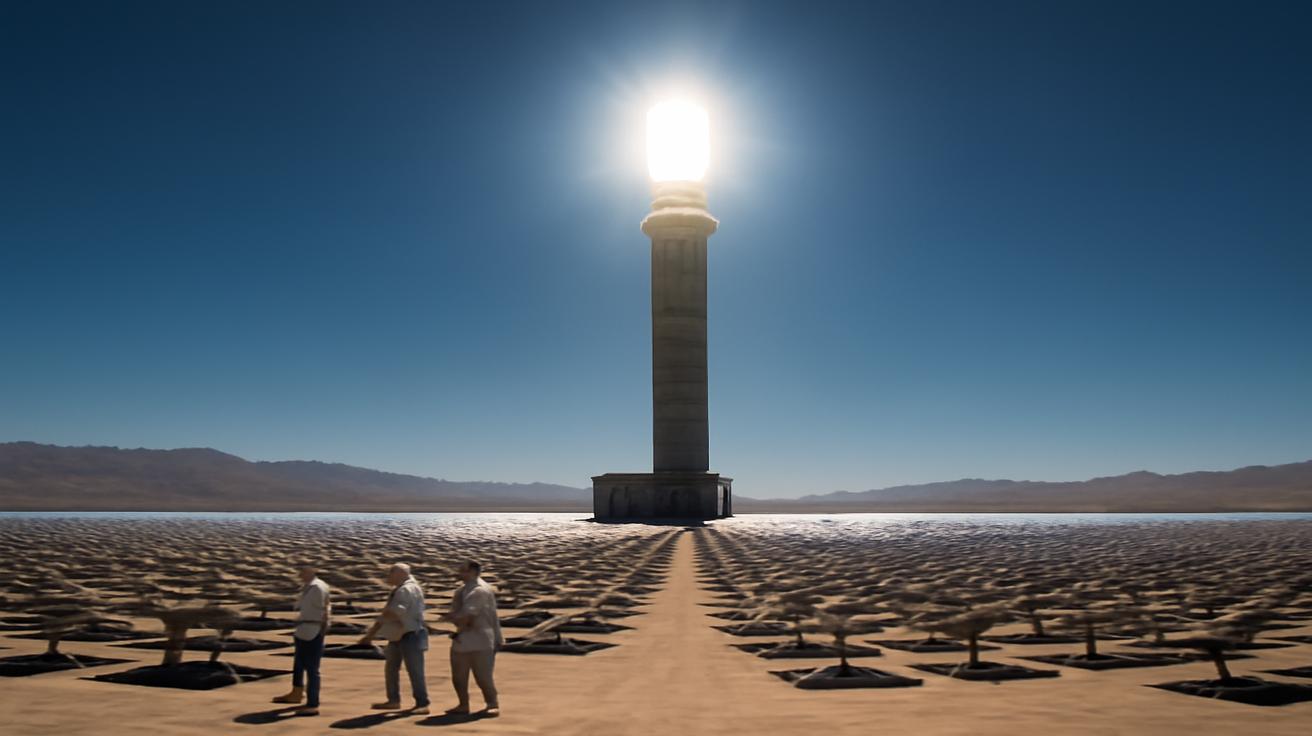
The first thing you notice is the silence. Not the gentle hush of a forest or the soft murmur of waves, but a kind of lunar stillness, thick and humming in the heat. The desert stretches in every direction, a shimmering quilt of sand and stone, the horizon wobbling in the midday glare. And in the middle of all this ancient emptiness, humans are trying to build a star.
It doesn’t look like a star yet. It looks like scaffolding and cranes and white containers lined in neat rows. It looks like engineers in sun-bleached hard hats, their radios crackling softly as they walk between humming machines. But beneath the cables and control rooms and coils of steel, the idea is the same wild, audacious thought that has haunted us since the first person looked up at the sky and felt very small: what if we could borrow the power of the sun itself?
Here, in this hot, wind-scoured valley, they are trying to do exactly that—a human-made sun, forged on Earth, to one day power cities that glow far away, over the horizon.
The Desert as a Laboratory of Light
The desert is a strange place to go in search of the future, but it’s always drawn people with impossible dreams. It is both harsh and generous: little water, little shade, yet endless sky and boundless space. For engineers and physicists, it has one more gift—clean, blinding sunlight by the bucketful and vast tracts of land where almost nothing else lives.
On certain days, the sky is so intensely blue it feels artificial. The air tastes of dust and metal. A warm wind runs its tongue over mirrors the size of billboards, polished so bright they seem not to reflect the sky but to carve holes in it. These are heliostats—sun-following mirrors that pivot through the day, tracking the arc of light like a field of silver sunflowers.
From a distance, the project looks like a mirage: a cluster of towers, stacks of equipment, a glittering halo of mirrors around them. Up close, you feel the scale in your bones. Each mirror is mounted on a steel frame with a small motor that nudges it ever so slightly as the sun moves, keeping the beam focused. A thousand tiny movements, all choreographed into a ballet of light.
And at the heart of this field, protected by concrete and steel, is where humans are trying to bottle a piece of the sun’s secret—fusion.
Chasing the Heart of a Star
The real sun, the one that burns in our sky, runs on fusion: crushing hydrogen atoms together under immense pressure and heat until they fuse into helium, releasing extraordinary amounts of energy in the process. It’s a simple idea on paper and almost impossibly difficult in practice.
To make fusion happen on Earth, we have to re-create the interior of a star: temperatures over 100 million degrees Celsius, pressures that defy everyday intuition, and magnetic fields strong enough to corral a plasma—a superheated soup of charged particles—without ever letting it touch the walls of its container. The desert “artificial sun” is not a single glowing orb but a carefully orchestrated set of machines designed to do this for a few seconds, then minutes, and one day, hours at a time.
Step into the control room and the desert vanishes behind tinted glass. Screens glow with false colors—magnetic field lines in electric blue, plasma temperatures in yellow and orange, diagnostic readings in quiet, scrolling numbers. Here, the star they’re trying to make is invisible to the naked eye, trapped inside steel and superconducting coils, existing as equations long before it ever burns as light.
One of the engineers, a woman with sunburned cheeks and a badge that’s clearly been on and off lanyards for years, says it almost casually: “We’re building a sun you can turn off.” She laughs after she says it, but her eyes stay serious. Because that’s the promise of fusion: a sun in a box, under human control, no runaway chain reactions, no chimney stacks of carbon smoke.
The Machine That Eats Starlight
In this desert complex, there is a symmetry that isn’t immediately obvious. The same sunlight that beats down on the sand is also what powers the attempt to mimic the sun’s deeper magic. One side of the project is pure optics: thousands of mirrors catching and concentrating sunlight onto a central receiver, heating special fluids or salts to blistering temperatures. These can store heat for hours, turning darkness into an illusion. Even after the sun dips behind the horizon, the heat remains, ready to generate electricity like a daytime that refuses to end.
But next to this world of mirrors and heat is the far stranger machine: the fusion experiment itself. Here, energy doesn’t simply flow from the sunlight; it is consumed as a kind of prelude, an opening act. The concentrated solar power helps run the vast electrical systems needed to ignite the fusion plasma—huge magnets, cooling systems, diagnostics, and the hungry infrastructure of a laboratory that wants to create a small star and not burn itself in the process.
It’s an elegant loop: the real sun powering the making of an artificial one. The desert, already a kind of solar battery, becomes both a fuel source and a test bench. Engineers talk about these systems like chefs discuss complicated recipes. You need just the right temperature, just the right pinch of magnetic field, a careful timing of fuel injection—too much and the plasma destabilizes, too little and you never reach ignition.
Inside the fusion chamber, nothing is gentle. Hydrogen isotopes—deuterium and tritium—are heated to such extremes that the concept of “burning” feels too small, too domestic. At those temperatures, electrons are stripped away, leaving a bare, roiling plasma. Magnets, cold as deep space thanks to superconducting technology, hold the plasma in a ceaseless, invisible grip. The whole thing is a contradiction made real: something a hundred million degrees hot, suspended by something hovering just above absolute zero.
The Cities Waiting Over the Horizon
The artificial sun in the desert is not an end in itself. It’s a rehearsal for a future that has not yet arrived, but that hums quietly in people’s imaginations—cities powered not by coal or oil or the unpredictable mood of the wind, but by a star in a building.
Imagine a city at night after fusion has become ordinary. Streetlights hum softly with power that began its life not in a buried fossil but in a fusion core. Trains slide across electrified rails, drinking from the deep, steady current. Apartments glow; heaters work; servers whisper in cool data centers—all on energy that carries no smoke trail, no invisible cloud of carbon looping around the Earth.
From the edge of the fusion desert, those future cities feel both close and immeasurably far. The engineer with the sunburn touches the railing and squints at the rows of mirrors. “We’re trying to make something that will outlive all of us,” she says. “We’re building infrastructure for people who haven’t been born yet.” It’s a strange kind of generosity: a gift of clean energy, prepared in the emptiest places, for the busiest ones.
At night, when the field is quiet and most of the workers have gone, the installation feels almost mythical. The mirrors turn into dull, dark plates. The air cools enough that your breath feels thicker in your chest. The actual sun is gone, but deep in the facility, instruments are still humming, data is still being logged, calculations still grinding away in digital silence. The star they are trying to make isn’t ready yet—but the work never sleeps.
The Numbers Behind the Dream
It’s easy to romanticize a desert full of mirrors and magnets. It’s harder—but necessary—to talk about the blunt arithmetic behind the dream. Fusion, if it works at scale, promises a kind of energy abundance that feels almost science-fictional: tiny amounts of fuel yield astonishing amounts of power, and the raw materials—especially deuterium from seawater—are effectively inexhaustible on any human timescale.
To understand the contrast, it helps to lay some of the big ideas out side by side:
| Energy Source | Fuel Lifetime Potential | Carbon Emissions in Operation | Key Challenge |
|---|---|---|---|
| Coal & Oil | Centuries (limited reserves) | Very High | Climate and pollution |
| Solar & Wind | Effectively limitless | Very Low | Intermittency, storage |
| Nuclear Fission | Thousands of years (with advanced reactors) | Very Low | Waste, perception, safety |
| Fusion (Goal) | Millions of years (seawater & abundant fuels) | Near Zero | Reaching net-positive, stable operation |
In the desert labs, the numbers that matter most right now are brutally simple: How much power goes in? How much comes out? Can the reaction sustain itself longer than the last attempt, and can it do so without tearing the plasma apart in turbulent rebellion?
Every experimental “shot” is a small drama—the countdown, the humming rise of current in the magnets, the blink-fast ignition, the surge of data, the sudden fall back to quiet. Sometimes it fails spectacularly; plasma slams into the walls, sensors trigger alarms, and the team is left staring at a jagged line on a graph that says: not yet. Other times, there’s a tiny, measurable win—an extra fraction of a second of stability, a slightly higher energy yield, a behavior that matches the simulation instead of surprising it.
Listening to the Desert
It would be easy to think of the desert here as only a backdrop, a blank slate to be written over with cables and steel. But the desert has its own terms, and the people building an artificial sun have had to learn them the hard way.
On some afternoons, the wind comes in like an insult. Fine sand lifts and scours the equipment, invades every unsealed crack. Panels must be cleaned relentlessly; moving parts protected from abrasion; electronics sealed like underwater creatures in their shells. Heat expansion becomes an everyday enemy—metal swells, shifts, loosens. Maintenance is as much an art as it is a schedule.
But the desert gives things, too. Clear skies mean more uptime for solar power, more predictable light for the heliostats. The openness provides space for expansion, for new towers and test rigs. Isolation provides safety—if anything goes wrong in a major way, there are no neighborhoods pressed up against the perimeter fence, no city just beyond the next hill.
At dusk, when the mirrors darken and the workers’ trucks snake away on dusty roads, the animals take back their shift: small foxes, beetles that write temporary hieroglyphs in the sand, a hawk riding last light. Above them, the original star comes down in a slow, blood-orange arc, indifferent to the fact that, in one corner of its endless light, its distant descendants are trying to copy it.
The Emotional Gravity of a Star
For the people who spend their days here, the work is technical but the motivation is rarely just numbers on a whiteboard. There’s a kind of emotional gravity to the idea of building an artificial sun, and it pulls people from all over the world, all ages, all disciplines—plasma physicists, materials scientists, software engineers, climate modelers, policy thinkers.
Ask them why they’re here, under this punishing sky, and the answers start rational and end up personal. One talks about growing up in a city where smog burned his lungs as a child. Another mentions a coastline back home that keeps creeping inland, storms chewing away at it year after year. Someone else simply says, “Because this is the wildest thing humanity has ever tried to do that’s actually about healing instead of conquering.”
There’s a humility that lives alongside the ambition. Human beings are very small, after all. We’ve only just learned to count our own carbon breath, to see the fingerprints we leave in ice cores and storm tracks and bleached coral. And here we are, trying to master the same reaction that keeps the universe lit. The desert, blank and ancient, is a constant reminder: you are short-lived; choose what you do with that time carefully.
In quiet moments, when experiments are paused and the hum of equipment winds down, the artificial sun is nothing more than a promise and a pile of machinery. But the people here have learned to live on promises. They know that, for decades, fusion has worn the label “always thirty years away.” They have heard the jokes. Still, they come. Still, they try.
Not Just One Sun, but Many
What’s happening in this particular desert is not unique, and that’s part of what makes it so powerful. Around the world, across continents and climates, a loose constellation of fusion projects is blinking to life. Some use magnetic bottles; others use lasers that converge on tiny fuel pellets. Some are run by governments, others by small, almost stubbornly optimistic private companies racing the clock of climate change.
This desert site is just one bright node in that network, distinguished by the way it weds the old, reliable star overhead to the new, imagined one inside. Here, solar fields and fusion halls share access roads and power lines. The traditional and the speculative sit side by side, like two siblings at different stages of life—one already holding the world’s hand, the other still learning to walk.
If fusion reaches its promise, the future won’t be about building a single artificial sun in a single desert, but about planting them like seeds wherever power is needed—near industrial hubs, in regions hungry for energy but rich in seawater and sunlight, perhaps even on ships or far-off bases beyond our home planet. The desert project, with its mirrors and magnets, is a kind of first story, a prototype of how those relationships between land, light, and machine might look.
In the meantime, the real sun rises again every morning over this lab of light and steel. Workers file through checkpoints, coffee in hand. The mirrors wake and begin to turn. Screens flicker on in the control rooms. Somewhere in the distance, a city flips a thousand switches, mostly unaware that, far beyond its suburbs, in a landscape that once seemed empty, people are quietly trying to build a second sun—one that will never rise, never set, but simply hum, steadily, for generations.
Frequently Asked Questions
Is an “artificial sun” the same as a nuclear bomb?
No. Fusion reactors and nuclear weapons rely on very different designs and purposes. Fusion experiments are carefully controlled, engineered systems meant to create sustained, stable reactions that can be turned off. They do not create the kind of rapid, runaway chain reaction that defines a bomb.
Why build fusion experiments in the desert?
Deserts offer large, relatively uninhabited spaces, abundant sunlight for supporting solar infrastructure, and clear skies. The isolation also adds a layer of safety, keeping complex experimental facilities far from dense populations while they are still being tested and refined.
Does fusion produce radioactive waste?
Fusion can produce some short-lived radioactive materials, mainly in the reactor’s structural components exposed to neutron radiation. However, this waste is far less long-lived and less problematic than traditional nuclear fission waste, and it does not involve large quantities of high-level spent fuel.
How soon could fusion power cities?
There is no exact date. Many experts are cautiously optimistic that demonstration plants producing net power could appear in the coming decades, but turning those into widespread, reliable commercial power stations will take additional time, investment, and engineering breakthroughs.
Will fusion replace solar and wind energy?
It’s more likely that fusion, if successful, will join solar, wind, and other sources in a diverse energy mix. Each technology has its strengths; fusion could provide steady, round-the-clock power, while solar and wind remain vital, rapidly deployable, and increasingly affordable solutions.
Is fusion safe during earthquakes or accidents?
Fusion reactors are designed so that if something goes wrong—loss of power, magnet failure, or other issues—the reaction naturally stops. There is no large inventory of chain-reacting fuel, so the risk of runaway accidents is dramatically lower than in conventional nuclear fission plants.
Why invest in such complex technology instead of just using more renewables?
Solar, wind, and storage are essential and must be expanded rapidly. Fusion is being pursued in parallel as a long-term option that could provide dense, dependable power with minimal environmental impact. In a warming world with growing energy needs, having multiple clean options reduces risk and increases resilience.