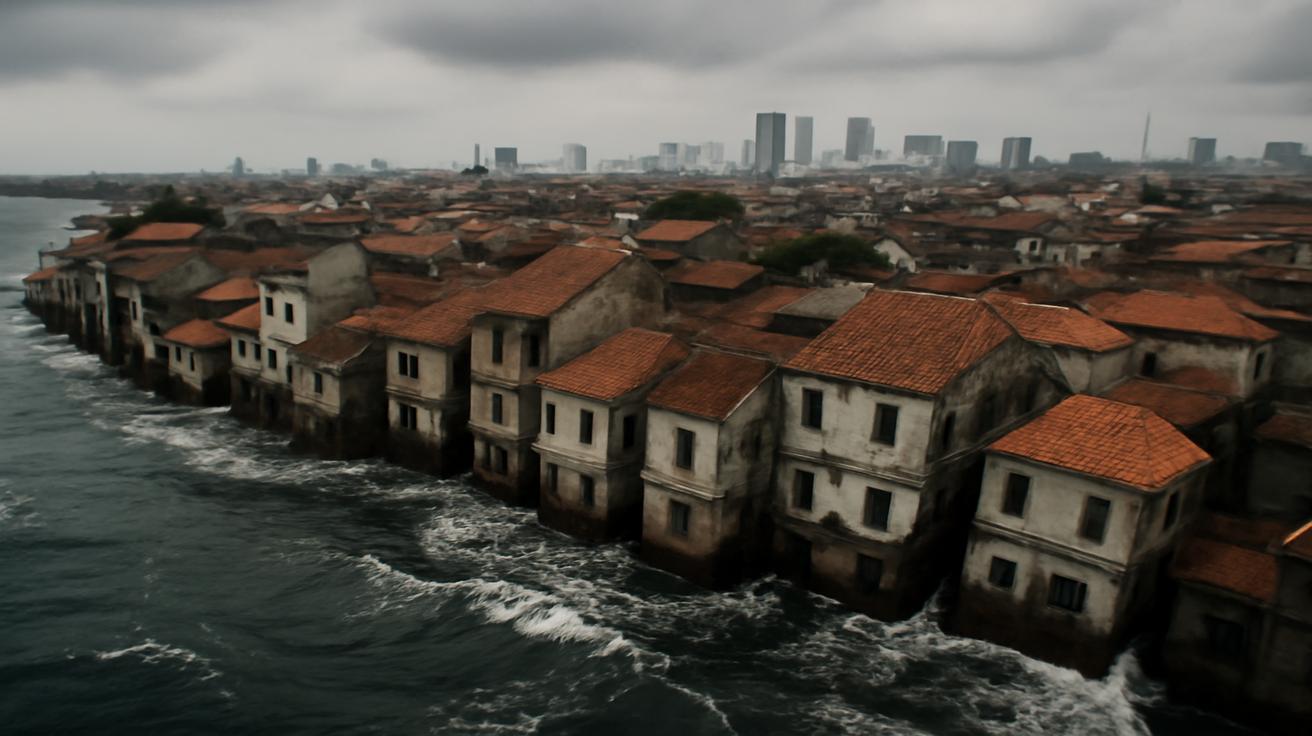
The first thing you notice is not the water. It’s the tilt. A front porch step in Jakarta, now slanting just enough that marbles roll on their own. A temple in Bangkok, where the floor feels like a warped vinyl record beneath your feet. A road in New Orleans that used to be level, now dipping just slightly toward a drainage ditch that never quite empties anymore. People blame the ocean; after all, sea level rise is the great villain of our warming world. But in many of the planet’s most vulnerable places, something more unsettling is happening: the land itself is sinking even faster than the seas are rising.
The Slow Fall Beneath Our Feet
To understand this quiet catastrophe, you have to learn to feel movement in things that seem immovable. Stand at the edge of a mangrove swamp in coastal Indonesia. The air is so thick you taste salt when you breathe. Roots curl like knotted fingers from the mud, and beyond them the Java Sea glitters in the heat. You look around and think: everything here is solid, rooted, ancient. But look closely at the stilt houses, at the waterlines along the concrete walls. Year by year, they’re slipping downward.
This sinking—scientists call it land subsidence—happens in slow, almost imperceptible increments. Millimeters in a year, sometimes centimeters. A few places are dropping at rates that make the global average sea-level rise of 3–4 millimeters per year look almost gentle. In some districts of Jakarta and Semarang, the land has been falling by as much as 10 to 15 centimeters every year. That’s like stacking a couple of smartphones on top of each other and losing that height annually. No storm surge needed, no glacier collapse required; the ground simply exhales its support and slumps.
Here’s the uncomfortable twist: in many of these places, the sinking is largely our own creation. We pump groundwater to keep farms irrigated and cities drinking. We compact wetlands and drain peatlands, build highways on top of marshes, and pack layers of soft sediments under the weight of concrete. The earth beneath us shrinks like a sponge when you wring it dry. And unlike a sponge, it doesn’t bounce back.
The Cities That Are Dropping Toward the Tide
When you map where the land is sinking fastest, a pattern appears: deltas, coasts, and crowded megacities. Places built on mud and memory, on sediments delivered by great rivers that no longer flood freely, their flow strangled by dams upstream. These are the places that feel the double punch of a rising ocean and a collapsing foundation.
Imagine flying low over the Ganges-Brahmaputra Delta, that sprawling triangle of life that cradles much of Bangladesh. Below, rivers weave silver threads through patchworks of rice fields and ponds, all gilded by the humid light. To a satellite, this region is a living lung of the planet; to the 170 million people who live here, it’s home. Yet much of this delta is subsiding as sediments that once rebuilt it are trapped behind faraway dams. Combine that with the weight of growing cities like Dhaka and Chattogram, and the delta’s ancient balancing act is faltering.
Across the world in the Mississippi River Delta, the story rhymes. New Orleans, already famously vulnerable, is perched on layers of peat and silt that were never meant to hold highways, suburbs, and levees forever. Those levees, built to protect the city from floods, also keep new sediment from refreshing the land. The result is a quiet deflation: neighborhoods that were once well above the tides now sit precariously low, while the Gulf of Mexico creeps inland.
Then there’s Jakarta, often called the world’s fastest-sinking city. Walk its northern districts and you see seawalls standing like weary sentries along the shore. In some places, the walls are now the only things that keep the Java Sea from wading into living rooms. Yet even these barriers are a kind of lie; the land behind them keeps falling, and every few years they must be raised again, concrete piled upon concrete, an arms race with gravity itself.
Where Land Sinks Faster Than the Sea Rises
To see just how stark this imbalance can be, it helps to look at a few regions side by side. The numbers feel clinical, abstract. But each millimeter is a new line on someone’s wall, a flooded street, a field turned brackish.
| Region / City | Approx. Land Subsidence Rate (mm/year) |
Approx. Sea Level Rise Rate (mm/year) |
What It Means on the Ground |
|---|---|---|---|
| North Jakarta, Indonesia | 100–150+ | 3–4 | Neighborhoods dropping by over 1 m per decade; frequent tidal flooding even on sunny days. |
| Bangkok, Thailand | 10–30 | 3–4 | Roads and buildings slowly dipping, more intense flood seasons, longer-standing water after storms. |
| New Orleans & Mississippi Delta, USA | 5–15 (locally higher) | 3–4 | Wetlands drowning, levees requiring constant upgrades, communities sitting ever lower than nearby waters. |
| Shanghai & Yangtze Delta, China | 5–25 | 3–4 | Urban districts experiencing drainage issues, heightened storm-surge risk along the estuary. |
| Northern coastal Vietnam | 5–20 | 3–4 | Rice paddies and aquaculture ponds more exposed to salinization and flooding. |
These are not the only hotspots; parts of Manila, Ho Chi Minh City, Alexandria, and even compacted industrial zones in Europe share similar trends. But they illustrate the core truth: in many places, the ground is collapsing several times faster than the oceans are climbing.
The Human Fingerprints in a Sinking World
Walk through a sinking city and the clues are everywhere if you know where to look. In a low-lying district of Bangkok, you find staircases that now end in midair because the road outside has been raised multiple times to stay above the floods. Houses crouch behind them like shy children, trapped in deepening pits. In Semarang, Indonesia, residents place bricks and planks by their doorways as makeshift stepping stones to reach streets that once met their thresholds.
The underlying causes spiral back to a few powerful decisions. Chief among them is groundwater extraction. Imagine an aquifer—an underground reservoir of water—threaded through layers of sand, silt, and clay. When full, it props up the land above like a mattress filled with springs. As water is pumped out for factories, farms, and swelling populations, those springs deform. Pores collapse. The ground settles. Importantly, in many geological settings, this process is irreversible; refilling the aquifer later does not fully re-inflate the ground.
Urban development layers its own weight onto this story. Skyscrapers, roads, and dense clusters of buildings sit on sediments that were, geologically speaking, just recently deposited by rivers or the sea. They aren’t fully compacted yet, so under the stress of modern cities, they compress. Meanwhile, upstream dams starve deltas of the sediment that once replenished them. What used to be a self-healing landscape—sinking a little, rising again with each flood—now just sinks.
And still, we’re surprised when the floodmaps change faster than the climate models predicted. Policy meetings talk about sea-level rise as a kind of distant, smooth curve—3 millimeters this year, 4 the next. The reality on the ground is more like a seesaw, except one side is weighted down by our own choices. In places like Jakarta, the curve is a cliff.
Life Lived at Water Level
Statistics only carry the story so far. To feel what it means to live where the land is falling, you have to stand with the people who wake each day and check the tide before they check the weather forecast.
In North Jakarta, a street vendor named Rudi pushes his cart through shallow water that didn’t use to be there. It’s not monsoon season. The sky is a perfect blue. Yet every high tide, the sea now sneaks in through the drainage canals, lapping at storefronts. Wooden boards bridge doorways like piers; children leap between them as though playing a game, but the adults don’t laugh. They’re too busy lifting furniture another notch higher, just in case.
Across the world in the Mekong Delta, a rice farmer walks along a narrow raised path that divides his fields. His father farmed this land before him, and the boundaries of the paddies were once as fixed as the stars. Now, each year, a little more land seems to vanish beneath brackish water. Salt nibbles at the roots of his crops in plots that never used to taste the sea. He’s heard that upstream dams and sinking soils are partly to blame, but such forces feel as distant as the moon. What he knows is that planting calendars no longer match the seasons, and that moving away would mean severing a family story rooted in this mud for generations.
In New Orleans’ lower-lying neighborhoods, many residents live with an unease that buzzes just under daily life. They’ve watched as storm after storm tests levees and pumps, as floodwalls are raised and raised again. They know the city sits in a bowl; they also know that bowl is gradually being pressed deeper into the soft sediments beneath. The steady subsidence doesn’t make for dramatic headlines the way a hurricane does, but it quietly increases the odds that the next storm will push water past the edge.
Can We Slow the Sinking?
Faced with this slow crisis, it’s tempting to shrug and file it under “too big, too late.” But land subsidence is not some mysterious, unstoppable force of nature. Much of it is directly linked to decisions we can change, and in some places, cities already have.
Consider Tokyo. In the mid-20th century, parts of the city were sinking rapidly as industries and households drew heavily on groundwater. Building foundations cracked; low areas flooded more often. Then, in the 1960s and 70s, Japan tightened regulations on groundwater extraction and shifted toward surface water and distant reservoirs. Subsidence rates plummeted. The land didn’t “rise” again, but the descent slowed enough to give the city breathing room.
Other measures may be less visible but just as critical. Restoring mangroves and wetlands along vulnerable coasts allows natural sediments to accumulate and buffer wave energy. Loosening the straitjacket of levees and allowing some controlled flooding in deltas can help replenish sinking land, though it demands rethinking where and how we live with water. Carefully managing building loads—how heavy and how dense construction can be in certain zones—helps prevent overburdening fragile soils.
Still, there are hard truths. In some rapidly sinking areas, the math is brutal. Even with reduced groundwater pumping, even with more sediment and smarter urban planning, parts of certain cities may eventually need to be abandoned or radically reimagined. Indonesia’s controversial plan to relocate its capital away from Jakarta is one dramatic example of what that reckoning looks like. The decision carries its own environmental and social costs, but it’s also an admission that some areas are on trajectories that engineering alone can’t easily undo.
Rethinking the Story of Sea-Level Rise
Perhaps the most important shift we can make is conceptual. When we talk about climate risk along coasts, we often picture a single line: the sea rising. Yet what truly matters to people and ecosystems is relative sea level—the changing relationship between the water surface and the land where we live, grow food, and build homes. In many of the world’s critical regions, that relationship is being altered far more by what’s happening beneath our feet than by what’s melting at the poles.
This doesn’t diminish the urgency of curbing greenhouse gas emissions. Quite the opposite: adding rapid land subsidence on top of global sea-level rise creates compound risks, shortening the timelines within which communities must adapt. It also means that some of the most effective near-term protections may not be giant seawalls or futuristic floating neighborhoods, but simpler actions like regulating groundwater, preserving wetlands, and changing building practices.
Picture two possible futures for a sinking city. In one, authorities ignore the subsidence problem, focusing only on bigger barriers against the sea. The land keeps falling, and every few years the walls must rise again, growing more expensive and technically challenging, until maintaining them is like trying to balance a teacup on the tip of a pencil. In the other future, the city treats the land as something dynamic, not static. Groundwater use is sharply reduced; sediments are allowed to move; sensitive zones are re-zoned; communities are gradually shifted from the areas most likely to become uninhabitable. The water still comes, the land still settles, but the pace slows, and people have time to move with the changes instead of being knocked flat by them.
Listening to the Quiet Tilt
There’s a peculiar humility in realizing that the ground, the one thing we’ve always trusted to stay put, is in motion. It shifts the way you look at a map. Coastlines that appear as clean lines on a screen are, in reality, breathing edges—subsiding, eroding, sedimenting, flooding, recovering. In some places, human hands have pressed hard enough on the landscape that those breaths have become gasps.
Yet there’s also a strange kind of hope in this awareness. Unlike the distant roar of an ice sheet collapsing thousands of kilometers away, land subsidence is local, tangible, and often directly connected to levers we can pull. It’s a story told in wells and pumps, in zoning laws and dam operations, in mangrove roots and rice paddy dikes. It asks us to see cities not as fixed monuments placed upon the earth, but as temporary arrangements of people and structures on a living, shifting skin.
Next time you stand in a coastal city, try a small experiment. Place your hand on a wall—an old one, if you can find it. Feel its roughness, the heat of the day stored in its bricks or concrete. Somewhere in its history there may be a faint line where paint once met the ground, now a few centimeters higher than your shoes. Imagine that line moving, year by year, as the land and the sea renegotiate their ancient relationship, accelerated by our modern impatience.
The land is sinking faster than the sea is rising in some of the most critical regions of our planet. It’s a quieter disaster than the shattering of glaciers or the fury of hurricanes, but no less consequential. Learning to listen to that quiet tilt—and to act on what it tells us—may be one of the most important steps we take in reshaping our relationship with a warming, softening world.
Frequently Asked Questions
What exactly is land subsidence?
Land subsidence is the gradual sinking or settling of the ground surface. It can be caused by natural geological processes, but in many coastal regions today it’s driven by human activities like excessive groundwater pumping, draining wetlands, compacting soils, and placing heavy infrastructure on soft sediments.
How is land subsidence different from sea-level rise?
Sea-level rise refers to the increase in the average height of the world’s oceans, mainly due to melting ice and the thermal expansion of warming water. Land subsidence is the downward movement of the ground itself. For people living on coasts, what matters most is the combination of both—how quickly the sea surface rises relative to the land they stand on.
Which regions are most affected by sinking land?
Some of the most affected areas include major river deltas and coastal megacities: Indonesia’s north coast (especially Jakarta and Semarang), the Ganges-Brahmaputra and Mekong Deltas, the Mississippi Delta around New Orleans, and parts of cities like Bangkok, Shanghai, Manila, and Ho Chi Minh City.
Can we stop land from sinking?
In many cases, we can significantly slow subsidence, though we can’t usually reverse what’s already happened. Reducing groundwater extraction, restoring wetlands, allowing more natural sediment deposition, and regulating heavy construction on soft ground are all effective strategies. Some cities, like Tokyo, have already seen subsidence rates drop after such measures.
What does this mean for people living in coastal cities?
For residents, faster relative sea-level rise means more frequent flooding, higher storm-surge risk, saltwater intrusion into freshwater supplies, infrastructure damage, and, in extreme cases, the need to relocate. Addressing land subsidence alongside climate-driven sea-level rise is crucial if coastal communities are to adapt and remain viable in the coming decades.