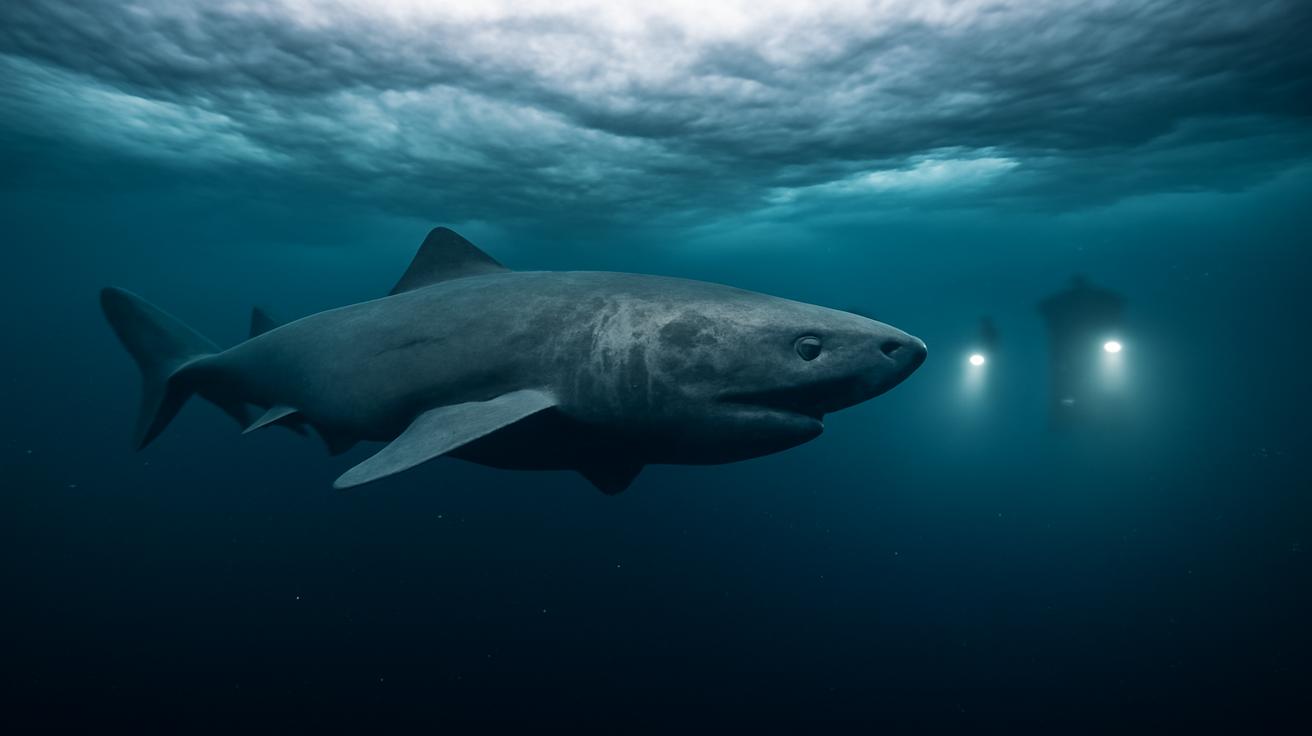
The ocean was holding its breath. In the raw blue quiet beneath the Antarctic ice, a camera drifted through the dim green light, following a string of bait swaying in the freezing current. Scientists on the surface huddled in thick jackets, squinting at live video on a monitor that flickered in the wind. Out of the gloom, something large and slow and impossibly ancient moved into view—first a shadow, then a hulking, ghost-grey body. A mouth studded with tiny teeth. A cloudy eye that seemed to have seen centuries. The deck went silent. Someone whispered it before anyone could quite believe it: “That’s a shark.”
The Day the Southern Ocean Revealed a Secret
Antarctica is a place we like to pretend we know. There are the familiar postcards: emperor penguins shuffling across the ice, humpback whales lunging through krill clouds, Weddell seals basking on floes like sleepy commas on a blank white page. It is, in our collective imagination, a stage with a limited cast, a frozen world where surprises feel increasingly rare.
But on this day, aboard a research vessel rocking in a bruised-grey sea, the script changed. For the first time in recorded history, a shark was filmed in Antarctic waters. Not near-Antarctic. Not on the edges of the Southern Ocean. In the real thing—waters governed by pack ice and long polar nights, where winter clamps down so hard that the sun itself seems to give up.
The shark on the monitor did not look like the sleek, torpedo-bodied hunters of tropical documentaries. It was heavier, slower, moving with the unhurried inevitability of a glacier. Its skin carried the pallor of old snow; its movements were patient, almost thoughtful. To the scientists gathered around the screen, it didn’t just feel like a new observation. It felt like a door in time had swung open.
A Ghost from the Deep Freeze
The team had not come to Antarctica specifically to look for sharks. They were there to map the seafloor, to study invertebrates and deep-sea corals, to understand how climate change is re-writing the rules of survival in icy waters. In a way, the shark was an interruption—an unscripted guest in a carefully planned expedition.
The camera system they used was classic deep-sea improvisation: baited rigs, pressure-resistant housings, lights dialed low so as not to startle anything that wandered into view. They had deployed it through a hole in the ice into water cold enough to numb bare skin in seconds. Outside, the air burned the throat with every breath. Inside, the control room hummed with electronics and the scratch of gloved fingers on notepads.
When the shark appeared, it did so without ceremony, gliding in from the edge of the frame like a thought you didn’t know you’d been having. Later analysis would suggest it belonged to the sleeper shark family—a group of slow-growing, deep-living species that have haunted the dark oceans for millions of years. These are animals that spend most of their lives beyond our gaze, moving through pressure and blackness we can barely imagine.
Seeing such a creature in Antarctic waters was like spotting an old myth standing in your kitchen, asking casually if you had any tea. These sharks were suspected to range widely, but until that moment, their presence in the Southern Ocean had never been confirmed by video. Paper records hinted, scraps of data suggested. Now the ocean itself had provided proof.
The Numbers Behind the Wonder
On the monitor, the shark lingered around the bait, circling in lazy, deliberate arcs. Its length was estimated at several meters—no great white, but substantial, a presence that felt more geological than animal. Its movement seemed almost too slow for the word “swim,” yet every sweep of its tail carried it confidently through the water, as though the cold were an old familiar companion rather than a threat.
Scientists would later log temperature, depth, and time with the precision of ritual: the water hovering just around the freezing point of seawater; the camera resting hundreds of meters down; the encounter recorded in high-definition frames that could be replayed and studied in the months to come. In a field where “firsts” grow increasingly rare, every data point felt like a small gift tucked inside a much larger miracle.
The raw notes from that day don’t quite capture what it felt like in the room: the sudden quiet, the collective intake of breath, the slightly shaking hands reaching for phones and notebooks. The scientist who whispered “That’s a shark” would later joke that their voice cracked like a teenager’s. In the moment, though, it was less a joke and more a confession: something vast and old and unexpected had just stepped—slowly, carefully—into the human story of this place.
A New Piece in the Polar Puzzle
Finding a shark here changes more than a single line in a field guide. It nudges at the way we imagine Antarctic life fits together. Ecosystems are networks of who eats whom, of who competes with whom, of which species rise and fall together as conditions shift. Add a shark—a large, slow predator and scavenger—and the web trembles in new and fascinating ways.
What is this shark eating in waters this cold? How long has it been here, gliding beneath ice shelves and drifting pack ice while we looked elsewhere? Are there breeding populations near the continent, or are these wide-roaming wanderers that drift in and out with shifting currents? Each question unfurls into ten more, like the branching arms of the starfish that cling to the Antarctic seafloor below.
Sleeper sharks are known, in other oceans, to feed on fish, squid, and even the occasional marine mammal carcass. Some species have been found with polar bear and seal remains inside them, suggesting a willingness to scavenge whatever the polar world offers. In Antarctic waters, that might mean whales fallen to the deep, dying seals, or the substantial fish that thrive in the cold, like toothfish adapted with natural antifreeze in their blood.
For years, the Southern Ocean’s food web has been treated as mostly driven from the bottom up: tiny phytoplankton feeding krill, krill feeding penguins and whales and seals. The presence of a big, stealthy predator in the deep adds a new top-down influence, a quiet, unseen force shaping life from the other direction.
How Climate Change Complicates the Discovery
There is another layer to this encounter, one harder to celebrate without a catch in the throat. The Southern Ocean is changing. Sea ice seasons are shifting; warm currents are nibbling at the undersides of ice shelves. Species that once stayed comfortably separated by temperature are now drifting closer together.
The discovery of a shark in Antarctic waters raises an uneasy question: has this animal always been here, passing unnoticed through a darkness we simply never bothered to film? Or is it part of a shifting front line, a sign that species we associate with other latitudes are expanding into a warming polar realm?
Scientists are careful with their language. One video, however remarkable, does not prove a new invasion or a climate-driven shift. It could be confirmation of an old, stable reality we are only now catching up to. Yet the timing cannot be ignored. As the polar world rearranges itself under the pressure of human-induced change, every new data point becomes double-edged: wondrous, and slightly worrying.
The shark itself, of course, knows nothing of our debates. It swims because it must, follows food because it is hungry, endures the cold because that is the world it was built for. To the shark, the Southern Ocean is not a frontier. It is simply home—whether newly claimed or very, very old.
Watching from the Edge of the World
On the deck above the shark’s passing, the sea smelled of iron and brine. The ship creaked softly against the pressure of wind-driven waves. A few snowflakes, dry and powder-fine, rattled against the windows like sand. Inside, the glow of the monitor drew everyone closer, a little digital campfire burning in the heart of the polar night.
There is a particular intimacy in seeing something live, as it happens, from a world your body cannot safely enter. The crew felt it instantly. This wasn’t archived footage smoothed and scored with music. This was now—a wild animal moving just beneath their boots, sharing the same coordinates, the same moment in time.
In that shared moment, the distances we usually hold between ourselves and the deep ocean narrowed to almost nothing. You could, if you let yourself, forget the layers of technology between you and the shark: the steel hull, the winch cables, the glass on the camera, the thin stream of data surging up through kilometers of cold water and air. It felt, instead, like two worlds making eye contact.
Someone on the ship later described the feeling in a log entry: “We came to count corals and map mud. The ocean sent a ghost to remind us we still don’t know who lives here.”
What the Data Looked Like on Paper
Back in the ship’s lab, the encounter quickly transformed from awe to task. Measurements were taken from the footage—body proportions, swimming speed, the way the dorsal fin sat on the back. Notes accumulated in neat, small handwriting. The event got a timestamp, a file name, a label.
To most people, the romance of discovery dies a little in the paperwork. But for the scientists on board, it is the opposite. The data is the spell that keeps the moment alive, that allows it to travel from a cold ship’s lab to conferences, journals, classrooms, and, eventually, the public imagination. Without the dry details, the shark would remain a story told over coffee, half-believed and easily forgotten.
Summarized later, some of those details would look something like this:
| Observation Detail | Description |
|---|---|
| Location | Antarctic waters within the Southern Ocean, near the continental margin |
| Depth | Hundreds of meters below the surface, in low-light conditions |
| Water Temperature | Around the freezing point of seawater (approximately -1.8°C) |
| Likely Species Group | Sleeper shark family (deep-living, slow-moving, polar-tolerant sharks) |
| Behavior | Slow circling of baited camera system; scavenger-like investigation |
Each cell in that table holds a fragment of a story still being written. Together, they become a baseline—a beginning against which future measurements will be compared. If more sharks are filmed in the coming years, scientists will return to this “first” as a reference point, the way you might return to the first page of a book to remember how the story began.
Why This One Shark Matters to All of Us
It can be tempting, staring at a single shark gliding past a camera in a place most of us will never visit, to wonder why it matters. The world is noisy with breaking news; a fish in a far-away sea feels like a whisper lost in the crowd.
But that quiet moment under the ice is connected, however subtly, to choices made far from the poles: the fuel burned in cities, the fishing policies set by distant governments, the plastics and pollutants that find their way into even the cleanest-seeming corners of the planet. The shark is not just an animal. It is a data point in a global experiment we are running, mostly unintentionally, on the only ocean we have.
At the same time, it is more than a symbol of human impact. It is also a reminder of wild resilience, of nature’s ability to surprise us even as we reshape it. We like to think of exploration as something that happened in the age of wooden ships and paper charts. Yet here we are, in the twenty-first century, still finding large predators in places we thought we understood.
There is humility in that realization—a good kind of smallness. The Antarctic shark says, simply by existing: you do not know everything yet. There are still corners of the map that defy your categories. There is still mystery, even at the cold, hard edges of the world.
What Comes Next Beneath the Ice
In the months and years after the video was recorded, plans began to shift. Future expeditions started penciling in more deep camera deployments, more baited rigs, more time spent in the dim green corridors where sleeper sharks and other hidden creatures might move. Genetic sampling and acoustic listening stations were proposed. Could they, perhaps, capture the quiet heartbeat of a shark’s presence more regularly?
Scientific curiosity is a restless thing. One ghostly shape on a monitor is never enough. Researchers want patterns: how often the sharks appear, in which seasons, at which depths, doing what. They want to know if this is a local population or part of a larger, connected network spanning the polar and subpolar seas. They want to understand how a shark’s life plays out in temperatures that would kill most fish and freeze an unprotected human hand to pain within seconds.
And beyond the technical questions lies a more human one: how do we learn from this discovery without loving it to death? As interest grows, as cameras and vessels and instruments multiply, there is always the risk of loving a wild place so intensely that we crowd it, disturb it, change it. The challenge ahead will be to listen more than we intrude, to study with care, to balance excitement with restraint.
Into the Unfinished Map
The day the shark appeared, the sky over the Southern Ocean never really brightened. The light just shifted from ink-black to iron-grey, then back again, as if the sun were shrugging at the effort of trying to reach this far south. The sea heaved, low and heavy, against the hull. Somewhere below, in the swaying dark, a slow-bodied predator turned away from a camera and vanished once more into its long private night.
On the ship, the moment became story almost instantly—told in the mess over trays of food, recorded in logbooks, described in hurried emails sent to colleagues when the satellite connection allowed. Beyond the ship, it would travel further still: into journal articles, into classrooms, into the hands of children tracing maps with their fingers and asking, “So there are sharks there too?”
We live in an age when it is easy to feel that the world has already been scrolled through, zoomed in on, and scanned from space. Yet in the shadow of Antarctic ice, something as large and as consequential as a shark can glide through our blind spots, almost indifferent to whether we notice it or not. When we finally do, it feels less like we have discovered something new and more like we have been quietly invited into a story that has been unfolding without us for a very long time.
For the first time in history, a shark has been filmed in Antarctic waters. It will not be the last time. More cameras will descend. More shapes will emerge from the gloom. With each encounter, the map of what we think we know about this planet will change, however slightly.
Somewhere beneath the ice, the ocean is still holding its breath—and, slowly, patiently, beginning to exhale its secrets.
Frequently Asked Questions
Was this really the first shark ever in Antarctic waters?
It was the first time a shark has been filmed in Antarctic waters, not necessarily the first shark ever to swim there. Scientists had long suspected that deep-living sharks could inhabit the Southern Ocean, based on scattered observations and knowledge from other polar seas. This video provided the first clear, visual confirmation.
What kind of shark was filmed?
The shark appears to belong to the sleeper shark family, a group of slow-moving, deep-sea sharks adapted to cold, high-pressure environments. Exact species identification can be difficult from video alone, but its body shape, behavior, and habitat strongly match known sleeper shark characteristics.
How cold were the waters where the shark was found?
The shark was filmed in water close to the freezing point of seawater, around -1.8°C. At such temperatures, only highly specialized organisms can survive, using physiological adaptations that prevent ice crystals from forming in their bodies.
Does this discovery mean climate change is pushing sharks into Antarctica?
Not necessarily. One filmed shark cannot prove a climate-driven shift. The species may have been present in Antarctic waters for a long time without being recorded. However, because the Southern Ocean is warming and changing, scientists are watching closely to see if shark sightings increase or expand into new areas.
Are these Antarctic sharks dangerous to humans?
Encounters between humans and these sharks are extremely unlikely. They live deep below the surface, far from swimmers or divers, and are generally slow, scavenging animals. In practical terms, they pose no real threat to people.
Why is filming a single shark so scientifically important?
This recording confirms the presence of large sharks in a part of the world where they had not been visually documented before. That changes how scientists understand the Antarctic food web, predator-prey relationships, and the true diversity of life in polar deep seas. It also creates a baseline for tracking future changes.
Will scientists try to find more sharks in Antarctic waters now?
Yes. This discovery has already motivated plans for more deep-sea camera deployments, improved monitoring, and potential genetic and acoustic studies. Researchers hope to learn how common these sharks are, where they move, what they eat, and how they fit into the broader Antarctic ecosystem.