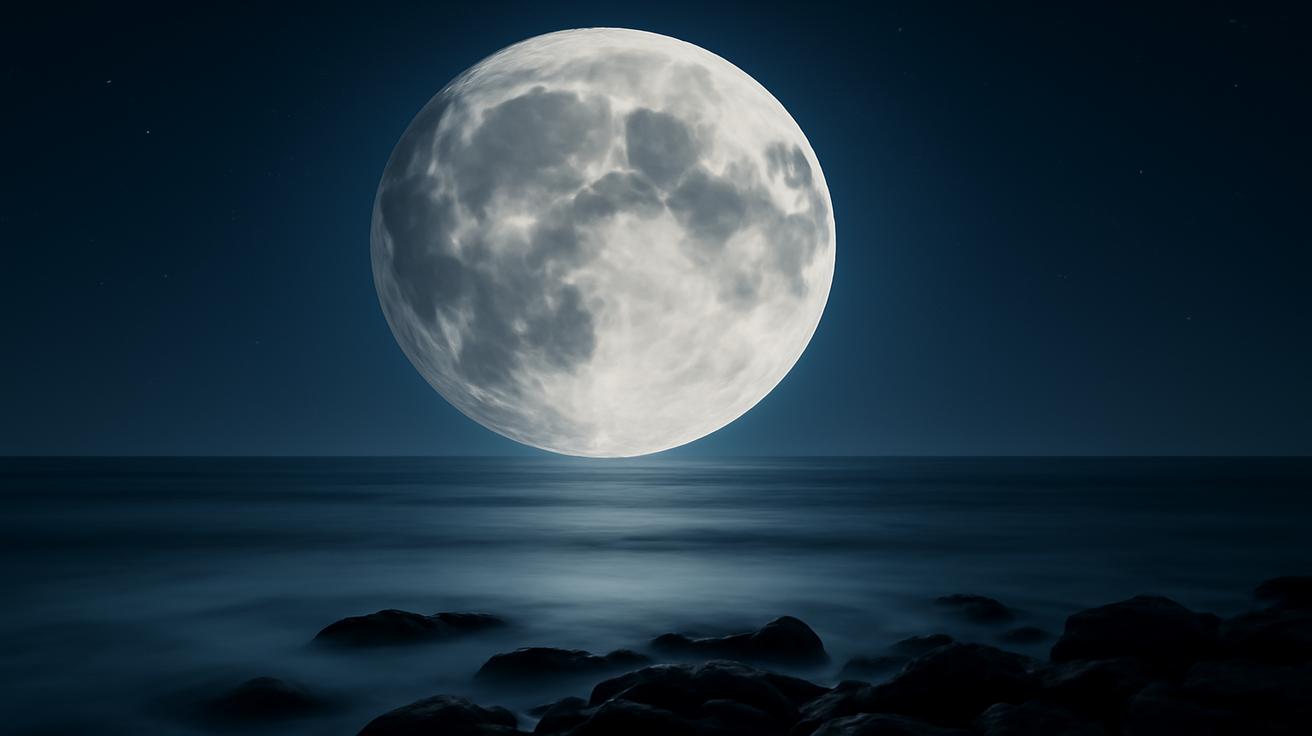
Some evenings, if you stand long enough by the edge of the sea, the world begins to whisper its slower stories. The waves arrive with an almost sleepy insistence, brushing your ankles, curling around driftwood, tugging at the sand. Overhead, the Moon hangs like a lantern—familiar, quiet, seemingly permanent. But while you watch, something almost unimaginable is happening: that pale companion in the sky is drifting away from us, millimeter by millimeter, year after year. And with every tiny step it takes, the length of our days and the rhythm of our tides are being rewritten.
The Moon That Refuses To Stay Put
The Moon looks frozen in the sky, rising and setting with ancient regularity, but it is not a still object. In the silence of space, it is slowly loosening its gravitational embrace with Earth, creeping away at roughly 3.8 centimeters each year—the rate our fingernails grow. Measured on the grand clock of the cosmos, this is no trivial shuffle; it is tectonic in its consequence.
Imagine a time-lapse film of the last few billion years. Earth spins faster; days flash by in quick bursts of light and shadow, only ten or twelve hours long. The Moon hugs close, looming larger, its gravity yanking enormous tides up and down the coasts, roaring inland far beyond today’s shorelines. Now let that film play forward. The Moon recedes; the tides soften; Earth’s spin gradually eases. The movie slows. The days lengthen.
We cannot feel the deceleration. Our lives are too short, our instruments too anchored to human time. Yet in ancient rocks that once lay beneath vanished oceans, in layers of sediment that preserve the faint signatures of tidal rhythms, the record is there: a younger Earth that spun more quickly beneath a nearer, more insistent Moon.
How The Ocean Turns Moonlight Into Friction
To understand how the Moon can stretch a day, you have to picture Earth not as a rigid sphere, but as a water-wrapped, slowly deforming world. The Moon’s gravity pulls on our oceans, dragging the water into bulges—one facing the Moon, one on the far side. These bulges are what we call tides, but they are not perfectly aligned with the Moon.
Earth spins once every 24 hours, while the Moon takes about 27 days to circle us. Because our planet is spinning much faster than the Moon orbits, those tidal bulges are carried slightly ahead of the line between Earth and Moon, like a wave front being pushed along by a spinning drum. That offset is the key to the whole story.
Inside those flowing bulges is friction—water sighing and grinding against the sea floor, swirling into bays, squeezing through straits, colliding with continental shelves. Every swirl loses a little energy as heat, but that energy has to come from somewhere. It comes from Earth’s spin.
Each day, as the planet turns, the ocean’s tidal bulges drag backward on the spinning Earth, like a hand on a spinning potter’s wheel. At the same time, because the bulge is pulled slightly ahead of the Moon, our gravity tugs on the Moon, flinging a bit of energy into its orbit, nudging it higher, farther away.
The result is a slow trade: Earth loses rotational speed and lengthens its day; the Moon gains orbital energy and recedes. Tides, in other words, are not just a twice-daily coastal spectacle—they are the mechanism of a long, quiet exchange of momentum between planet and satellite.
| Time in Earth’s History | Approximate Day Length | Moon’s Distance (Relative to Today) |
|---|---|---|
| Today | 24 hours | 1.0 × current distance |
| ~620 million years ago | ~21.9 hours | Slightly closer |
| ~1.4 billion years ago | ~18.7 hours | Noticeably closer |
| ~2.5 billion years ago | ~17 hours (approx.) | Significantly closer |
| Shortly after Moon’s formation | Possibly ~5–10 hours | Much closer, looming large |
The Long Shadow On Our Calendar
If you’ve ever complained that there aren’t enough hours in a day, the universe has an answer: you used to have even fewer. Over hundreds of millions of years, the braking effect of tides has stretched the day from about 22 hours to the current 24. The rate today is tiny—on the order of a couple of milliseconds per century—but geology is patient. What feels like nothing to us is dramatic when you stretch it across eons.
Scientists have teased this story out of unlikely places: ancient coral fossils, growth rings frozen in stromatolites, and fine layers of tidal sediments. Some of these rocks carry patterns—tiny laminations—that repeat with daily, monthly, and yearly rhythms. Count them, and they become a timepiece from long before clocks.
In certain rocks roughly 620 million years old, there are about 400 “daily” layers in a year instead of our modern 365. In other words, the year was about the same length, but Earth spun faster, packing more days into each orbit around the Sun. Each extra day is evidence of the Moon closer in, pulling harder, braking Earth more vigorously.
Our modern leap seconds, those occasional adjustments added to keep atomic clocks aligned with Earth’s slightly erratic spin, are like tiny punctuation marks in this story. They are human-scale hints that our planet’s rotation is not a perfectly steady metronome, but a gradually slowing turntable influenced by oceans, atmosphere, earthquakes, and the slow tug of the Moon.
Tides As Silent Architects Of Coasts
The Moon’s slow drift and its reshaping of our day length are inseparable from the tides that carved the edges of continents into the silhouettes we know today. High tides flood estuaries, redraw beaches, and feed salt marshes with nutrient-rich water. Low tides reveal tidal flats sculpted by centuries of rise and fall, dotted with burrows, ripples, and stranded pools, like fingerprints pressed into wet clay.
In a world with a nearer Moon, the tide’s touch would have been bolder. Stronger tides mean larger vertical differences between high and low water, and more powerful horizontal currents. Coasts would have been battered, estuaries wider and more deeply etched. Some scientists speculate that these large tides may have played a role in transporting nutrients and stirring the shallow seas where early complex life took hold.
Now, as the Moon drifts away and tides slowly weaken over immense timescales, the character of coasts must inevitably shift. The daily dance of water and shore is not just a backdrop to life; it is a shaping force. The arrangement of mudflats and mangroves, of barrier islands and beaches, is a constantly updated response to the interaction of gravity, wind, sediment, and the pull of that receding satellite.
The Moon, Life, And The First Rhythms
It is tempting to imagine that, without the Moon, life would simply have chosen a different metronome. But the Moon has been present for almost the entire history of Earth’s oceans, and its tides have written themselves into the earliest living scripts.
In tidal pools that filled and drained twice a day, early organisms were forced to adapt to cycles of wet and dry, light and dark, calm and turbulence. Salinity shifted as evaporation battled with replenishing waves. Temperatures swung widely. These pools, perched on ancient coasts under a more forceful Moon, may have been natural laboratories for resilience and innovation.
Even today, many coastal species carry lunar and tidal rhythms in their biology. Grunion fish lay eggs at the highest spring tides. Some corals in tropical seas release their gametes in mass spawning events synchronized with the full Moon. Certain crabs time their emergence to the pulse of the tides, living by a clock written in water rather than in hours.
As the Moon moves away and the tides very gradually soften, these patterns will not vanish overnight. Evolution works on timescales long, but not as long as orbital mechanics. Life will shift, adapt, rewrite its own scripts. The important point is this: the Moon’s gravitational reach has never been merely a physical constraint. It has been a choreographer, aligning the motions of water and organism into a tangled, tidal dance.
The Far Future: Locked In A Slow Embrace
If you carry the math forward far enough, the story leads to a peaceful but eerie conclusion. Given enough time, the Earth and Moon could end up “tidally locked” to each other, the way the Moon is already locked to us. The Moon always shows us the same face because its rotation period matches its orbital period; it turns once on its axis in the same time it takes to go around Earth.
In a very distant future—so distant that the Sun itself will have changed drastically by then—Earth’s rotation might slow until one side of our planet always faces the Moon. A day on Earth would then be as long as a lunar month, and the tides would settle into a steady, almost unchanging pattern. Our familiar rising and setting Moon would freeze into a permanent sky ornament for one hemisphere, while the other would never see it at all.
Whether this ultimate tidally locked state will ever actually arrive is uncertain, because the Sun’s own evolution will almost certainly disrupt the system first. But as a thought experiment, it lays bare the logic behind the Moon’s current escape: the system is seeking a state where there is no more friction to bleed away energy, no more tidal bulges lagging behind, no more trade between spin and orbit.
The Intimate Distance Between Us And The Moon
Knowing all of this—knowing that every high tide at your local beach is quietly exchanging momentum between Earth and Moon—changes the act of watching the sea. Stand on a pier at night when the Moon throws a glimmer onto the surface, and you are witnessing gravity connect two worlds in real time, reshaping their futures with each jot of water that rises and falls.
Even the Moon’s apparent stillness becomes suspect. Its face, cratered and gray, is the record of past violence. But its motion today is stealthy, almost tender. At 3.8 centimeters a year, the Moon’s recession is slower than the growth of a tree’s annual rings, slower than your hair grows. Over the span of a human life, the change in distance is less than what you would cross in a long stride. Yet multiplied over billions of years, this tiny drift re-sculpts the length of days, the pattern of coasts, the opportunities for life.
On some future shore, under a slightly smaller Moon and with slightly longer days, someone else might stand where you stand now, listening to the hiss of waves. They will inherit a planet whose rotation has been imperceptibly but inexorably reshaped by this distant companion. Their calendars, their clocks, even their internal body rhythms, will be part of a story that began when a Mars-sized object struck the early Earth and flung debris into orbit, coalescing into the Moon.
So when you next feel the tug of the tide at your feet, remember that you are feeling the gears of a very large, very slow machine. Earth spins; oceans slosh; friction hums; the Moon inches away. We live in the momentary balance between all these forces—a brief pause in an ongoing exchange between a planet and the small, bright stone that circles it.
FAQ
Is the Moon really moving away from Earth?
Yes. Precise measurements using laser beams bounced off reflectors left on the Moon by Apollo missions show that the Moon is receding from Earth by about 3.8 centimeters per year. This is due to tidal interactions between Earth’s oceans and the Moon’s gravity.
How does the Moon moving away change the length of our days?
As tides flow over the ocean floor, friction slows Earth’s rotation very slightly. The energy lost from Earth’s spin is transferred to the Moon’s orbit, pushing it farther away. A slower rotation means longer days. While the change is tiny on human timescales—milliseconds per century—it adds up over hundreds of millions of years.
Will our days ever become much longer than 24 hours?
On extremely long timescales of hundreds of millions to billions of years, days could lengthen significantly. In Earth’s deep past, days were around 18–22 hours long. In the far future, if nothing interrupts the process, a day could eventually match the Moon’s orbital period, but the Sun’s evolution is likely to alter the system before that happens.
Do the tides depend only on the Moon?
No. While the Moon is the dominant influence on tides, the Sun also plays a significant role. When the Sun, Moon, and Earth line up—during full and new moons—we get higher “spring” tides. When the Sun and Moon are at right angles relative to Earth, we get weaker “neap” tides.
Can we feel or notice the Moon’s drift in everyday life?
Not directly. The changes are far too small over a human lifetime. We notice related effects only in precise fields like astronomy and timekeeping, where leap seconds are occasionally added to keep our clocks aligned with Earth’s slowly changing rotation.
Did the Moon’s stronger tides in the past affect life on Earth?
Many scientists think so. Stronger tides in a past with a closer Moon could have created dynamic coastal environments, stirring nutrients and providing fluctuating conditions that may have helped drive the evolution of early life, especially in tidal flats and pools.
Could the Moon ever stop moving away?
In theory, if Earth and Moon eventually reach a mutually tidally locked state—where the same side of Earth always faces the Moon—then the main driver of the Moon’s recession would cease. However, the Sun’s changes as it ages are likely to significantly alter Earth’s rotation and the Moon’s orbit long before that equilibrium is fully reached.