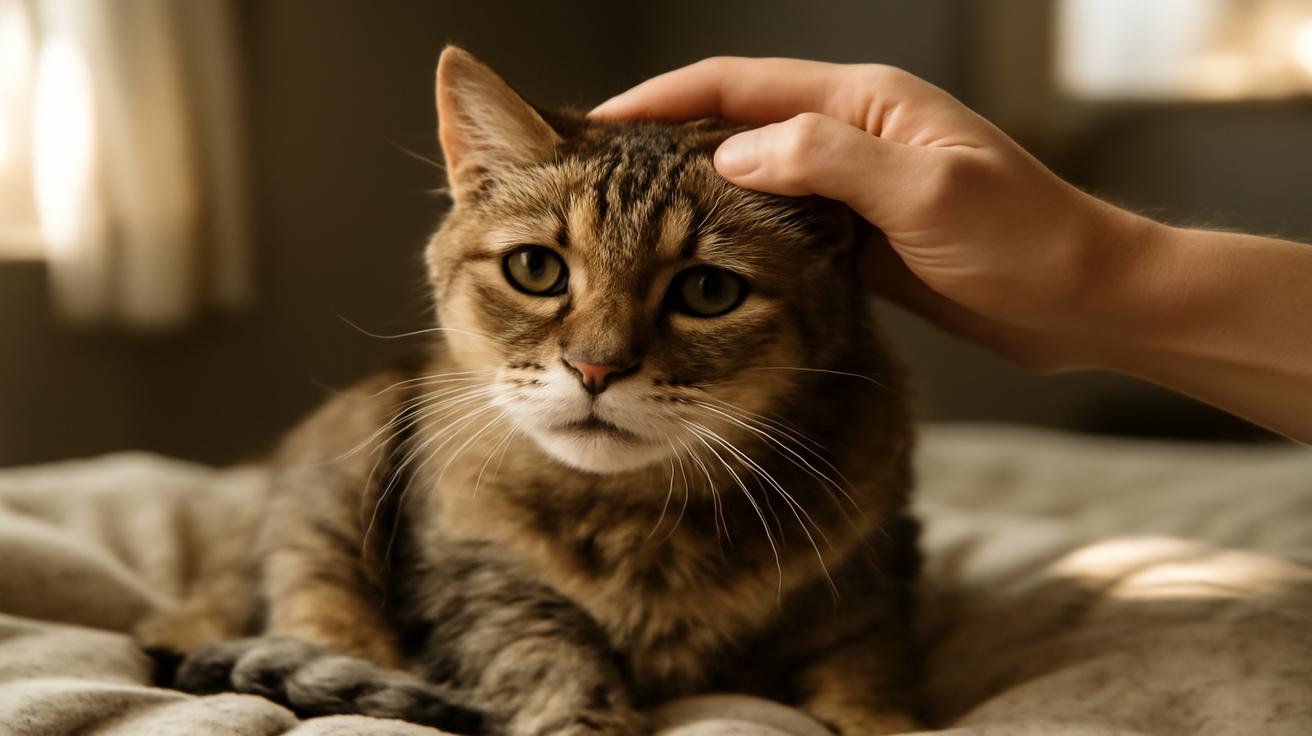
The first time you notice it, you almost convince yourself it’s nothing. Your cat, once a confident explorer of every high shelf and forbidden countertop, is standing in the middle of the living room, staring at the wall as if it holds some invisible doorway. Her ears twitch. Her tail makes a half-hearted sweep. Then she seems to remember herself, blinks, and walks away. You shrug it off—cats are weird, that’s part of the deal.
But then there’s the second time. The third. The night you wake up to a thin, wandering cry echoing down the hallway. She’s standing in the dark, halfway between your bedroom and the kitchen, looking lost in a house she’s lived in for over a decade. You call her name; she startles, then trots in with a slightly shaky purr, as if embarrassed to have been caught adrift.
It’s easy to joke that she’s “getting old,” the way people do about themselves when they misplace their keys. Yet behind the jokes, something uneasy settles in your chest. You start to wonder: could a cat forget? Not just where you left the treats, but the quiet, intricate map of her world? Could a cat’s mind actually fade?
The Hidden Winter in a Cat’s Mind
For years, veterinarians and researchers have watched aging cats and recognized familiar patterns: confusion, changes in sleep, random vocalizing, even accidents outside the litter box. But it’s only more recently that science has started to use a word many of us associate almost exclusively with humans: dementia.
A growing body of research suggests that cats can develop a dementia-like illness strikingly similar to Alzheimer’s disease in people. In veterinary terms, it’s often called feline cognitive dysfunction (FCD). Behind the clinical phrase is something intimate and quietly heartbreaking: the slow unraveling of a cat’s once-sharp awareness, the soft dimming of her inner compass.
When scientists examine the brains of older cats, especially those showing behavior changes, they sometimes find telltale signs remarkably like those seen in human Alzheimer’s: clumps of abnormal proteins, loss of specific neurons, and changes in the way brain cells talk to one another. The delicate electrical chatter that once guided a cat through her territory—your home, your garden, your balcony—begins to crackle and falter.
To understand this, picture a forest in late fall. Paths you once knew by heart are covered in leaves. Familiar landmarks blur in the gray light. The brain of a cat with cognitive dysfunction moves through a similar landscape: the trails are still there, but they’re harder to follow; the shortcuts are lost; the clearings are dim. The cat may stand at the threshold between rooms, unsure which way she was going, or wake in the middle of the night disoriented by shadows that used to be ordinary.
The Small Signs We Almost Miss
Ask any veterinarian who works with senior cats, and they’ll tell you: it’s not usually one glaring moment that draws people in. It’s a gradual collage of oddities—each small enough to dismiss on its own—that suddenly coalesces into a question: “Is something wrong with my cat’s mind?”
Researchers who study feline aging often group these behavioral changes into categories. One popular framework is summed up in a simple acronym that’s easy to remember during a vet visit: DISH. It doesn’t capture everything, but it’s a good doorway into the conversation.
| Letter | What it Stands For | What You Might Notice |
|---|---|---|
| D | Disorientation | Staring at walls, getting “stuck” in corners, seeming lost in familiar rooms. |
| I | Interaction Changes | Acting clingier or more withdrawn, changes in how the cat relates to people or other pets. |
| S | Sleep–Wake Changes | Pacing or yowling at night, sleeping more—or at odd times—during the day. |
| H | House Soiling | Missing the litter box, seeming to “forget” where it is or what it’s for. |
Not every change in an older cat is dementia, of course. Pain from arthritis can make a litter box hard to climb into. Kidney disease can trigger nighttime restlessness. Hearing loss can turn a quiet meow into a startling yowl. But those who live alongside old cats often describe a particular flavor of strangeness when the mind itself begins to slip.
It might be the twelve-year-old tabby who suddenly starts getting trapped behind the couch, meowing for help as if the once-familiar route around the furniture has evaporated. Or the dignified old queen who begins pacing the hallway at 3 a.m., her cries long and eerie, as though she’s searching for something that’s no longer there—an old companion, a younger body, a memory.
You see it in their eyes sometimes. Not the cloudy lens of cataracts, but a fleeting absence, a pause where recognition used to live. And then, just as quickly, your cat is back: chin-butting your hand, purring against your pillow, chasing a dust mote in a shaft of late-afternoon sun.
The Science Behind Feline Forgetting
What’s happening inside that small, sleeping head on the windowsill? How does a brain that once coordinated gravity-defying leaps and precision pounces start to betray its owner?
In human Alzheimer’s, scientists talk often about two main players: amyloid plaques and tau tangles. Amyloid plaques are clumps of a protein that accumulate between brain cells, interfering with their ability to communicate. Tau tangles form inside neurons, disrupting the micro-structures that help cells keep their shape and transport essential molecules. Together, these changes can slowly choke off the brain’s ability to process, store, and retrieve information.
In cats, researchers are discovering similar changes. Some aged feline brains show deposits of amyloid-like proteins that cluster in vulnerable regions—areas involved in memory, learning, and spatial awareness. Neurons that once formed vivid, three-dimensional maps of a cat’s world begin to thin and fade. The rich chemical conversations between brain cells grow quieter and more chaotic.
Of course, the story isn’t identical. Cats aren’t simply tiny humans with fur. Their lifespans, genetics, and brain structures differ, and the way dementia unfolds in them carries its own peculiar signatures. But the parallels are striking enough that some scientists are beginning to see elderly cats not only as patients to be helped, but also as potential models to deepen our understanding of dementia itself.
There’s a bittersweet irony in this. The same creature who’s curled on the arm of your reading chair could, in some small way, be offering clues to one of the most devastating human illnesses of our time. Her aging brain, mapped and studied with respect, might help illuminate why memory frays and how we might slow its unraveling—across species.
Living With a Cat Who Is Slowly Forgetting
If you’ve ever cared for an elderly cat who seems to be slipping, you know that science can only tell part of the story. The rest happens in the soft, ordinary minutes of a day: filling food bowls, cleaning litter, adjusting routines. It’s the way you start leaving more lights on at night, or the way your voice changes as you call your cat in from the garden, just a notch gentler, as if calling someone home through fog.
Living with a cat who may have a dementia-like illness means learning a new rhythm together. The cat who used to revel in unpredictability might now need sameness like a lifeline. Furniture left where it’s always been. Food placed in the same ceramic bowl, in the same patch of kitchen floor. Litter boxes added in easy-to-reach corners, with low sides that invite arthritic joints instead of challenging them.
It may mean adjusting your expectations. The cat who once threaded herself through the slats of a wooden chair now misjudges the gap and bumps softly against it. The hunter who never missed a jumping spider might stare, uncomprehending, at a slow-moving moth. You find yourself narrating the world to her: “Here’s your bowl. Here’s the couch step. I’m right behind you.” Your words aren’t magic, but they become a bridge, a way of reassuring both cat and human that the connection between you is still real, still present, even if some details blur.
There will be frustrating days. Days when the nighttime yowling frays your sleep and your nerves. When you find yet another damp patch on the rug. When your cat seems not only confused, but frightened, eyes wide, body tense in a way that tells you she’s not just being “quirky”—she’s genuinely adrift. Those are the days it’s hardest to remember that what you’re seeing is not stubbornness or spite, but a brain no longer able to keep all its threads neatly woven.
And yet, interspersed among the hard moments, there are still flashes of the cat you’ve always known. The particular trill she makes when you open a certain cupboard. The ritual of circling exactly twice before settling on your lap. The way, on a good morning, she still claims the sunbeam on the sofa with regal certainty, as if to say, “This is mine. This has always been mine.”
What You Can Do to Help an Aging Feline Mind
While there is no cure for feline cognitive dysfunction, that doesn’t mean you’re powerless. Much like in human dementia care, the focus shifts from fixing to supporting—from erasing the illness to easing its impact. If you suspect your cat may be developing a dementia-like condition, one of the most important things you can do is bring your observations to a veterinarian.
A vet will start by ruling out other causes: pain, kidney disease, hyperthyroidism, sensory loss, high blood pressure, and more. Many of these conditions can produce behaviors that mimic cognitive decline, and some are treatable or manageable in their own right. Describing not just what your cat is doing, but when and how often, can help your vet see the pattern.
If cognitive dysfunction seems likely, the plan that follows is usually a patchwork of small, thoughtful changes:
- Environmental stability: Keep furniture, bowls, and litter boxes in predictable places. Avoid major household rearrangements if possible.
- Multiple, accessible litter boxes: Especially in multi-story homes, add more boxes with low sides in easy-to-reach areas.
- Gentle enrichment: Simple puzzle feeders, slow and predictable play sessions, and short training games can gently exercise the brain.
- Light and sound cues: Soft nightlights and a small, consistent bedtime routine can ease nighttime confusion.
- Diet and supplements: Your vet may recommend specific senior diets rich in antioxidants, omega-3 fatty acids, or other compounds that support brain health.
- Medications: In some regions, there are drugs used to support cognition or reduce anxiety in aging pets. Your vet can guide you on what’s safe and appropriate.
Perhaps just as important is something less tangible: permission—to grieve, to adapt, to love this new version of your cat without constantly comparing her to her younger self. Caring for a cognitively impaired animal can feel strangely lonely; after all, few people talk openly about “cat dementia” over coffee. But the emotions it stirs up—sadness, tenderness, fatigue, fierce protectiveness—are deeply human, deeply valid.
Memory, Meaning, and the Quiet Work of Staying
Living alongside a cat whose mind is changing invites an uncomfortable but valuable reflection: what does it mean to know someone when their memories begin to thin? When the creature you love no longer navigates the world with the effortless confidence she once had?
In the end, memory in a cat may not function exactly as ours does, but connection often outlives the details. A scent, a voice, a familiar way of being touched—these may reach places in the brain that disease cannot quite erase. Many people caring for cognitively impaired cats describe a quiet, enduring recognition in the way their animals lean into a familiar hand or settle more deeply when they hear a certain voice.
You might find yourself redefining what “quality of life” looks like, not as a single threshold, but as a shifting landscape. Are there still moments of comfort, of curiosity, of pleasure? Does your cat still seek warmth, food, rest, gentle contact? You learn to read the subtle barometers: the looseness of her body when she sleeps, the way she eats, whether she still purrs when you stroke the soft hollow just below her ear.
There may come a day when her world has narrowed too far, when fear outweighs contentment, when the kindest choice is also the hardest one. But until that day—on all the days in between—there is the simple, complicated act of staying. You refill the bowl. You clean the accidents. You murmur into the darkness when the night cries start again. You bear witness to a small, beloved mind as it moves through its final season.
In doing so, you participate in a kind of quiet, everyday courage that rarely makes headlines or study abstracts. You affirm that a life does not lose its worth as it loses its sharpness. That an old cat staring at the wall at three in the morning is not just an inconvenience, but a being worthy of patience and care.
Somewhere, in a lab half a world away, a scientist may be peering at stained tissue slides from a feline brain, searching for patterns in pale tangles of protein. Their work matters. It may help unravel mysteries that haunt both cat and human families. But your work—sitting cross-legged on the kitchen floor at dawn, coaxing an old friend to eat, to trust, to rest—matters too.
Between the microscope and the food bowl, between the research paper and the rumpled blanket where an old cat sleeps, lies a shared truth: minds are fragile. Relationships are not. In the fading light of a cat’s later years, what remains is less about memory and more about presence—the steady, enduring choice to stay beside a creature whose world is shrinking, and to make that smaller world as gentle as you can.
FAQ
Can cats really get a form of dementia like Alzheimer’s?
Yes. While it’s not identical to human Alzheimer’s, many older cats develop a condition called feline cognitive dysfunction. It involves changes in the brain and behavior that closely resemble some aspects of human dementia, including disorientation, altered sleep, and changes in interaction.
At what age are cats most at risk?
Most cats begin to show noticeable age-related changes after about 10 years, with the risk of cognitive dysfunction increasing significantly after 12–14 years. However, not every senior cat will develop dementia-like signs.
How can I tell if my cat’s behavior is normal aging or something more?
Normal aging might mean moving a bit slower or sleeping more. Concerning signs include getting lost in familiar places, staring at walls, sudden changes in social behavior, nighttime yowling, and forgetting litter box habits. Any sudden or progressive change is worth discussing with a veterinarian.
Is feline cognitive dysfunction painful for the cat?
The condition itself isn’t thought to be physically painful, but it can be confusing and anxiety-provoking. Many older cats also have other conditions—like arthritis or dental disease—that can cause pain, so a thorough veterinary checkup is important.
Can medication or diet cure my cat’s dementia?
There is no cure at this time. However, certain prescription diets, supplements, and medications may help support brain function and reduce anxiety or sleep disturbances. These measures can often improve quality of life, especially when combined with environmental and routine adjustments.
When should I talk to my vet about my aging cat’s mind?
Any time you notice new, persistent behavior changes—particularly in an older cat—you should contact your vet. Early discussion allows you to rule out treatable causes and put supportive strategies in place before problems escalate.
How can I make life easier for a cat with cognitive decline?
Keep the environment predictable, add accessible litter boxes, use soft nightlights, maintain a calm routine, offer gentle mental stimulation, and be patient with accidents or confusion. Small, consistent adjustments can make a profound difference in your cat’s comfort and sense of safety.