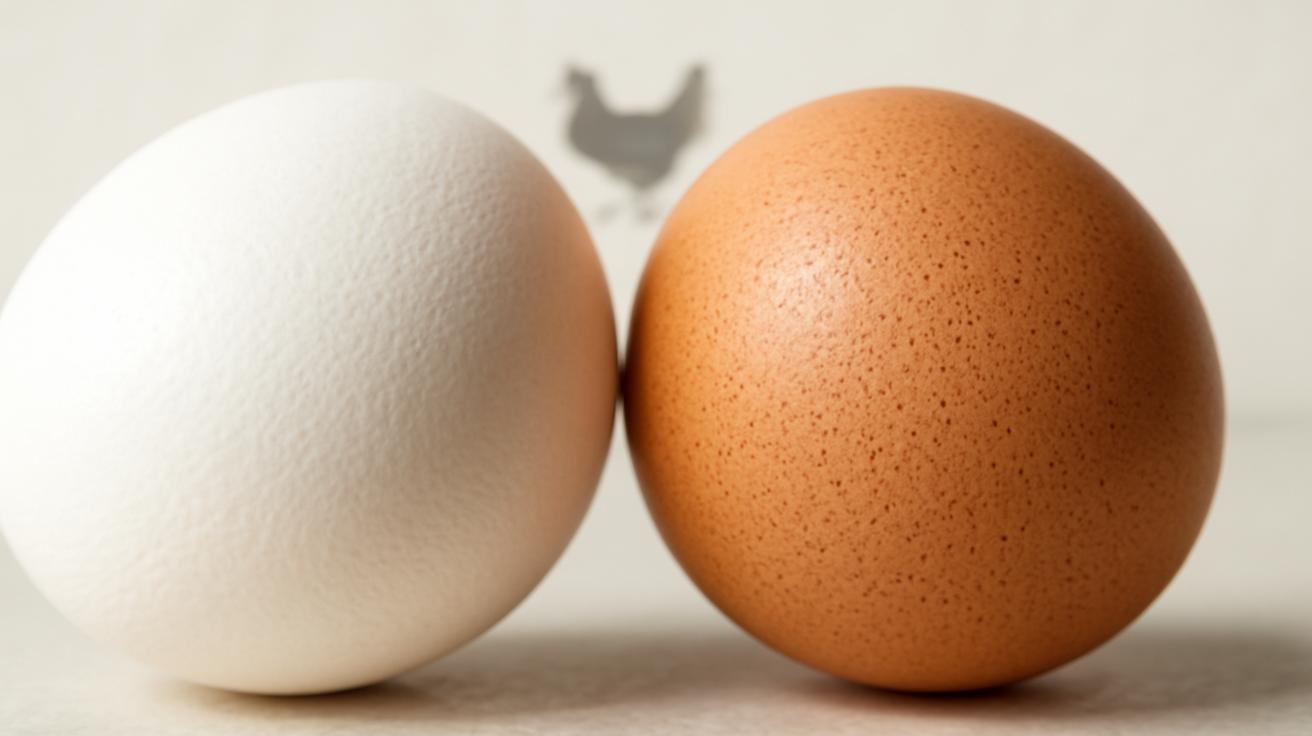
The first time you really notice an egg is almost never when you crack it. It’s when you’re standing in the cool light of a grocery aisle, fingers hovering over two nearly identical cartons. One says “brown eggs,” the other “white eggs.” Maybe the brown ones look more “natural,” more barnyard and wholesome. The white ones feel familiar, cafeteria-bright, the default egg of childhood. The price tags don’t help—brown, often, is a little more expensive, as if earth-toned shells must surely be hiding something superior inside. You choose one carton, close the fridge-like door, and walk away with a decision that feels oddly moral for something that comes from a chicken.
The Color Story Inside the Hen House
To understand why some eggs are brown and others are white, you have to step away from the fluorescent grocery aisle and into the softer, dustier light of a hen house.
Picture a row of nesting boxes, wooden and worn smooth by decades of feathers, straw, and the slow choreography of laying. The hens move with a sleepy sort of purpose. A Rhode Island Red hen—her feathers the color of rust and cinnamon—steps into a box, circles once, twice, then settles. A few boxes over, a white Leghorn, sharp-eyed and bright as a chalk line, does the same.
About 26 hours earlier, each of these hens began growing an egg inside her body. At first, every egg is colorless, wrapped in a chalky shell made mostly of calcium carbonate. In its pure form, that shell would always be white, no matter what kind of hen lays it. The shell is basically limestone in miniature.
Now comes the twist: toward the end of that 26-hour journey, the hen’s body decides what the shell will look like on the outside. Pigments seep into the shell while it’s still being formed in the shell gland. In brown-egg layers like the Rhode Island Red, a reddish-brown pigment called protoporphyrin IX is deposited onto the outer layers of the shell. In white-egg layers like the Leghorn, no pigment is added. The shell glides out of the hen pristine and white, like a blank page.
Shell color, in other words, is a matter of paint, not substance. The difference happens in the last stretch of the egg’s creation, like choosing the finish on a piece of pottery after it’s already been shaped and fired.
The Genetics Hiding in the Feathers
If you know what to look for, a hen will tell you what color eggs she lays long before she ever steps into a nesting box.
Walk into a pasture scattered with chickens. The birds are a living color chart. The white Leghorn, slender and restless, with her bright white feathers and light earlobes, will lay white eggs. The plump brown-feathered hen with reddish plumage and darker earlobes—your Rhode Island Red, Plymouth Rock, or Orpington—will lay brown eggs. The science hiding in that observation is genetics, quiet and precise.
Shell color is controlled by genes that determine whether the hen’s shell gland deposits pigments, and which kind. These genes are inherited, passed down from parents to chicks like feather color or comb shape. White-egg breeds carry the genetic instructions that simply say: “No shell pigment needed.” Brown-egg breeds carry a different set of instructions: “Apply brown pigment before release.”
The connection between earlobe color and shell color isn’t perfect across all breeds, but it’s a long-standing rule of thumb grounded in breeding history. Farmers selectively bred chickens not just for temperament or size but for predictable egg color, and over generations, those traits traveled together—white feathers with white eggs, red or brown feathers with brown eggs.
Some breeds write in more complex ink. The Araucana, Ameraucana, and their mixed cousins, often sold as “Easter Eggers,” produce blue or green eggs. There, another pigment steps in: biliverdin, a blue-green compound that colors the shell all the way through, not just on the surface like the brown pigment does. Crack a blue egg, and you’ll see that tint all the way through the shell’s interior, like sea glass. Combine brown and blue pigments in various ways, and you get greens and olive tones.
Science makes something very clear: an egg’s shell color is a genetic decision, not a nutritional one. The hen’s DNA picks the paint. The paint does not change the egg’s inner blueprint of protein, fat, and vitamins.
What Science Says About Nutrition, Taste, and Freshness
The clearest way to see through the myths around brown and white eggs is to look where science always looks—inside. Nutrition labs have been cracking eggs for decades, measuring everything from fat content to micronutrients with the cool curiosity of a chemist.
Here’s what those quiet experiments have found: If you compare a brown egg and a white egg from hens with similar diets and living conditions, their nutritional profiles are essentially the same. Same protein, same cholesterol, similar vitamins. Shell color is almost irrelevant.
What can change, however, are the details of how a hen lives and what she eats. Those differences sometimes travel with shell color, and that’s where the confusion begins.
In many regions, brown-egg layers are more often raised in smaller flocks, on pasture or in backyard settings. They may have access to bugs, grass, and a wider variety of feed. White-egg layers—like the famously productive Leghorn—are more often used in large commercial operations, where diets are tightly controlled, and movement is constrained. If you crack a brown egg from a backyard flock and a white egg from a generic supermarket carton, you might notice a few differences—the brown egg’s yolk may be a deeper orange, its flavor richer or more “egg-forward.”
But those differences are tracing the hen’s life, not her shell color. If you reverse the scenario—a white-egg hen roaming a pasture and a brown-egg hen living in a crowded barn—you can reverse those impressions too.
| Feature | Brown Eggs | White Eggs |
|---|---|---|
| Shell Color Source | Brown pigment (protoporphyrin IX) added near the end of shell formation | No pigment added; shell stays naturally white |
| Nutritional Content | Essentially the same as white eggs when diet and conditions are similar | Essentially the same as brown eggs under comparable conditions |
| Taste Differences | Can taste richer if hens have diverse, high-quality diets | Can taste milder or identical; flavor driven by diet and freshness, not color |
| Common Farming Context | Often backyard, small farms, or pasture in many areas | Often large commercial flocks, especially in industrial systems |
| Shell Thickness | Varies by hen age and diet, not inherently thicker because of brown color | Varies by hen age and diet, not inherently thinner because of white color |
Freshness, too, is colorblind. A white egg laid this morning will sit higher in a glass of water—its air cell still small—than a brown egg that has spent two weeks in the fridge. The wobble of a yolk in a frying pan, the clarity of the whites, the way it holds together in gently simmering water for poaching… those are all tied to time and storage, not shell hue.
Scientists have tested this directly. Double-blind taste panels, where people taste scrambled eggs or hard-boiled slices without knowing which color shell they came from, routinely fail to pick a consistent winner. When people do swear they taste a difference, it usually mirrors what they expect—if they’re convinced brown eggs are “healthier,” they’ll describe them as richer. Belief, here, is a kind of seasoning.
Why Brown Eggs Often Cost More
The price difference between brown and white eggs feels like a verdict—brown must be better, right? Healthier? More nutritious? But if shell color doesn’t change what’s inside, why do brown eggs so often come with a higher price tag?
The answer lives partly in the birds themselves. Many brown-egg breeds are larger and heavier than their white-egg cousins. They need a little more feed to carry their weight, a little more energy to lay the same number of eggs. Feed is one of the biggest costs in egg production. More feed per egg means a higher cost per carton.
There’s also history and marketing. For years, white eggs dominated large-scale commercial farms—white Leghorns are incredibly efficient layers, producing lots of eggs on less feed. Brown-egg breeds found their place on smaller farms and in local markets, where the aesthetic of a brown egg fit neatly into the story of “farm fresh” and “country raised.” Consumers started to associate brown shells with something more rustic, more honest, more real.
As demand for that feeling grew, so did the price people were willing to pay. Supermarkets responded. Brown eggs often show up in cartons that also say “cage-free,” “free-range,” or “organic”—all of which can legitimately raise the cost of production. Over time, brown became a kind of shorthand for “premium,” even though shell color itself doesn’t add a single vitamin.
A white egg laid by a hen on organic pasture and a brown egg laid by a hen kept indoors on a conventional diet would tell a very different story, nutritionally and ethically, than their shell colors suggest. But in the grocery aisle, the eye catches what’s easiest to see: brown, white, price, promise.
So What Actually Matters When You Buy Eggs?
If shell color is just cosmetic, how should you choose which eggs to bring home? Science and common sense quietly agree on a few things that matter more than whether the shell is brown or white.
First, the hen’s diet. Omega-3 enriched eggs, for instance, come from hens fed flaxseed, fish oil, or other rich sources of omega-3 fatty acids. Those compounds end up in the yolk, giving you eggs that truly are different inside. Deep orange yolks generally signal carotenoids—pigments from plants and insects the hen has eaten. A hen that can peck at grass and bugs all day may deliver yolks with more of these antioxidants.
Second, the hen’s health and living conditions. Birds that can move, dust-bathe, and express their natural behaviors are less stressed, and long-term, stress impacts immunity and productivity. That doesn’t automatically change the nutritional numbers in each egg in a dramatic way, but it does change the overall system you’re supporting.
Third, freshness. Store eggs cold if your region’s food safety system calls for refrigeration. Look at the “pack date” or “best by” date on the carton. A fresh egg will have a yolk that stands tall in the pan and whites that don’t run all over like spilled milk. If you’re not sure, there’s the classic water test at home: gently lower an egg into a bowl of cold water. Fresh eggs lie flat; older eggs stand or float, their air cells enlarged with time.
Against all of this—diet, living conditions, freshness—shell color begins to look like what it is: the least important detail, painted on at the last minute.
The Shell Itself: Strength, Safety, and Subtle Myths
Another quiet myth that pecks around the edges of this conversation is shell strength. Many people swear that brown eggs are tougher, harder to crack, more robust. Somewhere along the line, brown became a stand-in for “sturdy,” as if the color announced a thicker wall.
But shell strength is a more delicate chemistry. It depends on the hen’s age and how much calcium she can pull into each egg. Younger hens tend to lay eggs with thicker shells, whether they are brown or white. As hens age, the shells often grow a bit thinner. The hen’s diet, especially her calcium intake, shapes shell quality as well. Add in subtle factors like stress, disease, or overall health, and you have a whole web of influences on shell strength.
The brown pigment itself doesn’t significantly thicken the shell. It sits more like a stain than a second layer of plaster. When scientists measure shell thickness with precise instruments, they find plenty of thick white eggs and plenty of thin brown ones. Color alone predicts almost nothing.
Where color might play a minor supporting role is in protection against light. A darker shell can block a bit more light than a white one, which in nature may help shield a developing chick on a bright nesting site. But for the unfertilized eggs that end up in your kitchen, chilling in a closed fridge, that slight difference is less meaningful than how gently the carton was handled on its way to your door.
Seeing Eggs with New Eyes
Once you know the story that science tells, the egg aisle looks different. That brown carton and that white one are no longer symbols of “good” and “less good,” “natural” and “industrial.” Instead, they are a quiet record of breed choices, feeding strategies, marketing decisions, and our own cultural biases.
You might find yourself thinking not, “Brown or white?” but “How was this hen raised?” You might turn the carton to find the pack date, or notice that the richest yolks you’ve ever seen came from a neighbor’s motley backyard flock, where brown and white shells mingle in a basket on the counter like stones from different parts of the same river.
In that basket, freed from labels and price tags, the differences between brown and white begin to feel almost poetic instead of moral. They are variations in the same simple miracle: a complete package built in a day by a small, feathered body, carrying enough energy and order to hatch life—or to become your breakfast.
Science, in the end, has not robbed eggs of their mystery. It has simply shifted it. The real wonder is not whether the shell is brown or white, but that a hen can turn grain and sunlight and small green things into this perfect oval of possibility, day after day.
Frequently Asked Questions
Are brown eggs healthier than white eggs?
No. When hens have similar diets and living conditions, brown and white eggs are nutritionally almost identical. Shell color doesn’t significantly change protein, fat, cholesterol, or vitamin levels.
Why do brown eggs usually cost more?
Many brown-egg breeds are larger and need more feed, which raises production costs. Brown eggs are also often linked with specialty or small-scale farming—like organic or pasture-raised systems—which are more expensive to run. The higher price comes from the system and the breed, not from the color itself.
Do brown eggs taste better than white eggs?
Any taste difference usually comes from the hen’s diet and the egg’s freshness, not shell color. Hens that eat more diverse, high-quality feed (or forage outdoors) can lay eggs with richer flavor and darker yolks, whether those eggs are brown or white.
Are brown eggs safer than white eggs?
Safety depends on handling, storage, and hygiene, not shell color. Proper refrigeration, clean facilities, and good farming practices are what matter for food safety, regardless of whether the eggs are brown or white.
Which eggs are better for baking, brown or white?
They work the same in recipes. For baking, what matters is egg size and freshness. Shell color won’t change how your cake rises or your custard sets.
Are brown egg shells thicker than white egg shells?
Not consistently. Shell thickness depends mostly on the hen’s age and calcium intake. Younger hens tend to lay thicker-shelled eggs, whether brown or white. The brown pigment itself doesn’t add meaningful thickness.
How can I choose better-quality eggs if shell color doesn’t matter?
Look for clues about the hen’s life and the egg’s freshness: labels that describe housing or diet (like pasture-raised or omega-3 enriched), a recent pack date, and storage in a cold case. If you have access to local farms or backyard eggs, ask how the hens are raised and what they’re fed. Shell color is just the wrapping.