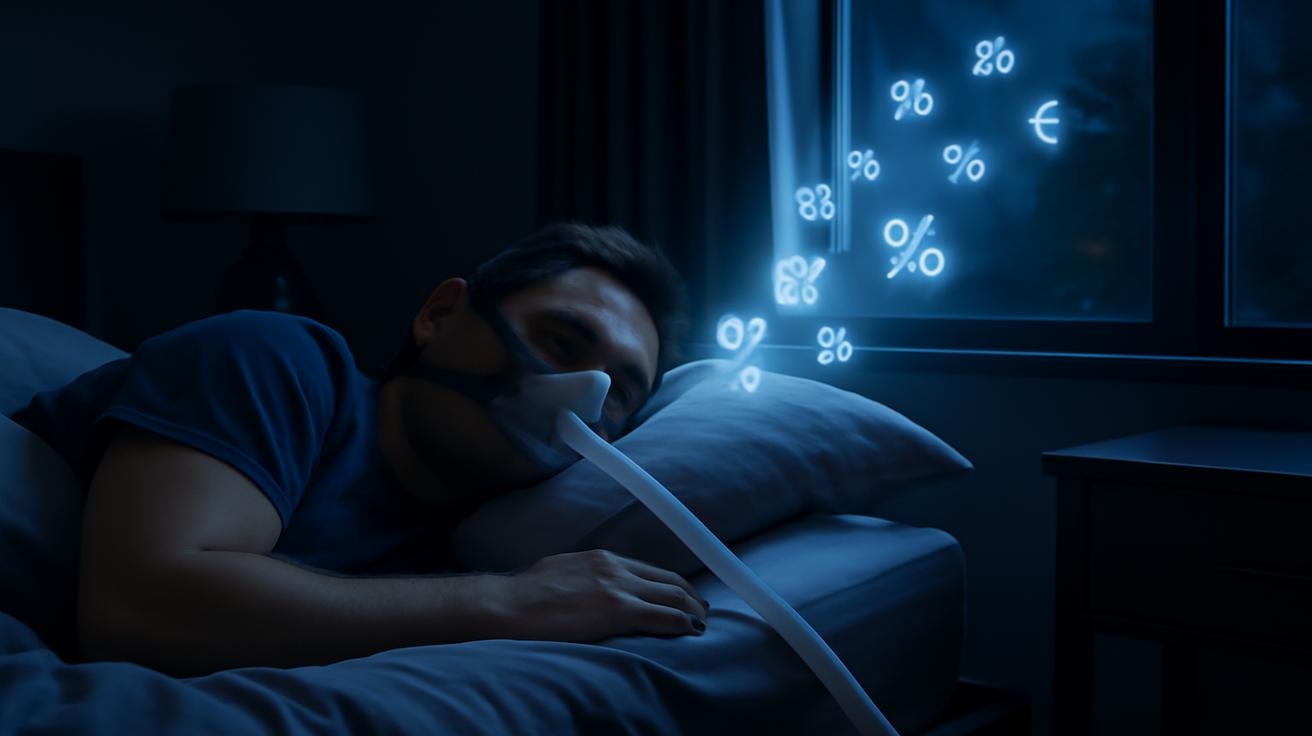
The man on the 7:02 a.m. commuter train looks like almost everyone else: collar slightly askew, coffee clutched in one hand, eyes half-open to a blur of scrolling news feeds. His head dips forward, jerks up, then dips again. You tell yourself he’s just tired; who isn’t? But if you could rewind his night, you’d see something stranger than simple exhaustion. You’d see his chest pause in the dark—stop, strain, then gasp back to life. You’d see his brain jolt awake again and again, hundreds of times, like a light switching on and off behind his closed eyelids. You’d see a perfectly ordinary night turned into a subtle kind of suffocation.
The quiet disorder that never clocks off
Obstructive sleep apnoea sounds technical, harmless even—like a minor snore with a fancy Latin surname. But step into a bedroom where it’s happening and nothing feels minor. The air is still. The only sound is a rough, ragged snore that suddenly cuts out. Silence stretches too long. The body on the mattress lies oddly still, as if suspended. Then, with a choking snort, breathing returns, the chest heaves, the cycle repeats. Every few seconds, every few minutes, all night.
In a body that’s supposed to be sinking into restoration, sleep apnoea is a nightly emergency drill. The throat collapses, the airway narrows like a tunnel filling with mud, oxygen levels drop, and the brain slams the panic button. Heart rate spikes. Stress hormones surge. Muscles tighten. You surface just enough to breathe again—but not enough to remember it in the morning.
From the outside, it leaves barely a trace: maybe a partner’s complaint about snoring, a dry mouth, a heavy head, that strange sense of having slept eight hours and still feeling like gravity has increased overnight. But beneath that quiet surface, something corrosive is happening. Cells take in less oxygen than they should. Blood pressure inches upward. Arteries stiffen. Insulin starts misbehaving. Mood and memory wobble.
Now zoom out. Imagine not one bedroom but millions across Western cities—London, Toronto, Sydney, Los Angeles—each dimly lit, each holding someone whose throat will close repeatedly before dawn. Most will have no diagnosis. They’ll rise with the sun, drag themselves through the day, and wonder why everything feels heavier, why coffee fixes nothing, why life seems slightly out of focus.
This is where obstructive sleep apnoea quietly steps out of the bedroom and onto the balance sheets of entire nations.
When a bad night becomes everyone’s problem
Economies, at their core, are not built from numbers or graphs but from people’s awake hours. A nurse moving from patient to patient on a night shift. A bus driver scanning the road. A software engineer solving an invisible tangle of code. A pilot on final approach in wet weather. Every decision they make—each careful step, each line of code, each glance in a mirror—depends on their brain being able to stay fully alert.
Obstructive sleep apnoea chips away at that alertness like a slow, invisible tide. People with untreated sleep apnoea often live in a state of permanent jet lag: their brains starved of deep sleep, their bodies stewing in stress hormones. They sit in meetings and struggle to follow the thread of conversation. They misplace tools. They reread the same paragraph three times. They park the forklift slightly off, send the email to the wrong address, forget the new procedure they were trained on last week.
It’s not dramatic. It rarely makes the news. But it’s everywhere. That accumulation of almost-errors and near-misses, of half-speed mornings and foggy afternoons, adds up to something enormous: lost productivity on a scale that rivals major recessions. Conservative estimates in Western countries suggest that obstructive sleep apnoea drains billions each year in reduced output alone.
And then there are the accidents. A lorry driver who nods off on a highway. An exhausted shift worker who blows through a red light. A surgeon whose hands are steady but whose attention, after too many fragmented nights, is not as sharp as it once was. Every collision on the road, every workplace mishap triggered by inattention, has a price tag—ambulances, repairs, insurance, court time, lost workdays. But behind each cost is a human story: a family car crushed at dawn, a worker who doesn’t come home from the factory floor.
Walk into a busy emergency department on a Monday morning and look at the aftermath of weekend accidents. Somewhere, woven through those injuries, is the trace of sleep apnoea. Not every case, of course. But enough to matter. Enough that economists who try to model this disorder’s impact keep arriving at the same uncomfortable conclusion: this isn’t a niche medical issue. It’s a slow leak in the hull of Western prosperity.
The invisible invoice: counting the true cost
Economists like to see things in tables: inputs, outputs, costs, benefits. Obstructive sleep apnoea refuses to be so tidy, but we can still sketch its economic shadow. Imagine a ledger where every line represents a consequence of one body that stops breathing in the dark, over and over again.
| Cost Category | How Sleep Apnoea Contributes | Economic Impact (Illustrative) |
|---|---|---|
| Healthcare spending | More heart disease, strokes, diabetes, depression, and related hospitalizations. | Billions in annual medical costs across Western health systems. |
| Workplace productivity | Fatigue, reduced focus, absenteeism, presenteeism (at work but not functioning well). | Billions lost in output and efficiency each year. |
| Accidents and injuries | Higher risk of car crashes and workplace incidents due to drowsy driving and impaired vigilance. | Costs from property damage, insurance, legal processes, and rehabilitation. |
| Social and family burden | Strain on relationships, caregiving demands, lost income from early retirement or reduced hours. | Harder to measure, but felt in every affected household. |
| Lost potential | Children and adults struggling in school or work due to untreated sleep disruption. | Long-term drag on innovation, learning, and economic growth. |
In Western economies where data is more easily tallied, analysts keep stumbling across the same pattern: people with untreated sleep apnoea are more expensive. Not in a moral sense, but on the raw numbers. They visit doctors more often. They’re more likely to turn up in cardiology clinics and diabetes wards. Their prescriptions pile higher. Their sick days accumulate faster. Their probability of being involved in a car crash is markedly higher than that of a well-rested driver.
Strangely, the disorder rarely appears on front pages. We are quick to headline the cost of pandemics, opioid crises, or aging populations, but sleep apnoea tends to be filed under “personal health issue” rather than “economic threat.” That misfiling is costing us. Imagine an entire mid-sized nation—millions of citizens—working at 80 or 85 percent of their mental sharpness, year after year. That is the kind of drag we’re looking at.
And while all this unfolds, the most expensive part of the story may be happening in complete silence: microscopic changes in the brain from years of disrupted sleep. Subtle shifts in memory, emotional regulation, and decision-making ripple forward into everything from workplace leadership to parenting. How do you put a number on the innovation never sparked because its would-be inventor was too exhausted to think clearly?
The misdiagnosis of “just being tired”
In Western cultures that wear exhaustion like a badge of honour, obstructive sleep apnoea slips by under a cloak of normalcy. Being tired is expected. Overwork is applauded. Falling asleep on the sofa before the credits roll is almost a cultural joke. So when a person drags themselves out of bed feeling flattened, they rarely think, “my airway might be collapsing hundreds of times a night.” They think, “I need stronger coffee.”
General practitioners—pressed for time, juggling dozens of concerns—sometimes miss the pattern too. High blood pressure? Here’s a pill. Depression? Let’s consider therapy or medication. Morning headaches, concentration issues, weight gain? Each symptom finds its own little pigeonhole, treated in isolation. The nocturnal thread stitching them together often goes unnoticed.
Partners may notice before doctors do. They lie awake, listening to the person beside them stop breathing, willing them to inhale again. They nudge, roll, prod. In the morning they say, “you should really get that checked,” but the one who snored remembers nothing. How serious can a problem be if you sleep right through it?
There’s also the quiet stigma. Snoring is still the stuff of sitcoms, of cartoon characters and exaggerated sound effects. People joke about it, post memes, poke fun at the snorer on family trips. Few imagine that behind those sounds might lurk a disorder that raises the risk of stroke and heart attack, sabotages blood sugar, and chips away at brain health.
All the while, the economic costs continue to mount. Companies subtly adapt to a chronically tired workforce: more coffee breaks, longer timelines, more staff to achieve the same amount of work. Governments sink money into treating end-stage disease instead of addressing one of its upstream drivers. Highways are redesigned after too many crashes on the same stretch of night road. We keep treating the symptoms of a half-asleep society while ignoring the cause.
Nature’s design, modern life’s disruption
To understand how we got here, it helps to step away from fluorescent-lit offices and rush hour traffic and think back to something wilder. For almost all of human history, sleep came with the dark. No blue-lit screens, no midnight emails, no streaming services whispering “just one more episode.” Bodies followed a rhythm tuned to sunrise and stars, breathing unobstructed in cooler, darker air.
Modern life has bent that rhythm into strange shapes. We eat late, under bright light. We sit more, move less, gain weight around our necks and midsections. We drink alcohol in the evenings, relaxing the very muscles that hold our airways open. We crowd into noisy cities and then try to sleep through the hum. The structure of our jaws and noses, influenced by diet and urban living, may be subtly shifting too—narrower arches, more crowded teeth, changes that can constrict the airway just enough to matter when muscles relax at night.
Obstructive sleep apnoea thrives in this environment. It’s the disorder of a world that has turned night into an afterthought, that has made rest negotiable. You can almost see it from the sky: a continental patchwork of glowing windows, each one sheltering a body that is supposed to be resting but is instead fighting a small, continuous battle for air.
In a forest, you might watch a fox curl into its den at dusk, its breathing slow and smooth, every exhalation a soft cloud in the cold air. In contrast, the human city at night is full of strained breathing, muffled gasps behind blinds and curtains. Nature designed us for restorative sleep; modern life keeps nudging us away from it, and the economy absorbs the impact.
Paradoxically, the very systems that could help—healthcare, research, workplace policies—often move too slowly. Diagnosis requires awareness, referrals, sleep studies. Treatment needs upfront investment in machines, support, follow-up. It’s easier, in the short term, to keep paying for the consequences than to rewire the structures that allow the problem to grow.
The surprising upside of switching the brain back on
There is another version of this story, though, and it begins in the same place: a bedroom at night, a person whose breathing falters as sleep takes hold. This time, there’s a small device by the bed or a slim oral appliance fitted before lights out. The airway stays open. The body, tentatively at first, then with mounting relief, remembers how to slide into deep, unbroken sleep.
The transformation can be startling. People who start effective treatment for obstructive sleep apnoea often describe it in almost cinematic terms: colour returning to a washed-out world, fog lifting from their thoughts, a missing gear in their brain finally clicking into place. They wake up and, instead of groping blindly for caffeine, they feel something unfamiliar: rested.
Multiply that feeling by millions and the economic implications become obvious. Treated sleep apnoea patients crash their cars less often. They visit hospitals less frequently. They tend to be more productive at work, more present at home, less prone to the cascade of chronic diseases that untreated oxygen deprivation encourages.
From an economic standpoint, the math is almost embarrassingly clear. The cost of diagnosing and treating obstructive sleep apnoea—sleep studies, equipment, follow-up care—is real but finite. The savings from fewer accidents, hospitalizations, sick days, and early retirements, on the other hand, stack up year after year. Many analyses suggest that, over time, the investment more than pays for itself.
Yet the benefits go deeper than balance sheets. Imagine a teacher who no longer snaps at students by mid-afternoon because their brain is starved of rest. A paramedic who responds to a 3 a.m. emergency with a mind that feels sharp instead of sandpapered. A grandparent who has the energy to read stories on the floor instead of watching, half-asleep, from the couch. These are not line items in a national budget—but they change the emotional economy of families, of communities.
On a societal scale, treating sleep apnoea is like quietly turning up the brightness on an entire population. Sharper thinking. Safer roads. More stable moods. Less strain on the healthcare system. The sort of subtle, background improvements that never generate dramatic headlines but quietly shift the trajectory of countries over decades.
From bedroom secret to national priority
So why, if the stakes are so high, does obstructive sleep apnoea remain so under-recognized? Part of the answer lies in its intimate setting. It happens in the dark, in private. There are no public rallies for breathing at night, no televised charity drives for quieter bedrooms. Sleep is singular; every person retreats to their own pillow, their own cycle of dreams and jolts awake.
Changing that means telling a different story about tiredness. It means teaching medical students to see chronic fatigue, resistant hypertension, and loud snoring not as isolated quirks but as potential clues to a treatable disorder. It means insurers and health systems recognizing that funding sleep diagnostics and equipment is not a luxury, but an investment that pays off in fewer ICU beds occupied years later.
In workplaces, it means moving beyond the macho myth of “I’ll sleep when I’m dead” toward policies that support rest as a cornerstone of safety and performance. Trucking companies scheduling shifts with sleep in mind. Hospitals protecting staff off-duty time. Employers making room, quietly but intentionally, for workers to seek help without fear of stigma or job loss.
And at home, it means learning to see snoring and relentless daytime sleepiness not as punchlines but as warning signs. To treat the gasping silence after a snore the way we’d treat chest pain in the afternoon: as something worth investigating, not ignoring. It means partners persistently urging, “please talk to someone about this,” and individuals giving themselves permission to believe that their exhaustion is not a personal failing, but a solvable medical problem.
There is nothing glamorous about obstructive sleep apnoea. It will never have the dark drama of a sudden epidemic or the political theatre of a budget crisis. It moves too slowly to scare us, too quietly to demand urgent action. But in aggregate, night after night, it is reshaping Western economies, draining billions in care and lost capacity, and dimming the potential of millions of lives.
Some crises announce themselves with alarms and sirens. This one arrives as a muffled snore, a long pause in the dark, and a sleepy commuter blinking at the blur of the morning train. Beneath that ordinary scene lies a question with extraordinary implications: how much brighter, safer, and more prosperous could our societies be if we simply let our people breathe—and truly sleep—through the night?
Frequently Asked Questions
What exactly is obstructive sleep apnoea?
Obstructive sleep apnoea (OSA) is a sleep disorder in which the upper airway repeatedly collapses or becomes blocked during sleep. This leads to pauses in breathing, drops in oxygen levels, and brief awakenings that fragment sleep—even if you don’t remember waking up.
How common is obstructive sleep apnoea in Western countries?
Estimates vary, but moderate to severe OSA likely affects a significant portion of adults in Western nations, with many cases going undiagnosed. The prevalence increases with age, higher body weight, and certain anatomical features of the jaw and throat.
Why does sleep apnoea affect the economy?
Sleep apnoea leads to chronic fatigue, poorer concentration, and health problems such as heart disease and diabetes. These issues reduce work productivity, increase sick days, raise healthcare costs, and contribute to more accidents on roads and in workplaces—all of which carry large economic consequences.
Is snoring always a sign of sleep apnoea?
Not always. Many people snore without having sleep apnoea. However, loud, frequent snoring combined with gasping, choking, or pauses in breathing—especially if paired with daytime sleepiness—is a strong reason to get evaluated for OSA.
Can obstructive sleep apnoea be treated?
Yes. Common treatments include CPAP (continuous positive airway pressure) devices that keep the airway open, oral appliances that adjust jaw position, weight management, positional therapies, and, in some cases, surgery. Effective treatment can dramatically improve sleep quality, health, and daily functioning.
How can someone know if they should be tested?
Warning signs include loud snoring, witnessed pauses in breathing, waking up choking or gasping, morning headaches, unrefreshing sleep, and daytime fatigue or difficulty concentrating. Anyone with these symptoms—especially if they also have high blood pressure or heart disease—should talk to a healthcare professional about a sleep evaluation.
What can governments and employers do about this problem?
Governments can fund public awareness, support accessible sleep diagnostics and treatment, and integrate sleep health into chronic disease strategies. Employers can promote healthy schedules, reduce stigma around sleep disorders, and encourage staff—especially in safety-critical roles—to seek evaluation and treatment when needed.