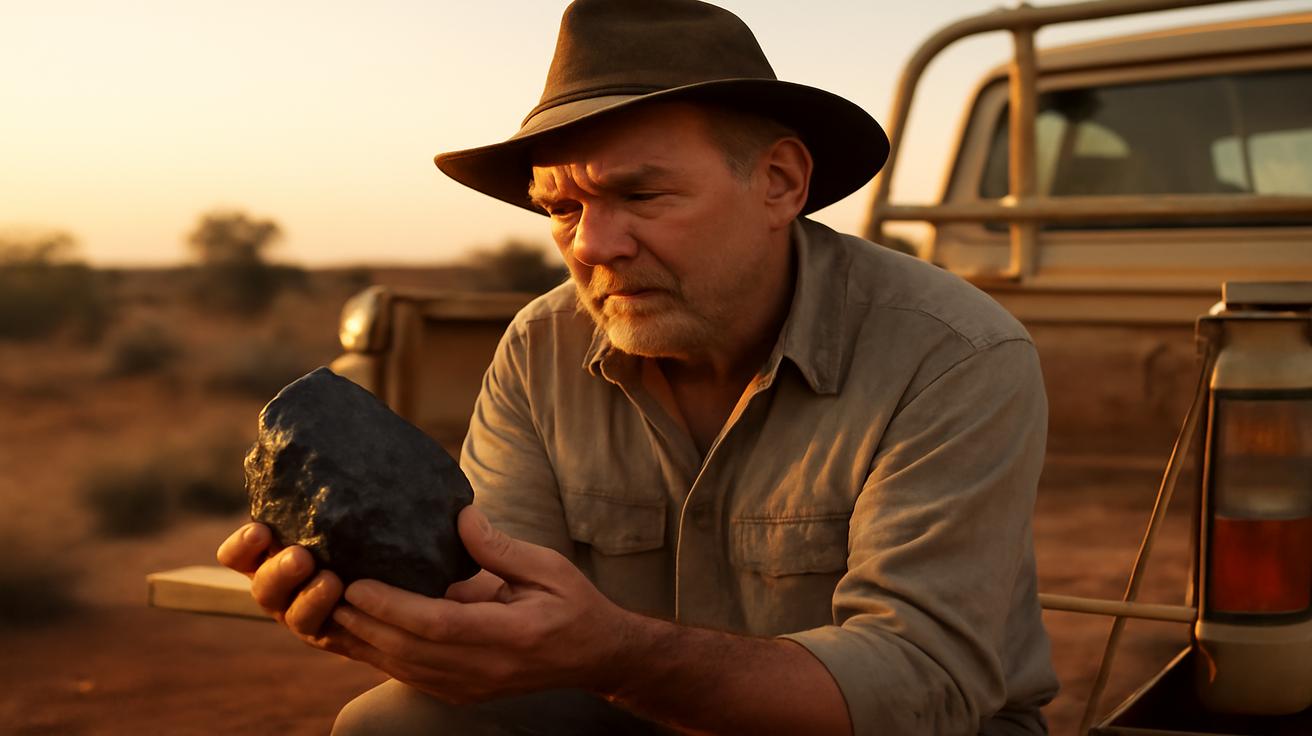
The rock was small enough to fit in the palm of his hand, but the longer he stared at it, the heavier it seemed to grow. It was 2015, and David Hole was alone in the red-dusted silence of Australia’s Goldfields region, the afternoon heat pressing on his back as flies stitched lazy circles around his hat brim. His metal detector had screamed over this patch of ground, a sharp, insistent signal that made his pulse jump. Gold, he thought. At last. The nugget every prospector dreams about. But as he turned the mud-caked lump over in his fingers, something felt off. It was too smooth. Too stubborn. Too strange.
A Rock That Wouldn’t Break
Back at home, David did what any hopeful modern prospector would do: he tried to set his treasure free. In his mind, that reddish, clay-hardened stone was hiding a heart of gold just waiting to gleam. He tried prising it open with a hammer and chisel. Nothing. He hit it harder, the clang of metal echoing through the shed. Still nothing. He soaked it in acid. He attacked it with a power saw. He even tried a rock saw engineered to slice through some of the toughest materials on Earth.
Nothing worked. The rock simply refused to give way.
It was dense, far denser than any ordinary stone he’d picked up. Smooth yet scarred with a pattern of shallow dimples, like the skin of an overripe orange that had been forged in a furnace. It didn’t look like the usual quartz, ironstone, or weathered sandstone you might expect from the Victorian bush. Holding it, he felt a curious mix of frustration and awe, as if he’d stumbled onto a secret that would not easily be coaxed into the light.
Weeks went by, then months. The rock migrated across shelves and benches in his house, gathering dust but never quite getting thrown out. Every time he caught sight of it, something nagged at him. What if it was gold? Or something else, something even rarer?
Finally, after two years of wondering, David did what many of us swear we’ll do and rarely actually manage: he took the mystery seriously. He walked his rock into the Melbourne Museum and placed it in the hands of people who spent their lives decoding the deep histories of stone and space.
From Gold to the Cosmos
In the softly lit back rooms of the museum, away from the noise of school groups and camera flashes, geologist Dr. Dermot Henry turned the rock over in his hands. He had seen thousands of specimens during his decades-long career—rocks bearing the fingerprints of volcanoes, glaciers, ancient seas. But this one tugged his attention in a particular way.
For one thing, it was heavy—far heavier than it had any right to be for its size. For another, it bore a tell-tale skin, a thin, dark crust burned onto its surface. And then there were the shallow pits, the thumbprint marks that spoke of cosmic fire and unimaginable speed.
They carried it for testing, not cutting it open, but peering inside using a tool far more gentle and revealing: an X-ray fluorescence spectrometer. When the elemental signatures came back, the truth turned David’s little “lump of gold” into something astonishing.
It wasn’t gold at all.
It was a meteorite—an iron-rich fragment of an asteroid, older than any gold vein, older than any mountain, older even than Earth’s own continents. Not just a rock from the ground, but a relic from space, a piece of the solar system’s raw beginnings that had survived a violent plunge through our atmosphere and come to rest in the soil beneath David’s boots.
He thought he’d found a fortune. Instead, he was holding time itself.
The Stone That Outlived Worlds
Meteorites like David’s are more than just space souvenirs. They are the original building blocks of our planetary neighborhood, material that has remained largely unchanged for over 4.5 billion years. Imagine that for a moment: while life on Earth crawled, walked, swam, flew, and finally built cities, this small, dense stone simply waited—first in space, then in the earth—carrying its quiet record of a time before any ocean shimmered under our sun.
Scientists estimate David’s meteorite formed early in the solar system’s history, when dust and rock swirled in a thick, hot disk around our young star. Some clumps grew into planets. Others collided, shattered, and reformed. A few were left drifting, incomplete, fragments of worlds that never fully came to be.
His particular specimen belongs to a class known as iron meteorites. These are thought to be shards of the metallic cores of ancient protoplanets or sizeable asteroids—bodies large enough that their heavier elements sank inward while lighter materials floated outward. When those proto-worlds collided and blew apart, their iron hearts were flung into space like broken bones.
At some point, long after the major fireworks of planet formation had quieted, one such iron fragment broke free of its lonely orbit and began a new journey. It crossed the dark reaches between Mars and Jupiter, then threaded a path through the inner solar system, where one small, blue world rotated patiently in its way.
When it finally met Earth, it did so at a terrifying speed—perhaps 40,000 to 50,000 kilometers per hour. The friction of our atmosphere burned its outer layer, leaving behind the charred fusion crust that still clings to its surface. Molten eddies of metal shaped the strange thumbprint hollows as air roared past at hypersonic velocities.
Most such visitors never make it to the ground. They flare brilliantly for a few seconds and vanish as meteors, “shooting stars” that live and die before you can finish a wish. But this one was big enough, strong enough, dense enough to survive the plunge. It slowed, cooled, and finally fell—probably thousands of years ago—onto a landscape nothing like the one David walked.
Red Earth, Old Stories
Long before prospectors and metal detectors, the land where David found his meteorite was home to Aboriginal peoples whose connection to sky and country stretches back tens of thousands of years. Across Australia, there are traditions that speak of stones falling from the heavens, of fiery sky serpents, of stars that seed the land with power or danger.
It’s impossible to know who first saw this meteorite strike—or whether anyone did. Maybe it came in the cool hush of pre-dawn, a silent streak across a cloudless sky. Maybe it fell with a sonic boom that rolled across the land like distant thunder. Or maybe it landed quietly, its long journey ending in a simple, unremarked thud.
Over time, wind and rain buried it. Grass grew and burned and grew again. Animals grazed, rivers shifted, dust settled. Still, the stone waited, its core unchanged, patient as only rock can be.
Then, one afternoon in the 21st century, a man with a metal detector swept his coil above that patch of soil and heard a sudden burst of electronic urgency. Two lifetimes intersected in that moment: the brief, bright spark of a human life, and the vast, slow arc of a rock that began its story before Earth even had an atmosphere thick enough to burn it.
The Science Inside a Space Rock
To a prospector, a stubborn rock is a problem. To a geologist, it’s a treasure chest. Museum scientists did what David could not: they looked inside the meteorite without breaking it open, using advanced imaging and chemical analysis.
They discovered a mix dominated by iron and nickel—typical of iron meteorites—along with tiny traces of other elements that help scientists identify its “family tree.” The patterns of metal within, if seen in cross-section, would likely reveal interlocking crystals known as Widmanstätten patterns, delicate geometric designs that cannot form in Earth’s fast-cooling environments. They need millions of years of slow, steady cooling within a parent body in space.
These structures act like a time signature, telling researchers how quickly the meteorite’s parent body shed heat, how large it might have been, and what kind of environment it formed in. When scientists cut a small slice from such a meteorite, polish it, and etch it with acid, those hidden metallic landscapes glare back like something out of a dream—a frozen clock of cosmic metallurgy.
To hold a meteorite is to hold evidence of processes we can barely replicate on Earth: the slow, inexorable cooling of planetary cores; the delicate dance of gravitational attractions; the chaos of cosmic collisions that shaped the architecture of our solar system.
But beyond the lab, meteorites live a second life: as objects of wonder.
How to Tell If Your “Weird Rock” Is From Space
If you’ve ever walked along a beach, a riverbed, or a dusty outback track and picked up a strange, heavy rock, you’ve probably felt that flicker of possibility. Could this be a meteorite? Most of the time, the answer is no. But not always.
Here are some of the features scientists often look for. They’re not foolproof tests, but they’re a start—and they underline just how unusual David’s find really was.
| Feature | What It Might Mean |
|---|---|
| Unusual weight for its size | Meteorites are often much denser than common Earth rocks, especially iron-rich ones. |
| Thin, dark “burnt” outer crust | A fusion crust forms when the surface melts and then cools quickly during atmospheric entry. |
| Shallow dimples or “thumbprints” | Called regmaglypts, these can form as the outer surface ablates and reshapes in flight. |
| Attraction to a magnet | Many meteorites contain iron and nickel, making them magnetic to some degree. |
| No bubbles or “airy” holes inside | Meteorites rarely have gas bubbles; bubbly rocks are usually industrial slag or volcanic rock. |
Even with these clues, the only reliable way to be sure is to have the rock examined by scientists. Museums, universities, and geological surveys often accept possible meteorites for assessment. Most hopeful submissions, as curators will gently tell you, turn out to be terrestrial—the infamous “meteor-wrong.”
David’s rock was one of the rare exceptions. Not only genuine, but scientifically valuable.
Why These Ancient Visitors Matter
To some, a meteorite is mostly a curiosity or a collector’s item. To planetary scientists, it is a messenger from an era we can never revisit, a physical record of conditions that existed before Earth settled into its present form.
From meteorites, we learn the age of the solar system by dating the decay of radioactive elements locked inside. We trace the distribution of water and organic molecules, clues to how life-friendly ingredients found their way to Earth. We peer into the deep interiors of destroyed worlds, understanding how planets separate into cores, mantles, and crusts.
Some meteorites even contain tiny grains—presolar grains—that are older than the solar system itself, tiny stardust crystals forged in the atmospheres of ancient, dying stars and swept into the cloud that would collapse to form our sun and its planets. In a handful of grams, you can find history written across scales so vast they’re almost impossible to comprehend.
And yet, the story returns, always, to something intimately human: someone walked across a field, or a desert, or a patch of scrubland, and bent down to pick up a stone. Curiosity bridged the gap between everyday life and cosmic time.
David could have left his rock where he found it. He could have tossed it aside when it didn’t break apart. But he didn’t. And that small act of attention—of wonder—added one more piece to the grand puzzle of how our solar system came to be.
The Humbling Gift of Looking Up
There’s a strange comfort in knowing that while we go about our daily tasks—commuting, scrolling, cooking dinner—pieces of other worlds occasionally fall into our own. Our planet is not sealed off; it’s part of an ongoing exchange, an open system of stone and ice and dust drifting and colliding in the dark.
Stand outside on a clear night, and you might see one of these future meteorites in its brightest, briefest moment: a streak of light carving its name into the sky before vanishing. Most will never be found on the ground. They’ll erode away or sink into the ocean floor. But a stubborn few, like the rock in David’s hands, will outlast us.
And maybe, centuries from now, someone else will be walking across some sunburnt paddock, metal detector in hand, listening for that urgent, high-pitched beep that says: there is something here. Something much older than you. Something that has traveled farther than you ever will.
Maybe they’ll think, as David did, that they’ve struck gold. Maybe they’ll be right, only not in the way they expect.
Frequently Asked Questions
Was the rock David found actually valuable in terms of money?
In pure financial terms, most meteorites are not worth as much as people imagine, especially compared with a large gold nugget. Their true value is scientific and cultural: they offer irreplaceable information about the early solar system and are often preserved in museum collections for public education and research.
How common are meteorites in Australia?
Australia, with its wide open spaces and often dry, stable landscapes, is a good place to find meteorites. Dark rocks stand out against pale sands and soils, and low rainfall can help preserve specimens for long periods. Even so, genuine meteorites are still rare compared with everyday rocks.
Can anyone bring a suspected meteorite to a museum?
Yes. Many museums and universities around the world accept suspected meteorites for examination. It’s best to contact the institution first, provide clear photos, and describe where and how you found the rock. They can then advise whether it’s worth bringing in for testing.
Are meteorites dangerous or radioactive?
Meteorites are generally not dangerous. Their radioactivity levels are typically similar to those of common terrestrial rocks. They’re not toxic to handle, though washing your hands after handling any rock or soil sample is always sensible practice.
What should I do if I think I’ve found a meteorite?
First, keep the rock as intact as possible—don’t cut, polish, or break it. Take clear photos from multiple angles and note the exact location where you found it. Try a magnet test and observe its weight and surface features. Then reach out to a local museum, university geology department, or geological survey for guidance. Your “odd rock” might just be a fragment of the solar system, waiting to tell its story.