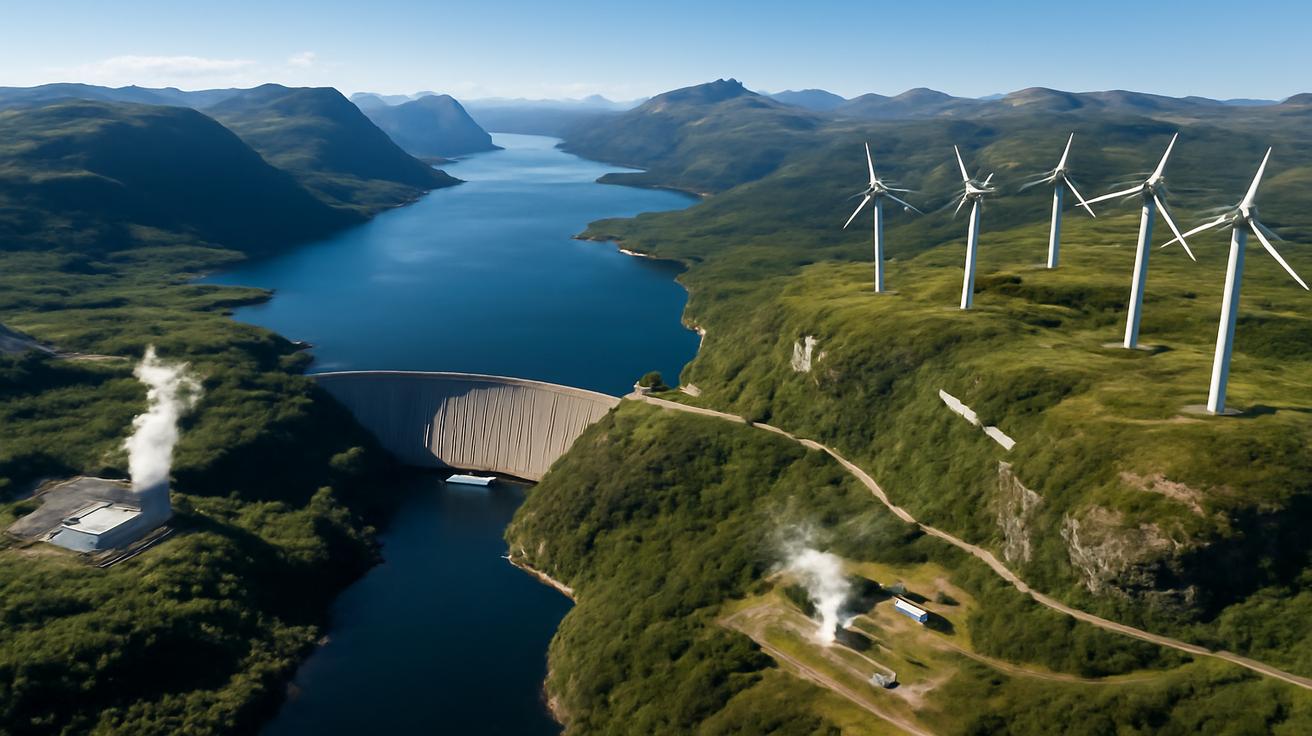
On the train north, the smudged window became a moving watercolor of silver rivers and dark pines, and I realized I was staring at a country that has quietly turned climate ambition into daily habit. Wind turbines, like white brushstrokes, spun slowly along distant ridgelines. Solar panels clung to barn roofs, not as futuristic ornaments but as matter-of-fact tiles, weathered by rain and gulls. Somewhere beyond the fjord, another record was being broken: another day of almost fossil‑free electricity, another year of rising forest, another village swapping diesel for something cleaner, quieter, cleverer. While much of Europe argues, postpones, and steps sideways, this place seems to keep walking—sometimes stumbling, sometimes sprinting—but always forward.
A country that runs on waterfalls and stubbornness
You notice it first in the sound. Not traffic, not engines, but water. It’s in the white roar of the river shouldering its way down a valley, in the hiss of rain along a mossy rock face, in the softer shuffle of a tide slipping through a harbor framed by wooden houses. For Norway, water is not just scenery. It is electricity, history, and—if you listen carefully—a kind of stubborn promise.
More than 90 percent of Norway’s electricity comes from hydropower, a figure so high it reads almost fictional for a developed, industrial country. Massive reservoirs carved out in the early and mid‑20th century, once dismissed as cold monuments to over-engineering, are now the quiet engines of a green revolution. A flick of a light switch in Oslo or Bodø is powered not by coal or gas, but by gravity and rain.
Europe, viewed from this valley of hydropower, looks oddly stuck. The European Union has talked big on climate for years—colorful roadmaps, timelines, sweeping speeches in echoing parliaments. But the reality is more complicated and less flattering: coal plants still humming in parts of Eastern and Central Europe, gas pipelines treated like umbilical cords, political parties campaigning on slowing, not speeding, the green transition. Targets slip. Deadlines get rephrased as “aspirations.”
Norway has its own contradictions, of course. An oil‑funded economy striving to lead on clean energy is a paradox etched into every national debate. Yet the difference lies in what actually changes on the ground. While other countries wrangle over pilot projects and future scenarios, Norway keeps stacking up practical, measurable records—kilowatt by kilowatt, car by car, heat pump by heat pump.
Where the quiet streets hum with electrons
Walk through downtown Oslo on a weekday morning and the scene feels familiar: cyclists in reflective jackets, parents herding children to school, delivery vans crowding narrow streets. What’s different is the sound—or rather, the absence of it. The engine noise feels strangely dialed down, as if someone took the city’s soundtrack and skimmed off the low, growling layer.
In 2023, more than 80 percent of all new cars sold in Norway were fully electric. Add in plug‑in hybrids and the share of plug‑in vehicles climbs even higher. On some mornings, watching a line of silent cars glide through the drizzle, you might struggle to spot a traditional exhaust pipe at all. It’s not unusual to see elderly neighbors plug in their compact EV in a courtyard while a delivery company quietly tops up its electric vans nearby.
Across Europe, government ministers stand next to gleaming electric prototypes at press conferences, promising that the transition is coming “soon.” But “soon” is a slippery word. In Germany, France, Italy, and Spain, the EV share of new car sales has grown, but still floats far below Norway’s near‑total dominance. Incentive schemes start, stop, get watered down, or vanish with a change of coalition. Charging networks lag behind enthusiasm. Drivers are curious but cautious.
Norway’s approach, in contrast, has been almost disarmingly pragmatic: tax what you don’t want, reward what you do. High taxes on gasoline and diesel cars, exemptions and perks for EVs—reduced tolls, cheaper parking, access to bus lanes in the early years—and a fast‑growing charging network turned what once felt like an eco‑statement into the default choice. The culture shifted not in a blaze of rhetoric, but in a series of small, practical nudges that, together, rewired the market.
On a crisp winter morning, with the low sun smearing the sky in pale gold, you might step into a Norwegian grocery store and realize that the delivery truck that just rolled away was electric. The taxi that brought you here? Also probably electric. The bus waiting at the corner? Increasingly likely to hum, not roar, as it pulls off. This is what a “record‑breaking” transition looks like up close: boring, convenient, and quietly transformative.
Numbers that tell a different story
Behind the sensory details, the data sketches out how far ahead this small country has pulled. Consider just a few indicators from recent years:
| Indicator | Norway | EU Average | What It Means |
|---|---|---|---|
| Share of renewables in electricity | ≈ 98–99% | ≈ 40% | Norway’s power grid is almost fossil‑free; the EU still leans on coal and gas. |
| EV share of new car sales | 80%+ (battery EVs) | ≈ 15–20% | Norway is years ahead in electrifying road transport. |
| Emissions per person (CO₂ from energy) | Well below EU’s heavy industrial states | Higher, especially where coal remains | Cleaner power and transport lower Norway’s per‑capita footprint. |
| Forest area trend | Growing, net carbon sink | Mixed; some countries losing forest | Norway’s managed forests absorb more CO₂ than they emit. |
It’s not that Europe lacks the technology. Wind turbines turning above the North Sea, solar farms shimmering in Spanish fields, spotless new metros gliding under Paris and Copenhagen—all these exist. What’s missing is the same consistency, the same refusal to let climate policy become a political toy tossed between elections. Norway, with fewer people than some major European cities, used its scale almost as an advantage: smaller, yes—but nimble.
Forests that remember, and a future being planted
Far from the cities, the stories become quieter and older. In a Norwegian forest, if you walk long enough, you reach places where the air feels padded, as if sound itself has grown moss. Spruce trunks rise in orderly ranks, a living archive of post‑war replanting. In the undergrowth, older birch and pine hint at the messy, wilder forests that once covered more of the land.
Norway’s forests are not untouched wilderness; they are, in many places, carefully managed landscapes. Yet they hold another of the country’s quiet records: they are a significant carbon sink, absorbing more greenhouse gases than Norway’s land‑based emissions release. Each ring of growth in a tree trunk is a thin, woody record of the atmosphere it drank from that year.
Across Europe, forest stories read very differently. There are signs of hope—rewilded valleys in Scotland, expanding woodland in parts of France and Spain—but also of loss: clearing, fragmentation, fires aggravated by hotter, drier summers. Competing demands for land—food, housing, bioenergy, biodiversity—turn every forest policy into a tug‑of‑war.
Norway’s balancing act is far from perfect; environmental groups still clash with loggers, and disputes flare over roads and wind farms that cut through reindeer grazing lands and wild plateaus. Yet, on balance, the country has managed to keep its forest carbon ledger in the black. Policies incentivize sustainable forest management, wood products that lock away carbon, and protection of key habitats and old‑growth pockets. The forest becomes not just scenery, but infrastructure—green, silent, and essential.
When Europeans debate carbon neutrality on talk shows and in parliaments, these forests are already doing the work, year after year, whether or not politicians remember to mention them. The trick, which Norway has at least begun to practice, is to see forests as more than an extractive resource, but less than a sacred museum: living systems that can both host life and help cool a feverish planet.
Heat that comes from beneath your feet
Step into a new apartment block or school in many Norwegian towns, and the warmth you feel may not come from a roaring boiler in the basement. Instead, invisible circuits of warmth loop quietly through the building: heat pumps pulling energy from the air, the sea, or the bedrock; district heating pipes circulating recovered heat from data centers, waste incineration, or industrial processes.
Heating is Europe’s hidden climate problem. While electricity has become the glamorous frontier—solar! wind! hydrogen!—the humble act of keeping buildings warm still devours gas and oil across the continent. From Polish coal stoves to Italian gas boilers, heat is stubbornly old‑fashioned.
Norway has leaned into alternatives. Ground‑source and air‑source heat pumps have spread into homes and offices; building codes and subsidies pushed adoption steadily upward. Data centers, instead of venting their waste heat into the sky, are increasingly plugged into local heating networks. In coastal towns, seawater itself becomes a thermal reservoir, its chill hiding a surprising amount of usable energy.
The result is another climate advantage that’s harder to photograph than a field of solar panels, but no less significant. Each replaced oil boiler, each quietly humming heat pump, nudges national emissions down again. Meanwhile, many EU states still argue over how fast to phase out gas boilers, torn between short‑term fuel prices and long‑term climate commitments.
The paradox of the oil‑rich climate champion
To understand Norway’s green records, you have to sit with an uncomfortable truth: this is a country whose wealth is built on oil and gas. The sovereign wealth fund—one of the largest in the world—was filled by fossil fuels. The roads that EVs glide over were partly paid for by offshore exploration. The hydropower dams and EV chargers were rolled out by a state that still licenses new oil fields, even as it declares high climate ambition.
From the outside, this looks perilously close to hypocrisy. How can a nation claim climate leadership while shipping fossil fuels abroad? Why should Europe applaud Norway’s electric cars when Norwegian gas still heats European homes and powers EU factories?
Inside Norway, the conversation is more jagged and intimate. Politicians speak of “transition, not collapse,” arguing that a too‑sudden shutdown of petroleum would destabilize both the economy and European energy security. Activists, especially younger ones, push back, staging protests, challenging new exploration in court, demanding a clearer end date to fossil extraction. Coastal communities worry about jobs. Engineers wonder what their skills will be worth in twenty years.
And yet, in this paradox, something important is happening. The very fact that a major fossil exporter is racing ahead on domestic decarbonization changes the tempo of Europe’s conversations. Norway’s electric ferries, zero‑emission construction sites, and near‑zero‑carbon grid are no longer theoretical models; they are living counterarguments to the claim that “it can’t be done” or “it will ruin the economy.”
Europe, watching from across the North Sea and down the train lines, sees a complicated but undeniable example: a small, oil‑rich country redirecting its wealth, bit by bit, into a future in which that oil becomes less and less central. Imperfect? Absolutely. But compared to the foot‑dragging in some EU capitals, the contrast is stark.
Why Europe is stalling while Norway sprints
So why does this country keep breaking green records while much of Europe falls behind? Geography gives part of the answer: Norway’s steep valleys are perfect for hydropower; its cool climate favors heat pumps; its small population and high income make transitions easier to finance and manage.
But geography is only the stage. The script is political and cultural. Norway turned climate policy into a relatively stable, cross‑party project. Successive governments, from left and right, kept nudging in the same direction—sometimes faster, sometimes slower, but rarely reversing outright. People came to expect that electric mobility, renewable power, and efficient heating weren’t fads but the new normal.
In contrast, Europe’s green push often feels like a pendulum. One election brings ambitious climate packages; the next summons backlash and slowdowns. Farmers protest fuel taxes. Truckers blockade highways. Parties campaign on “defending drivers” and protecting “ordinary people” from the alleged excesses of climate policy, as if clean air and stable weather were luxury goods.
Norway has not escaped protest or backlash. But incentives were structured to feel less like punishment and more like a deal: pay more if you want to keep the old way; get a smoother path if you switch. The result is a cultural shift where driving electric or installing a heat pump is not a moral badge but a smart, sometimes cheaper choice.
And there is something else: trust. In surveys, Norwegians often report relatively high trust in public institutions. When authorities say toll revenues will fund better public transport, or that electricity taxes will support grid upgrades and green infrastructure, more people believe that this might actually happen. In parts of Europe where trust is thinner, every climate policy can look like a scam in disguise.
Lessons from a rainy, record‑breaking country
The rain was still falling when the train finally rolled into its last stop, a gauzy curtain along the windows, blurring the edge between sky and earth. Stepping onto the platform, I watched someone unplug their small electric hatchback, brush sleet from the windshield, and drive off without a sound. Nearby, a ferry waited at the dock, its battery packs tucked away under a clean white hull. Above it all, the dark shapes of spruce and pine held the hill, drinking in another wet, wind‑torn afternoon.
What Norway shows is not perfection, nor an easily copy‑and‑paste model. Its hydropower riches can’t be replicated everywhere. Its oil‑funded wealth is both blessing and burden. Its politics, though calmer than many, are still laced with tension and contradiction. Yet beneath all that complexity lies a set of simple, transferable lessons for a Europe that risks losing its climate lead:
- Make the clean choice the easy, obvious, and eventually cheapest choice.
- Use today’s wealth—however derived—to build the foundations of tomorrow’s economy.
- Treat forests, coastlines, and rivers as climate infrastructure, not background scenery.
- Stick with policies long enough for people to believe the direction won’t suddenly flip.
- Accept the paradoxes, debate them fiercely, but keep moving.
On a map, Norway appears as a long, frayed edge of Europe, a narrow band of land pressed between mountains and sea. In the climate story, though, it has become a kind of leading indicator—a preview of what a decarbonized power system, electrified transport, and revalued nature might look like when they stop being slogans and start being the everyday texture of a society.
Europe can choose to read this as an embarrassment: a reminder that a small, rainy, sparsely populated neighbor is doing more, faster. Or it can treat it as an invitation. The technology is not the issue—wind, solar, batteries, heat pumps, forest management, electric ferries, all of these are now well understood. What’s missing is the will to string them together with the same dogged, day‑to‑day persistence.
Somewhere tonight, another Norwegian record will quietly fall—another percentage point of EVs, another coal‑free hour on the grid, another hectare of forest reaching maturity. The rest of Europe, stuck in traffic behind its own hesitations, might do well to look up at the turbines on that far ridge and ask not whether this is possible, but how long it can afford to wait.
Frequently Asked Questions
Why is Norway so far ahead on renewable electricity?
Norway built extensive hydropower infrastructure over many decades, taking advantage of steep terrain and abundant water. That early investment means its grid is now almost entirely powered by renewable sources, mainly hydropower, with growing contributions from wind.
Is Norway’s electric vehicle success only because it’s a rich country?
High income helps, but policy design is crucial. Norway heavily taxed fossil‑fuel cars while exempting EVs from many taxes and fees, making electric cars financially attractive. Clear, long‑term incentives and strong charging infrastructure encouraged rapid adoption beyond what income alone would explain.
How can Norway claim climate leadership while exporting oil and gas?
This is one of Norway’s central contradictions. Domestically, it has cut emissions in power and transport, but its exported fossil fuels still contribute to global emissions. Supporters argue that Norway is managing a gradual transition; critics say true leadership requires planning a faster phase‑out of extraction.
Can other European countries replicate Norway’s model?
Not exactly—few have Norway’s hydropower potential or its specific economic history. But many elements are transferable: strong, consistent incentives for clean technology, investment in grid and charging infrastructure, modern heating systems, and policies that value forests and ecosystems as climate assets.
What is the main reason Europe is falling behind Norway on green progress?
The gap comes less from technology and more from politics and policy stability. In much of Europe, climate measures swing with elections and face strong short‑term backlash, slowing implementation. Norway has maintained a more consistent direction, turning climate goals into practical, everyday changes rather than distant promises.