The first snowstorm of the year usually doesn’t announce itself loudly. It just sort of appears—soft, sideways flakes drifting across the highway, turning the world into a smudged watercolor painting. One minute your wipers are smearing cold rain; the next, the road is a quiet, slick ribbon of white. Your hands tighten on the wheel. The car ahead of you brakes a little too hard. You test your own brakes, just to feel how the tires respond. That subtle slide—barely a whisper under your fingertips—asks a question that’s as old as the first frosted windshield: are these really the right tires for this road, in this weather, right now?
When the Road Turns to Ice: What Your Tires Are Really Doing
Most of the time, we treat tires like background characters. We buy a set, maybe notice the price and the brand, then forget about them until something goes wrong. But when the weather changes—really changes—they become the main characters in the story of whether you get home safely or not.
Imagine you’re driving on a cold morning. Maybe there’s just a dusting of snow, maybe it’s only near freezing, the kind of day where your breath hangs in the air but the sun still feels like it’s trying. The road looks wet, not dangerous. You approach a corner you’ve taken a thousand times. You tap the brakes. The car hesitates, slides just an inch farther than you expected. That tiny delay? That’s your rubber chemistry, your tread design, your temperature rating—all revealing themselves in a split second.
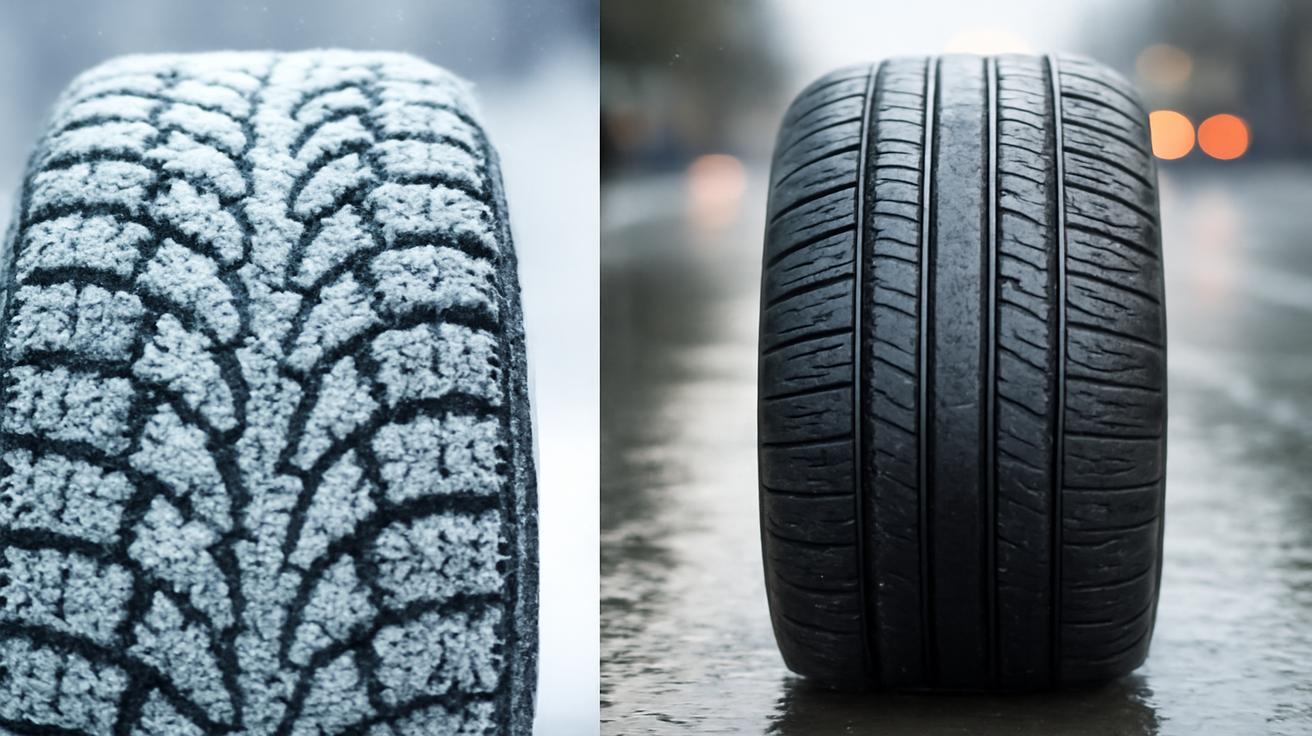
All-season tires and winter tires look similar at a glance: black, round, patterned with grooves. But under that ordinary appearance, they are built for different worlds. All-season tires are the generalists, the jack-of-all-weathers. They’re designed to do “pretty well” across warm summers, cool autumns, mild winters, and wet springs. Winter tires, on the other hand, are specialists. They are built for one thing above all: control in cold, snow, and ice.
On a microscopic level, rubber behaves like a living thing. In warmth, it’s flexible, able to mold itself onto the tiny imperfections in asphalt, creating grip. In cold, regular rubber stiffens and hardens. Think of a rubber band left in the freezer: brittle, unyielding, more likely to snap than stretch. That’s what can happen to the compound in many all-season tires once temperatures dip below about 7°C (45°F). Winter tires, tuned for cold, stay softer, almost sticky, even when the wind bites and your breath fogs the cabin glass.
The Science of Grip: Winter vs. All-Season, Side by Side
It’s easy to assume all tires are roughly equal until the snow piles up. But the difference isn’t just about deep snow; it starts long before the drifts appear. It’s about how your car handles every cold, wet, or slushy mile.
To make this more tangible, here’s a simple comparison that brings the decision into focus:
| Feature | All-Season Tires | Winter Tires |
|---|---|---|
| Ideal Temperature Range | Above ~7°C (45°F) | Below ~7°C (45°F) |
| Performance on Dry Cold Roads | Adequate but can stiffen | Excellent grip and response |
| Performance on Snow | Compromised; longer stopping distance | Optimized; much shorter stopping distance |
| Performance on Ice | Limited traction | Significantly better traction, especially with studs where legal |
| Comfort & Noise (Mild Weather) | Smooth and quiet | Can be slightly noisier and softer |
| Lifespan if Used Year-Round | Good overall longevity | Wears quickly in warm weather |
| Best For | Mild climates, light winter, convenience | Regular snow/ice, cold winters, maximum safety |
On a snowy road at city speeds, independent tests often show winter tires stopping several car lengths sooner than all-season tires. Picture that difference not as numbers on a chart, but as the space between your bumper and the back of the car that just braked in front of you. Or between your front end and a crosswalk someone’s hurrying across with their hood up against the wind.
Winter tires use not just softer rubber, but different tread patterns. They’re full of narrow cuts called sipes, like tiny claws that bite into ice and packed snow. Where an all-season tire might ride up and glide on a thin film of melted water atop ice, a winter tire tries to cut through and grip something solid underneath. It won’t turn ice into dry asphalt, but it drastically shifts the odds in your favor.
Where You Live Matters More Than You Think
So, should you switch to winter tires, or are all-season tires enough? The honest answer depends less on what you drive and more on where—and how—you live.
If your winters are the kind that show up in postcards—thick evergreen branches sagging under fresh snow, plows clanking by in the early morning, your driveway becoming a workout routine—winter tires are not a luxury. They are, quite simply, the right tool. This holds especially true if:
- You regularly see temperatures well below freezing for weeks at a time.
- Snow or slush stays on the roads for days, not just hours.
- You drive early in the morning or late at night when black ice is more likely.
- Your routes include hills, curves, or rural roads that aren’t quickly cleared.
In these conditions, relying solely on all-season tires is like hiking a glacier in sneakers. You might manage, but you’re banking on luck and gentle weather. Winter tires, in contrast, turn winter driving from a gamble into a manageable task. You still respect the conditions, still slow down, still watch for ice—but the car feels composed rather than anxious beneath you.
What if you live somewhere with only occasional snow, where winter is more about cold rain, frost, and the odd dusting that melts by noon? In milder climates, all-season tires begin to make much more sense. You gain convenience—no seasonal changeover appointments, no tire storage—and if snow appears only briefly and rarely, you might choose to simply stay off the roads during the worst of it.
That’s really the heart of the decision: how often do you have to drive when winter is at its worst, not just when it’s pretty? If the answer is “often,” winter tires start looking less like an extra expense and more like an insurance policy that pays out every single time you hit the brakes on a frozen morning.
The Money Question: Are Winter Tires Actually Worth It?
There’s a practical, unromantic part of this story: cost. A full set of winter tires isn’t cheap, and at first glance, it feels like buying a second set of shoes for your car. But take a closer look at the real math.
When you run winter tires in the colder months and switch back to your all-season or summer set when it warms up, you’re not burning through twice as many tires. You’re dividing the wear across two sets. Yes, there’s the upfront purchase of that second set—and possibly an extra set of wheels if you want easy seasonal swaps—but the actual tire life, in combined years, often keeps in step with what you’d spend running just one set year-round.
Then there’s the hidden math we don’t usually write on a receipt: one low-speed fender bender avoided in a sleet storm. One curb you didn’t slide into. One set of suspension components you didn’t knock out of alignment. One insurance claim you never had to file.
There’s also fuel and tread wear to think about. Use winter tires all year and they’ll wear quickly in the heat, their soft rubber scrubbing off onto hot asphalt like an eraser on sandpaper. Your fuel economy may dip slightly due to their more aggressive tread. All-season tires used only in their ideal temperature range, by contrast, hold up longer and roll more efficiently.
So the real question isn’t “Can I afford winter tires?” but “What exactly am I paying for if I choose not to run them where they’re needed?” It comes down to your risk tolerance and how much you value those few, critical moments when grip matters more than anything.
How to Read the Signs on Your Sidewall (And Your Weather App)
If you step outside and crouch beside your car, the answer to the tire question is already written there, circling your wheels. Every tire has a story stamped into its sidewall—if you know how to read it.
All-season tires are usually marked with “M+S” (Mud and Snow). This designation speaks to a tread pattern designed to shed some slush and loose material, but it doesn’t guarantee strong cold-weather performance, especially on ice. It’s more of a “this is better than a summer tire when things get messy” kind of promise.
Winter tires go further. Look for the three-peak mountain snowflake symbol—a small mountain outline with a snowflake in the center. This isn’t just a logo; it indicates the tire meets specific winter performance standards. In some regions, this symbol is also what counts as a “legal winter tire” under local regulations when the laws require them.
Then, check your weather app, not just your calendar. If, for a good chunk of the year, your daytime highs sit near or below that 7°C (45°F) mark, you’re living in winter tire territory, even if you don’t always see deep snow. Cold itself, not just snow, is the line that divides where all-seasons start to struggle and winter tires come into their own.
Your driving patterns matter too. A city driver who takes short trips on well-plowed streets may calculate their needs differently from someone who drives long distances at highway speeds through open country, where snow drifts and black ice can form silently overnight. The farther you go from the warm halo of city lights and rapid plow service, the more persuasive winter tires become.
So, Which Should You Choose? The Clear Answer Hidden in the Gray
This debate can feel endless because life doesn’t fall into neat categories like “always winter” and “always summer.” There are slushy afternoons and clear cold nights, sunny January days and sudden March blizzards. But once you filter out the marketing slogans and look at how the tires are truly built and tested, a simple rule emerges.
If you live where winter mostly means chilly rain, occasional frost, and the rare, brief snowfall—and you don’t absolutely have to be out driving when those rare storms hit—all-season tires can genuinely be the smart, practical choice. They offer year-round convenience and good performance in moderate conditions. You respect their limits, slow down when it gets sketchy, and, when in doubt, stay home until the plows and salt trucks have done their work.
If, however, winter in your world is not a brief visitor but a season with real staying power—if snowpack lingers, if ice is a familiar sight on your commute, if the temperature spends serious time below freezing—then the answer is no longer murky. Winter tires are the correct choice. Not a splurge, not an accessory, but the right equipment for the environment you travel through.
All-season tires are like a good, sturdy rain jacket that you wear most of the year. Winter tires are the insulated, waterproof parka you grab when the wind howls and the world turns white. You could wear the rain jacket in a blizzard if you had to—but why would you, if you had something in the closet built for exactly that storm?
Some questions on the road never have a final answer. Best car? Best engine? Best route to work? Those change with taste, technology, and time. But this one, the one about winter tires versus all-season tires, does come down to a clear, dependable rule:
If your roads are regularly cold, snowy, or icy, choose winter tires. If your winters are mostly mild with only rare snow, high-quality all-season tires are enough.
After that, on some future evening when the snow comes in sideways and the world outside your windshield goes softly, dangerously quiet, the question won’t nag at you anymore. Your hands will rest easier on the wheel. Your tires will answer for you, in the only language that matters out there: grip, stability, and the steady, reassuring feeling of a car that still goes exactly where you tell it to, no matter what the sky has decided to throw down.
Frequently Asked Questions
Do I really need four winter tires, or can I just put them on the drive wheels?
You should always install winter tires as a full set of four. Mixing winter and all-season tires can create unpredictable handling, especially during cornering and braking, because the grip level will differ dramatically between the front and rear axles.
When should I switch to winter tires and when should I take them off?
A good rule of thumb is to put winter tires on when daily temperatures consistently fall below about 7°C (45°F), and switch back to all-season or summer tires when temperatures reliably stay above that mark in spring.
Are all-weather tires the same as all-season tires?
No. All-weather tires are a newer category designed to bridge the gap between all-season and winter tires. Many carry the mountain snowflake symbol and can legally count as winter-rated in some regions, but they still won’t usually match dedicated winter tires on ice and deep snow.
Will winter tires make my car unstoppable in snow and ice?
Winter tires greatly improve traction and control, but they don’t change the laws of physics. You still need to drive slowly, leave more following distance, and anticipate stops and turns earlier than you would on dry roads.
Can I use winter tires all year to save money and hassle?
It’s not recommended. Winter tires wear out quickly in warm weather, can feel squishy in handling, and may reduce fuel efficiency. Using them only in their intended season preserves their performance and extends their life.
Do I need winter tires if I have all-wheel drive?
All-wheel drive helps you get moving, but it doesn’t help you stop or turn on slippery surfaces as much as dedicated winter tires do. AWD plus winter tires is an excellent combination for harsh winters; AWD with all-seasons alone can still be limited on ice and packed snow.
How long do winter tires typically last?
With normal seasonal use, many winter tires last four to six winters, depending on mileage, driving style, and road conditions. Proper storage in a cool, dry place and correct inflation help extend their lifespan.