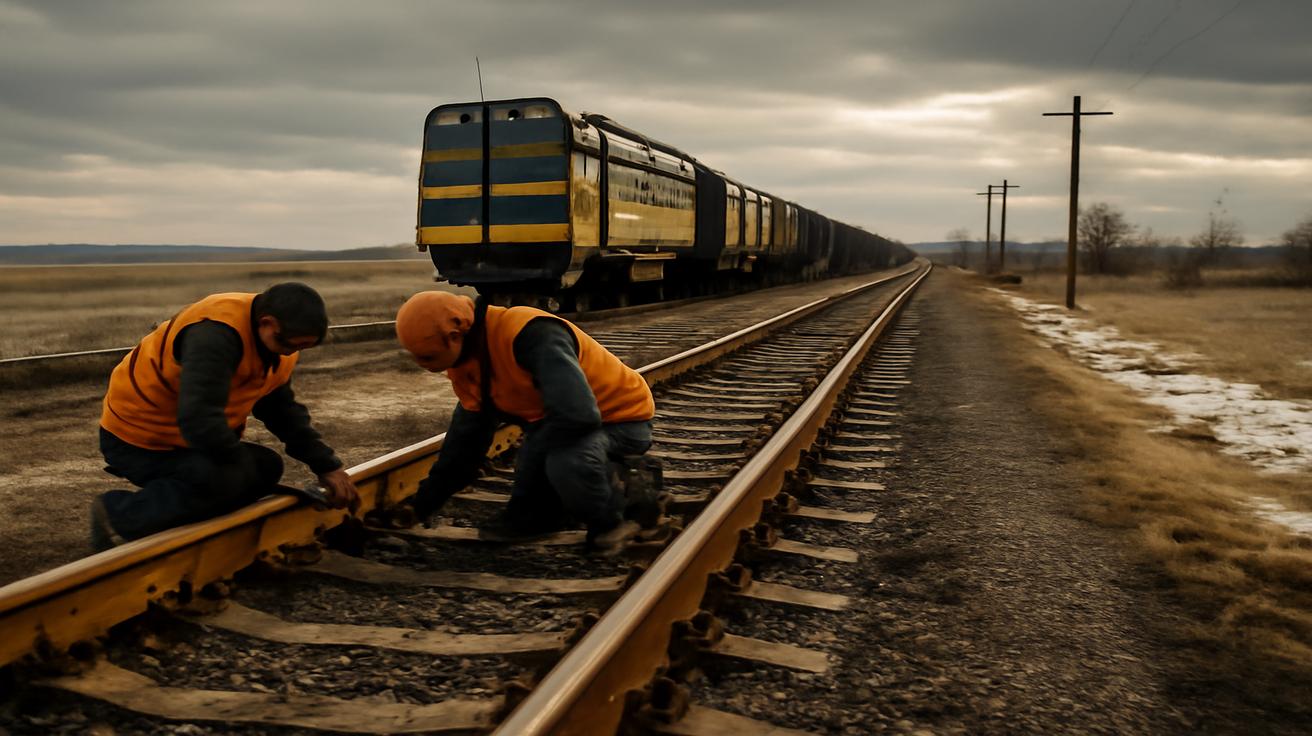
The train comes in just before dawn, long before the sun has the courage to rise above the black soil plains. In the half-light, its windows glow with a dull yellow, like a moving village slipping past sleeping fields and frozen rivers. Somewhere inside, a child leans against the glass, tracing a finger over the faint outline of a cracked sticker. A soldier dozes with his boots still on. An old woman clutches a plastic bag of apples, their scent filling the carriage with something that smells like home. Outside, the station loudspeaker crackles, the wind whistles through broken panes, and on the platform a single worker in an orange vest taps the iron rail with a practiced ear, listening for trouble beneath the metal song.
Steel Lines in a Fragile Country
For most of the world, the story of Ukraine in recent years has been told in hard numbers and sharp angles: battle maps, missile counts, and headline figures like “100 Rafale jets.” Those fighter planes, part of a sweeping defense deal, easily capture attention. Slender silhouettes slicing through cloud, roaring engines, tactical prowess, air superiority—the imagery is tailor-made for front pages and bold graphics.
Yet, far from the roar of jet engines, another story hums low to the ground, almost too modest to notice from afar. It runs on steel, on diesel fumes and electrical wires, on the steady clatter of wheels over worn-out sleepers. It’s the story of a vital rail lifeline, stitched across Ukraine’s broad chest like a network of old scars and new stitches.
That’s where the €470 million deal enters, overshadowed by the glitter of fighter jets yet quietly aimed at something more basic and, in some ways, more existential: keeping the country moving. Because while airpower shapes the battlefield, railways sustain the nation behind it. Ukraine’s trains carry grain and fuel, refugees and returned families, medical supplies and everyday hope. Take them away, and the map of need and relief falls apart.
Ask almost any Ukrainian today, from Lviv in the west to Kharkiv in the east, and they’ll tell you a version of the same truth: when everything else feels uncertain, the train must arrive. Maybe late, maybe crowded, maybe under blackout. But it has to come. Still, metal fatigues. Tracks buckle. Bridges bear the memory of too many shocks. And the war has turned the country’s railways into both lifeline and target.
The Deal That Hums Beneath the Headlines
On paper, the €470 million rail package doesn’t look dramatic. There are no sleek silhouettes in the sky, no triumphant flyovers. Instead, there are procurement lists, engineering diagrams, and spreadsheets dotted with terms like “traction substations,” “bridge reinforcement,” and “rolling stock modernization.” It’s the kind of deal that glazes over eyes in a quick news cycle, unless you’ve stood on a dim platform at midnight, waiting to see if the next train still runs.
In broad strokes, this financing is designed to rescue and rewire a crucial portion of Ukraine’s rail network—part repair, part modernization, part lifeline insurance policy. Under the strain of war, thousands of kilometers of track have been stretched beyond their intended capacity. Freight loads surged as sea routes were blocked or threatened. Passenger demand—families fleeing, aid workers returning, soldiers rotating—spiked in unpredictable waves. And all the while, maintenance crews worked between air raid sirens, replacing rails and power lines with numb fingers and tired eyes.
To understand why this money matters, you have to picture more than a single line on a map. Imagine instead a living web. Grain trains inching west toward European borders, their wagons heavy with the promise of bread. Fuel tankers heading east and south toward frontline regions where every liter matters. Humanitarian cargo heading north, disassembled generators and medical devices in crates stacked like puzzle pieces. Intercity passenger trains patched together from older carriages, their heating systems pushed to their limits through brutal winters.
The €470 million is meant to keep that web from tearing. It will help replace aging locomotives that break down more often than they move. It will upgrade key corridors, improving signaling systems and power lines. It will reinforce bridges that stand over wide rivers and narrow ravines, structures that carry not just weight, but a national burden. It will fund the kind of unglamorous but essential work that keeps a country’s veins open.
Beyond Jets: A Different Kind of Security
There’s a quiet irony in how we talk about security. Rafale jets—sleek, advanced, undeniable in their presence—offer a symbol of strength that fits neatly into old ideas of warfare. But ask any logistics officer, any mayor of a town near the front, any medic waiting for supplies, and they’ll tell you of another kind of security: the certainty that a train with fuel, medicine, or evacuees will show up when the schedule says it should.
Security, for a grandmother in Zaporizhzhia, is not just an air defense system; it’s knowing that the train to her daughter in Lviv still runs three times a week. Security, for a farmer in central Ukraine, is the knowledge that his harvest will not rot in a silo because there’s no way to move it. Security, for a young volunteer doctor in Kharkiv, is the expectation that her overnight train from Kyiv will bring her back to her patients by morning.
Where the jets patrol the boundaries of airspace, the railways knit together the interior landscape. In war, that interior connection is under constant pressure. Bridges strike fear into military planners and civilians alike, not only because they’re strategic targets, but because they represent a thin, singular point of failure. Take down a bridge, and you don’t just slow a convoy—you sever a vein. The €470 million package acknowledges this, focusing on shores, spans, tunnels, and key nodes, turning abstract budget lines into steel, concrete, cables, and ballast.
On the Ground: Where Rails Meet Reality
Step into one of Ukraine’s large rail depots on a gray, damp morning and you’ll understand how much is being asked of this system. Locomotives stand side by side like tired draft horses, paint faded, wheels scarred. Workers in oil-stained overalls move among them with tools and flashlights, their breath hanging in the cold air. Somewhere, a metal grinder throws sparks against an old chassis. A kettle whistles in a tiny break room cluttered with calendars, spare parts, and an aging radio crackling with news.
Years of underinvestment before the war had already left the rail network in a precarious state. War pushed it to the edge. Tracks designed for moderate loads now carry traffic patterns more akin to arterial highways. Freight wagons carry heavier and more constant loads, some pressed into service far beyond their intended lifespan. The electrical grid that powers much of the system has itself been a target, forcing diesel backups to shoulder the load.
In this environment, every euro in the rail deal is asked to pull triple duty. Engine replacements become, in practice, life-extension capsules for entire corridors. A new substation is not just an upgrade in efficiency; it’s a hedge against blackout, a promise that in the next wave of strikes, at least one more segment will stay lit. Modernized signaling systems don’t only prevent collisions—they wring precious minutes out of every journey, allowing more trains to pass, more aid to arrive, more people to escape or return.
The scale of the challenge, and the ambition of the rescue, can be glimpsed in the way planners break it down. Consider this simplified snapshot of what such a package might feed into—numbers that, though illustrative rather than exhaustive, hint at the anatomy of a lifeline:
| Area of Investment | Example Use | Impact on Lifeline |
|---|---|---|
| Rolling Stock | Modernizing locomotives and key freight wagons | Fewer breakdowns, more reliable evacuation and supply trains |
| Track & Bridges | Reinforcing critical bridges, renewing worn rails | Prevents bottlenecks and single-point failures on major corridors |
| Power & Signaling | Upgrading substations and signaling technology | Keeps electric routes running during grid stress, increases capacity |
| Stations & Yards | Improving key hubs, loading infrastructure | Speeds up transfers of people, grain, fuel, and aid cargo |
It’s not glamorous. But if you’ve ever watched a shivering crowd wait for a delayed train under a siren-streaked sky, the glamour question dissolves. What matters is not how pretty the investment looks on a billboard, but how steadily the wheels keep turning.
Grain, Passports, and the Pulse of a Country
To grasp the true stakes of Ukraine’s rail network, imagine riding a single line from east to west, watching the country slide by your window like a restless film strip. At the edge of industrial towns, empty factory yards give way to apartment blocks with patched-up windows. Then come long fields—the legendary black earth, dark and glossy after rain—cut by narrow village roads and speckled with lone tractors. Every so often, the train glides past a small station, its name painted on a peeling blue sign, where a handful of passengers stand, bundled and waiting.
On this imagined journey, the carriages carry more than bodies. They carry grain contracts, in the form of sealed wagons whose contents might feed distant cities. They carry passports pressed into coat pockets, each a small book of choices made under pressure—who left, who returned, who still decides. They carry letters, digital and paper, homecomings, departures, and the quiet calculations of risk and hope.
The €470 million deal recognizes that, in Ukraine, rail is not merely transport. It is diplomacy with steel rails and timetables. Every grain shipment that reaches a border helps reassure tense global markets. Every medical supply train that reaches an embattled region prevents another breakdown in local health systems. Every passenger train that runs on time under fire becomes a statement: the country is still functioning; the map is still whole enough to traverse.
Rebuilding While the Ground Still Shakes
One of the strangest, most difficult truths of rebuilding in wartime is that nothing waits for the perfect moment. There is no pause button, no “after the war” clean line where everyone can start fresh. Tracks must be fixed while bombs still fall in other regions. Bridges must be reinforced under skies that hum with drones. Procurement contracts must be signed in offices where the power flickers and backup generators rumble in the hallway.
For engineers and planners, this means something close to a tightrope walk. Every euro spent on long-term modernization competes with the need for emergency patchwork. Replace an entire bridge span with a modern structure, or weld and bolster the old one just enough to buy another year? Order new locomotives from foreign factories, or cannibalize parts from older units to keep ten others limping along?
The rail deal tries to bridge this impossible divide. Some of the money is aimed at immediate hardening: fortifying embankments in vulnerable zones, installing more resilient signaling, shoring up the most at-risk structures. The rest points further out, toward a vision of a future network better integrated with European standards, more energy-efficient, more digitally managed.
There is a subtle, deeply human bet embedded in that division: that Ukraine will not only survive the present, but will also one day step fully into a calmer future where those investments will pay dividends in peacetime commerce, tourism, and daily commuting. To allocate funds for long-term modernization in the middle of crisis is, in its own way, an act of faith.
The Sound of Tomorrow on Rusted Tracks
Stand near a rural crossing on a cold, clear night and listen. Long before you see a train, you hear it. At first just a faint tremor in the rails, then a low, rising hum, then the rhythmic clatter that swells like an approaching storm. As it nears, the air quivers. Windows rattle in their frames. The locomotive bursts into view, a small thunderhead of metal and light, dragging its chain of carriages into the dark.
Today, many of those trains run on systems built decades ago, nursed along by the ingenuity of overstretched crews. But if the rail deal unfolds as intended, that sound may gradually change. Quieter, more efficient locomotives. Smoother transitions over renewed joints. Faster clearance at refurbished stations where loading cranes and platforms speed up the shuffle of cargo.
At every stop, the abstract sums—€470 million, 100 fighter jets—dissolve into particular faces. The station master in a small town who still signals departures with a green flag and a stern nod. The teenage boy filming the passing train on his phone, counting the wagons, wondering how far they go. The baker in a western city whose flour arrives by rail, who watches the freight yard from her back window and times her kneading to the rhythm of incoming cars.
For them, and for millions like them, the rail network is not a symbol or a statistic. It is the background pulse of everyday life, sometimes annoying, often taken for granted, absolutely indispensable. When international negotiators inked that €470 million deal, they were, whether they knew it or not, placing a careful hand on that pulse and deciding it was worth sustaining.
More Than Metal: A Promise of Continuity
Look again at the contrast that headlines love: 100 Rafale jets versus a €470 million rail package. One conjures sky wars and burning contrails; the other, maintenance yards and budget lines. It is tempting to treat them as separate universes—war up there, infrastructure down here. But in Ukraine, they are two sides of the same fragile coin.
The jets speak to deterrence, to the ability to push back against aggression, to the rejection of conquest. The trains speak to endurance, to the ability to function under pressure, to the rejection of collapse. Without the first, the country’s borders are in peril. Without the second, its interior begins to fray, community by community, station by station.
In the quiet corners of policy papers, the rail deal acknowledges a truth that people waiting on night platforms already know: survival is not just a matter of winning battles. It is a matter of getting children to safer cities, moving grain to foreign ports, bringing doctors where they are needed, and maintaining the simple, stubborn continuity of public life. No parade celebrates a freight schedule. No chant rises up for track ballast and upgraded substations. And yet, when the night feels longest, it is often the sound of an approaching train that reminds a town that it still exists on the map of a functioning, connected country.
One day, if peace takes root, Ukraine’s trains will carry different kinds of weight. More tourists than refugees. More students than soldiers. More business travelers than aid workers. Those same tracks, reinforced and renewed with today’s emergency funding, may then feel like the quiet evidence of a difficult bet that paid off: the bet that it was worth investing in tomorrow while today was still on fire.
Until then, as dawn slowly lifts over frosted fields and bomb-scarred factories, the trains will keep threading their way through the landscape. In the glow of their windows and the clatter of their wheels is a simple message that every traveler, every station worker, every trackside village can hear: we are still connected. We are still moving. We are still here.
Frequently Asked Questions
Why is the €470 million rail deal so important for Ukraine?
Because Ukraine’s railways are its main internal lifeline. They move grain, fuel, humanitarian aid, and people across a vast country under extreme strain. The deal helps repair and modernize critical parts of this network so that it can keep functioning despite war damage and heavy use.
How does this rail investment relate to the 100 Rafale jets?
The jets address military security in the air, while the rail deal addresses civil and logistical security on the ground. Together, they represent two forms of resilience: one that protects borders and skies, and one that keeps the country’s interior—its economy and population—alive and connected.
What kinds of projects can be funded by the €470 million?
Funds can support modernization of locomotives and wagons, reinforcement of bridges and tracks, upgrades to power and signaling systems, and improvements to key stations and freight yards. The goal is to reduce breakdowns, prevent bottlenecks, and increase the system’s reliability under stress.
Why focus on rail instead of roads or air transport?
Rail moves far larger volumes of cargo and passengers than roads or aircraft can, especially over long distances and in difficult conditions. It is more energy-efficient, less vulnerable to fuel shortages, and better suited to mass evacuations and bulk shipments like grain and fuel.
Will these rail upgrades still matter after the war?
Yes. Investments made now can form the backbone of a modern, more integrated network in peacetime, supporting trade with Europe, domestic travel, and economic recovery. In that sense, the rail deal is both an emergency measure and a down payment on Ukraine’s future.