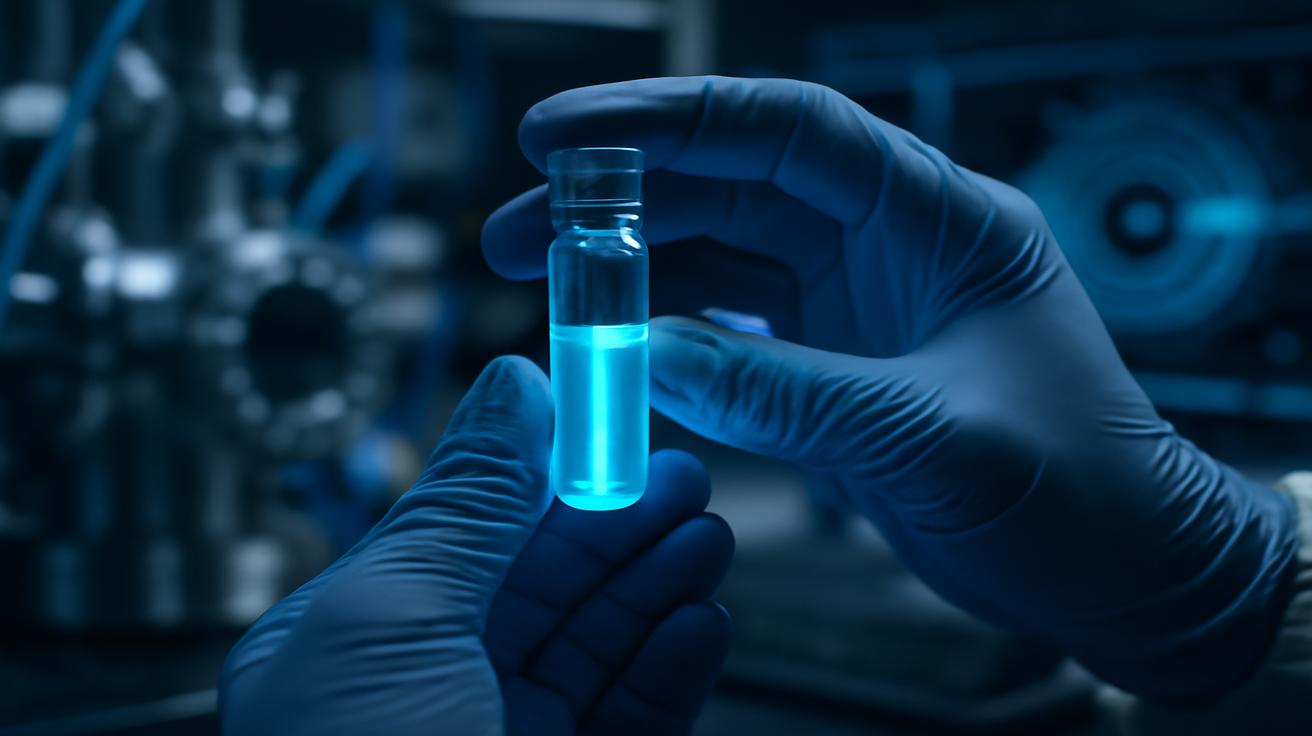
The first time you see a canister of high‑level nuclear waste, your body reacts before your brain catches up. Your shoulders tense. Your breath shortens. Centimeters of steel and concrete separate you from everything you’ve ever been taught to fear: invisible rays, half‑lives longer than human history, a problem we’ve buried, argued over, and quietly handed to our grandchildren. Now imagine someone leans in and says, almost casually: “We’re going to turn this into fuel for the stars.” It sounds like science fiction, or a slick corporate slogan. But in quiet labs and national facilities across the United States, an idea is coalescing that could do something astonishing: convert nuclear waste into tritium, the rare fuel that could power the world’s most promising fusion reactors. If it works at scale, it doesn’t just tweak our energy story—it flips it.
The day nuclear trash turned into treasure
The story doesn’t begin in a gleaming fusion lab. It starts with a problem that has sat, quite literally, in our backyard for decades. Across the U.S. and in many other countries, spent nuclear fuel is stacked in cooling pools and dry casks—ship‑container‑sized cylinders sitting behind tall fences, watched by cameras and security patrols. Inside them: ceramic pellets of uranium and a witch’s brew of fission products and transuranic elements, the leftovers of atomic fission that powered cities and submarines.
For years, the plan was simple and politically impossible: bury this stuff deep underground and trust engineered barriers and geology to keep it isolated for tens of thousands of years. The conversation rarely moved beyond storage locations and safety protocols. But a handful of American researchers and entrepreneurs started asking a different, impolite question: What if this isn’t garbage? What if this is a feedstock?
To understand why that question is electrifying fusion researchers, you have to meet tritium. Tritium is a form of hydrogen—just one proton, like regular hydrogen, but with two neutrons hitching a ride. It’s rare, a little radioactive, and extraordinarily precious for one particular reason: mix it with deuterium (another variety of hydrogen), squeeze it tight and hot enough, and you get the kind of nuclear fusion reaction that could generate vast amounts of clean energy.
The catch? Tritium doesn’t just lie around. It decays in about 12 years, and there’s almost none in nature. Today, most tritium is produced in fission reactors as a byproduct—a trickle of supply for a potentially ocean‑sized demand. If fusion ever truly takes off, the world will need tritium in quantities we currently can’t imagine. This looming bottleneck is so serious it has a name in the field: the tritium supply problem.
Enter the American twist: what if the material we fear the most—nuclear waste—could become the solution to that bottleneck?
The alchemy of modern reactors
This isn’t medieval alchemy, of course. It’s nuclear engineering. At its heart, the concept is elegant: use certain components of spent nuclear fuel, plus specialized materials and high‑neutron environments, to breed tritium. Some approaches involve using lithium—already at the center of many fusion fuel plans—as a “blanket” around a reactor or neutron source. When high‑energy neutrons slam into certain forms of lithium, tritium is born.
Other concepts go a step further, proposing ways to repurpose isotopes within nuclear waste—along with advanced reactors or dedicated breeding facilities—to crank out tritium at industrial scale. It’s not that the waste is magically turned directly into tritium like a sci‑fi transmutation; rather, the energy and neutrons available in advanced nuclear systems, fed by or associated with waste streams, become the engine of tritium production.
The vision looks something like this: Instead of building vast underground tombs for spent fuel and walking away, you design a circular nuclear economy. Spent fuel is reprocessed. Valuable isotopes and materials are separated, some burned in advanced reactors, others used to breed tritium. What was once a liability becomes an asset feeding a new generation of fusion machines.
It’s a startling inversion. The waste that once symbolized the moral debt of the atomic age could become the resource that underwrites a new era of clean power—if the technology works and the politics don’t smother it first.
Inside the fusion dream
Talk to people working in fusion and you’ll hear the same mantra repeated with varying degrees of weariness and hope: “Fusion is always 30 years away.” The joke is old enough to collect a pension. But underneath the cynicism, something has changed. Advances in high‑temperature superconducting magnets, materials science, plasma control, and AI‑driven design have pushed fusion closer to practical reality than ever before.
Private fusion startups now number in the dozens. National labs bristle with new experiments and upgraded machines. There are lasers powerful enough to compress fuel pellets to star‑like conditions, magnetic bottles (tokamaks and stellarators) that cling more tightly to plasma than any human‑made field in history, and compact concepts barely bigger than a truck. When you look at the tech landscape, “never” is no longer a safe bet.
But behind the dazzling demo videos and confident executive interviews lurks a quieter calculation: “If this works, where are we getting all the tritium?” The fusion fuel mix most of these designs count on is deuterium‑tritium, or D‑T fusion. Deuterium is easy—it’s in seawater. Tritium is the problem. Our current global stockpile is measured in kilograms, not tons.
Here’s where the idea of nuclear waste‑to‑tritium hits like a plot twist. If you can attach tritium production to existing or future nuclear infrastructure—especially if that infrastructure is partly fueled by what we now call waste—you ease the most pressing long‑term constraint on a D‑T fusion economy. Suddenly, fusion doesn’t just need nuclear to help with R&D or grid integration; nuclear’s most hated byproduct becomes a foundational pillar of the fusion supply chain.
The hidden value in radioactive leftovers
To really feel the magnitude of that shift, picture a dry cask storage yard at dusk. Rows of cylindrical casks stretch out like a concrete forest. Each one represents megawatt‑years of electricity already delivered and centuries of headache yet to come. These casks are heavy with more than fear—they’re heavy with unrealized utility: unused uranium, plutonium, and a suite of isotopes that still contain staggering amounts of nuclear potential.
In the conventional story, this is the end of the line: perpetual guardianship, legal battles, careful monitoring, and the uneasy hope that nothing leaks and no one gets too close. In the emerging story, these same casks become part of a strategic reserve. Their contents are feedstock for advanced reactor fuels, sources for medical and industrial isotopes, and—through associated breeding systems—gateways to tritium.
That doesn’t mean you pop them open and start pouring pellets into futuristic fusion machines. It means you rethink the entire lifecycle of nuclear materials. Facilities that once focused only on storage start to look more like banks or refineries. New types of reactors—fast reactors, molten‑salt reactors, high‑temperature gas reactors—are designed not just to make electricity, but to intelligently manage and transform nuclear materials across generations.
Through this lens, a piece of high‑level waste isn’t the end of a story; it’s a chapter break.
What this could mean for the fusion future
To understand how transformative this could be, it helps to zoom out and look at the energy scale we’re talking about, and what changes when tritium scarcity shifts to tritium abundance. Imagine a world where nuclear waste is effectively mined to feed a fast‑growing fusion sector. The relationship between the two technologies flips from awkward coexistence to deliberate choreography.
| Scenario | Tritium Supply | Fusion Growth | Role of Nuclear Waste |
|---|---|---|---|
| Today | Scarce, from few reactors | Lab‑scale, pilot projects | Long‑term storage liability |
| Conventional Fusion Rollout | Chronic bottleneck | Slow, fuel‑limited expansion | Mostly unchanged; still waste |
| Fusion + Waste‑to‑Tritium | Strategically scalable | Faster, supply‑supported growth | Converted into a strategic resource |
Notice what shifts in that last row. Tritium goes from being a rare commodity doled out in grams to an industrial product. Fusion, in turn, can be planned like other major energy infrastructure—no longer just a dazzling experiment, but a technology you can actually deploy at scale without hitting a fuel wall in a decade.
From “bury it” to “build with it”
This is where the narrative stops being about physics and starts being about culture. For most of the modern era, nuclear power has lived with a kind of social curse. Fission promised clean electricity; the price was a legacy of waste measured on geological timescales. Even people who grudgingly accepted reactors often did so with a sense of uneasy compromise. The story was: We get the power; the future gets the problem.
Waste‑to‑tritium flips that script. Suddenly, the act of building a nuclear plant isn’t just a bargain with the future; it’s the seeding of a future resource. Each reactor becomes, in principle, a long‑term contributor to a fusion economy that might ultimately render fossil fuels almost irrelevant. The worry about “what do we do with the waste?” doesn’t go away—technical and safety hurdles remain enormous—but it is joined by a new question: “What value are we leaving locked up in those casks?”
The American innovation here isn’t just technological. It’s conceptual. It suggests that we can look at our most feared industrial leftovers and imagine them as part of a regenerative system. Not in the soft, metaphorical way we use with recycling, but in a hard, physics‑driven way that turns isotopes and neutrons into currency.
The messy middle: risks, politics, and hard questions
Of course, nothing in the nuclear world is simple. Every step in this vision is wrapped in caveats and legitimate concerns. Converting waste into tritium involves reprocessing steps and advanced reactor designs that must be proven safe, economical, and secure against misuse. Any time you move nuclear materials around, you invite worries about proliferation, accidents, and opaque governance.
There’s also a social question: will communities that already host nuclear facilities be comfortable seeing them morph into hubs of a new nuclear‑fusion ecosystem? Some may relish the long‑term jobs and investment. Others may feel like they’re being signed up for another century of bearing the externalities of everyone else’s electricity.
Then there’s the engineering stack itself. Breeding tritium at meaningful scale requires mastering not only the core nuclear reactions, but the delicate handling of tritium—a gas that can permeate metals and must be carefully managed to prevent leaks. Fusion devices will need integrated fuel cycles: systems to capture the tritium they themselves breed in blankets surrounding the plasma, purify it, and feed it back into the reactor. Waste‑to‑tritium concepts could complement this, but they won’t replace the need for robust in‑reactor breeding.
Still, these are problems of method, not of physics. Unlike some clean‑tech fantasies that hinge on breakthroughs we may never see, the fundamentals here are known: neutrons make tritium from the right targets; spent fuel and advanced reactors can provide neutrons and materials; tritium can, in turn, drive fusion.
Why the U.S. is a uniquely interesting test bed
The United States carries a peculiar combination of assets and anxieties that make it fertile ground for this transformation. It has one of the world’s largest inventories of spent nuclear fuel, a deep bench of nuclear engineers, powerful national labs, and a rapidly expanding private fusion sector attracting billions in investment. It also has a public that is increasingly climate‑anxious but still wary of anything nuclear.
This tension creates both friction and urgency. On one hand, every mention of reprocessing or new nuclear infrastructure ignites old debates about safety and cost. On the other, the scale of the climate challenge and the visible limits of solar‑wind‑battery solutions in some contexts are prompting a reevaluation. Many younger engineers and policymakers are no longer interested in the old binary of “nuclear: yes or no?” They’re asking “nuclear: how, and for what larger system?”
In that conversation, turning waste into tritium is a narrative lever. It offers a way to talk about nuclear that is not haunted solely by Chernobyl and Fukushima, but animated by the prospect of seeding a future where fusion shouldered a sizable share of the world’s demand for heat, power, and industrial energy. It invites Americans to see their controversial nuclear legacy not just as an obligation, but as a strategic resource that could place the country at the center of a global fusion economy.
The moment where everything quietly pivots
Stand again, in your mind, at the edge of that storage yard. Imagine that the casks are no longer the end of the road but stepping stones. Somewhere beyond the barbed wire and cameras, in a different building, engineers are calibrating neutron sources, lithium blankets, and separation systems. Their goal is simple and audacious: harvest the hardest parts of our nuclear past and feed them forward into a radically different energy future.
In that future, fission and fusion are not rival visions. They are phases of one long experiment humans are running with the atomic nucleus. The first phase gave us weapons and power plants and a lot of fear. The next could give us power sources that burn no fossil fuels, emit no carbon, and, managed well, produce less and less long‑lived waste over time because what we once called waste has been drafted into service.
This is what makes the notion of waste‑to‑tritium feel like a hinge in the story, the point where a line that was heading one way bends, almost imperceptibly, toward another destination. We may not get everything right. We rarely do. But it is hard to escape the feeling that our relationship with the atom is changing—from extraction and abandonment to stewardship and reuse.
These shifts often don’t come with fanfare. They arrive in the hum of a vacuum pump at 2 a.m. in a lab, in the scribbles of a policy draft that reclassifies a waste product as a strategic input, in the quiet flicker of a plasma on a diagnostics screen thousands of miles away. A technician signs off on a test run that produces a few more micrograms of tritium than last month. A grad student updates a model showing that, under certain scenarios, the American spent fuel stockpile could supply a meaningful share of global fusion fuel demand for years.
Somewhere, perhaps not too far in the future, a kid in a classroom will learn that their city’s lights are powered partly by fusion reactors, and that the fuel for those reactors traces back to the waste their grandparents once worried about. The fear won’t be erased—history doesn’t work that way—but it will be complicated, softened by the strange, hopeful realization that we learned to turn our most persistent problem into part of the solution.
When that happens, it will be tempting to look back and say, “This changed everything,” as if the transformation were sudden and clean. In reality, the change will have been gradual, contested, messy. But it starts here, with a simple, slightly audacious idea: maybe nuclear waste is not the end of the story. Maybe it’s the beginning of the next chapter, where the glow we feared in steel canisters becomes the fuel that lights a different kind of star on Earth.
FAQ
Is it really possible to turn nuclear waste directly into tritium?
Not in a single magic step. The idea is to use components of spent fuel and advanced reactors or neutron sources to breed tritium, often via lithium targets. Waste becomes part of the fuel cycle infrastructure rather than a direct one‑to‑one conversion.
Why is tritium so important for fusion?
Tritium, combined with deuterium, enables fusion reactions at temperatures and pressures that are more achievable with current technology. Deuterium‑tritium fusion is the leading pathway for early commercial fusion reactors.
Does using nuclear waste for tritium solve the waste problem completely?
No. It can reduce the burden and extract additional value, but there will still be materials requiring long‑term management. It changes the scale and character of the problem rather than making it vanish.
Is this approach safe?
Safety depends on design, regulation, and operation. Reprocessing and tritium handling bring real risks, but these are engineering and policy challenges that can be managed with robust standards, oversight, and transparent practices.
When could waste‑to‑tritium systems become a reality?
Elements of the technology already exist at experimental scales. Widespread deployment will likely track the pace of advanced reactor rollout and fusion commercialization, unfolding over the next few decades rather than years.