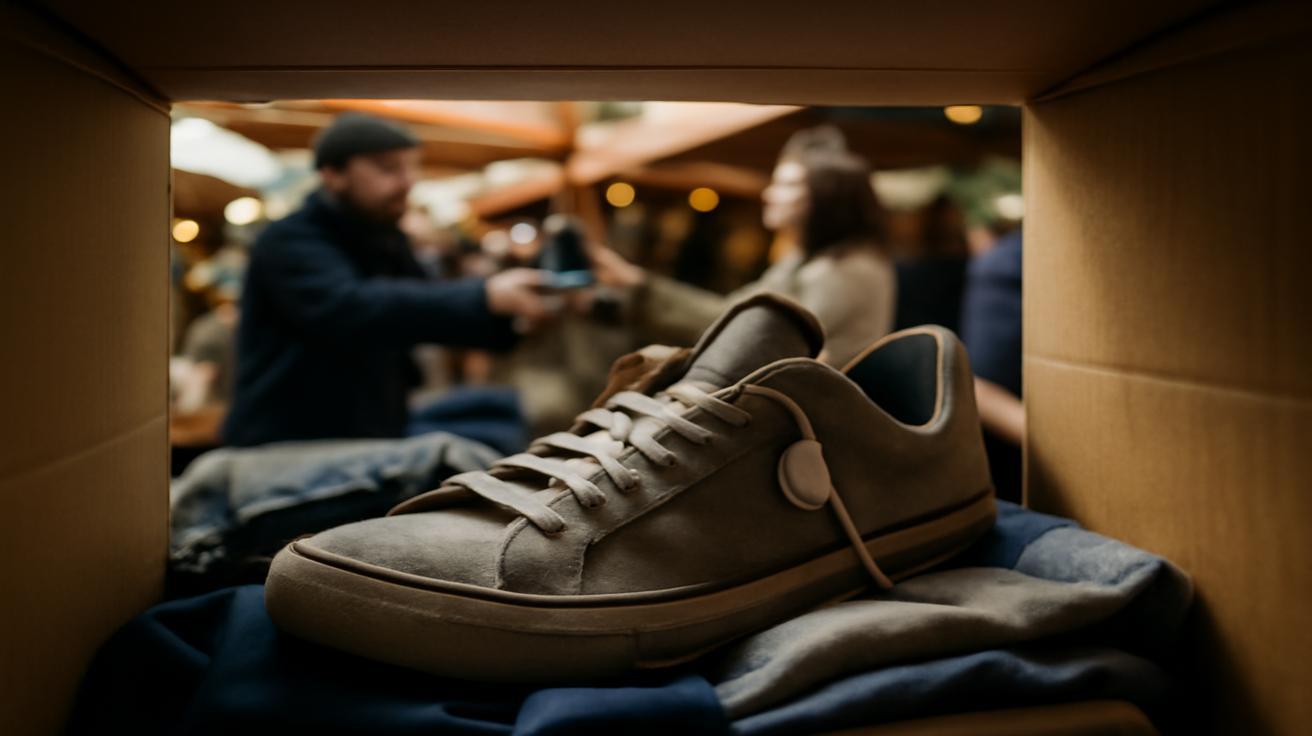
The sneakers sat on his kitchen table, still wearing the dust of his morning run, when the idea came to him—half mischief, half suspicion. Outside, the city hummed with an ordinary Tuesday, buses groaning at stops, a dog barking somewhere down the block, the smell of rain still clinging to the pavement. Inside, Daniel turned the left shoe over slowly in his hands, thumb tracing the fading logo on the sole, and weighed something much heavier than worn-out rubber: trust.
The Morning He Decided Not to Look Away
Daniel had always liked to believe that, in the quiet chain between giving and receiving, charity was the one place in the world where things still worked the way they were supposed to. You donate. They help. Simple, almost sacred. But over the past few months, little stories had begun to gnaw at that belief: a friend who swore she’d seen her donated winter coat for sale in a high-end thrift boutique; an online thread full of people wondering whether some donation centers were flipping “gifts” for profit without donors really understanding how it worked.
None of it proved anything. Rumors travel faster than truth, especially online. Still, every time he walked past the big white donation bins with the Red Cross logo printed in bold, comforting red, he felt a twinge of doubt. Where do these things actually go?
Then one night, while scrolling through his phone in bed, he read about someone who had hidden a tracking device in a piece of luggage to see what airlines really did with it when it went “missing.” The story was equal parts funny and unsettling. Technology had become a flashlight people could point into places that had always been kept politely dark.
The next morning, his eyes fell on the sneakers. They weren’t fancy—gray mesh, frayed laces, a tiny rip along the toe box where his big toe liked to argue with the fabric. But they were still good shoes, perfectly wearable. He’d replaced them with a new pair a few weeks earlier, yet he couldn’t bring himself to toss them. They seemed like just the sort of item a charity could pass along to someone who needed them. Someone who couldn’t afford new running shoes but might use them to walk to work, or to a job interview, or simply to feel a little bit less left behind.
He opened the drawer by the sink and pulled out a small, white disc: an AirTag he’d bought on a whim and never really used. He turned it over in his fingers, feeling its smooth plastic, the cold metallic edge. Something inside him shifted from vague discomfort into a sharp, curious intention.
“What if I just see?” he murmured to himself. Not to accuse. Not to sabotage. Just to watch.
The AirTag in the Left Shoe
He synced the AirTag to his phone, renaming it “Gray Sneakers,” the absurdity of the label making him smirk. The setup was quick—too quick, he thought, for how much it might change what he believed about giving. Then he slipped the tag carefully under the insole of the left sneaker, pressing it flush so it wouldn’t rattle or poke. If someone put them on, they’d never know.
The shoes felt different in his hands now, as if they were carrying a secret. He placed them in a reusable bag with a few neatly folded T-shirts and a pair of jeans he no longer wore. Outside, the air was damp and cool; the sky an overcast blanket that made colors look softer and streets look closer. He walked the six blocks to the Red Cross collection center, leaves stuck in the gutter, cars hissing past on wet asphalt.
Inside the foyer of the building, the familiar donation bins waited: metal mouths open, signs taped above them with tidy lists of what they accepted. A volunteer, middle-aged with tired eyes and a friendly smile, stood nearby, organizing a stack of pamphlets.
“Clothes?” Daniel asked, lifting his bag slightly.
“Yes, thank you,” the volunteer replied, voice warm. “We really appreciate it. They help a lot of people.”
That sentence—the one he’d heard a hundred times, the one that always made him feel a little lighter—landed differently now. They help a lot of people. He studied the bin, the logo, the small print about “supporting humanitarian work.” Then he dropped the bag in, heard it thud softly on top of other offerings: jackets, scarves, someone’s old backpack with a broken zipper.
On the walk home, he checked his phone. The dot labeled “Gray Sneakers” still hovered over the Red Cross address. It felt like planting a seed and walking away, not sure what might grow.
Watching the Dot Move
For the first day, nothing really happened. The AirTag stayed right where he had left it. Maybe they sort donations once a week, he thought. Or maybe the building walls were thick and the signal was weak. Life went on: emails, coffee, the clatter of neighbors going up and down the stairs. But every few hours, he opened the app and checked. The dot became a habit, a tiny digital heartbeat at the edge of his awareness.
On the second day, it moved.
He saw it while stirring onions in a hot pan, the smell of caramelizing sweetness filling his kitchen. He glanced at his phone and froze. “Gray Sneakers” had left the Red Cross center and was on the move, drifting across the city map like a little ghost. He wiped his hands on a towel and zoomed in. The path traced along a familiar route: down a main boulevard, a turn past the train station, then into a part of town he knew was stitched together by warehouses and wholesale shops.
The dot stopped at an address he didn’t recognize. An industrial area, according to the satellite view—big rectangular buildings with wide loading docks, the kind of places where deliveries disappeared behind roll-up doors. His mind began to race. Sorting center? Partner organization? Some contracted warehouse? None of it necessarily meant anything bad. Large charities were complex. Logistics weren’t magical; they were messy and practical.
But fascination had him by the collar now.
The following midday, when he checked again, the dot had jumped. It now sat near the city’s central market district, a dense, buzzing lattice of streets known for its cheap clothes, street vendors, and stalls packed like teeth in a crooked smile. Daniel’s stomach tightened. He enlarged the map until he could see the exact intersection.
A market. Not a shelter. Not a community center. Not a distribution point for refugees. A marketplace known for “bargains.”
The Market and the Gray Sneakers
By late afternoon, the curiosity was no longer something he could manage through a screen. He pulled on a hoodie, grabbed his keys, and left his apartment, the hallway echoing with his hurried footsteps. The air outside had warmed; the sky broke apart into streaks of pale blue, sunlight filtering down onto brick façades and fast-food wrappers tumbling along the sidewalk.
The market district greeted him with a rush of smells—grilled meat, ripe fruit, cigarette smoke, engine exhaust—and a soundtrack of overlapping conversations, car horns, and crackling radios. He followed the map on his phone like a quiet compass, winding through clusters of stalls hung with cheap belts, knockoff sneakers, and stacks of jeans that all looked suspiciously the same. People brushed past him, arms loaded with plastic bags, laughter and arguments mixing into one frayed chorus.
The dot pulsed on the screen, close now. Twenty meters. Ten. Then, almost abruptly, he was there: standing in front of a street vendor’s stall, where a carpet of secondhand shoes spread outward in all directions like a tattered mosaic.
His sneakers were in the second row.
He knew them instantly—gray mesh, the tiny rip on the left toe, the faint trace of mud on the sole that no amount of scrubbing had ever fully erased. They lay next to a pair of bright blue running shoes and some white high-tops that had clearly seen better days. A cardboard sign at the front of the stall announced the deal in hurried black marker: “GOOD SHOES – CHEAP!”
His heart slammed against his ribs, and for a moment the noise of the market dimmed, as if someone had turned down the volume on the world.
He edged closer, pretending to browse. The vendor, a man in his forties with a weathered face and sharp, assessing eyes, nodded at him.
“Looking for running shoes, my friend? Good brands, small prices,” the man said.
Daniel swallowed. “Yeah, maybe. How much for these?” He picked up his own sneakers, holding them as if they were just another pair.
The vendor glanced at them quickly. “Those? Good condition. Fifteen.”
Fifteen. He had given them for free. Not only them, but with the belief they would land on the feet of someone who couldn’t afford even ten.
“Where do you get all these?” Daniel asked, keeping his voice casual.
The vendor shrugged, gesturing vaguely behind him. “Different places. Collections, big organizations, sometimes from warehouses. They sell in bulk. I buy, I sell. Business.”
There it was. Said plainly, without shame. The invisible part of the charity chain, dragged into the sunlight.
A Table of Truths: What We Think Happens vs. What Often Does
Later that night, back in his apartment with the market’s noise still buzzing in his ears, Daniel tried to untangle what he’d seen. The situation wasn’t as clean as “heroes” and “villains.” But it also wasn’t as innocent as the posters and pamphlets suggested. He opened his laptop and sketched out a few simple contrasts, a way to organize the gut-deep confusion into something more concrete.
| What Donors Commonly Believe | What Often Actually Happens |
|---|---|
| Items are given directly and freely to people in need. | A portion is sold in bulk to resellers; funds then support charity programs. |
| Every donated item ends up in a local shelter or aid package. | Many items are graded, exported, or sold in secondary markets if not needed locally. |
| “Donated” automatically means “given away for free.” | “Donated” often means “given to the organization,” which may monetize those goods. |
| Charities are fully transparent about how items are used. | Details are usually buried in reports or not clearly explained at the donation point. |
On one hand, the logic was undeniable: selling donated goods can generate money for food programs, shelters, emergency relief. If the end result helps people, maybe the path doesn’t matter. On the other hand, donors like him walked in believing a very different story. The betrayal didn’t come from the act of selling; it came from the silence around it.
Is It Betrayal or Just an Ugly Kind of Honesty?
In the days that followed, the weight of those sneakers lingered in his mind. He kept thinking about the vendor at the market, who never pretended to be anything but what he was: a businessman. About the Red Cross center, where the volunteer had spoken sincerely about helping people. About the invisible trucks moving bags of clothes between them—bags that began as acts of generosity and ended as inventory.
Was this an actual scam? Or was it a brutally pragmatic system that charities relied on, but rarely explained in plain language?
He dove into research, poring over annual reports, piecing together how donation-based funding often worked. Many large organizations did acknowledge, somewhere in their documents, that donated goods might be sold to finance programs, especially when certain items weren’t immediately needed or suitable for direct distribution. The model wasn’t a secret, exactly. Just… not obvious.
Most donors, like him, weren’t reading financial PDFs before dropping a bag of clothes into a bin on their way to work. They were operating on images: a child in a warm coat, a disaster survivor pulling a blanket around their shoulders. They weren’t picturing a pair of worn-out sneakers laid out on a blue tarpaulin next to a hand-lettered price sign.
The situation lived in a moral gray zone that technology had suddenly lit up.
When Transparency Feels Like Trespassing
Daniel replayed his small act—hiding the AirTag—over and over. It hadn’t felt like breaking into anything, just watching. But the deeper he thought about it, the more complicated it seemed. He hadn’t asked permission. He’d turned an act of giving into a private investigation. Was that fair?
He imagined a spectrum. On one end: blind trust, the kind that allows systems to drift, unexamined, for decades. On the other: invasive surveillance, the kind that erodes every boundary until no one can do their work without worrying they’re being tracked. Somewhere in the middle, maybe, lay a fragile balance: enough transparency for accountability, enough privacy for dignity and practicality.
His little AirTag experiment had yanked the system toward one side of that spectrum, if only for him. But people everywhere were doing the same thing now—dropping trackers into suitcases, onto shipped packages, even into the pockets of loved ones they didn’t fully trust. Technology had made it possible to turn doubt into data, suspicion into a blinking dot on a screen.
So what do we do when the dot confirms our worst suspicions—but also tells a more complicated story than we expected?
The Case for Calling It Out—Carefully
Once you’ve watched your donation land on a pricing tarp at a market, you can’t unsee it. The temptation is to throw up your hands and declare the whole system corrupt. But that reaction, Daniel realized, was too easy—and, in a way, too selfish. It relieved him of the responsibility to think more deeply about how help actually functions in an imperfect world.
Still, something needed to change.
Honesty at the Bin
Imagine, he thought, if that donation center had a sign that said, in plain language: “Some donated items are given directly to those in need. Others are sold, and the money funds our humanitarian programs. Either way, your donation helps.” No romanticized illusions, no curated imagery without context. Just the truth.
Would he have still donated the sneakers? Probably. But he would have known what story he was stepping into.
Respecting Donor Intent
Different people give for different reasons. Some want to fund programs; others want their actual items—those shoes, that coat—to reach specific kinds of recipients. Charities could do better at offering pathways: one bin for resale fundraising, another for direct distribution with more limited criteria. Not every organization can manage that complexity, but some can, and some already quietly do.
Instead of treating donors as an anonymous mass, what if they treated them as partners who deserve to understand the mechanics of impact?
Following the Threads Without Burning the Fabric
As for people hiding trackers in their donations—is that wrong? Or is it a rough, unpolished form of citizen oversight, the kind that flourishes when institutions don’t volunteer enough clarity on their own?
Maybe the real solution isn’t to condemn the trackers outright, but to make them unnecessary. When charities are radically transparent, fewer people feel compelled to sneak peeks behind the curtain. When donors understand that selling a pair of shoes can sometimes feed more people than giving them away, suspicion has less fertile soil to grow in.
Until then, though, stories like Daniel’s will keep surfacing—uneasy, messy, full of conflicting emotions. They are warnings, but they’re also invitations: to ask better questions, to demand clearer answers, and to resist the seductive simplicity of calling everything either a scam or a saintly sacrifice.
Where the Sneakers Finally Stopped
A week after his market visit, Daniel opened the app again. The dot labeled “Gray Sneakers” no longer pulsed near the stall. It had moved to a residential neighborhood on the edge of the city—rows of modest apartment blocks, a park, a school. The AirTag, still hiding silently beneath the insole, now rested in someone’s home. Maybe by the door, kicked off after a long day. Maybe under a chair, waiting for tomorrow’s walk.
He imagined the new owner: someone who had stood in front of that same stall, weighing fifteen against their wallet, who had decided that those gray shoes were worth it. Maybe they needed them for work. Maybe they just needed one thing in their life that didn’t have holes.
Somewhere between the donation bin and that apartment, value had been redirected, sliced, repackaged. Money had changed hands. A charity had gained a small contribution. A vendor had earned a bit of income. A stranger had walked away with decent shoes at a price they could manage.
Was that chain corrupt? Or simply tangled?
The next time Daniel packed a bag for donation, he paused. He didn’t reach for another AirTag. Instead, he took a pen and paper and wrote a note to himself to look up each organization’s policies, to read beyond the slogans, to ask questions if the answers weren’t already clear. He still wanted to give. He still believed, stubbornly, that helping mattered. But he no longer believed that trust should be blind.
Maybe the smartest use of that little white disc hadn’t been to expose a villain. Maybe it had been to expose the gap between what we think happens when we give—and what actually does.
FAQs
Is it legal to hide an AirTag in donated items?
Legality varies by location, but in many places, using trackers in ways that can follow individuals without their knowledge raises privacy and ethical concerns. While you technically still own the tracker, once the item is donated, it’s no longer your property, and tracking its new owner can cross into problematic territory.
Do charities really sell donated clothes and shoes?
Yes, many large charities sell a portion of donated items—often in bulk to wholesalers or through thrift outlets. The money raised is used to support their programs. This practice is usually mentioned in reports or policies, but not always highlighted at the donation point.
Does selling donated goods mean a charity is running a scam?
Not necessarily. Selling goods can be a legitimate funding model. It becomes questionable when organizations are not transparent about how donated items are used, or when marketing leads donors to believe all goods go directly and freely to people in need.
How can I know what my donated items will be used for?
Check the organization’s website or printed materials for donation policies, or contact them directly and ask. Look for clear explanations about whether items are given away, sold, exported, or repurposed, and how that supports their mission.
What’s a good way to donate if I want items to go directly to people in need?
Look for local shelters, community centers, mutual aid groups, or grassroots organizations that publicly state they distribute items directly. Some groups publish specific wish lists and distribution practices, giving you a clearer sense of where your items will end up.
Should I stop donating to big charities because of practices like reselling?
Not automatically. Large charities often run critical programs that depend on multiple funding streams, including the resale of goods. Instead of withdrawing entirely, consider diversifying your giving, demanding clearer transparency, and choosing organizations whose methods align with your values.
Is using technology to track donations a good way to hold charities accountable?
It can reveal hidden practices, but it also raises privacy and ethical issues. A better long-term approach is to support and advocate for transparent reporting, independent audits, and open communication, so trust rests on clear information rather than covert tracking.