The first time Lena noticed the white arc above her left ear, it glinted in the bathroom light like a tiny bolt of lightning. She leaned closer to the mirror, stretching her skin taut with two fingers, as if she could iron time out of her face. A single silver strand became a cluster, the cluster a streak, until one day the woman in the mirror looked older than she felt inside. What startled her wasn’t the gray itself—it was the memory tied to it: the sharp chemical sting of traditional hair dye, the plastic gloves, the stained towels, the low hum of the bathroom fan as she waited for color to “take.”
That night, as steam fogged the glass and the scent of ammonia still clung to the air, Lena did something quietly radical. She opened her laptop and typed: “Is there a way to cover grey hair… naturally?”
A Goodbye Written in Color
There’s a quiet revolution happening in bathrooms and salons around the world. It looks like a jar of herbal paste on a kitchen counter. It sounds like a kettle boiling for tea instead of the crinkle of plastic dye caps. It smells not of bleach and ammonia, but of damp earth, spices, and leaves warmed by sun.
For decades, the story of grey hair followed a predictable script: you spot your first few silvers, you rush to cover them. Bleach, dye, tone, repeat. Every four to six weeks, you paint youth back onto your head—and somewhere in the process, your scalp tingles, burns, or goes numb. Your bathroom cabinet becomes a museum of half-squeezed tubes and developer bottles. You’re left with two nagging questions: Is this really good for me? And why does it feel like I’m fighting against my own body?
The new trend doesn’t start with a box from the supermarket. It starts with a different question:
What if covering grey could feel like caring for myself, not hiding myself?
This is the slow, steady rise of plant-based hair color, herbal infusions, mineral-rich clays, and gentle botanical pigments that don’t just mask grey—they nourish the hair that carries it. It’s a subtle shift in thinking, but a seismic one in practice. Instead of forcing your hair into submission, you’re working with its texture, its history, its chemistry. You’re asking: how can I look like the best, most vibrant version of me—without burning my scalp or poisoning the planet?
The Moment the Smell Changes
The first thing most people notice when they switch away from traditional hair dye is the silence. No harsh chemical scent clawing at the back of the throat. No artificial sweetness trying to cover up the burn. The room smells, strangely, like a kitchen—or a forest after rain.
Think of the ingredients that are taking the stage now: henna leaves ground into fine powder, indigo, amla, bhringraj, cassia, coffee, black tea, sage, rosemary, chamomile, hibiscus, walnut shells. These are not new, not really. Grandmothers from Morocco to India, from the Mediterranean to Latin America, have used them for generations. What’s new is how they’re being rediscovered, researched, blended, and shared globally as a heartfelt alternative to synthetic dyes.
You can feel the difference with your fingers. Traditional permanent dyes work by prying open the hair’s cuticle, stripping the natural pigment and then flooding the strand with artificial color molecules. It’s effective, but it’s also brutal. Hair often feels dry, fragile, and dull after repeated sessions. Many dyes contain ingredients like ammonia, PPD (para-phenylenediamine), resorcinol, and strong oxidizers—compounds that can irritate skin and eyes, trigger allergies, and linger in waterways long after they swirl down your drain.
Natural coloring blends, in contrast, tend to sit on or gently bind to the outside of the hair shaft, wrapping each strand like a soft, translucent cloak instead of replacing its core. You’re not bleaching out your identity; you’re tinting it. The results can be nuanced: deep chestnut with flashes of copper in the sun, dark brown that glows warm rather than flat, grey turned into soft blond highlights instead of a monochrome block of color.
And the biggest surprise? When done thoughtfully, these methods can make people look younger in a way that’s hard to name. It’s not the uniform, box-dye kind of young. It’s the healthy kind—hair that catches the light, a scalp that isn’t inflamed, a face that looks relaxed because you’re no longer counting weeks until the next appointment.
How Nature is Quietly Rewriting the Color Chart
There’s a growing eco-conscious, health-savvy, quietly rebellious crowd who no longer want to sacrifice comfort or conscience at the altar of “covering greys.” They’re blending tradition with science and showing that natural doesn’t mean dull—and aging doesn’t mean faded.
Here’s how the emerging trend is reshaping the story of grey hair:
From Erasing Grey to Softening It
Instead of aiming for total obliteration of grey strands, many are embracing partial coverage or tonal blending. Herbal color layers over silver like watercolor over pencil sketch, letting some lightness peek through. The result looks less like a hard line between “colored” and “grown out,” and more like intentional dimension.
A naturally derived brown, for instance, might turn stark grey at the temples into a halo of soft, sandy highlights. The eye stops reading “aging” and starts reading “texture,” “movement,” “sun-kissed.” That alone shifts how old someone appears—because the hair no longer looks tired or overworked; it looks interesting.
From Monthly Panic to Seasonal Ritual
Traditional dye cycles often run on anxiety: “My roots are showing. I have that meeting. Those photos are coming.” Appointment, retouch, repeat. With gentler methods, there’s a drift toward ritual instead of emergency. People brew teas, mix pastes, warm oils, and set aside an evening that feels almost like a spa at home rather than damage control.
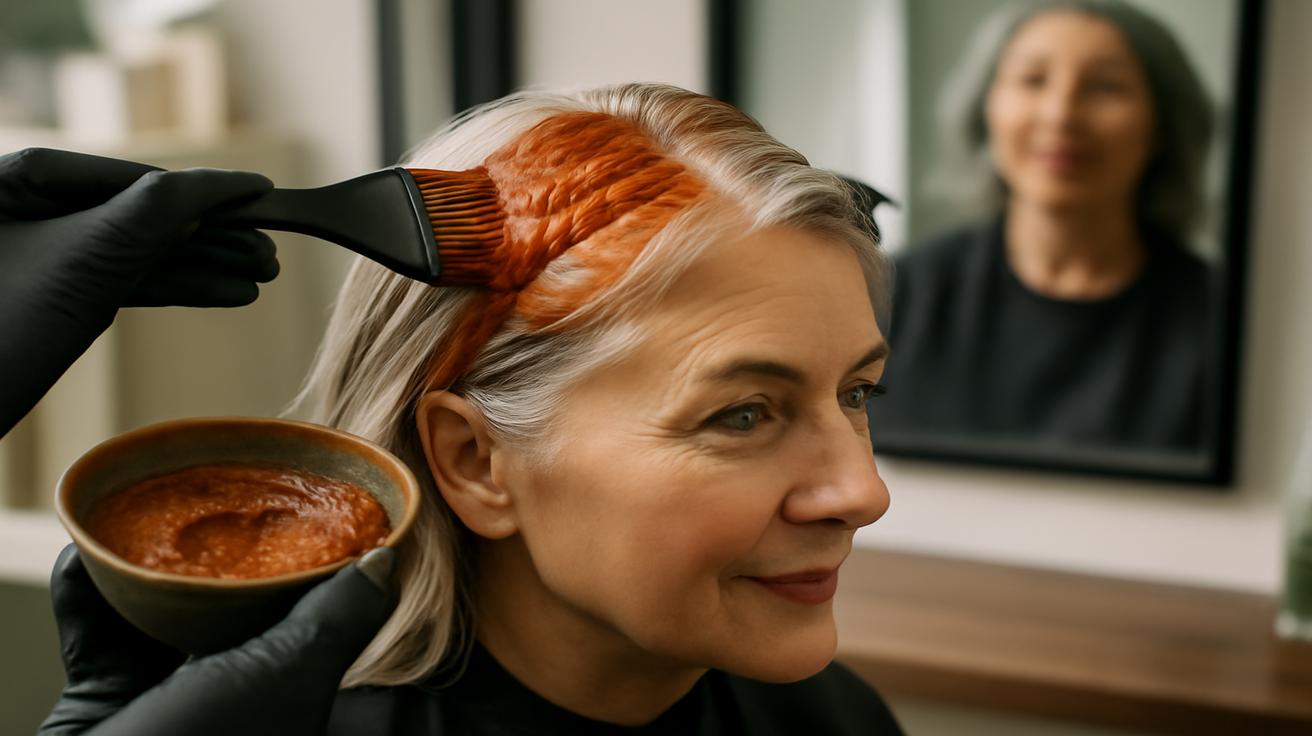
You might simmer black tea and coffee with a handful of sage leaves, cooling the liquid before pouring it slowly through your hair, catching it in a bowl and pouring again and again, the scent of roasted beans and herbs filling the bathroom. Or you might stir a deep green powder of henna and indigo into warm water until it becomes a thick, mossy paste that you smooth onto your roots like clay from a riverbed.
Some do it every three weeks, others every six or eight, because the grow-out line isn’t nearly as harsh. The color fades gracefully. If you skip a month, it doesn’t feel like a crisis.
From Synthetic Shock to Gentle Alchemy
Rather than lifting your hair several shades and then forcing pigment back in, botanical color works with what you have. Grey tends to grab color differently than pigmented hair, often becoming lighter or warmer. Skilled herbal colorists and DIY experimenters learn to play with this, layering tones to turn wiry white into soft gold, smoky steel, or rich chocolate with copper glints.
There is an alchemy in it, but it’s more like cooking than like chemistry lab. The variables become familiar: the hardness of your water, the porosity of your hair, how long you let the paste sit, whether you wrap your head in a towel to keep it warm. Instead of fear—“Will this burn?”—there’s curiosity: “What color will the sun catch when I walk outside?”
What Natural Grey Coverage Actually Looks Like
For anyone tempted to make the switch, it helps to picture how this trend translates to real life. Below is a simple overview of what people are turning to instead of traditional dyes, and how these options tend to behave on grey hair. It’s not a promise, but a map—a starting point on a more mindful journey.
| Natural Approach | Typical Result on Grey Hair | Best For |
|---|---|---|
| Henna-based blends (often with indigo, amla, herbs) | Coverage from warm copper to deep brown; greys often become natural-looking highlights | Those wanting strong coverage with added shine and thickness |
| Herbal teas (black tea, coffee, sage, rosemary) | Subtle darkening and blending; greys soften but may not fully disappear | Early greys, sensitive scalps, low-maintenance routines |
| Cassia and chamomile infusions | Greys turn to soft blond or “sunlit” strands; overall brightening | Light hair tones wanting a youthful, luminous effect |
| Oil masks with botanicals (bhringraj, amla, brahmi) | Do not fully color greys, but improve shine, thickness and reduce wiriness | Anyone embracing salt-and-pepper hair who wants it to look rich and glossy |
| Mineral clays with plant extracts | Soft, muted tones; greys become blended, slightly deeper versions of themselves | Those preferring very subtle, earthy color shifts |
On paper, these may seem mild compared with the instant, intense shift that comes from a bottle of conventional dye. But hair doesn’t live on paper. It lives in motion: in wind, under fluorescent office lights, beneath the sharp honesty of midday sun. In those spaces, “mild” often translates into “believable.” And believable, more often than not, reads as youthful.
The Psychology of Looking Younger, Naturally
Something tender happens when people stop attacking their hair and start listening to it. The grey that once felt like a threat becomes information: my body has lived; my body has stories. The choice ceases to be “hide or show” and becomes “how do I want to tell this story on my own terms?”
Looking younger is not only about color. It’s about how we carry ourselves, how we feel stepping out the door. A scalp that doesn’t sting or flake. Hair that no longer snaps at the ends. A face that isn’t framed by a block of matte, overprocessed dye but by strands that catch light, curve softly, move.
When hair is healthier, it naturally thickens in appearance. The cuticle lies smoother; frizz calms; natural wave or curl patterns often return. All of this sends the eye a familiar set of cues we associate with youth: shine, bounce, softness, density. You may still have grey, but it’s part of a living, vibrant landscape, not a dry and brittle confession.
There’s also the quiet confidence of alignment. Many people who switch from synthetic to natural methods describe a subtle emotional change; they feel less like they’re “getting away with something” and more like they’re honoring themselves. When you no longer fear what’s in the bowl or what will happen if a drop runs down your neck, the whole experience relaxes. That relaxation shows up in how you smile, how you laugh, how you meet your own eyes in the mirror.
Stepping Into the New Ritual
The emerging trend isn’t about throwing away every bottle of traditional dye overnight. It’s about choice expanding, stories changing. If you’re curious about naturally covering your greys—and maybe softening your relationship with aging at the same time—there are gentle ways to begin.
Start small. Perhaps it’s a rinse of strong black tea after your regular shampoo, letting it sit for ten minutes while you listen to a podcast. Or massaging warm, herb-infused oil into your scalp once a week before bed, wrapping your head in a soft towel and letting the scent lull you toward sleep.
You might talk to a stylist who understands plant-based coloring, or experiment with a single strand test at home, watching how your hair responds to a simple mix of henna and indigo or cassia and chamomile. Approach it not as a battle but as a conversation: “What happens if I offer you this?”
This is the quiet beauty of the new movement away from traditional dyes: it replaces urgency with curiosity, resentment with relationship. It lets you say a clear goodbye to fumes and burning and mystery ingredients—without saying goodbye to feeling vibrant, polished, or yes, younger.
The next time you catch your reflection and spot that shimmer of silver, imagine a different scene than the old, rushed dye job. Picture a kettle boiling gently on the stove, a bowl of fragrant herbs on the counter, a towel waiting nearby. Picture color not as camouflage, but as collaboration. The story of your hair is still being written; it just may no longer be written in ammonia.
Frequently Asked Questions
Does natural hair color really cover grey, or just stain it lightly?
It depends on the method and your starting hair. Henna- and indigo-based blends can provide solid, long-lasting coverage, especially on darker shades, while herbal rinses (like tea or coffee) tend to soften and darken greys rather than fully hide them. Think of rinses as “blenders” and herbal dyes as “true color.”
Will natural coloring make me look younger than traditional dye?
Many people feel they look younger because their hair becomes shinier, thicker-looking, and more dimensional. Instead of one flat, opaque color, you get tones and highlights that mimic how natural hair behaves in light. Healthier hair and a calmer scalp also contribute to a more youthful overall appearance.
How long does natural grey coverage last?
Henna and indigo blends can last several weeks to months, gradually fading rather than showing a harsh root line. Herbal rinses usually need to be repeated more often—anywhere from once a week to every couple of washes—to maintain visible results. Because the grow-out is softer, you can often stretch the time between applications.
Is switching from chemical dye to natural color difficult?
It can take patience, especially if your hair has layers of old synthetic dye. Some people transition by letting their roots grow a bit, then using plant-based color to blend the line. Others cut their hair shorter first. Doing strand tests and, if possible, consulting a stylist familiar with natural methods can make the process smoother.
Can natural dyes damage my hair?
Most plant-based approaches, when pure and used correctly, are far gentler than conventional permanent dyes. Henna, for example, often makes hair feel thicker and stronger. However, low-quality or adulterated products, or very frequent application without conditioning, can lead to dryness. Moisturizing treatments and oiling help keep hair soft and flexible.
Will I be stuck with one color if I use natural dyes?
Botanical colors can be layered and adjusted, but they don’t strip pigment like chemical bleaches. Once you’ve used strong plant dyes (especially henna), lightening your hair significantly later can be challenging. That’s why starting with strand tests and choosing a shade close to (or slightly deeper than) your natural color is wise.
What if I decide to embrace my grey completely later?
You still can. Because natural methods often fade gently and blend rather than mask, the transition to full grey typically looks softer than growing out harsh chemical color. You can gradually reduce the intensity or frequency of your natural treatments until your own silver takes the stage, framed by hair that’s been well cared for along the way.