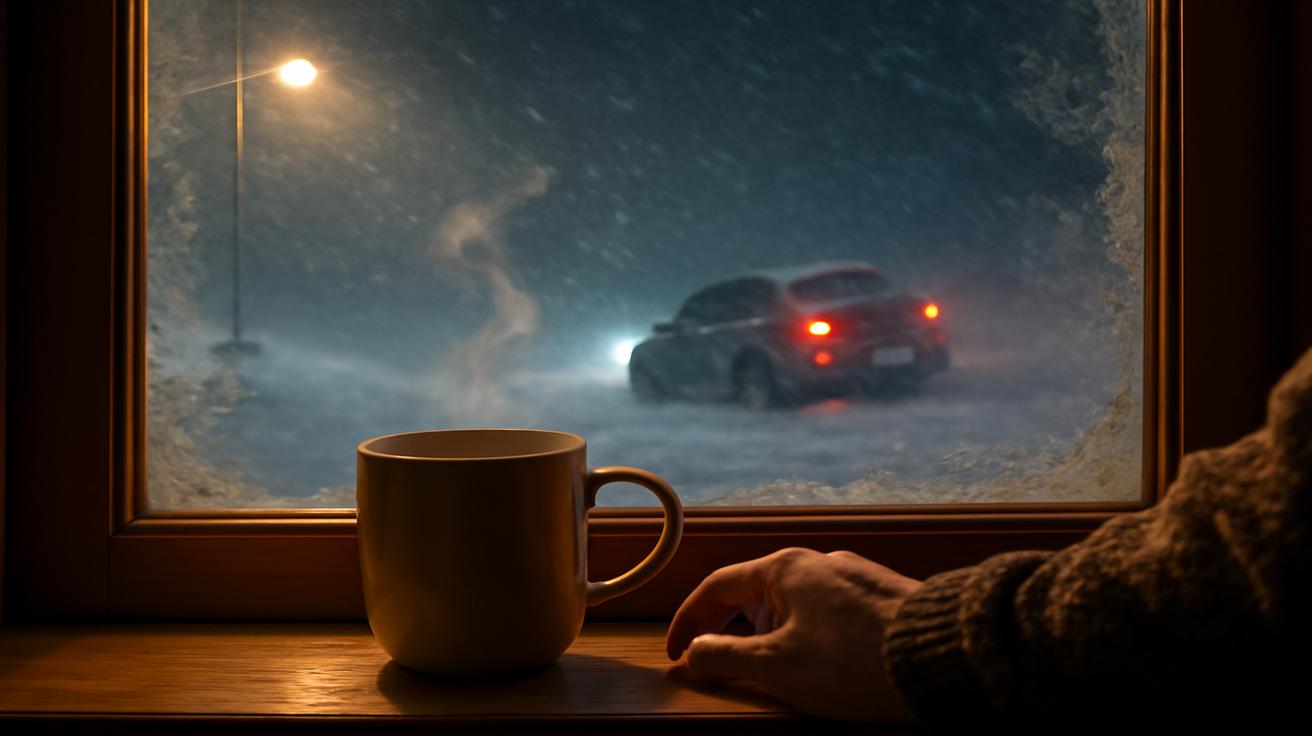
The first alert lands on your phone as a soft chime, the kind you almost ignore out of habit. A tiny red triangle, a few bold words: “Severe Weather Warning: Heavy Snow.” It does not look like danger. It looks like another notification in a world that never stops buzzing. Outside the window, the world still seems harmless enough—damp pavement, a lazy gray sky, the faint glow of streetlights blinking awake. Somewhere in the distance, a siren wails and then fades. You tell yourself there’s still time. Time to get home. Time to squeeze in one more errand. Time to stick with the plans you made days ago, before the warnings got louder, more insistent, less ignorable.
The Night the Forecast Turned from Background Noise to Breaking News
By early evening, the language shifts. What began as “possible heavy snow” becomes “officially confirmed.” Meteorologists, who sounded tentative and careful yesterday, now speak with a new certainty. Radar images show a thick, swirling wall of white tumbling toward the region, expanding and deepening in angry blues and purples. On TV, a presenter stands in front of a glowing weather map, tracing its edge with a hand that moves like a blade: “This is the leading front. Once it arrives, conditions will deteriorate rapidly—late tonight, through tomorrow morning, and possibly well into the weekend.”
Still, a part of you resists. That resistance is everywhere. In the grocery store where a man in a business suit tells his coworker, “I’m still driving to the airport at 5 a.m. They always exaggerate.” In the coffee shop where a student laughs, “If they cancel class, I’m still going to that concert. I already bought the ticket.” In the group chat where someone types, “We’re not letting a bit of snow ruin our plans.”
The snow isn’t here yet; that’s the problem. Warnings always feel too early, too theoretical. They arrive while the world is still behaving, while tires still hum on wet asphalt and buses still arrive with only the usual delay. It is hard to believe in a disaster you cannot yet see. Hard, too, to imagine your ordinary routines turning suddenly hazardous—your morning commute becoming a slow-motion maze of hazards, your short drive to the store becoming a trap you can’t easily reverse.
A Sky Heavy with Intent
Step outside and the air already feels different. It carries a kind of thick anticipation, a density that clings to your lungs as you breathe. The wind has lost its casual gustiness and now moves with deliberate purpose, steady and gathering. Streetlights halo the mist in a way that suggests snow is rehearsing nearby, just out of sight. Somewhere above that low, uniform ceiling of cloud, the storm is arranging itself—layer upon layer of moisture and cold colliding in a choreography of inevitability.
Local authorities start to ramp up their language. “Major disruptions,” they say now. “Travel chaos. Dangerous conditions.” The kind of phrasing that used to belong exclusively to distant disasters you saw on the news: hurricanes in other states, ice storms you only heard about in stories. Now the words are attached to your own exit number, your own highway, the bridge you cross twice a day without thinking. It no longer feels abstract.
And yet, the pushback continues. Human beings are creatures of momentum; it is hard to stop once we are already in motion. Weddings, flights, overnight shifts, family visits, road trips, deliveries, exams—plans that took weeks or months to arrange now stand in the path of a storm building by the hour. Cancelling feels like failure. Changing plans feels like surrender. And so many people do what people are wired to do: they downplay, rationalize, minimize. “It won’t be that bad.” “They said this last year and nothing happened.” “My car can handle it.” “I’ve driven in worse.”
Why Warnings Often Arrive Before Our Belief
Forecasting heavy snow is both science and storytelling. Meteorologists read the language of the atmosphere: pressure systems, temperature gradients, moisture plumes, and wind direction. They can see, hours and sometimes days ahead, that all the ingredients for a paralyzing snow event are sliding into place like gears in a massive, grinding machine.
But the human brain doesn’t run on radar signatures and millibars. It runs on memory and emotion. If the last storm “missed” you, if your area was spared when others got hammered, that memory looms large. If your previous experience with snow is mostly harmless—pretty flakes, a day off, a social media moment—then your mind quietly files the new warning under “probably fine.”
There’s also the quiet, stubborn belief that risk is something that happens to other people. You imagine the “travel chaos” as a drone shot of a faraway highway, not your street. The “major disruptions” become vague images of strangers stuck in airports, not your name being read over a loudspeaker in a terminal full of delays. The “dangerous conditions” are cars in another town’s news report, not your own vehicle sliding sideways at 15 miles per hour, powerless against a thin invisible glaze of ice under freshly fallen snow.
On the Edge of the First Flake
By late evening, the landscape is holding its breath. The last commuters hurry home, their tire tracks darkening the pavement. Delivery drivers make a final push, headlights slicing through the growing murk. Somewhere downtown, diners still linger over late meals, the clink of cutlery and low hum of conversation unfazed by a forecast they half-heard on their way in.
Inside living rooms and kitchens, though, the storm is beginning to claim more space. Parents refresh weather apps between loading the dishwasher and folding laundry. Teens open group chats to compare rumors of school closures. Remote workers eye their laptops and wonder if tomorrow’s “office” will be a couch under a blanket while flakes pile against the windowpanes. The soundscape of the house changes: more radios tuned to local stations, more TVs fixed on the corner where the weather ticker crawls steadily along the bottom of the screen.
And then, almost shyly, the first flake arrives.
You might not notice it at first. One pale fleck drifting past a streetlight, then gone. Another, then three together, swirling awkwardly like they’re still learning the steps. Within minutes, the performance becomes more confident. The air fills with white shapes, each one spinning with its own private logic, all headed for the same stage: the ground, your roof, your car, the road. The world begins to soften, edges dissolving under a delicate dusting that thickens by the minute.
What the Warnings Really Mean Tonight
As the snow intensifies, the phrases from the alert take on a more visceral meaning. “Major disruptions” means buses crawling behind schedule, trains delayed or canceled, service workers struggling to get to jobs that can’t simply be done from home. It means supply trucks stuck behind jackknifed semis, grocery shelves slow to refill, caregivers unable to reach the people who count on them.
“Travel chaos” is the chaos of small decisions colliding with physical limits. It’s the driver who leaves “just ten minutes later” and hits the first wave of black ice. The out-of-town visitor who trusts GPS over gut instinct and ends up on an unplowed back road. The shift worker who can’t afford to call off, white-knuckling through drifts that erase lane lines completely. On overpasses and ramps, where wind scours the pavement clear and temperatures drop just enough, ice blooms silently, viciously. Tires lose their grip in a second that stretches into a slow, helpless spin.
“Dangerous conditions” means visibility collapsing from clear to opaque in the space of a single block. It means snow muffling sound, but not risk—hiding curbs, concealing ditches, erasing the divide between shoulder and road. It means emergency responders navigating the same treacherous surfaces everyone else does, their sirens thin and mournful against the smothered quiet of a city being wrapped in white.
Why So Many Still Refuse to Change Their Plans
Even as the storm asserts itself, resistance hangs on. Confirmation of heavy snow does not instantly rewrite human intention. Someone is still determined to drive to the gym at dawn, insisting, “That’s my routine.” Another is still packing a suitcase for a pre-dawn flight, reasoning, “If I can just make it to the airport, I’ll be fine.” In a small apartment across town, a couple debates whether to postpone a long-awaited visit to aging parents, the guilt of canceling pressing on them as powerfully as the storm pressing on the windows.
Part of this stubbornness comes from how we see ourselves. We like to be the ones who cope, who adapt, who push through. We draw pride from being “the reliable one,” from not being “the type” who panics or overreacts. There’s a quiet heroism many attach to the idea of braving bad weather, of being the person who shows up anyway.
There is also a deeper, subtler force at work: denial as a form of emotional self-defense. To fully absorb what the warnings are saying is to acknowledge that life is far more fragile and contingent than we prefer to believe. That a simple layer of frozen water falling from the sky can halt planes, flip vehicles, strand entire cities. That our schedules, deadlines, even our most heartfelt plans can be rearranged overnight by a storm system that does not know or care what we wanted to do tomorrow.
The Small Choices That Matter Most
Yet it is in these moments of resistance that our choices hold the most power. Changing plans does not always mean dramatic cancellations. Sometimes it looks like shifting a departure time, calling ahead, sharing a ride with someone in a safer vehicle, or choosing a train over a car. It might mean staying overnight with a friend closer to work, or simply deciding that a dinner out can wait until the roads are no longer a roulette wheel.
The difference between “we got through it” and “we never saw it coming” often lies in a few quiet, practical adjustments made before the snow reaches peak intensity. There is a kind of unsung courage in that—less cinematic than plowing forward into a blizzard, but wiser, more sustainable, and, in the long run, kinder to yourself and everyone who shares the road with you.
A Storm Measured in Inches, Hours, and Human Impact
As night deepens, the snowfall thickens into a steady curtain. Streetlights burn inside fuzzy halos. Cars left outside grow soft, rounded shoulders, every sharp edge padded in white. Footsteps disappear seconds after they’re made. The world is being quietly, relentlessly rewritten.
Meteorologists begin to talk in hard numbers now: predicted inches, snowfall rates per hour, wind speeds. At one point, they mention that accumulation could reach a level where even plows struggle to keep up—that by morning, secondary roads may be nearly impassable, and some main routes could resemble narrow, icy trenches flanked by walls of snow.
But beneath every inch of this forecast lie human stories. The nurse nervously checking road cams before her overnight shift. The small business owner wondering if tomorrow’s lost revenue can ever be recouped. The single parent eyeing an almost-empty fridge, calculating whether it would have been safer to risk one more store run or to wait it out and get creative with what’s already in the pantry.
Authorities have learned, sometimes through bitter experience, to take these storms seriously. That’s why the alerts sound so urgent now. They recall the pileups on interstates, the drivers trapped for hours in cars that slowly turned into freezers, the overloaded tow trucks, the exhausted first responders who spent entire nights pushing through whiteout conditions to reach people who assumed they’d be fine.
An At-a-Glance Look at What’s Coming
In a world saturated with words, sometimes a simple snapshot helps make things real. Here’s a compact look at what “heavy snow officially confirmed” most often translates to in lived experience over the next day or two:
| Timeframe | What to Expect | Smart Moves to Consider |
|---|---|---|
| Late Tonight | Snow begins, roads turning slick, visibility dropping. | Finish essential trips early, park off-street if possible, charge devices. |
| Overnight | Heaviest snow, rapid accumulation, plows struggling to keep up. | Avoid driving, keep emergency kit handy, stay updated via local alerts. |
| Early Morning | Challenging commute, packed snow and ice, travel delays and cancellations. | Consider remote work, delay departures, check closures before leaving. |
| Daytime | Lingering snow, reduced services, slow cleanup. | Limit trips to essentials, help clear walkways safely, check on neighbors. |
Listening to the Silence the Storm Brings
By the small hours, a deep hush settles over everything. The usual city soundtrack—engines, horns, the distant thrum of traffic—dims to a muted murmur or vanishes entirely. Snow is a great silencer, swallowing sound and smoothing sharp edges of noise as thoroughly as it covers the landscape.
From a window, you might see just a handful of moving lights: a plow grinding down the main road, a single pair of headlights creeping cautiously through swirling white, perhaps the pulse of an ambulance cutting across the muffled night. Most people, at last, have stayed where they are, heeding what instinct and alerts and the evidence outside their doors have all been trying to say: this is not a normal night. This is a night to pause.
Inside, life contracts to the radius of the rooms you inhabit. The storm redraws priorities in quiet ways. Coffee makers are checked for the morning. Extra blankets appear at the foot of beds. Candles and flashlights are placed a little closer to hand. Conversations shift from “What are we doing tomorrow?” to “What do we really need to do, and what can safely wait?”
Somewhere in that shrinking circle of concern, there is space for reflection. About how often we race ahead of ourselves, assuming the world will always bend to our schedules. About how fragile our sense of control can be when something as simple as frozen water in the air decides to fall and keep falling.
When Caution Becomes an Act of Care
As heavy snow cements its hold through the night, the warnings begin to feel less like intrusions and more like a kind of rough kindness. They are blunt because the stakes are high, because experience has shown what happens when they are ignored. Every choice to leave a little earlier, or later, or not at all, ripples outward in ways we rarely see. The decision to postpone a trip can be the reason an emergency responder reaches someone else a few minutes faster. The choice to work from home can mean one less vehicle spinning out on an overpass, one less blockage on a route already stretched thin.
Refusing to change plans in the face of an officially confirmed storm often feels like defiance, a way of asserting control. But there is another, quieter power in adaptation. In saying, “My safety, and yours, matter more than my calendar.” It is not dramatic. It will never trend. Yet it is the kind of strength that holds communities together when the snow falls hardest.
Outside, the storm continues its relentless work, flake by flake, minute by minute. By morning, the landscape will be transformed—some of it brutally, with cars buried and roads closed; some of it beautifully, with trees bowed under glittering weight and rooftops turned into pure, unbroken canvases. Between those two realities lies the space where our choices were made in the hours before the worst arrived.
Tonight, the alerts have done more than inform. They have asked a question: Will you listen? The snow, thickening by the hour, is the answer we cannot negotiate with. How we respond to it—whether we cling to our plans or allow them to bend—will shape what sort of stories we tell when the storm at last begins to melt away.
Frequently Asked Questions
How dangerous is it to drive once heavy snow is officially confirmed?
The danger depends on factors like snowfall rate, temperature, wind, and road treatment, but conditions can deteriorate much faster than most drivers expect. Visibility can drop suddenly, ice can form beneath fresh snow, and stopping distances increase dramatically. If authorities and forecasts are warning of major disruptions and travel chaos, it’s wise to avoid driving unless it’s absolutely essential.
What should I do if I can’t cancel my plans?
If you truly cannot cancel, focus on reducing risk: leave earlier or later to avoid peak conditions, use main roads that are more likely to be plowed, slow your speed significantly, increase following distance, and tell someone your route and expected arrival time. Consider alternatives such as public transit, staying overnight closer to your destination, or switching to remote options if possible.
Why do weather services sometimes sound alarmist?
What can sound alarmist is often the result of painful lessons from past storms where people underestimated the risk. Strong language—“major disruptions,” “dangerous conditions”—is intended to prompt action before the worst conditions arrive. When storms underperform, it’s visible and often criticized; when they are deadly and warnings were too mild, the consequences are far worse.
How can I prepare at home for a confirmed heavy snow event?
Have enough food, water, and essential medications for a few days; charge phones and backup batteries; locate flashlights and extra blankets; ensure you have a basic first-aid kit; and, if safe, clear gutters and check that outdoor drains are not blocked. Bring pets indoors and plan for how you’ll stay warm and connected if power outages occur.
Is changing my plans really that important if I’m a confident winter driver?
Confidence and experience help, but they don’t change physics or road conditions. Even skilled drivers can lose control on black ice or in whiteout conditions, and other drivers around you may be less prepared. Adjusting your plans is not just about your own safety; it also reduces strain on emergency services and lowers the overall risk for everyone sharing the roads during the storm.