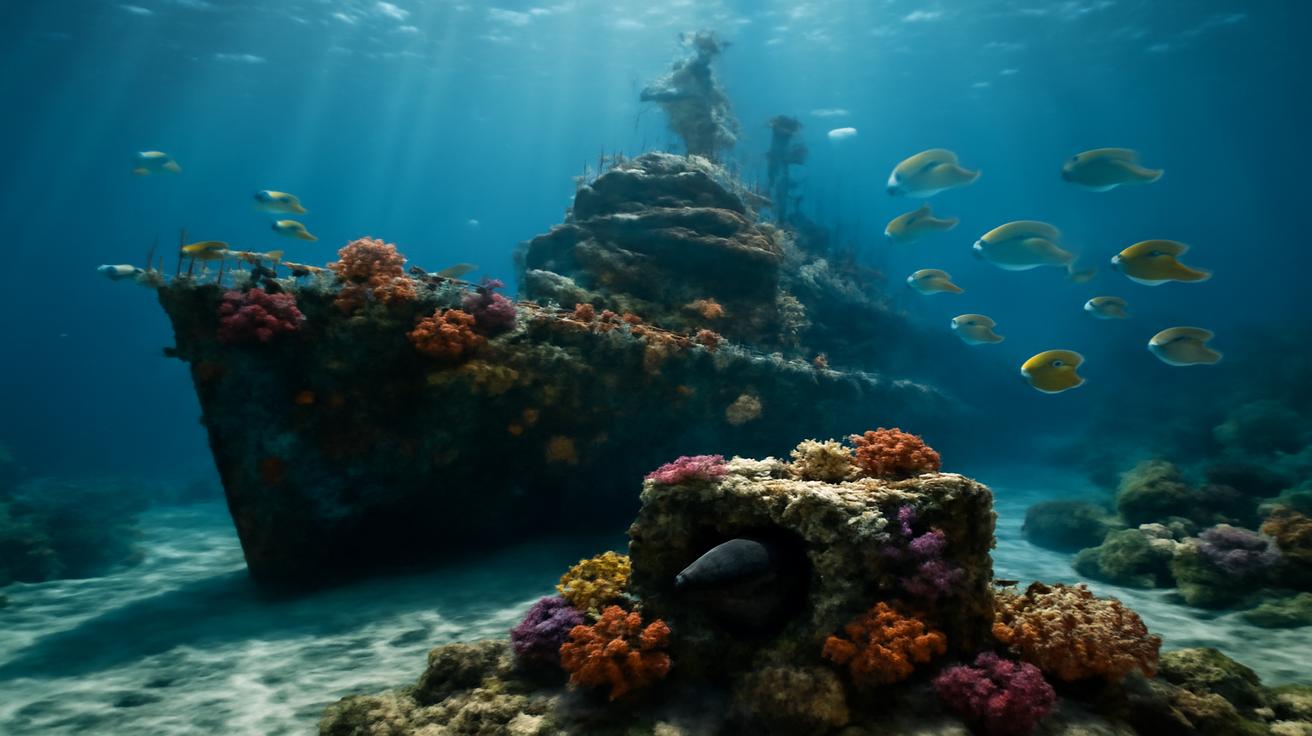
The first time the fishermen saw the ship sink, they went quiet. Engines idled, ropes rested slack in their hands, and even the gulls seemed to pause mid‑cry as the rust‑scarred vessel slipped beneath the surface. It was an old coastal freighter, years past its prime, emptied of fuel and stripped of anything toxic. To most eyes, it was scrap metal. But to the people watching from the small patrol boat that humid morning, it was something else entirely: the skeleton of a future reef, the bare frame of an ecosystem yet to be born.
The Country That Chose to Grow an Ocean
The decision didn’t begin with poetry. It began with panic.
For years, the nation’s coastal communities had been complaining that the sea was changing—slowly at first, then all at once. Nets that once came back brimming with snapper, grouper, and amberjack began to return thin and ragged, clotted with plastic and algae instead of fish. Older fishers muttered that the currents felt wrong. Younger divers, who had grown up thinking coral reefs were bright places bristling with life, started coming back from weekend trips shaking their heads: Dead. Bleached. Quiet.
Scientists confirmed what the fishers already knew in their bones. Years of overfishing had put unimaginable pressure on wild stocks. Coastal development had smothered seagrass beds and nearshore reefs in silt. Climate change, with its warming waters and acidifying seas, had stressed corals to the breaking point. The ocean floor off the nation’s coast—once a quilt of coral heads, rocky outcrops, and seagrass meadows—was turning into an underwater desert.
In a small, wood‑paneled government conference room overlooking the harbor, a group of marine biologists laid out the stark truth: “We can’t just stop the damage,” one of them said, tapping a map mottled with red warning zones. “We have to build new habitat. From scratch.”
That phrase—from scratch—hung in the air. It sounded impossible, almost arrogant. You don’t just assemble an ecosystem like furniture. But the idea nagged at them, and in the months that followed it tightened into a plan that was at once radical and surprisingly simple: they would make the sea floor interesting again.
Shipwrecks by Design
The first step was to redefine what “waste” meant.
In shipyards up and down the coast, old steel hulls lay waiting for the scrap cutter’s torch—retired naval patrol ships, aging ferries, coastal freighters no longer worth refitting. For decades, their fate had been the same: dismantled, melted down, forgotten. Now, marine planners saw them with different eyes. Their hulls, with their doorways and cavities, were ready‑made caves and corridors for fish. Their masts and railings promised vertical relief, a scaffolding on which corals and sponges could anchor.
But first, each ship had to be transformed from hazard to habitat. In dry docks, crews in hard hats and respirators moved methodically through the empty shells, stripping out fuel tanks, cleaning oil residue, removing asbestos, lead paint, and anything that might poison the sea they were trying to heal. Loose wires were cut away. Doors were welded open so no diver—or fish—could ever be trapped inside. Structural supports were checked and reinforced where necessary. It took months of preparation for each vessel to be declared clean enough to sink.
On deployment day, the operation unfolded with the precision of a choreographed dance. Tugboats nudged and guided the hulking ship from its birth in the harbor toward its new graveyard, a carefully chosen patch of barren seabed miles offshore. Coastal patrol boats circled at a distance to keep curious spectators clear. Scientists hovered over sonar screens, verifying depth and bottom topography. The goal was not simply to sink the ship, but to place it gently on the seafloor, upright, where currents could sweep through and larvae could settle.
When the final valves were opened and the ballast tanks began to flood, the mood shifted. The ship, which had survived storms and decades of work, now trembled like a living thing giving up its last breath. The waterline crept higher along the steel hull. Anxious eyes flicked between the vessel and the depth gauges. Then, with a hiss and a slow, inevitable roll, the ship slid under, leaving only a swirl of foam, bubbles, and a quiet gash of absence on the surface.
“In a few years,” one of the biologists murmured, watching the last of the wake flatten out, “this spot is going to be crawling with life.”
Concrete Cities Beneath the Waves
But ships, as impressive as they were, could only do so much. The ocean floor needed more than a few scattered giants—it needed neighborhoods, corridors, and safe houses on a smaller scale. That’s where concrete came in.
The country had an unglamorous problem: piles of broken concrete from demolished buildings, old highway overpasses, and failed port projects stacked in weedy lots and dusty corners of industrial yards. Too irregular for reuse, too bulky for easy disposal, it was the kind of material no one liked to think about.
Until someone realized that where humans saw rubble, fish saw real estate.
Engineers and marine ecologists began designing modular concrete reef blocks shaped to beckon marine life. Some resembled oversized honeycombs: thick rings with large round holes, edges roughened to help tiny organisms cling. Others were squat pyramids with archways through the base, designed as safe nooks for juvenile fish. Still others were slabs with textured grooves mimicking the crevices of a natural rocky reef.
At casting yards, the clanging rhythm of construction took on a new purpose. Workers poured marine‑grade concrete into molds, embedding a little roughness, sometimes even mixing in crushed shells to change the surface texture. After curing, the blocks were trucked to ports, stacked like strange, gray sculptures awaiting an audience.
Deployed by cranes from barges, these blocks descended in deliberate patterns, arranged on the sandy bottom in clusters and ridges. There were spaces narrow enough for small fish to hide, gaps wide enough for rays to glide through, and open zones to let currents thread between the structures. In some sites, concrete modules were laid out in long chains, forming “reef highways” that connected isolated natural outcrops, giving marine life a continuous corridor of shelter and feeding ground.
How an Empty Seafloor Learns to Breathe Again
The first weeks after deployment, the new reefs looked lonely to the human eye. Divers dropped down expecting instant transformation and instead found pale concrete and blank steel cloaked in that deep‑blue stillness of midwater emptiness.
But life in the sea starts small—almost invisibly small.
Within days, microscopic plankton and bacteria formed a faint, slippery film called biofilm on the surfaces of the ships and blocks. To us it seems like grime; to the ocean, it’s a Welcome sign. That film attracted larger microorganisms and larvae—tiny drifting specks of corals, sponges, barnacles, and algae carried by currents from miles away. Some died. Some drifted on. Some stuck.
Week by week, that film thickened into color. Pale greens and soft browns first, then flecks of orange and yellow as sponges and tunicates took hold. Algae sprouted like a hesitant fuzz. When divers returned after a few months, the empty walls of steel and concrete had lost their sterile sheen. They now wore the marine equivalent of stubble.
The fish came next.
First, the shy scouts—little damselfish and wrasses—appeared, zipping between holes, investigating new hideouts. Soon after, clouds of baitfish began to gather, swirling around the skeletal masts and between concrete ribs. With them came the predators: sleek jacks, curious groupers, and the occasional barracuda materialized from the blue, drawn by the promise of an easy meal.
The nation’s marine agency began to log what was happening, dive by dive, year by year. What they documented was nothing short of ecological choreography.
| Time After Deployment | Notable Changes | Typical Visitors / Residents |
|---|---|---|
| First few weeks | Biofilm and initial algae growth on surfaces | Plankton, microorganisms, a few curious small fish |
| 3–6 months | Settlement of barnacles, sponges, soft corals | Damselfish, wrasses, baitfish schools |
| 1–3 years | Complex communities; increasing structural cover | Snappers, groupers, jacks, crustaceans, octopus |
| 5+ years | Mature reef assemblages, high biodiversity | Large reef fish, turtles, visiting pelagics, occasional sharks |
Five years into the project, places that had once been blank expanses of featureless sand now pulsed with life. A sunken coastal ferry lay under a curtain of baitfish so dense it looked like smoke. Its railings were draped in feathery soft corals; its shaded underbelly had become prized real estate for lobsters and moray eels. Concrete pyramids that had once seemed laughably artificial were now barely recognizable under the layered crust of sponges and coralline algae.
The People Who Live by a Rebuilt Sea
For those who earn their living from the water, the transformation was more than scientific—it was personal.
In one small fishing town, the changes played out in stories swap‑ped at dawn over plastic cups of sweet coffee on the pier. At first, many fishers had been skeptical, even angry. To create artificial reefs, the government had declared no‑take zones around certain sites, forbidding fishing within a set radius. “You’re taking away our grounds,” some protested at heated community meetings. “You’re telling us not to fish when we’re already catching less.”
Patience is a hard sell to someone watching their income shrink. But the marine team came back again and again, this time with charts showing how artificial reefs, if protected early on, could actually replenish nearby natural areas through “spillover”—fish foraging outside the reef zones as populations recovered. They promised something that sounded almost impossible in that moment: More fish, not fewer. Just not right away.
In the third year, one of the older captains, who had refused to waste fuel on “those experimental junk heaps,” changed his tune. His nephew had persuaded him to set their nets along the boundary of one of the earliest reef sites. That morning, the net came back heavy—so heavy it took all three crew members grunting and laughing to haul it over the gunwale. Silver flanks flashed in the early light: snapper, trevally, a scattering of plump groupers, more than they had seen in a decade from that stretch of coast.
Word spread faster than any government brochure ever could.
The new reefs didn’t just boost fish stocks. They reshaped local economies in quieter ways. A generation of young divers and underwater photographers began offering trips to the shipwreck reefs, guiding visitors through what had become living museums of steel and coral. On weekends, the harbor filled with small boats ferrying tourists to snorkel over the shallower concrete blocks, watching turtles graze on algae and clouds of reef fish glittering around them like confetti.
Some of the same kids who once listened, restless and bored, to marine biologists explaining reef ecology in school halls now found themselves working as reef guides, pointing out species to visitors with the practiced eye of someone who knew these structures not as ideas but as neighborhoods.
Designing for Fish, Not Just for Photos
From the beginning, the architects of this underwater rebuilding project made a conscious choice: the reefs were not to be ornaments. They were not theme parks, or underwater sculptures for pretty pictures. They were, first and foremost, functional habitat.
Every decision flowed from that principle. When tourism agencies suggested more “eye‑catching” designs—fantastical shapes, human statues, intricate patterns—the marine team pushed back. Complex didn’t always mean better, they argued; the sea already knew what forms worked. Caves, ledges, overhangs, nooks: these were the currencies of safety and survival for small fish. Vertical surfaces for filter feeders. Rough textures for coral larvae to grab. Shaded pockets for nocturnal creatures. Open sand nearby for foraging rays.
To refine their designs, biologists and engineers ran small‑scale experiments. They deployed test modules with different hole sizes, surface textures, and arrangements. Some were quickly colonized, buzzing within months. Others remained oddly quiet, visited only by a few passing fish. Underwater cameras and diver surveys revealed why: a slightly different orientation might channel currents better, delivering more food. A narrower opening offered refuge to juveniles but kept out larger predators long enough for them to grow. Over time, the failed designs were quietly retired. The successful ones were replicated and scaled up.
It was trial and error, but not guesswork—it was a dialogue with the sea, conducted in slow motion.
Lessons from a Nation That Refused to Give Up
As the years rolled by, other countries began to notice. Delegations arrived to tour the shipyards where decommissioned vessels were cleaned for sinking, the casting yards where reef blocks were poured, and the control rooms where maps of artificial reef sites were layered with satellite data, fishing records, and biodiversity surveys.
They found a model that was powerful not because it was perfect, but because it was honest about its limits.
The nation’s scientists were the first to point out that artificial reefs are not a magic cure. They do not fix warming seas or ocean acidification. They cannot, by themselves, halt overfishing or reverse every lost coral reef. If placed carelessly, they can even do harm—drawing fishers to sensitive areas, or offering only the illusion of abundance while deeper problems remain untouched.
But in this country’s case, the artificial reefs were never a stand‑alone fix; they were a thread in a much larger tapestry of change. Fishing quotas were tightened. Destructive gear was phased out. Mangrove restoration programs took root along muddy shorelines. Pollution controls upstream began to cut the flow of sediment and nutrients into coastal waters. The artificial reefs were both symbol and tool: a visible commitment to rebuilding, a practical way to give the ocean more places to do what it does best when given half a chance—heal.
One of the lead ecologists liked to explain it this way when visiting officials asked why the project worked: “We didn’t create an ecosystem,” she would say, “we created the stage. The ocean wrote the play.”
Standing on the Surface, Imagining the World Below
Today, if you stand on a high cliff overlooking that nation’s coast on a calm day, you will see almost nothing of this story. The sea lies flat and inscrutable, a sheet of blue broken only by the white scars of boat wakes. The sunken ships and concrete blocks are invisible, their steel and stone softened by distance and waves.
But somewhere under that reflective surface, a school of young snapper is sheltering in the shadow of a rusted hull door. A turtle is pausing to let a cleaner wrasse nibble parasites from its shell, hovering above a fan of orange sponge growing from a concrete arch. An octopus is investigating a bolt hole, deciding if this crevice in a retired ferry’s bulkhead might make a good home.
From up here, the ocean looks empty and eternal. From down there, it is anything but. It is busy, improvised, stitched back together from the bones of our discarded machines and the dust of our demolished cities.
In a century defined by loss—of species, of habitats, of certainty—there is something quietly radical about the idea that a nation chose not just to stop taking, but to start building. Not high‑rise towers or new ports. But homes for creatures that will never know our names, on a seafloor most of us will never personally see.
We like to think of wilderness as something untouched by human hands. But in an age where very little on this planet is truly untouched, maybe the more honest question is this: when we do leave our fingerprints, what do we choose to build?
In this coastal nation, they answered with ships and concrete, lowered gently into the deep. Over time, the ocean answered back—with color, with movement, with the shimmer of scales and the purple branches of soft coral swaying in a current that now has something to flow around.
You could call it engineering. You could call it restoration. But to the people who remember when these waters fell silent, it feels like something simpler, and older.
It feels like bringing the sea back to life.
Frequently Asked Questions
Do artificial reefs really help marine life, or just attract existing fish?
They do both. Artificial reefs certainly attract fish from surrounding areas because they provide instant shelter and feeding grounds. But when designed and managed well—especially when paired with fishing restrictions—they can also increase overall biomass and biodiversity by creating new habitat where there was previously little or none.
Why use old ships and concrete instead of building natural reefs?
Natural reefs, like coral formations, take decades or centuries to form and require very specific conditions. Old ships and specially designed concrete blocks offer immediate three‑dimensional structure on barren seafloors, giving marine organisms places to settle, hide, and hunt much more quickly, while corals and other slow‑growing species gradually move in.
Is it safe to sink ships in the ocean?
Only if they are carefully prepared. Before sinking, ships must be thoroughly cleaned of fuel, oils, hazardous materials, loose plastics, and toxins. Governments usually follow strict environmental guidelines and inspections to ensure that the vessels become habitat, not pollution sources.
Can artificial reefs replace natural coral reefs?
No. Artificial reefs can complement and support natural systems, but they cannot fully replicate the complexity and long‑evolved relationships of intact coral reefs. They are best seen as a tool for habitat creation and restoration, not a substitute for protecting what remains of natural reefs.
Do artificial reefs benefit local communities economically?
Yes, when managed well. They can boost fish stocks near fishing communities and create new opportunities for tourism, diving, and education. Many coastal towns have seen new jobs and businesses emerge around reef‑based recreation and sustainable fisheries linked to artificial reef projects.