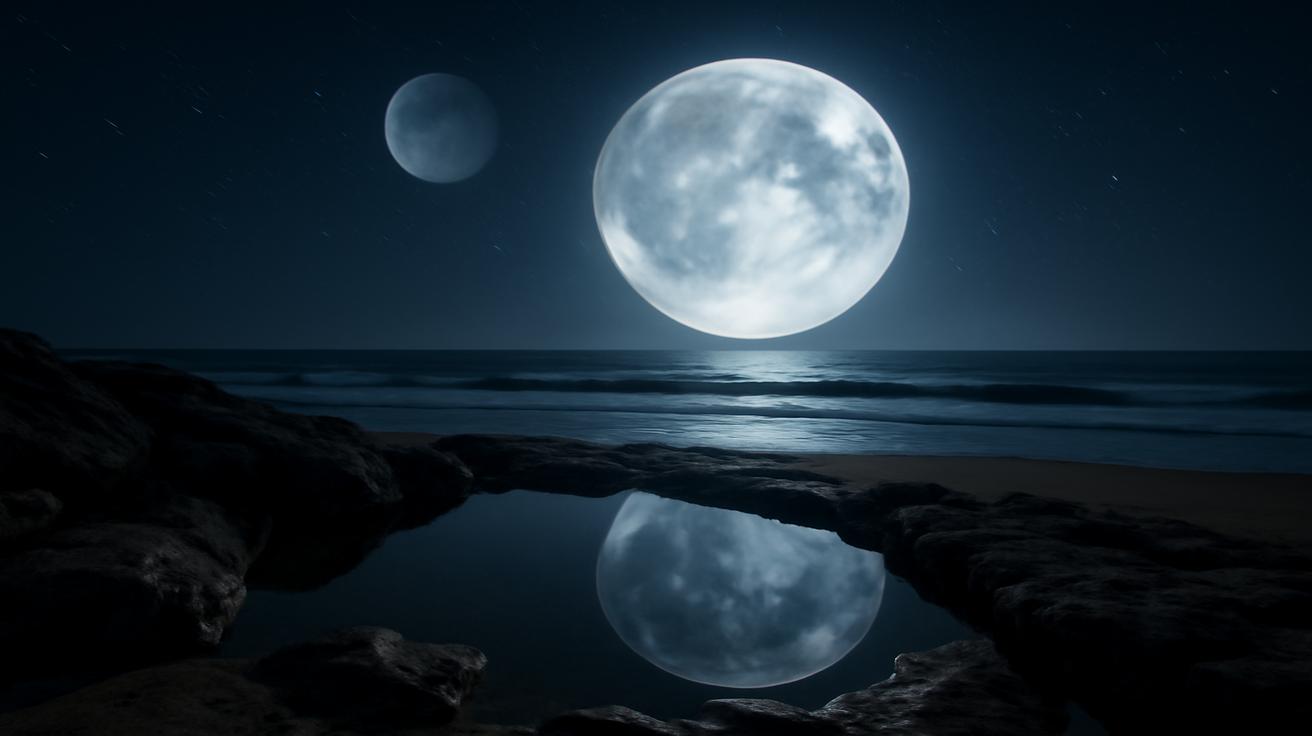
The first time you really notice the Moon is often by accident. Maybe you’re taking out the trash at night, or walking the dog, or sitting in traffic as the sky turns from blue to ink. There it is: that pale, steady coin looking back at you, familiar and unhurried. It feels eternal, like a fixture that has always belonged exactly where it hangs. But that calm face is hiding a quiet secret. The Moon is leaving us. Not dramatically, not in a way the eye can catch. Each year, it creeps a tiny bit farther away, changing our days, our tides, and our future in ways we’re only beginning to fully understand.
The Slowest Breakup in the Solar System
Imagine standing on a beach 1.4 billion years ago. The air smells sharper, saltier, and the Sun hangs in a slightly dimmer sky. You look up, and the Moon is enormous. Not just “a bit bigger” enormous, but dominating-the-horizon enormous, its pale face looming so low and close that you can almost feel its presence pressing down on the ocean beside you.
Back then, Earth spun much faster. A single day may have lasted barely 18 hours. The Moon, tucked much closer to us, tugged ferociously at Earth’s oceans, whipping the tides into high, wild surges. The sea would have risen and fallen with a drama we rarely witness today except during the fiercest storms or king tides.
Now, wind the clock forward to this exact moment—where you are, reading this, under a quieter sky. The Moon is still there, but it’s about 384,400 kilometers away, and counting. Laser measurements from mirrors left on the lunar surface by Apollo astronauts show that the Moon is receding from Earth by about 3.8 centimeters every year. That’s roughly the rate your fingernails grow. You don’t see it from night to night, but over millions of years, that microscopic drift adds up to a cosmic rearrangement.
You could call it the slowest breakup in the solar system: not a sudden severing, but a long, drawn-out drifting apart, written in tides and time.
How Tides Push the Moon Away
The reason the Moon is moving away begins at your feet—literally, in the water that laps at our shores. Stand by the ocean and watch waves surge and slide back, leaving a ghostly sheen of foam on the sand. Beneath that ordinary rhythm lies a subtle battle of forces, a dance of gravity and friction stretching from the seafloor to the sky.
The Moon’s gravity pulls on Earth’s oceans, creating bulges of water—high tides—on the side facing the Moon and on the opposite side as well. In a perfectly smooth, frictionless world, those bulges would line up neatly with the Moon. But Earth is spinning faster than the Moon orbits us. Our planet drags those tidal bulges slightly ahead of the Moon’s position, like a runner pulling a kite forward in the wind.
That offset is everything.
Those tidal bulges are made of water—and water has mass. Because they’re pulled a little in front of the Moon’s path, their gravity tugs on the Moon, giving it a faint but persistent forward pull. It’s as if Earth’s oceans are giving the Moon a tiny, constant shove, accelerating it in its orbit. As that happens, the Moon climbs to a slightly higher orbit and drifts a little farther away.
But nothing comes free in physics. As the Moon gains energy, Earth loses some of its rotational energy. Our planet’s spin slows down. The cost of the Moon’s escape is time itself. Our days grow longer—by about 1.7 milliseconds every century. It’s a whisper of change, invisible to your body clock, but written unmistakably in ancient rocks and coral fossils that record more days per year in the deep past than we have now.
The Quiet Stretching of Time
If you could somehow line up clocks from every era of Earth’s history, you’d see something remarkable. Billions of years ago, days were shorter; there were many more of them packed into a single orbit around the Sun. Over time, as the Moon receded, Earth’s spin slackened. Our days elongated, like taffy being very gently pulled at the edges.
Geologists have found evidence of this in the layered skeletons of ancient corals and sedimentary rocks. Some coral fossils from about 400 million years ago show growth bands that, when counted like tree rings, reveal that a year then contained about 400 days. The year itself—the time Earth takes to go around the Sun—hasn’t changed much. But the length of each day has. Back then, each day lasted about 21.8 hours. Now, we cram only about 365 days into a year, each one around 24 hours long.
It’s almost poetic: in giving the Moon distance, we gain more spacious days. We don’t feel the difference of a millisecond stretch, but, project it forward, and the future Earth becomes a world of distinctly longer days, slower sunsets, and a different rhythm of life.
When the Ocean Breathes Differently
To understand what this means for our seas, go back to that beach—this time, today. The air is soft. The horizon is a scrim of gray-blue. The surf rolls in and out with that hypnotic hush humans have listened to for as long as we’ve been here.
Tides are the pulse of the ocean. They shape coastlines, guide migrations, and stir nutrients that feed entire food chains. Every time the sea rises and falls, it’s partly answering the Moon’s call. But as the Moon drifts away, the tides are slowly, quietly changing.
A closer Moon in the past meant stronger tidal forces. Imagine higher high tides, lower low tides, and more vigorous tidal currents streaming through ancient bays and along primitive shores. Those forces may have carved different coastlines and estuaries and created richly mixed waters—nurseries where early life could thrive in the shallow, sunlit sea.
As the Moon recedes, its tidal grip weakens. Today, we still have powerful tides, but over immense timescales, the average tidal range—how far the water rises and falls—will shrink. The ocean will still breathe, but more gently. Coastal ecosystems that rely on dramatic tidal swings might gradually shift, adapting to a subtler rhythm.
The Future Shoreline, Rewritten in Slow Motion
Picture a future Earth, hundreds of millions of years from now. Continents have drifted into new configurations. Mountain ranges you know today are dust. Somewhere on that reshaped world, a coastline faces a familiar Moon—only smaller, hanging a bit farther away in the sky.
The tides along that shore won’t be entirely still, but they may be more modest. Estuaries that once flooded and drained in wide, sweeping arcs might now only breathe in shallow sighs. Some tidal flats could shrink, replaced by more permanent stretches of marsh or seagrass. Species that evolved with extreme tidal variations may fade, while others better suited to gentle, predictable shifts might flourish.
This isn’t a sudden catastrophe. It’s not the stuff of disaster movies; it’s the slow re-sculpting of the water’s edge. While humanity worries—rightly—about rapid, human-driven sea level change and coastal erosion, a much slower, more patient change has been underway for billions of years, working in the background. The Moon is continually rewriting the book of our coastlines, one millimeter of movement at a time.
Locked in a Gravitational Embrace
Look at the Moon on a clear night, and you always see essentially the same face. The same dark maria, the same bright highlands. For all of human history, the Moon has shown us just one side, the other turned permanently away, hidden until spacecraft finally flew around it.
This isn’t a coincidence. The Moon is tidally locked to Earth. Long ago, the same gravitational forces pulling on Earth’s oceans also tugged on the Moon’s rocky body, slowing its spin until one side became locked facing us forever. Now, the Moon rotates once on its axis in the same time it takes to orbit Earth—about 27.3 days. To our eyes, it simply hangs there, turning its face in slow, predictable phases but never fully away.
In a distant future, the same thing may happen to Earth.
Earth’s Possible Tidal Fate
Continue the story of tidal friction far enough, and a strange scenario emerges. Over billions of years, if nothing else intervenes, Earth’s rotation could eventually slow until our planet also becomes tidally locked to the Moon. One hemisphere of Earth would always face the Moon; the other would never see it, not even as a faint crescent on the horizon.
In that state, Earth’s day and the Moon’s orbital period would match. We’d reach a kind of gravitational truce—no more net transfer of energy, no more drifting away. The Moon’s outward journey would stall.
But this is a projected endgame so distant that it brushes against other looming cosmic deadlines, like the future swelling and brightening of the Sun as it ages. The Sun itself may disrupt this slow dance before it can conclude. Still, as a thought experiment, it’s haunting: a world where the Moon forever hangs above one hemisphere, fixed in the sky like a silver emblem, as day and night play out in a different, slower pattern.
The Moon We Used to Know
The story of the Moon’s escape is also a story about what we’ve lost—things no human ever witnessed, but which the planet itself remembers.
In Earth’s earliest chapters, soon after a Mars-sized object likely struck our young planet and flung material into orbit that later coalesced into the Moon, the two worlds were shockingly close. Some estimates suggest the Moon could have hung only about 20,000 to 30,000 kilometers away, compared to nearly 400,000 kilometers today.
From that newborn Earth, the Moon would have loomed monstrously large, perhaps tens of times the size we see now. Its presence would have transformed the night into something otherworldly—bright, looming, perhaps tinged with volcanic red as both bodies still glowed with internal heat. Tides then may have surged hundreds of meters in certain basins, racing across shorelines with ferocity that defies modern imagination.
No eyes saw that sky. No one stood on those shores to feel the ground shake with titanic tides. But the marks remain in ancient rocks and in the very existence of our stable climate and tilted axis. The Moon, by braking our spin and stabilizing our tilt, helped make Earth the comparatively calm, life-friendly planet we know.
Our Days, Rewritten by the Moon
It’s tempting to think of the length of a day as something fundamental, almost sacred. Twenty-four hours. Morning, noon, evening, night. But really, a day is nothing more than the time it takes our planet to complete one full spin on its axis—and that spin is negotiable.
Without the Moon’s braking influence, Earth today might still be spinning much faster. We could be living with 12- or 16-hour days, with a Sun that races across the sky. Winds would be wilder, storms perhaps more intense, jet streams more chaotic. The rhythm of life, including our sleep, our sense of time, even the way our bodies evolved, would likely be profoundly different.
As the Moon slowly retreats, it’s not just moving through space; it’s editing the tempo of our world. Every creature that has ever tracked the tides, or synchronized breeding with lunar cycles, or relied on dusk and dawn, has done so on a stage subtly reshaped by the Moon’s quiet departure.
Measuring the Drift, Feeling the Wonder
Today, the fact that we can even measure the Moon’s tiny yearly escape is a wonder in itself. On the Moon’s surface, in several locations, sit small arrays of mirrors, placed there by Apollo astronauts and robotic missions. From Earth, scientists aim pulses of laser light at those mirrors. The beams travel to the Moon, bounce off, and return. By timing that journey with exquisite precision, we can measure the Earth–Moon distance to the millimeter.
In those numbers is a story that stretches from primordial oceans to far-future shores. Each year’s fraction-of-an-inch increase whispers that the gravitational dance continues, unhurried and unstoppable.
Sometimes, science can feel cold, all decimals and data. But stand under a clear sky on a cool night and look up. Think of that faint, pale disk not as a fixed ornament, but as a traveler, slowly receding. Imagine the countless nights before you, when early humans stared at a slightly larger Moon, weaving it into stories and gods and calendars. Imagine the nights after you, when future eyes—human or otherwise—will see a slightly smaller Moon and perhaps measure time in days a little longer than yours.
A Tiny Change with a Cosmic Echo
On human timescales, the Moon’s retreat and the lengthening of our days are negligible. Our calendars won’t crumble; the tides tomorrow won’t suddenly forget the shoreline. Yet, taken together over the age of the Earth, these shifts reveal a planet in motion, not just spinning in space but evolving in its deepest physical rhythms.
In the end, maybe that’s the most humbling part. We like to think of the cosmos as something that happens “out there”—to stars, to galaxies, to distant planets we’ll never touch. The Earth–Moon story reminds us that cosmic change is happening right here, under our own sky, in the length of our days and the reach of our tides.
We live on a world whose very idea of “one day” is a moving target, slowly rewritten by a neighbor that is pulling away. And yet, tonight, the Moon will still rise over oceans that follow its pull, over cities that barely notice, over individuals who might glance up for a moment and feel, if only faintly, the ancient, ongoing dance.
Key Numbers in the Earth–Moon Dance
| Fact | Approximate Value |
|---|---|
| Current average Earth–Moon distance | 384,400 km |
| Moon’s recession rate | 3.8 cm per year |
| Lengthening of Earth’s day | ≈1.7 milliseconds per century |
| Age of the Earth–Moon system | ≈4.5 billion years |
| Length of day 400 million years ago | ≈21.8 hours (≈400 days per year) |
FAQ: As the Moon Drifts Away
Is the Moon really moving away from Earth?
Yes. Precise laser measurements show that the Moon is receding from Earth by about 3.8 centimeters every year. This happens because tidal interactions transfer rotational energy from Earth’s spin into the Moon’s orbit, pushing it gradually outward.
Will the Moon ever leave Earth completely?
Not in any realistic scenario we know. Over extremely long times, tidal forces tend to bring Earth and the Moon into a stable, tidally locked configuration where the Moon stops moving away. Other factors, like the Sun’s future evolution, are likely to change the system long before the Moon could ever truly escape.
Are our days actually getting longer?
Yes, but very slowly. Earth’s rotation is gradually slowing down, making each day about 1.7 milliseconds longer per century on average. Over hundreds of millions of years, this adds up to hours, but within a human lifetime it’s imperceptible without precise instruments.
Do the changing tides affect us right now?
The weakening of tides due to the Moon’s recession is so gradual that, on human timescales, other factors—such as local geography, weather, and sea level rise—have a far greater impact. The long-term trend shapes Earth’s history over hundreds of millions of years rather than influencing day-to-day life.
Has the Moon always looked the same size in the sky?
No. In the distant past, when the Moon orbited much closer to Earth, it would have appeared significantly larger in the sky and produced much stronger tides. Over billions of years, as it drifted away, its apparent size gradually shrank to what we see today, and it will continue to look slightly smaller to observers in the far future.