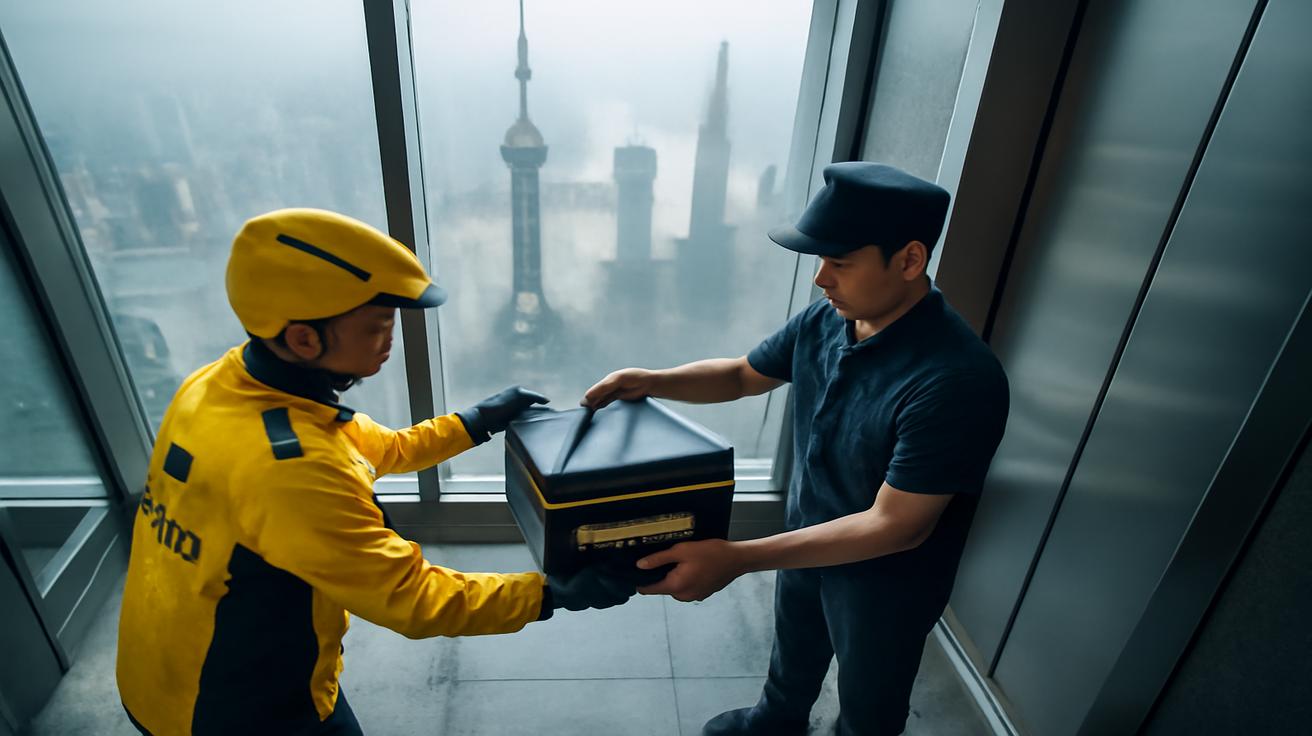
The first thing you notice isn’t the height. It’s the silence between the elevator doors closing and the numbers starting to climb. For a heartbeat, suspended in that quiet, you feel the weight of ninety-eight floors above you and fifty floors below. Then the panel blinks: 1… 12… 27… 41… It accelerates like a countdown in reverse, and beside you a young man in a bright insulated backpack shifts his weight, thumb hovering over his phone. His name is Li Ming, and this brief pause in a humming metal box is his office, his highway, and sometimes his only moment alone all day.
The Vertical City
In the densest neighborhoods of Shenzhen, Guangzhou, Chengdu, and Shanghai, the city doesn’t just spread out; it stacks. The streets are only the first layer. Above the traffic and scooter horns, above the food stalls and fruit carts, a second city rises in steel and glass. Balconies sprout like ledges on a cliff face. Windows stack in repeating patterns that disappear into the haze. Laundry, neon, office lights, rooftop gardens—life folded into the air.
China’s skyscrapers aren’t just tall; they’re vertical ecosystems. One building might hold a private kindergarten on the 12th floor, a dentist on the 26th, co-working spaces on 35, a spa on 56, and apartments layered from 60 to 101. In some complexes, you can drop your child at school, visit the gym, attend a meeting, get your hair cut, buy groceries, and go home without ever touching the ground.
But there’s something these towering cities require that no city planner put on a blueprint: a human chain of couriers who climb the modern mountain every day, all day, with bags of hot noodle soup and cold milk tea. Skyscrapers have become so tall, and so labyrinthine, that an entirely new kind of job has emerged—not quite delivery rider, not quite concierge: the vertical meal messenger.
The People Who Climb the Sky
Li Ming started a year ago. “I didn’t think it would be different from other delivery jobs,” he says, scratching his jaw as the elevator hums. “You ride the scooter, you pick up the food, you follow the app, you drop it off. Same everywhere, right?” He laughs. “Wrong. You can’t understand until the elevator breaks at lunch hour.”
On the screen of his phone, a map glows with pulsing pins. But instead of streets and intersections, his world is stacked by floor numbers. Each order has two coordinates: building and height. A bubble might read: Tower 3, Floor 72, West Wing. Another: Block B, 54F, Sky Garden Lobby. Riders like Li still weave through the horizontal city on electric scooters, but the real work, the frantic work, the sweaty, time-bending, stair-climbing work, happens after they step through the sliding glass doors of a high-rise.
Many of China’s mega-towers are essentially mini-cities with their own mazes: security gates, turnstiles, elevator banks, sky lobbies, elevator transfers, facial recognition scanners. To reach the 80th floor, you might ride one elevator to a mid-level transfer floor, then hike across a long corridor’s polished stone to hail another elevator that serves only the upper tier.
At lunchtime, when tens of thousands of office workers tap an icon on their phones within a ten-minute window, the towers transform. Delivery riders line up at the turnstiles, their insulated backpacks like bright carapaces. Elevators open to reveal couriers packed shoulder to shoulder, each glancing at countdown timers on their screens. The air fills with the smell of braised pork, chili oil, scallion pancakes, and bubble tea.
The Birth of a Vertical Specialist
As buildings climbed higher and higher, something unexpected happened: the last few hundred meters between the lobby and the top floors became the most logistically complicated. Ordinary delivery riders could navigate city traffic with quick reflexes and street knowledge, but what slowed them down, again and again, were buildings—key cards, security checks, elevator waits, confusing floor layouts.
In response, some companies and property managers began hiring people like Li specifically for the vertical part of the journey. Instead of roaring through traffic from restaurant to office, these specialists stay inside one skyscraper—or a cluster of adjacent ones—for their entire shift. Their routes are carved not by street names, but by elevator banks and corridor shortcuts.
In many of these complexes, you might spot a small desk by the entrance around lunchtime: a staging zone. Regular riders pull up outside, drop bags of food, and zip away to the next restaurant. Behind the desk, the vertical couriers sort, stack, and scan. Each bag gets matched with a floor, a wing, and a countdown. Then the sprint begins.
“I know this building better than my own apartment,” Li says. “Which elevators are slower, which ones are crowded at 12:15, where the air feels colder if you stand on the left side. Even the sound the doors make when they’re going to close too fast.”
Inside the Tower’s Veins
If you want to understand this job, you have to walk it—step off the crowded street and into the controlled cool of a marble lobby. The noise of scooters fades behind you, replaced by the soft hiss of air conditioning and the muted click of polished shoes on stone.
The security guard barely glances up as Li flashes a digital pass on his phone. His insulated backpack is already unzipped, a row of steaming containers nested neatly inside. A small group of couriers gathers near the central elevator bank, each one holding a phone like a compass.
There’s a dance here, a choreography born of seconds and patterns. Elevators in these mega-towers are often “smart”—you tap your destination floor on a panel before you board, and the system groups passengers going to similar ranges. For an untrained visitor, it feels slightly disorienting. For a vertical courier, it’s a moving puzzle they solve dozens of times an hour.
“You don’t just go up and then down,” Li explains. “You stack the orders by floor, by wing, by time. If I have three orders between 70 and 80, and two more at 65, I have to decide: do I wait for the 70–90 car, or jump in the one going to 60–70 and run the stairs for the last 10?”
Sometimes the answer changes minute by minute. A delay at a security checkpoint, a full elevator that glides past without stopping, a sudden surge in orders from a single company floor—these can ripple through a courier’s internal map.
| Time | Task | Floors Covered | Orders Delivered |
|---|---|---|---|
| 11:30–11:45 | Collect batches from lobby staging desk | 1 → 35 | 8 |
| 11:45–12:10 | First elevator run, mid-level offices | 35 → 58 | 12 |
| 12:10–12:40 | High-floor run, with stair segments | 58 → 82 | 15 |
| 12:40–13:00 | Return to lobby, pick up overflow | 82 → 1 | 5 |
The physical sensation of this work is its own story. The elevator doors open on the 68th floor and a wave of warm air hits your face, scented with printer toner and reheated lunch. The corridor is carpeted, lined with frosted glass doors. Office workers in lanyards stride past, eyes drifting briefly to the courier in his bright jacket before returning to their screens.
Li moves quickly but not frantically. His mind is a series of checklists: 68 West, 69 East, 72 Central. A buzzer sounds on his phone when an order’s promised time window begins to narrow. The game is not just speed—it is anticipation. Hit the wrong elevator at the wrong moment and your carefully balanced route collapses.
Time, Temperature, and Trust
On the surface, these couriers are carrying food. In reality, they are carrying promises—of heat, of crispness, of punctuality. In China’s hyper-competitive delivery market, apps display estimated arrival times down to the minute. Customers can track their orders step by tiny step: Meal picked up. Rider en route. Arrived at building. In elevator.
Inside a mega-tower, though, the gap between digital certainty and physical reality yawns open. An elevator stalls. A fire drill shuts down a wing for ten minutes. A security guard insists on double-checking a list. Somewhere on the 74th floor, a woman watching her phone begins to frown at the slowly ticking clock.
“People think the hardest part is the height,” Li says. “It’s not. It’s the timing. The food has a life. If I’m late, the fries go limp, the milk tea ice melts, the soup goes cold. If I’m early, I might have to wait for them in front of the door, and that costs me minutes for the next order.”
Over time, regular customers begin to recognize familiar faces. Some offices cluster their orders, sending one person down to meet the courier on a specific floor to cut down on travel. Others leave instructions in the app: Don’t ring the bell, our team is on a call, just leave in the pantry. Trust builds floor by floor.
Between Ground and Sky
There is a moment that vertical couriers know well: the pause at a window between deliveries. Stepping out of a cramped elevator, heart still racing, they’ll sometimes catch a glimpse of the city far below through a gap in the offices—a window at the end of a hallway, a fire-exit landing, a sky lobby with wide glass walls.
From the ground, skyscrapers can seem abstract, like lines on a chart of economic growth. From the 70th floor, they feel living. You can see balconies with hanging plants, rooftop basketball courts, clusters of people on terraces cradling coffee. Other couriers move as colored specks in other buildings. The city’s famous smog is no longer just a concept; it becomes a texture in the air, softening the edges of towers in the distance.
“Sometimes I stand here for ten seconds,” Li admits, glancing out over a horizon of glass. “Only ten. But it’s like my reward between runs. I watch the other towers. I think, in that one, someone like me is running up and down too.”
His job exists in a liminal space—neither fully part of the office world he steps through, nor fully part of the street traffic he used to navigate as a traditional rider. The vertical courier inhabits the city’s veins, slipping from lobby to sky and back again, rarely staying anywhere long enough to belong.
The Body Learns the Building
Ask Li what surprised him most about the work, and he doesn’t mention technology or the scale of the towers. He talks about his legs.
“At first, going from 70 to 75 by stairs felt like climbing a small mountain,” he says. “My thighs burned. I thought, this is impossible. After a month, I barely noticed. My body learned the building.”
He gestures to different directions as if pointing to invisible altitudes. “This corridor feels longer than that one, even if the distance is the same, because the air is hotter. Those stairs echo more. On this side, the floors smell like coffee; on that side, like perfume from the spa.”
It’s an intimate knowledge that doesn’t appear on any blueprint. The building may be drawn in precise lines and labeled with fire exits and loading bays, but for people like Li, it becomes something lived and sensory. The cool metal of elevator buttons under sweaty fingertips. The brief rush of air when the doors open to a pressurized sky lobby. The way sound changes as you move upward: street noise replaced by the hum of HVAC systems, then by a soft, padded quiet.
The Future of High-Rise Deliveries
China’s skyline is still evolving. New towers rise with every passing year, their renderings shimmering with promises of sky gardens, air bridges, stacked parks, and mixed-use spaces that blur the lines between work and home. As buildings grow taller and more complex, the simple act of getting a bowl of noodles from kitchen to desk has become a kind of micro-engineering problem.
Urban planners talk about “last-mile delivery”—the final leg of a journey from distribution hub to doorstep. In these vertical cities, the challenge has split again into “last hundred meters” and “last hundred vertical meters.” Companies experiment with solutions: dedicated delivery elevators, smart lockers on mid-level transfer floors, even robots that can handle a few flights of stairs.
But for now, the most flexible, resilient, problem-solving machine inside these towers is still a human carrying a bag.
“People ask if I’m afraid of heights,” Li says. “I don’t have time to be afraid. I’m too busy counting floors.” He grins, but then his expression turns thoughtful. “Maybe someday the robots will do this. But will they know when to knock softly because the office sounds quiet? Will they remember that the woman on 74 likes her milk tea shaken before you hand it to her? I don’t know.”
Beyond efficiency, there’s a social fabric woven into these vertical deliveries. Couriers become unofficial messengers and mood barometers. They notice which startups are hiring more people by the number of extra lunch boxes. They see when a whole floor suddenly switches from cheap takeout to salad bowls, or when a company moves out and the lights go dark behind tinted glass.
Work, Dignity, and Invisible Labor
At street level, the image of China’s delivery workers has become iconic: colorful jackets, insulated boxes, scooters lined up at intersections like cavalry. The vertical couriers are a quieter tribe, less visible from the ground but no less essential to the rhythm of the day.
Their work is physically demanding and often stressful, governed by strict time windows and app ratings. A delayed elevator can impact their pay. A confused security guard can cost them a bonus. The people they serve may see them only as a flashing dot on a screen, not as someone panting in a stairwell after sprinting up five floors to beat the countdown.
Yet when you walk with them, floor to floor, the abstraction peels away. You see the small acts of care: adjusting a drink’s plastic lid to make sure it doesn’t spill in the bag, checking a name twice before leaving food on a reception desk, choosing to wait thirty extra seconds so a shy intern doesn’t have to collect lunch in front of all her colleagues.
“My parents think it’s just a delivery job,” Li says. “Sometimes I wish they could follow me for one day, from morning to night, from ground to top, to see the whole path.”
A City Measured in Floors
As evening falls, the towers transform again. Office windows darken, apartment lights warm. Elevators that carried lunches now carry children home from after-school classes, tired parents from overtime meetings, couples from date nights at the rooftop bar. The flood of orders slows to a trickle: a late-night snack on the 53rd floor, a solitary bowl of noodles on the 89th, an overtime dinner on 72.
Li’s phone finally quiets. His steps, for the first time all day, are unhurried. In the lobby, cleaning staff push brooms across the marble floor. The city outside glows with reflected lights, each tower a stack of illuminated rectangles fading into the night.
There’s a strange poetry in this new job that exists because buildings have learned to stretch so far into the air that gravity itself has become an obstacle. Somewhere in the gap between ambition and appetite, between height and hunger, a role appeared for people like Li—a job no one planned, but which now feels as natural to the functioning of the city as street sweepers or subway drivers.
Tomorrow, and the day after, and the day after that, he will ride his scooter through the morning traffic, step into the cool lobbies, and begin again. Up and down, up and down, stitching together the stacked worlds of concrete, glass, and human need.
If you ever find yourself on the 80th floor of a Chinese skyscraper at noon, listening to your stomach growl and watching a tiny icon inch across your screen, remember: your lunch is not just traveling across town. It is climbing the sky, carried in the hands of someone who knows every echoing stairwell, every hesitant elevator, every hidden corner of the tower you call, for a few hours each day, your whole world.
Frequently Asked Questions
Why did this specialized delivery job emerge in China?
China’s rapid urbanization produced clusters of super-tall, mixed-use skyscrapers where thousands of people live and work in a single building. The internal complexity—security checkpoints, multiple elevator systems, sky lobbies, and long corridors—made traditional street-focused delivery too slow and unreliable, creating demand for specialists who navigate only the vertical part of the journey.
How is a vertical meal courier different from a regular delivery rider?
Regular riders focus on the horizontal city: traffic, routes between restaurants and neighborhoods, and quick navigation through streets. Vertical couriers usually stay inside one tower or a small group of towers, handling the last leg from lobby to top floors, mastering elevator timing, floor layouts, security procedures, and efficient walking or stair-climbing routes.
Do these couriers use special technology?
They rely on delivery apps like other riders, but also use building-specific digital passes, smart elevator systems, and sometimes internal dispatch software that groups orders by floor and time. The most important “technology,” though, is experience: knowing how to stack deliveries, predict elevator congestion, and choose when to switch from waiting for a lift to taking the stairs.
Are robots or drones replacing these workers?
Experimental delivery robots and smart lockers exist in some high-end buildings, but they are limited by stairs, tight spaces, complex security systems, and the need for flexibility. For now, humans remain far more adaptable, especially in older or crowded buildings. Automation may grow, but in the near term it’s more likely to complement than fully replace human couriers.
What challenges do vertical delivery workers face?
They deal with strict time windows, long waits for elevators, physical strain from repeated stair climbs, and navigating changing building rules. A single unexpected delay—a fire drill, a broken elevator, a new security policy—can disrupt their entire route. Yet their work is often invisible to the people who rely on them every day.