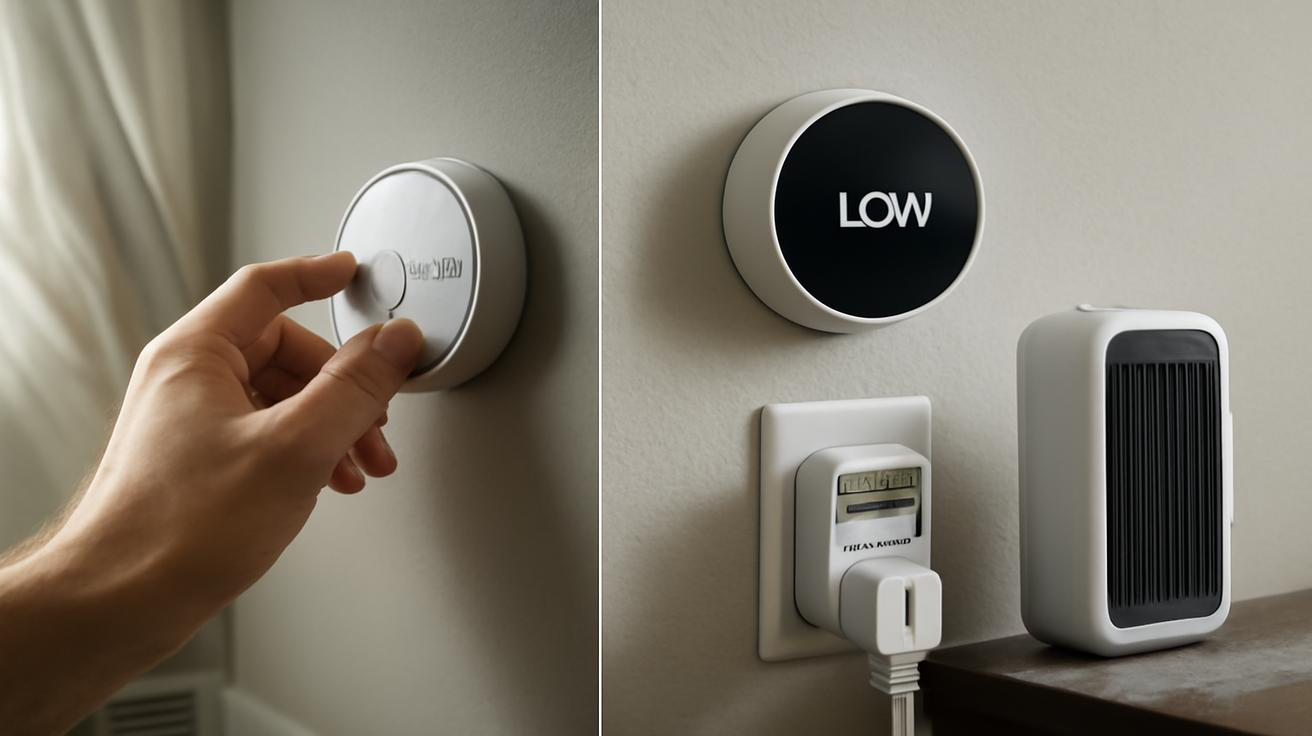
The cold arrives quietly at first. A faint nip in the hallway tiles at dawn. The way your breath hangs, almost invisible, above the duvet edge when you dare stretch an arm into the morning air. Then, one especially sharp evening, you stand in the middle of your living room, remote in hand, hovering over the thermostat and asking the question that creeps into homes across the colder world every year: is it better to turn the heating on and off, or to leave it on low all the time?
Why This Question Won’t Go Away
This debate has the staying power of an old family argument. You might have grown up in a house where the radiators hummed from October to March, a gentle background presence like the fridge. Heat was a constant, just turned down, never off. Perhaps your grandparents swore by it: “It’s cheaper in the long run,” they would say, wrapping a cardigan tighter while insisting the boiler never slept.
Then there’s the other school of thought, the on‑off brigade. These are the people jabbing the thermostat as they put on a coat indoors, marching around the house turning down radiators, muttering that heating an empty house is madness, a crime against both wallet and planet. To them, every degree is a decision, every hour of warmth a conscious choice.
It feels like a clash of worldviews: comfort versus control, habit versus data. Yet, beneath the folklore and inherited wisdom, there is a simple, physical reality at work: the way heat moves through your walls, your windows, your roof, and into the world outside. And once you see that clearly, the answer to the old question begins to shift.
The Hidden Physics Inside Your Walls
Imagine your house as a big, slightly leaky thermos flask. Not a perfect one – more like the old metal bottle that’s been dropped a few too many times. Heat is constantly trying to escape. It seeps through glass, sneaks under doors, flows patiently through bricks and plaster and roofing felt. The bigger the temperature difference between inside and outside, the harder it pushes.
That difference – the gap between your cosy living room and the chilly street – is the heart of this whole debate. If your house is warm all the time, the temperature difference is there all the time. Your boiler, heat pump, or furnace isn’t just heating the air; it’s constantly replacing the warmth that slips away into the wider world. A slow, steady leak, like a tap not quite turned off.
Turn the heat off when you go out or at night, and the indoor temperature drops. The gap between inside and outside shrinks. With a smaller temperature difference, your home loses heat more slowly. Less warmth leaking out means less energy needed overall. When you switch it back on, the system has to work harder for a little while to warm everything back up – the air, the walls, the furniture – but it hasn’t been fighting that full temperature difference the whole time you were away.
There’s a popular myth that it takes “more energy to heat a cold house back up than to keep it warm constantly.” For almost every ordinary, reasonably insulated home, that simply isn’t true. Physics does not keep track of “starting again” as a penalty. It only cares about how much heat leaks out over time. The longer you keep your home warm, the more heat escapes, and the more fuel or electricity you use.
The Comfort Trap: Warm Toes, Cold Numbers
Of course, we don’t live inside physics diagrams; we live inside bodies that shiver and sigh in relief. You’re not a machine, and neither is your life. The moment you arrive home on a wet, dark evening, the question “what’s most efficient?” can quickly give way to “why isn’t it warm already?”
This is where the temptation to leave the heating on low all the time creeps in. The idea is seductive: maintain a gentle background warmth so the house never feels icy, so the walls never cool right down, so you never have to sit in a coat waiting for the boiler to catch up. It’s not really about cost calculations in that moment; it’s about avoiding discomfort.
But look closely, and this “comfort insurance” hides its price. If you keep the heating on low 24/7, you’re paying for warmth during every empty hour: while you’re at work, while you’re asleep under a thick duvet, while the house sits quietly in the pale winter sunlight. The radiators might only be warm to the touch, not hot, but the meter is still ticking.
It becomes a kind of background subscription: small, steady, easy to ignore, but always there. When you add it up across a full winter, it can mean far more fuel burned, far higher bills, and a larger carbon footprint than necessary. Comfort, in this version, is bought on a payment plan – quiet, continuous, and easy to underestimate.
The Quiet Work of Your Home’s Shell
How stark that trade‑off feels depends hugely on the kind of home you live in. A modern, super‑insulated house with triple glazing and carefully sealed drafts is like that new thermos flask with a tight lid. It holds onto heat well. Let it cool down, and it cools slowly. Warm it up, and it stays cosy with minimal top‑ups.
An older, draughty house – tall ceilings, single‑glazed sash windows, gaps under every door – is another matter. Heat escapes fast. You feel it as a creeping chill across the floorboards, as the odd wind that moves curtains with the windows closed. In this kind of home, turning the heating off can see the temperature plummet quickly. Turning it back on can feel like you’re heating the entire street.
Even then, though, the basic reality still holds: the longer your home spends at a higher temperature, the more heat it loses, and the more energy you use. What changes with a leaky home isn’t the physics – it’s the experience. The drop in comfort during off times is more dramatic, and the warm‑up period feels longer. That discomfort can push people towards leaving the heating on low, not because it’s cheaper, but because living with big swings in temperature feels harsh.
Smart Controls: A Truce Between Comfort and Cost
Between “on all the time” and “off unless I remember” lies a more interesting path: timed and responsive heating. Modern thermostats and heating controls can feel almost like a quiet, invisible housekeeper, thinking ahead for you.
Instead of leaving the system gently ticking over 24/7, you can ask it to start heating before you wake, to pause when you’re out, and to ease back just before you usually go to bed. In other words, you aim for “warm when you need it, cooler when you don’t,” without having to stand sentry over the thermostat yourself.
In many homes, simply using a programmable thermostat or timer can reclaim a surprising amount of wasted energy. The house may never have to plunge into icy discomfort; it just doesn’t stay at full comfort level round the clock. You begin to think of warmth as something you shape to your routine, instead of a permanent background state.
| Approach | When It Makes Sense | Main Pros | Main Cons |
|---|---|---|---|
| Heating on low all the time | Very cold homes where pipes might freeze or for vulnerable occupants needing constant warmth | Steady comfort, fewer big temperature swings | Usually higher bills and more energy use overall |
| On and off manually | People home at irregular times, simple systems with no programmer | Clear sense of control; energy only used when you remember to turn it on | Easy to forget, big swings from too cold to too hot |
| Timed heating with thermostat | Most modern homes, regular routines | Good balance of comfort, lower energy use, less effort | Needs a bit of setup and occasional adjustment |
| Smart/learning controls | Homes with changing schedules, people who like fine‑tuning | Learns your patterns, maximizes comfort vs. cost automatically | Higher upfront cost, tech‑reliant |
The Damp Corners: When Constant Low Heat Helps
Still, there are quieter reasons why some people feel drawn to low‑level, constant heat – reasons that live not in energy charts but in the corners of their homes. Walk into an old stone cottage on a wet winter’s day and you might smell it: that cool, faintly earthy hint of damp, the way the air clings just a little to your skin.
In some homes, letting the temperature drop too low for too long invites damp and condensation. Cold walls can meet moist indoor air and quietly grow black spots of mould behind furniture, around window frames, in the shadowy edges of bathroom ceilings. For people dealing with asthma, allergies, or simply the indignity of scrubbing those black streaks away every few months, this isn’t an abstract concern.
In such cases, a bit of gentle, background warmth can help keep surfaces just warm enough to stay dry. Combined with ventilation – extractor fans that actually get used, brief bursts of window‑opening when weather allows – low‑level heating can be part of a strategy to keep the building itself healthier.
But here, again, we meet a crossroads. The answer isn’t automatically “leave the whole house heated all day.” Sometimes, you only need to keep certain problem rooms from getting too cold: that north‑facing bedroom, the bathroom, the uninsulated hallway where pipes snake through a cold void. Targeted heat in those zones – and better insulation and draft‑proofing around them – can protect against damp and freezing pipes without surrendering your entire heating system to 24/7 duty.
The Personal Equation: Your Body, Your Routine, Your Home
So where does all this leave you, standing in front of that thermostat on a gray afternoon, torn between your senses and your bills? It helps to remember that the “best” approach will always be entangled with who you are and how you live.
If you work from home most days, you need a kind of background comfort that someone away for ten hours simply doesn’t. If you live with very young children, someone elderly, or anyone with medical needs that make cold risky, keeping larger parts of the home at a steady, safe temperature is more important than shaving every possible unit from the bill.
On the other hand, if you’re out from morning until evening and return to a house that’s been gently heated empty all day, you’re essentially paying to keep your furniture comfortable. There might be a deeper pleasure – and a quieter pride – in learning how little warmth you can get away with when the house is empty, and how smartly you can time its return to cosiness for when you step back through the door.
Many people find a middle path: they allow the house to cool down while they sleep or are out, but not to the point of biting cold. The thermostat might fall from, say, 20°C in the evening to 16–17°C at night or during work hours. The heating is “off” in the sense of not aiming for full comfort, but not so far off that the house has to climb a steep hill to feel pleasant again.
So, Which Is Better?
Draw all these strands together – physics, comfort, damp, routine – and a clear pattern emerges. For the vast majority of homes, especially those with at least moderate insulation, it is more energy‑efficient and usually cheaper to heat the home only when you need it, rather than leaving the heating on low all the time.
Turning the heating on and off – or, more accurately, up and down using timers and thermostats – generally reduces the total amount of heat your home leaks into the outside air. Less leaked heat means less fuel burned or electricity used. Over a full winter, that difference can grow large enough to feel in your bank account and to matter in your home’s environmental impact.
Leaving the heating on low constantly can make sense only in quite specific situations: very poor insulation where sudden drops could cause pipe freezing, severe damp issues not solved by better ventilation and insulation, or households with vulnerable occupants who must be kept consistently warm. Even then, targeted warmth, better draft‑proofing, and smart control are often better answers than simply surrendering to round‑the‑clock heating.
In the end, the real shift is not just technical but emotional. Instead of treating warmth as an all‑or‑nothing background condition, you begin to see it as something that ebbs and flows with your day. You notice which rooms you truly use, which hours you actually need full comfort, which corners might be asking quietly for just a little steady protection from cold and damp. You move from habit to attention.
On the next cold morning, when you wake to that sharp edge in the air, the question will return: on and off, or low and constant? By then, you’ll know that what matters most isn’t just whether the radiators feel warm right now, but how your house sheds its heat over time, and how your patterns of living can dance with that slow movement rather than fight it. The answer will no longer be a superstition passed down across the dinner table, but something you feel in the bones of your home – and, quietly, in the shape of your bills at winter’s end.
FAQs
Does turning the heating off and on damage the boiler?
Modern boilers and heating systems are designed to cycle on and off. Using a timer and thermostat to control when the system runs is normal and should not cause damage when the system is properly maintained.
Will it cost more to reheat a cold house than to keep it warm constantly?
In most ordinary homes, no. Over time, keeping a house warm continuously leads to more total heat loss than letting it cool when not needed. Reheating uses energy, but usually less overall than maintaining constant warmth.
What is a good temperature to set when I’m at home?
Many people find 18–21°C comfortable when they’re active at home. Lower might suit you if you like cooler air and wear warm clothing; slightly higher may be needed for vulnerable occupants.
How low can I let the temperature drop when I’m out or asleep?
Dropping to around 15–17°C is common for many homes. Much lower may feel too cold and could risk damp or pipe issues in very cold weather, especially in poorly insulated properties.
Can leaving the heating on low help prevent damp and mould?
Gentle background heat can help reduce condensation on cold surfaces, but it works best alongside good ventilation and insulation. Heating alone rarely solves damp issues if moisture isn’t being removed from the air.
Is it more efficient to heat just the rooms I use?
Yes, in many cases. Using thermostatic radiator valves or zone controls to warm only the spaces you regularly occupy can reduce overall energy use while keeping key rooms comfortable.
Should I upgrade to a smart thermostat?
A smart thermostat can help tailor heating to your routine, reducing wasted energy without sacrificing comfort. It’s not essential, but it can make it easier to avoid unnecessary constant low‑level heating.