The first hint arrives not with a scream, but with a soft, almost polite tapping at the window. Tiny crystals ride an uneasy wind, tracing faint, melting tattoos across the glass. Streetlights glow in ghostly halos. Somewhere far above this quiet neighborhood and its drowsy cul-de-sacs, the atmosphere is unraveling—an invisible engine stalling, gears grinding against the unexpected. You don’t know it yet, but that faint, restless draft under the door is an early postcard from the upper sky, signed by a phrase that will soon dominate the news: polar vortex disruption.
The Sky Is Splitting Apart
To understand what is coming, you have to tilt your head upward—far beyond the clouds, beyond the cruising altitude of red-eye flights and migratory geese. Some 20 to 50 kilometers above Earth’s surface, in a region called the stratosphere, winter normally builds a giant spinning fortress of cold air above the Arctic. This is the polar vortex: a whirling, high-altitude colossus locked in place by intense winds that circle the pole like a planetary racetrack.
Most winters, the vortex is stable, grimly efficient. It pens the brutal cold in the far north, like a guard dog faithfully watching the gate. Down here at ground level, we live beneath its boundaries, receiving passing cold fronts, a nor’easter here, a blizzard there. But the real monster—the deepest reservoir of cold—usually stays chained to the Arctic night.
Not this time.
In the coming days, that fortress is forecast to buckle. High-altitude waves—ripples of energy pushed upward by mountains, weather systems, and shifting jet streams—are slamming into the vortex, slowing its winds, distorting its once-tight circle into a lopsided, wobbling shape. Imagine a spinning top that’s been nudged one too many times; the spin warps, the edges fray, and suddenly the motion looks more like a stagger than a dance.
Forecasters are tracking a significant “sudden stratospheric warming” event, where temperatures tens of kilometers above the Arctic spike dramatically in a matter of days. It’s a misleading phrase—“warming” sounds comforting—but it’s actually the trigger that can send bitter air crashing southward. As the vortex weakens and splits, immense pockets of frigid Arctic air can spill over North America, Europe, and parts of Asia, like a shattered glass of icy water spreading across a tilted table.
And this time, the tilt looks steep.
The Moment the Maps Turn Purple
In weather offices around the world, computer screens are already glowing with ominous color palettes. Maps shade from soft blues to menacing purples, cold plunging like a slow-motion waterfall over familiar outlines of continents. Over the next couple of weeks, this disruption aloft is expected to cascade downward, step by step, into the troposphere—the layer where we live, breathe, fly, and drive.
Meteorologists have seen polar vortex disruptions before; they’re not rare. But what is rattling forecasters this time is the combined magnitude and timing. Model after model hints at a sprawling, multi-continental outbreak of severe cold and snow right when millions of people and goods are on the move—commuting, trucking, flying, restocking store shelves. The risk isn’t just another cold snap; it’s a systemic slowdown, a potential paralysis of the very networks that keep modern life humming.
In plain terms: the sky is rearranging itself in a way that may soon rearrange your plans, your travel, and your sense of how winter behaves.
The Air You Breathe Will Feel Different
The first sign at ground level will be subtle. A sharper edge when you step outside to grab the mail. The way your breath hangs a fraction longer in the air. A dry, desert-like sting that sneaks under gloves and collars. This isn’t the gentle, damp cold of early winter rain; it’s the kind that bites the inside of your nose and makes doors feel heavier.
Cold of this intensity carries a certain soundscape. Snow underfoot doesn’t just crunch; it squeals, brittle and high-pitched, like walking on broken porcelain. Trees groan in the dark as sap thickens and branches contract. Thin wisps of snow, lifted by a restless wind, skitter across parking lots like ghostly tumbleweeds.
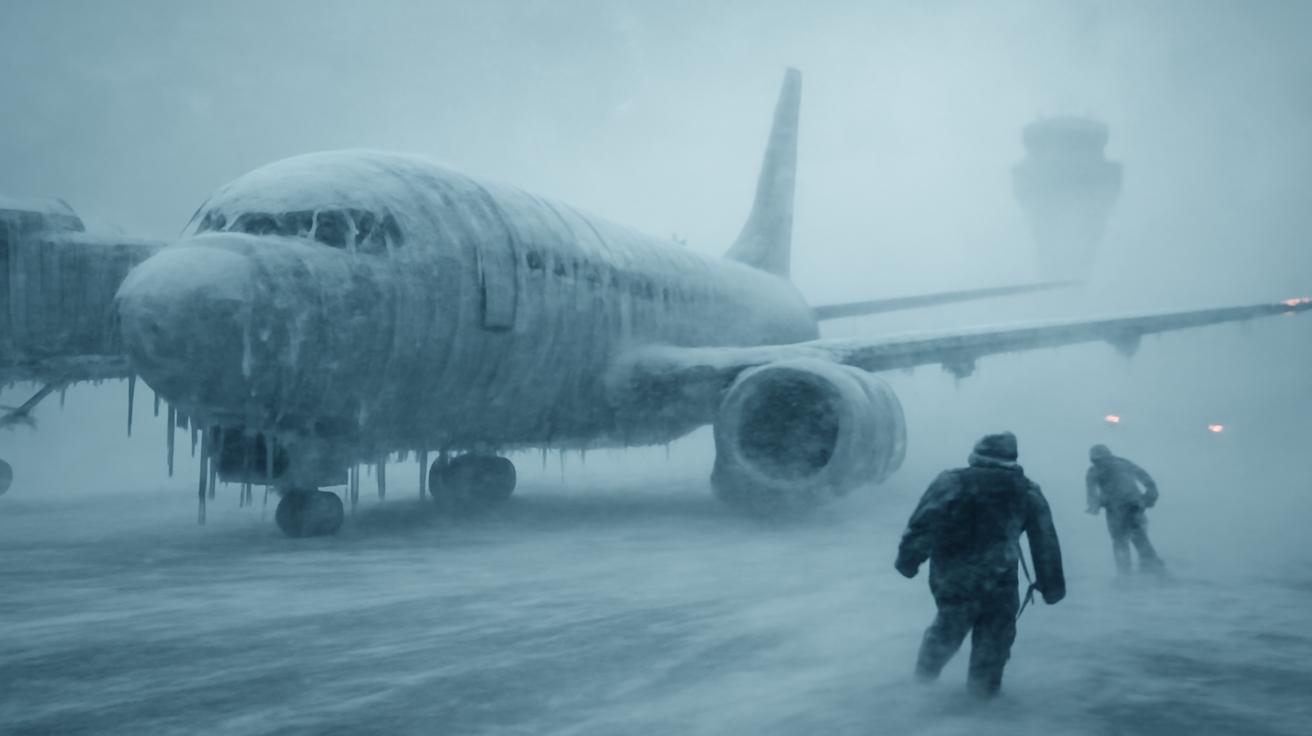
At airports, the air will be filled with the acrid tang of de-icing chemicals and the muffled roar of engines straining against dense, frigid air. On highways, it will be the hiss of salt trucks and the distant whine of tow winches tugging stranded vehicles from drifts. The atmosphere isn’t just colder; it’s heavier, more insistent, as if winter has decided to show you its unedited version.
How a Broken Vortex Breaks Your Travel Plans
Forecasters are unusually blunt this time: if the projected patterns hold, the disruption above will translate into days, possibly weeks, of high-impact weather below—enough to threaten “widespread travel paralysis.” That sounds dramatic until you start tracing all the ways we rely on clear roads and open skies.
The Road Network on Thin Ice
Think of highways as the veins of a continent. Each day, trucks carry food, medicine, fuel, and countless just-in-time deliveries along asphalt arteries that were never designed for sustained, extreme cold. When a polar vortex disruption pushes Arctic air southward, it changes how these roads behave.
Black ice blooms in the dark, invisible and nearly frictionless. Road salt becomes less effective as temperatures plummet. Diesel gels in fuel lines. Batteries surrender, engines groan, and the margin for error shrinks with every degree the thermometer falls.
Meanwhile, snow doesn’t simply fall; it drifts, sculpted by gusts into hard-edged ridges across interstates and rural byways. Plows can’t be everywhere at once. For every heroic video of convoys carving through whiteouts, there’s the quieter reality of jackknifed semis, multi-car pileups, and miles-long backups where red taillights blend with swirling snow.
Airports as Snowbound Islands
Airports are the beating hearts of modern mobility, but cold this deep can bring their choreography to a halt. Runways require constant clearing. Aircraft need de-icing again and again—each cycle adds minutes, then hours, to already fragile schedules. One major hub shutting down creates a ripple; several hubs at once create a domino collapse.
Now imagine that the polar vortex disruption doesn’t simply clobber one region but spreads, as models suggest, across large swaths of the Northern Hemisphere. You might not live in the bullseye of the coldest air and heaviest snow, yet your connecting flight depends on a plane that does. Delays stack like dominoes. A snowstorm in Chicago can cancel a meeting in Dallas, strand a family in Atlanta, and postpone a medical supply shipment to a small town hundreds of miles away.
Airlines know this pattern intimately; they’re already war-gaming schedules, aircraft positions, and crew availability. But there’s only so much they can do when the atmosphere redraws the map overnight.
When Railways and Sidewalks Slow to a Crawl
Rail lines, often touted as weather-resilient, have their own vulnerabilities. Extreme cold contracts steel rails, increases the risk of fractures, and forces slower speeds. Switches freeze. Doors stick. Commuter trains, meant to whisk workers into cities, instead stand idling in yards, engines chugging against the deepening chill.
On the most human scale, the disruption arrives on sidewalks and station platforms. Ice-polished steps, buried crosswalks, bus stops encased in powder. Parents dragging sled-like suitcases instead of rolling luggage. The once-simple act of leaving your home becomes a calculation: is this trip necessary, and is this pair of boots really enough?
What the Numbers Whisper About the Coming Weeks
Behind the headlines and breathless TV graphics, the data tells its own quiet, chilling story. Ensemble forecasts—dozens of parallel model runs, each making slight tweaks to the starting conditions—are increasingly in agreement: the stratospheric disruption is both strong and likely to have lasting impacts. Confidence is rising not just in the event itself, but in its downward propagation.
The key message: this is less about one dramatic day and more about a pattern shift. Instead of a quick cold shot followed by a thaw, this kind of polar vortex event can lock in a colder, stormier regime that lasts for weeks. While exact snow totals, storm tracks, and local temperature extremes are impossible to pin down far in advance, the broad brushstrokes are becoming clear enough that forecasters are moving from cautious language to direct warning.
Some are already talking openly about the possibility of “travel paralysis” on regional and even national scales—not in the sense of every road closed, but of enough disruption, across enough key routes, for long enough, that the flow of people and goods is severely constrained.
To bring those possibilities closer to home, consider how such a pattern might translate into real-world impacts in a typical region heavily affected by the disrupted vortex:
| Potential Impact | What It Could Look Like on the Ground |
|---|---|
| Road Travel | Frequent whiteouts, ice-glazed interstates, chain-reaction collisions, extended closures on key freight corridors, and local authorities urging people to stay home. |
| Air Travel | Wave after wave of delays, rolling cancellations at multiple hubs, long rebooking lines, and luggage stranded in snowbound airports. |
| Rail & Transit | Slower train speeds, frozen switches, curtailed commuter schedules, and reduced service on exposed lines and elevated tracks. |
| Supply Chains | Delayed deliveries, sporadic store shortages of essentials, tight fuel supplies in some areas, and overworked logistics networks trying to catch up. |
| Daily Life | School closures, remote work days, rescheduled medical appointments, and a general slowdown as people hunker down and wait for roads and runways to recover. |
These are not certainties, but they’re plausible outcomes when a high-altitude phenomenon reaches down and rearranges the familiar rhythms of the surface world.
Preparing to Move More Slowly
There’s a temptation, in the age of rapid information and overnight shipping, to assume that the machines will always find a way. Planes will route around storms. Plows will clear the roads. Crews will work overtime, and life will continue at its usual pace. But a large-scale polar vortex disruption doesn’t just challenge our infrastructure; it challenges our relationship with time itself.
Resilience Begins With Expectation
Preparation for an event like this has less to do with panic and more to do with humility. The atmosphere is about to remind us that, for all our satellites and simulations, we still live at the mercy of moving air and frozen water. The most practical response isn’t fear; it’s flexibility.
That may mean adjusting your mental calendar: assuming that trips will take longer, deliveries may be delayed, and schedules will need to bend. It may mean treating weather forecasts not as background noise but as crucial daily briefings. When forecasters use unusually strong language, that’s a signal to shift from “I’ll see how it looks” to “I’ll plan around this.”
On an individual level, it could be as straightforward as:
- Ensuring your vehicle is winter-ready with proper tires, an emergency kit, and a nearly full fuel tank.
- Stocking a modest buffer of essentials—medications, non-perishable food, pet supplies—so you don’t have to travel in the worst conditions.
- Checking in on neighbors who might be more vulnerable to isolation in severe cold or snow.
- Building contingency time into travel plans, from the morning commute to cross-country flights.
None of this will stop the cold from coming. But it will help you meet it on its own terms rather than being caught trying to outrun a storm that is, by design, much larger than you.
A Different Kind of Stillness
There is, strangely, a kind of grace in this enforced slowing down. When roads are empty and runways quiet, the world feels suddenly smaller and more local. Your universe contracts to the glow of your windows, the path to the corner store, the muffled conversations of neighbors airing dogs in the brittle air. Planes etch fewer contrails across the sky. Highways that once hummed with endless motion lie muted beneath a pale, shifting hush.
In that stillness, you can almost hear the atmosphere working—winds howling across unseen plains, snow rattling against remote hangars, ice forming on river stones hundreds of miles away. You get, if only briefly, a visceral sense of living inside a huge, breathing system rather than above or beyond it.
When the Vortex Finally Lets Go
Eventually, the polar vortex will find its footing again. The stratospheric winds will reorganize, tightening the broken loops around the Arctic. Temperatures will slowly moderate. Airports will clear their backlogs; highways will dry to a dull winter gray. Trains will run on time again, or close enough. Travel paralysis will give way to the usual frictions and delays we’ve grown used to blaming on traffic, mismanagement, or bad luck.
But something lingers after a disruption like this—something beyond the stranded luggage and the stories of epic drives home through snow tunnels. It’s the memory of how quickly the familiar can be transformed, how paper-thin the illusion of control really is when the atmosphere decides to rearrange its furniture.
You might find yourself checking the sky differently after this. Listening more closely when the forecast mentions the stratosphere or the polar vortex. Feeling a quiet thread between your little street and those vast circling winds above the pole.
Because that’s the deeper truth embedded in all the warnings about widespread travel paralysis: what happens overhead is not abstract. The invisible physics of the upper atmosphere touches your heating bill, your grocery shelves, your vacation plans, your commute. A disruption 30 kilometers above the Arctic can echo down into the way you open your front door, brace against the wind, and decide whether today is a day to move—or a day to stay still.
And so, as the first truly bitter wind of this event snakes its way into your town, whistling under eaves and rattling old windows, you might pause for a moment before stepping outside. Feel the air on your face. Notice the way the world sounds—muted, crystalline, expectant. Somewhere overhead, the polar vortex is tearing, twisting, recalibrating. Down here, on the frozen streets and stalled runways, we are learning once again how to live inside its mood swings.
Frequently Asked Questions
What exactly is a polar vortex disruption?
A polar vortex disruption happens when the usually stable, fast-spinning pool of cold air high above the Arctic is weakened, distorted, or even split apart by atmospheric waves. This can lead to sudden stratospheric warming and allows very cold Arctic air to spill southward into lower latitudes.
Does a polar vortex disruption always mean extreme cold where I live?
No. A disruption increases the risk of severe cold outbreaks, but the exact areas affected depend on how the atmosphere responds. Some regions may see brutal cold and snow, while others experience only modest changes. Local forecasts remain essential.
Why are forecasters warning about travel paralysis this time?
The current event is projected to be both strong and wide-reaching. That combination raises the likelihood of prolonged cold, frequent snowstorms, and ice across multiple transportation hubs and corridors, which can collectively slow or halt road, air, and rail travel.
How long can the impacts of a polar vortex disruption last?
While the disruption itself occurs over days in the stratosphere, its effects at the surface can persist for several weeks. It may create a pattern of recurring cold waves and storms rather than a single, short-lived event.
What can I do to prepare for potential disruptions?
Stay informed through reliable local forecasts, build flexibility into your travel plans, winterize your vehicle and home, keep basic supplies on hand, and be ready to postpone non-essential trips during the worst conditions. Preparation and patience are your best tools.
Is climate change making polar vortex disruptions more common?
Scientists are actively studying this question. Some research suggests that a warming Arctic may be linked to more frequent or intense disruptions, but the relationship is complex and still under debate. What is clear is that a warming world can still produce—and even amplify—extreme cold events in specific regions.