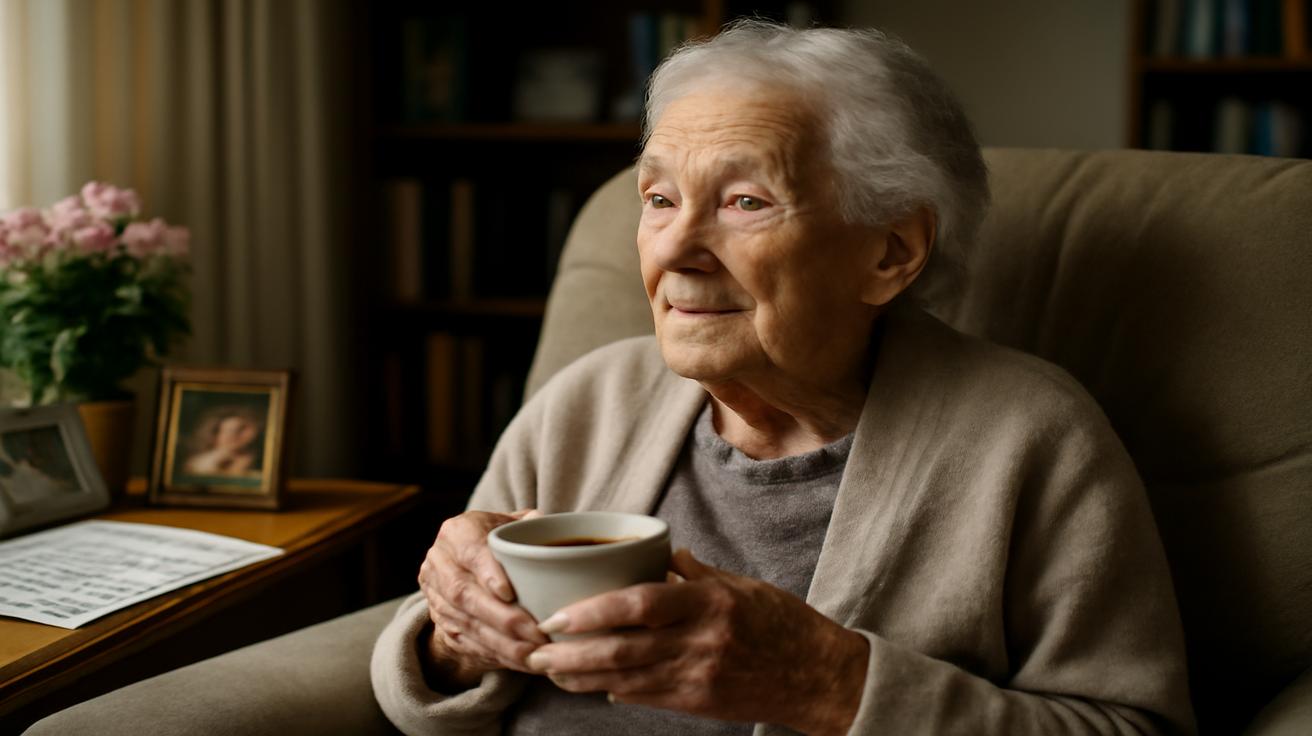
The first thing you notice is her walk. No tentative shuffling, no careful half-steps. At 102 years old, Elena strides across her small stone courtyard in flat canvas shoes, the laces tied in a double knot she insists on doing herself. The air smells like warmed rosemary and damp soil, and somewhere a kettle begins to whisper on the stove inside. She doesn’t invite you to sit. She tells you to follow.
The Woman Who Outlived Everyone’s Expectations
“They expected me to fall apart at 80,” Elena says, squinting into the late-morning light. “Doctors, neighbors, even my own children. They started dropping hints about ‘good homes’ and ‘helpful carers’ before I’d even finished my morning coffee.” She laughs—sharp, amused, entirely unbothered. “I told them, ‘I refuse to end up in care. If you put me in a home, I’ll haunt you while I’m still alive.’”
Her house, a modest two-story place on the edge of a small town, wears its age more heavily than she does. Paint flakes from the wooden shutters; the garden wall leans like an old man listening for gossip. But everything vital is tended: the vegetable patch, the herb pots, the lemon tree she insists is older than some of her grandchildren.
Inside, the kitchen smells like toasted oats and strong black tea. On the table sits a chipped blue bowl filled with nuts, an apple, and a single dark square of chocolate. When you comment that it looks like a still life, she smiles.
“This,” she says, tapping the bowl, “is part of why I’m still here. And why I’m not in a care home. You want to know my habits? Sit. Breakfast is the best time for honesty.”
The Quiet Architecture of an Ordinary Day
Elena’s daily life, laid out hour by hour, looks almost painfully ordinary on paper. No expensive supplements, no cutting-edge therapies, no app-tracked biohacks. Just a kind of stubborn consistency that has outlasted fashions, doctors’ fads, and several governments.
She wakes before the sun. Not because a wellness guru told her it improves productivity, but because that’s how her body has always done it. “My bones start talking at five,” she says. “I listen.” She sits at the edge of the bed, feet on the cool floorboards, and waits ten full breaths before standing.
“People rush those first ten seconds,” she says. “That’s when the world tilts, when you fall, when they say, ‘Ah, now you need care.’ No. You need patience.”
Her mornings are a ritual of slow, deliberate motion. She opens the window and lets the outside in: the scent of damp earth, the sound of a distant bus grumbling down the hill, a blackbird declaring rude opinions from the sycamore. She stretches her arms overhead until her shoulders complain, then a little more, but never enough to make them shout.
In the kitchen, she prepares the same breakfast she has eaten, more or less, for the past forty years: porridge with grated apple, a handful of walnuts, a drizzle of honey, and a pinch of cinnamon. One boiled egg. Tea, never coffee. “Coffee makes my heart think it’s at a party,” she says. “I like my heart to stay home.”
She pauses, spoon halfway to her mouth. “Habit is a kind of scaffolding,” she says slowly. “It keeps the day standing. When you are old, people want to take your choices away. Habits are choices I made long ago and kept. They remind me this is my life, still mine.”
The Small Daily Rules She Refuses to Break
Ask her for specifics, and her rules come out clear, practical, and oddly gentle. She changes the subject whenever they sound too noble.
| Daily Habit | How She Describes It | Why It Matters to Her |
|---|---|---|
| Morning movement | “I walk my body back into itself.” | Keeps her steady, reduces falls, starts day with intention. |
| Simple, regular meals | “Food my grandmother would recognize.” | Stable energy, less illness, no fuss. |
| Daily outdoor time | “I report to the sky once a day.” | Sunlight, fresh air, sense of connection. |
| House tasks | “My gym is my broom.” | Strength, balance, independence. |
| Evening wind-down | “I land the day like a plane in fog.” | Better sleep, calmer mind, fewer worries. |
“This is not magic,” Elena says, waving a hand at the table as if dismissing an overcomplicated recipe. “This is common sense that people forgot because it doesn’t fit in a bottle.”
Food as Quiet Medicine, Not a Religion
Elena opens her pantry like someone showing you a family photo album. Inside: jars of lentils, chickpeas, rice, oats, barley; cans of tomatoes and beans; strings of garlic; potatoes tumbling out of a wooden crate. The colors are earthy and matte—no glossy packaging promising miracles.
“They ask me, ‘What’s your secret food?’” she says. “I tell them: beans, greens, and not too much of anything that comes in a shiny bag.” She eats mostly plants, small portions of fish when she can get it fresh, meat maybe once a week. Butter in thin slices, olive oil in generous drizzles. Bread, but the kind that goes stale in two days and leaves crumbs like sand.
She does not diet. She does, however, stop eating when she is “politely full.” That’s the phrase she uses. “If I wouldn’t accept more from a guest,” she explains, “I don’t accept more for myself.”
Her lunch is the largest meal of the day: soup made from whatever is in season, a salad full of herbs, a small piece of fish or a boiled egg, always some kind of bitter leaf. “Bitterness reminds the body to work,” she says. “Sweetness puts it to sleep.”
In the afternoon, she has fruit and a handful of nuts. Later, a light supper—vegetable stew, a slice of bread, sometimes a little cheese. And almost every evening, that single square of dark chocolate.
“Pleasure keeps you alive longer than fear,” she says, breaking the chocolate with a crack that seems too loud in the small kitchen. “People fear sugar, they fear fat, they fear salt. They no longer taste. When you stop tasting your life, you start looking for someone else to run it for you. A carer, a home, a system. No. I will taste everything I can, as long as I can.”
Her Uncomplicated Relationship With Health
Elena sees her doctor once or twice a year. She takes a small handful of medications: one for blood pressure, one for her thyroid, a baby aspirin some mornings. She keeps them in a ceramic bowl beside the fruit, not hidden away like a shameful habit.
“I am grateful for medicine,” she says. “Antibiotics saved my life once. But I do not ask pills to do the work my legs and my fork can do.” She means walking, stretching, eating well. She also means sleeping, which she treats not as an optional upgrade but as non-negotiable infrastructure.
Lights dim at nine. Phone off. Curtains closed against the glow of the town. She reads from a book with pages “that make a sound when you turn them” for half an hour, and then she goes to bed. No scrolling, no screens, no news. “If the world ends,” she says, “someone will tell me at breakfast.”
Movement as a Declaration of Independence
Every afternoon, unless there is ice on the ground or a storm that rips branches from the trees, Elena walks. Not far, not fast, but with intention. Down the lane, past the bakery, up the slight hill to the park bench that looks over the river. She uses a walking stick now, more as an accessory than a necessity. “It’s a conversation starter,” she says. “Also good for poking rude dogs.”
On the way, she chats with whoever is outside: the cafe owner, the postman, a neighbor unloading groceries. She asks about their children, their deadlines, their leaky roofs. “If I do not move,” she says, “I become someone who is visited. I prefer to be someone who visits.”
Her movement is not formal exercise, except on rainy days when she marches slowly around the living room, using dining chairs as props. She lifts small water bottles like dumbbells while the radio murmurs the afternoon news. She stands on one leg while waiting for the kettle to boil, sometimes touching the counter, sometimes not.
“I train for very simple things,” she says. “Getting out of a chair without help. Reaching the top shelf. Walking to the bathroom in the dark without falling. People laugh when they are young. Then at 80 they can’t do these things, and they wonder why someone else must come live their life for them.”
She sees it clearly: every time she gets up from her chair instead of calling for help, she casts a small vote for her own independence. Every step is a kind of ballot slip dropped into the box of tomorrow.
Why She Refuses “Care” as a Destination
When Elena says, “I refuse to end up in care,” she is not denying the reality that bodies wear out. She is objecting to the idea that aging should automatically end in dependence, that an older person’s preferences are negotiable.
“Care is a beautiful word,” she says. “But we have twisted it to mean control.” Her voice is gentle, not bitter. “I have seen homes that are kind and homes that are cruel. In both, the door locks from the outside.”
What she fears is not help but captivity. The loss of her right to say no, to open her own window, to eat bread at midnight if she wishes. “I do not want to fit into someone else’s schedule for waking, eating, sleeping,” she says. “I have spent a century negotiating with time. We have an understanding.”
So her daily habits are not just about living longer; they are her quiet rebellion against the assumption that old age is a passive state. Every choice—what she eats, when she walks, how she sleeps—is a thread in the safety net she is weaving for herself, so that when her strength falters, she has as many supports as possible that do not involve surrendering her keys.
The Invisible Muscles: Community, Curiosity, and Stubborn Joy
It would be easy to reduce Elena’s life to routines of food and movement, to treat her like a neatly labeled case study in longevity. But she insists that the real engine of her long, independent life lies elsewhere.
“I have three secrets,” she says, leaning back in her chair so it creaks softly. “People, puzzles, and purpose.”
By people, she means the web of small, consistent relationships that hold her days together. The woman at the market who sets aside the good tomatoes. The nurse at the clinic who tuts when she forgets her scarf in winter. The grandchildren who video call most Sundays, their faces framed by messy student rooms or cluttered family kitchens. She has outlived many friends and her husband, but she has not outlived her curiosity about other people’s lives.
By puzzles, she means anything that makes her think hard enough to forget, for a moment, the ache in her knees: crosswords, language apps on a hand-me-down tablet, the daily arithmetic of managing her bills and budget. “If I hand over all my thinking to someone else,” she says, “they will soon want to decide everything for me. So I count, and I read, and I argue with the newspaper.”
By purpose, she means her belief that someone, somewhere, still needs her. On Tuesdays, she calls an old neighbor who moved into assisted living last year. On Thursdays, she reads with a child at the local school, her finger moving slowly under the lines of print. She knits hats for premature babies at the hospital, each one smaller than her hand.
“If I have a job, even a small one,” she says, “I must stay in the world. People in care homes, they are often kept safe but made useless. You lock up a tool and say, ‘Now you will last longer.’ But what is a tool for if not to be used?”
Her Relationship With Fear and Acceptance
Elena is not naïve. She knows she could fall tomorrow, that her mind could cloud, that her body could betray her in the quiet of the night. “Longevity is part hard work, part luck,” she says. “Do not let anyone sell it to you as anything else.”
She has made practical preparations: a list of medications taped inside a cupboard, a folder with important documents, a note to her children about what to do “if my brain leaves before my body does.” She lives in reality, not denial.
“If I must have care one day,” she says slowly, “I want it to be because life insists, not because I gave up early. My habits are my way of meeting life halfway.”
She does not fear death as much as she fears a long, slow erosion of agency. And yet there is no bitterness in her voice when she talks about the possibility. Only a kind of clear-eyed tenderness for her future self. “I am trying to be a good ancestor for the old woman I will be next year,” she says. “I want her to say, ‘Thank you for walking today. It made standing up a little easier.’”
A Day That Adds Up to a Life
As afternoon light slants across her kitchen, turning dust motes into slow, drifting planets, Elena stands to make tea. She moves a bit more carefully now; talking has tired her. But she still insists on pouring the boiling water herself.
Outside, someone is mowing a lawn. A siren wails briefly then fades. On the radio, a presenter announces the time in a bright, practiced voice. Another ordinary day in a life that has held more days than most of us dare to imagine.
What emerges, watching her, is not a list of rules to copy perfectly, but a different way of seeing the hours between waking and sleep. Each choice is small, almost forgettable. Yet together, they form a kind of quiet manifesto:
- Your body is not a problem to fix but a companion to tend.
- Your independence is not guaranteed; it is strengthened or weakened by tiny decisions, repeated daily.
- Help, when needed, is not failure—but surrendering choice too early might be.
- Routine is not a prison if you are the one who built it.
As you leave, she walks you to the gate. She insists. The sky has turned the color of cooling ash. A breeze lifts the hair at her temples, revealing the delicate web of veins beneath parchment skin.
“People think I am strong,” she says quietly. “I am not. I am simply practicing. Every day, I practice being the kind of old woman who can still say no.” She smiles, not unkindly. “That is all ‘I refuse to end up in care’ really means. It means I will fight, with my breakfast, with my walks, with my conversations, to stay the author of my own days for as long as this body lets me.”
She turns back toward the house, her steps careful but assured. The door closes softly behind her, but the echo of her habits—small, stubborn, and deeply human—lingers long after you’ve walked away.
Frequently Asked Questions
Does she completely reject the idea of care homes?
No. Elena doesn’t deny that care homes can be necessary or even life-saving. What she rejects is treating them as an inevitable end point for everyone who grows old. Her determination is to delay or avoid that need by staying as physically, mentally, and socially active as she can.
What are the most important daily habits she credits for her long, independent life?
She emphasizes five core habits: gentle daily movement, simple home-cooked meals, regular outdoor time, consistent sleep routines, and staying mentally and socially engaged. None of these are extreme; their power lies in decades of repetition.
Does she follow any specific diet plan?
Not in the modern, branded sense. She mostly eats plant-based meals with beans, vegetables, whole grains, fruit, nuts, and small amounts of fish or meat. Portions are modest, and she avoids heavily processed foods. She still enjoys treats—especially dark chocolate—in small, deliberate amounts.
How does she keep her mind sharp at over 100 years old?
She reads daily, does puzzles, manages her own bills, learns small new skills (like using a tablet), and stays curious about other people’s lives. She believes thinking for herself, even about everyday tasks, is crucial to maintaining mental independence.
What can younger people learn from her approach to avoiding dependence?
The main lesson is that independence at 80, 90, or 100 is built long before you get there. Regular movement, good sleep, thoughtful eating, and strong social ties are like deposits into a future “independence account.” Her message is not about perfection, but about consistent, kind choices made for your future self.