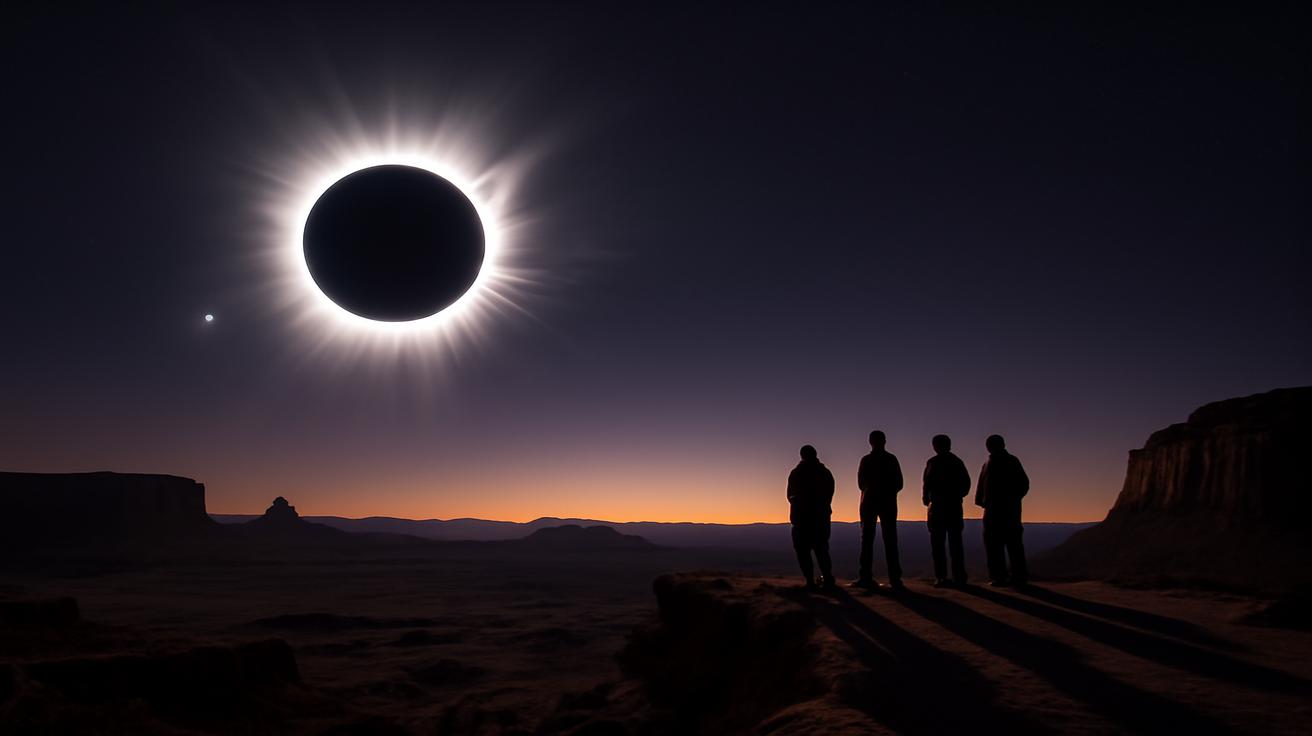
The first sign is not darkness. It’s a change in the air—an almost imperceptible hush that slips into the landscape like someone turning down the world’s dimmer switch. Birds pause mid-song. A breeze that had been warm on your arms cools as if a door to some distant, air-conditioned universe has been cracked open. You check your watch again for the tenth time in five minutes. Shadows sharpen around your feet, razor-thin and oddly intense. Then someone nearby says it, half whisper, half disbelief: “It’s starting.”
The Day the Sun Blinks
We talk about eclipses as if they belong to astronomy, but when the Moon finally slides in front of the Sun, the experience feels far older than science—something tribal, almost primal. Animals react. Humans gasp. For a few minutes, the ordinary logic of day and night is suspended, and we stand in a kind of cosmic twilight, every nerve aware that something enormous is happening, even if the brain calmly recites orbital mechanics.
The upcoming event often called the “eclipse of the century” offers something incredibly rare: nearly six full minutes of totality. Six minutes may sound short on paper, but in eclipse time it’s practically an eternity. Most total solar eclipses give you just two or three minutes in the Moon’s shadow before daylight returns. This one lingers. It stretches that fragile, silvery darkness into something you can settle into, breathe in, and truly absorb.
Imagine it: a mid-morning or afternoon sky turning an eerie, deep twilight while the Sun is high. A wide, black circle hangs where the bright disk had been moments before. Around it shimmers the corona—delicate, pearly light streaming in fine tendrils and wings across the sky. Stars blink into view. Planets you usually only know from star charts glow with a steady brightness. Time dilates. The crowd around you goes very quiet… or erupts in cheers, sobs, laughter—an entire spectrum of human reaction compressed into a few spellbound minutes.
And you, somewhere along a narrow path etched across Earth’s surface, will have a decision to make: where will you stand when the Sun blinks and the world falls into midday night?
When Will the Eclipse of the Century Happen?
Distant as it may feel when you circle a date on a calendar, this eclipse is already in motion. The orbits are set, the geometry precise. Long before anyone reading this was born, the Moon and Earth fell into a clockwork rhythm that makes this particular alignment possible. Astronomers can trace these patterns decades—sometimes centuries—into the future, which is why we already know not just the date, but the hour, and even the path of the Moon’s shadow.
On the chosen day, the partial phases will begin quietly. The Sun, viewed through safe eclipse glasses, will look as if a celestial bite has been taken from one edge. That bite grows. Crescent sunlight spills across fields, water, rooftops, and your skin. Shadows under trees break into countless glowing crescents, each one a tiny pinhole projection of the changing Sun. The temperature slips downward. The light takes on a hushed, metallic tone.
Then comes the moment everyone waits for: the onset of totality. The last diamond-bright point of sunlight flares, then vanishes. The world tips into a rich, indigo twilight. Totality begins.
For this “eclipse of the century,” astronomers calculate a maximum totality of just under six minutes—one of the longest you are ever likely to witness in your lifetime. The exact duration you experience depends on where you are along the track of the Moon’s shadow. If you stand in the very heart of that path, near the point of greatest eclipse, you’ll claim almost every second of that gift. Stray toward the edges and totality will be shorter—still astounding, but seconds, not minutes, are shaved away.
The Time Window That Matters
Your experience will fall into three important windows that day:
- Partial eclipse begins: The first nibble from the Sun. This is when you put on your eclipse glasses and start paying attention.
- Totality: The Moon fully covers the Sun. Glasses off, eyes on the sky. This is the soul of the event.
- Partial eclipse ends: The Sun reemerges, daylight returns, the temperature climbs back up, and the sky resets.
The total event, from first contact to last, can span a couple of hours, but it’s those six dark minutes in the middle that will brand themselves into your memory.
The Path of Shadow: Best Places to Watch
Not every place on Earth will witness the show equally. The Moon’s umbra—the darkest part of its shadow—traces a narrow line called the path of totality, just a few hundred kilometers wide. Inside that track, you see the Sun completely blotted out. Step outside it, and you’ll get only a partial eclipse, interesting but nowhere near the visceral power of totality.
Choosing your spot along that path becomes both an art and a science. You’re not just chasing darkness—you’re chasing clear skies, good horizons, and a setting that makes the experience feel exactly right for you.
Chasing the Longest Darkness
The point of greatest totality tends to fall near the middle of the path, often over open ocean or remote terrain. For this eclipse, that sweet spot will deliver almost the full six minutes of darkness. Nearby regions along the centerline will only slice away a handful of seconds. If you’re willing to travel, you can position yourself close to that central line and know you’re making the most of each precious moment.
But totality is not just about the stopwatch. Imagine standing on a high plateau where the horizon falls away in every direction, giving you a 360-degree view of the “eclipse sunset”—a ring of orange and rose light circling the dark center of the sky. Or on a coastline, watching the Moon’s shadow race across the water to meet you. Or in a quiet village where generations of stories about the sky share space with modern telescopes on makeshift tripods.
Some will head for remote deserts, where the air is often dry and clear, the sky an unbroken dome overhead. Others will seek out small towns along the path that transform the event into a festival: local food, music, impromptu astronomy lessons in the street, children chasing their own crescent shadows. Each location gives the same cosmic event a different flavor.
A Quick Comparison of Viewing Choices
When you’re weighing where to stand when the sky goes dark, a few criteria matter: weather, accessibility, experience, and crowd level. Here’s a simple way to think about your options:
| Location Type | Pros | Cons |
|---|---|---|
| High plateau or mountain | Wide horizons, often clearer air, spectacular views of approaching shadow | Can be difficult to access; weather can change quickly |
| Coastal region | Dramatic light over water, cooler air, beautiful photography possibilities | Marine clouds or fog can roll in; popular areas may be crowded |
| Small town on centerline | Local events, easier logistics, close services (food, lodging, restrooms) | Light pollution at night, busier roads before and after event |
| Remote countryside | Quieter experience, more personal, open skies | Fewer facilities, longer travel times, must be self-sufficient |
Whatever you choose, one rule stays firm: if you can get into the path of totality, do it. A 99% partial eclipse is not 99% of the experience. It’s closer to 1%. Only totality unlocks the full, almost mythic strangeness.
How Six Minutes Change Everything
You may have heard people say that once you’ve seen one eclipse, you’ll chase the next. There’s a reason many seasoned eclipse chasers build entire years around these brief alignments. It’s not just the spectacle—it’s how the world feels during those strange minutes.
In a typical eclipse with two or three minutes of totality, you scramble. There’s barely time to absorb the corona, glance at the horizon, notice the stars and planets, check on your camera, and breathe. It’s like trying to appreciate a symphony while sprinting through the concert hall. Six minutes, though, alters the tempo entirely.
In six minutes, you can let your shoulders drop. You can spend the first 30 seconds simply staring, open-mouthed, as the corona blooms into view. You can then turn slowly in place, drinking in the horizon: a band of molten orange circling you, distant clouds lit from some unseen sunset. You can look down, watch the way the light falls on faces around you, each person transformed by that strange twilight glow.
Maybe you’ll notice the stars. Maybe you’ll pick out a planet you’ve only ever seen in apps or textbooks and feel the hair rise on your arms realizing it’s been above you this whole time, hidden in the glare of the Sun. With six minutes, there is room for wonder to deepen instead of rush.
And then there’s the emotional current. In the half-hour before totality, anticipation runs high. People chatter, fuss with equipment, pace. But once darkness lands and the Sun becomes a midnight jewel, voices fall. Some people whisper. Others cry without quite knowing why. A few shout and applaud, unable to contain themselves. The scale of it—the fact that you are literally standing in the shadow of the Moon—strikes somewhere below language, in the same place that music and grief and awe reside.
The World Responds
It’s not only humans who react. Birds often roost as if evening had arrived. Bees and butterflies alter their patterns. Farm animals grow restless, unsure of this false night. Spiders may take down their webs. Then, as the first shaft of sunlight returns, there’s a second stirring, like a reset button pressed on the entire landscape.
You might find yourself noticing details you never expected to: the way your own breath fogs slightly in cooler air, the sudden awareness of every sound—distant traffic, a dog barking, someone’s nervous laughter. For six minutes, your senses are turned up high. The everyday world, stripped of its usual sunlight, becomes strange and thrillingly new.
Preparing for Your Moment in the Moon’s Shadow
Seeing an eclipse can be as simple as stepping outside with a pair of eclipse glasses or as complex as flying halfway across the planet with a suitcase full of camera gear. Somewhere in that spectrum lies your perfect plan. A little preparation, though, goes a long way toward turning a single astronomical event into a lifelong memory.
Safety First, Always
Before and after totality, the Sun is still dangerously bright. Looking at it directly, without proper protection, can cause permanent eye damage. That means certified eclipse viewing glasses or solar filters are non-negotiable. Regular sunglasses, even very dark ones, are not enough. During the partial phases, keep those filters on any time you look at the Sun.
Only during totality—when the Sun is completely covered and the world has slipped into full shadow—can you safely look with your unaided eyes. The moment a bead of sunlight returns, filters go back on.
Tools or Just Your Senses?
You don’t need a telescope. You don’t even need binoculars. The naked-eye view of the corona and the changing sky is profoundly moving all by itself. If you do bring equipment, keep it simple and practice using it before eclipse day. Many people miss the experience fiddling with camera settings.
Think about what will make you comfortable: warm layers for when the temperature drops, water, a blanket or chair if you expect to wait for hours, a notebook to jot down thoughts while they’re fresh. And plan your arrival. Roads on eclipse day can become rivers of taillights as people crowd into the path. Give yourself time, and then some.
Choosing Your Eclipse Story
Every eclipse watcher comes away with a story, and no two are quite the same. Some will remember the child who reached up, small hand seeking theirs, just as the last sunlight vanished. Others will recall the wave of silence that fell over thousands of strangers in an open field. Someone might remember the distant ridge where the onrushing shadow looked like night falling with a visible edge.
Think, for a moment, about the story you want. Do you picture yourself in a bustling town square, with spontaneous applause echoing off stone walls when the corona appears? On a secluded hillside with just a handful of friends, listening to the wind shift and the birds fall quiet? On a beach, waves rolling in under an indigo sky that shouldn’t exist in midday?
The eclipse of the century is not just an astronomical event; it’s an invitation—to step outside, to look up, and to place your daily life against a backdrop that makes its routines feel small and precious all at once. You’ll remember the logistics, of course: the early alarm, the traffic, the scramble for coffee. But above all, you’ll remember that moment when the Sun became a blackened circle and the world, for nearly six long minutes, turned into something strangely beautiful and new.
Frequently Asked Questions
How long will the total solar eclipse last?
At its peak, this eclipse will offer nearly six minutes of totality—the period when the Sun is completely covered by the Moon. Your exact duration depends on how close you are to the center of the path of totality, but anywhere near that central line will give you several unforgettable minutes of darkness.
Is it safe to look at the eclipse with my eyes?
It is only safe to look at the Sun with the naked eye during totality, when it is fully covered. During all partial phases—before and after totality—you must use proper eclipse glasses or solar filters. Ordinary sunglasses do not provide adequate protection.
Where is the best place to watch the eclipse?
The best place is anywhere along the path of totality with a good chance of clear skies and a comfortable viewing setup for you. Being close to the centerline will maximize your time in darkness. High plateaus, open countryside, coastal areas, or small towns on the path can all be excellent choices.
Do I need a telescope or camera to enjoy it?
No. The eclipse is fully awe-inspiring with just your eyes. Some people choose to photograph or observe through binoculars or telescopes equipped with solar filters, but equipment is optional. Many experienced eclipse chasers recommend prioritizing the experience over complex photography.
What will the environment feel like during totality?
You can expect a noticeable temperature drop, an eerie twilight color to the sky, and a 360-degree “sunset” around the horizon. Birds may roost, insects may change their behavior, and people often go very quiet or react emotionally. It’s a powerful, multi-sensory experience that feels unlike any normal sunrise or sunset.
What if I’m outside the path of totality?
Outside the path, you will see only a partial eclipse. It can still be interesting, but it lacks the dramatic darkness, visible corona, and full emotional impact of totality. If at all possible, travel into the path of totality; even a short trip can transform your experience.
How should I plan my eclipse day?
Arrive early at your viewing location, bring proper eye protection, check weather forecasts, and have a backup site in mind if clouds threaten. Pack water, snacks, layers of clothing, and something to sit on. Most importantly, once the moment comes, remember to pause, lower the camera, and simply look up. This “eclipse of the century” will not come again in your lifetime in quite the same way.