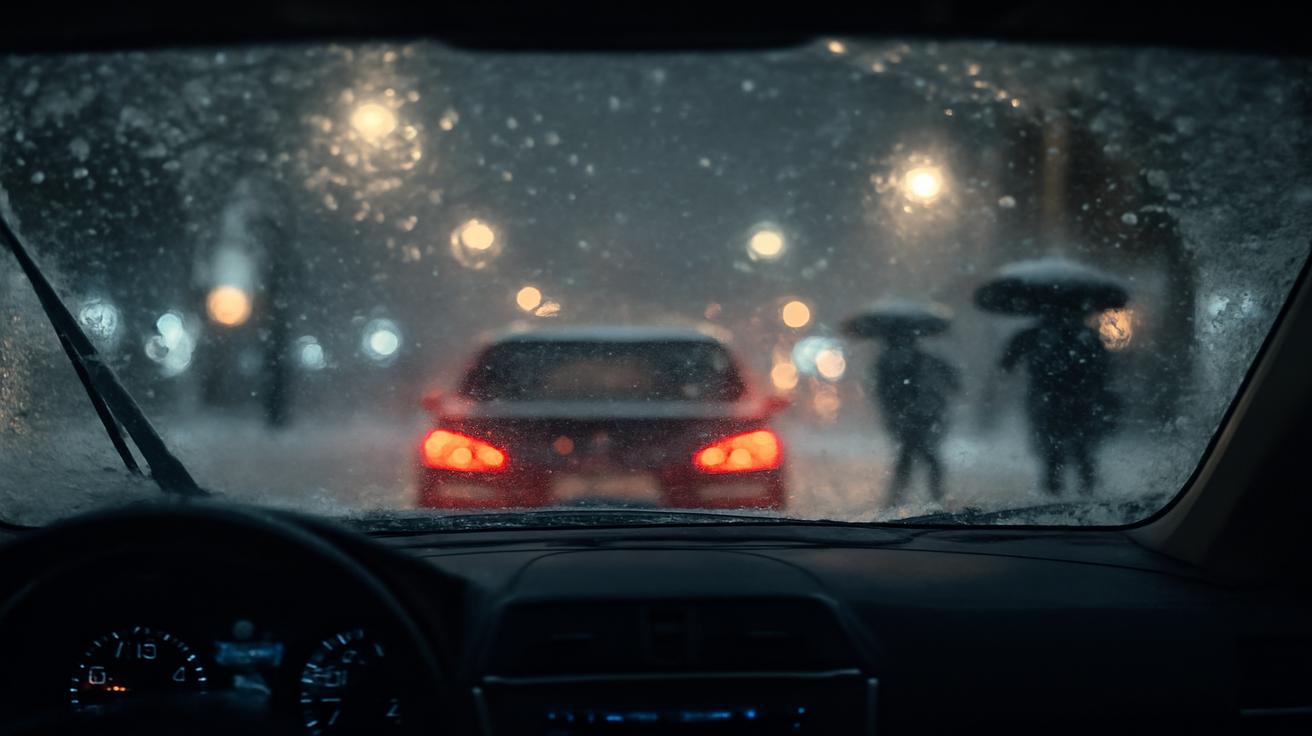
The first flakes arrive almost shyly, drifting through the yellow halo of the streetlights like ash shaken from some invisible fire. You notice them while rinsing dishes, your hands submerged in warm, soapy water, the glass cool under your fingertips. Outside the kitchen window, the world is going soft at the edges. A car hums past, wipers skittering nervously across the windshield, and you can already tell: tonight is the kind of night that asks you to stay home—whether you’re ready to listen or not.
When the Forecast Turns from Background Noise to a Warning
All week, the storm was just a rumor in the background. A line at the bottom of the evening news, a shifting pale swirl on radar maps, an afterthought between sports highlights and the weatherperson’s practiced smile. Maybe it would veer north, maybe it would fizzle out, maybe—like so many winter threats—it would become nothing more than a dusting clinging to the tips of pine needles.
But sometime this afternoon, the story changed. The language sharpened. “Heavy snow is expected to begin tonight,” the announcer said, the words landing with the same heavy certainty as the gray clouds rolling in. A ticker crawled along the bottom of the screen: Authorities urge drivers to stay home. Nonessential travel strongly discouraged.
Your phone chimed almost in sync. A push alert from the Department of Transportation. Another from the local police department. Phrases like “whiteout conditions,” “dangerous travel,” and “limited visibility” stacked up, one on top of the other, until the message was unmistakable: the roads, by morning, might not be roads at all—just indistinct white corridors of risk.
And yet, while the storm gathers itself in the quiet dark, inboxes across the city fill with a different tone entirely.
The Two Voices of a Winter Night
You scroll through your emails after dinner, the glow of the screen reflecting in the window, where snowflakes are thickening into something more serious, more insistent. There’s a note from your office: “We’re planning normal operations tomorrow. Employees are expected to make every reasonable effort to report on time.” Reasonable. The word hangs there, slippery as black ice.
A message from your gym follows: “We’ll be open with full class schedules. No excuses—show up and crush your goals!” A chain store writes, “Despite the incoming weather, our team is committed to serving you. We anticipate remaining open regular hours.”
Outside, the snow is writing its own memo against the pavement, in swirls and gusts. You can hear the wind’s low, emerging growl between the sealed edges of the windows. Somewhere downtown, traffic lights are changing from red to green to yellow over nearly empty intersections, unaware that by tomorrow morning, cars might crawl through them like cautious animals or be absent entirely.
The authorities and the businesses are telling two versions of the same story. One is about risk and restraint, about staying put and respecting the weather’s quiet authority. The other is about resilience and productivity, the cultural engine that insists the day must unfold on schedule, storm or not.
And you’re standing in the space between those voices, trying to decide how you’ll answer the question the storm is really asking: Is being out there worth it?
Listening to the Language of Snow
By late evening, the snow has lost its timidity. It no longer drifts but drives, slanting sideways under the streetlights as the wind claims it and hurls it against roofs, windows, and parked cars already wearing shadowy white coats. There’s a muffled hush outside, that strange winter silence that’s not silence at all, but absorption—sound swallowed by a thickening blanket.
You crack the door open for a moment and step onto the porch. The air is instantly on your skin, sharp and raw, sliding into the gap between your collar and your neck. Your breath ghosts into the darkness in pale ribbons that dissolve as quickly as your thoughts can form. The snow crunches under your shoes with that particular squeak that only arrives when the temperature drops below a certain unforgiving line.
Down at the intersection, a plow grinds past, casting sparks as its metal blade scrapes the asphalt. Its amber lights rotate above the cab, painting the low clouds and the falling snow with brief, swirling halos of gold. A second truck follows, then a third, slow and stubborn, building a rough defense against what’s spilling down from the sky.
Back inside, you pour yourself something warm—a mug of tea, a late coffee, cocoa dusted with cinnamon—and settle near the window. On the coffee table, your phone vibrates again with another alert from the city: “Travel advisory remains in effect. Heavy accumulation expected overnight. Please stay off the roads unless absolutely necessary.” The words have the cadence of pleading now, as if spoken by someone who’s already seen the worst that storms like this can do.
Accidents start to appear in social media feeds: grainy photos of twisted guardrails, a sedan nose-down in a ditch, the eerie flicker of hazard lights blinking in a whirling whiteout. Someone posts a short video taken from their front yard—a delivery truck struggling, wheels spinning, engine whining against a hill that was easy yesterday.
The snow is speaking in its own grammar: slowing things down, covering sharp edges, blurring boundaries. It asks for patience, slowness, presence. It doesn’t care about productivity metrics, profit margins, or quarterly goals. It cares about gravity and friction, about where rubber meets ice and how much time it takes a body to stop in an emergency.
The People Who Can’t Stay Home
While the storm builds its argument against travel, the reality of the night is more complicated than any advisory. In quiet houses across town, alarms are being set for 4:30 a.m. because weather or no weather, some people can’t choose to stay home.
A nurse lays out her scrubs, folding them on a chair by the door. The hospital has already sent a message asking staff to plan for delays and possibly extended shifts. She remembers last winter’s storm, the exhausted faces in the ICU, the rush of stretchers, the way snow on the ambulance bay turned red in a matter of seconds. She sets her boots by the mat and checks the storm updates one more time before bed.
A plow driver sips coffee from a cracked mug in a fluorescent-lit garage, waiting for the call that the first major band of precipitation has arrived. He knows these roads by feel—the way certain drifts form repeatedly on exposed stretches of highway, the places where meltwater freezes fast under overpasses. He jokes with his coworkers, but underneath, there’s the solid understanding: they’ll be out when most people are asleep, pushing back the snow again and again in an unwinnable but necessary battle.
On the other side of town, a grocery store clerk checks tomorrow’s schedule and sees their name still locked in place. The corporate email says, “We pride ourselves on being there for our community in all conditions.” There’s pressure in that sentence, invisible but heavy. Buses may run slow or not at all; rideshares will be scarce. Yet calling in feels risky, too—rent is due next week.
In so many winter stories, “stay home” is a luxury. The people who keep hospitals functioning, who run power plants, clear snow, respond to emergencies, and keep basic services alive often don’t get the safety that advisories suggest. They move through the whiteout so that others can stay curled on couches, counting their blessings in the flicker of candlelight if the power goes down.
And then there are the people caught in the middle: office workers told they’re “expected” to come in despite the storm, delivery drivers nudged to hit targets, employees in retail and food service where the lights must never go dark. For them, the night’s central tension is very real: obey the weather, or obey the clock.
Between Obligation and Instinct
You sit with your mug growing cool and stare at the snowfall thickening outside, the flakes now blurring into fast white lines as the wind picks up. The world out there is transforming by the minute, the dark street slowly dissolving under an accumulating weight of silence. And somewhere underneath your rational calculations—how long it usually takes to get to work, how reliable your car is, how early the plows come down your street—there’s another voice entirely.
It’s the animal voice, the intuitive nudge that studies the angle of the snow and the tempo of the wind and quietly says: This is not a night for moving fast through the world.
But our lives are wired for motion. For showing up. For demonstrating that we are the kind of people who push through inconveniences and weather the weather. We’ve been taught, often rewarded, for ignoring what our senses tell us in favor of what the calendar dictates.
Inside this bind, the city feels like it’s holding its breath. Streetlights cast hazy cones of pale orange onto drifting piles. A lone car creeps by, leaving snowy wake like a boat on a winter sea. The quiet is deep enough that you can hear the papery rustle of snowflakes hitting the window, a sound so soft it’s almost imaginary.
This is the part of the night where decisions are made: Do you set your alarm for the same time as always, promising yourself you’ll “see how it looks in the morning”? Do you write your manager, explaining your concerns and asking to work remotely, if that’s even an option? Do you gamble on the storm underperforming, assuming the roads will be manageable by sunrise?
Storms, though, have their own sense of timing. They rarely care about your morning plans.
The View from the Snowplow and the Corner Office
Somewhere above this blanket of falling white, satellite images trace the storm as a swirling mass, a perfect spiral of clouds dragging moisture and cold air together. Weather models churn through equations. Meteorologists adjust predictions—six inches, eight, suddenly ten or more. On the ground, the impacts land in more intimate ways: a canceled appointment, a delayed shipment, the flicker of fluorescent lights staying on in glowing islands while everything beyond the parking lot goes gray.
If you could listen in on the conversations that shape tomorrow’s expectations, you’d hear very different tones in different rooms.
In an emergency operations center, officials track snow totals, road temperatures, and wind patterns in real time. Traffic cameras show hazy scenes of almost-empty interstates. They issue statements with careful wording, balancing urgency with calm, keenly aware that too strong a warning might go ignored next time if the storm disappoints, and too gentle a suggestion might leave people stranded in ditches tonight.
In a suite of offices several floors up in a corporate building, another conversation unfolds. Missed productivity days cost money. Keeping stores open means maintaining customer loyalty. There’s a culture to protect: the myth of unbroken normalcy. Even while reading the same forecasts everyone else sees, decisions tilt toward staying open “as long as it’s safe,” a phrase so elastic it can stretch to cover almost anything.
Between these two vantage points lies the daily reality of workers and drivers and families. The result is a kind of winter tension you can almost feel in the air: a storm pulling one way, economic expectation tugging another.
And yet, if you strip everything back to basics, you’re left with something simple and physical—a car on slick pavement, momentum versus friction, reaction time versus stopping distance. No mission statement, no earnings call, no “we value your dedication” email can change the physics of ice under rubber, of snow-packed intersections, of wind that blinds you in a heartbeat.
How a Night Like This Unfolds
Imagine the next twelve hours as a series of quiet, unspectacular choices that add up to a city’s story of the storm. Down below, some people opt to stay home even though their offices are technically open. Others climb into cold cars before dawn, scraping thick rime from windshields, fingers aching in thin gloves as the wind knifes between parked vehicles. A few won’t leave at all because the risk is too clear, or they have the privilege not to.
Emergency dispatchers will answer calls from drivers who thought they could make it and then couldn’t. Plow operators will clear the same stretch of road three, four, five times, watching tire tracks fill in almost as soon as they carve them. A paramedic will press their hand against a fogging window in the back of an ambulance, hearing the faint ping of ice hitting the metal roof as they move slowly toward the hospital.
And somewhere, a manager will look around a half-empty office or a nearly deserted retail floor and feel a pang of conflict: pride in the people who made it in, unease for the ones still out there, silent curiosity whether staying open was really the right call.
A Small Table of Choices in a Big Storm
When the weather and the world send mixed messages, clarity can look like a simple list: what matters, what doesn’t, what can wait, what truly can’t. On a night like this, your personal calculus tightens around safety, obligation, and the weight of expectation.
| Consideration | Questions to Ask Yourself | Possible Choice |
|---|---|---|
| Safety | Are roads actually passable? Do you feel confident driving in low visibility and on ice? | Delay travel, reduce speed, or stay home if conditions are severe. |
| Necessity | Is this trip essential right now, or could it wait hours—or days? | Prioritize medical, caregiving, and critical work; postpone the rest. |
| Work Expectations | Has your employer offered flexibility? Can you work remotely or shift your hours? | Communicate early, document conditions, suggest alternatives. |
| Preparedness | If you must drive, do you have emergency supplies in your vehicle? | Pack blankets, water, snacks, charger, and a small shovel. |
| Community | Could staying off the roads help plows and emergency crews work more safely? | Limit nonessential trips to reduce congestion and risk. |
No table can tell you exactly what to do when the flakes start stacking up, but it can quietly re-center the conversation away from slogans and toward the concrete realities of a winter night.
Letting the Storm Have Its Say
By the time you’re ready for bed, the world outside has become almost unrecognizable. The street is a soft, continuous beam of white, broken only by the dark humps of buried cars and the occasional ache of a snow-laden branch bending lower than it did yesterday. The sky glows faintly with reflected city light, a pearly dome stretching over rooftops.
You click off the lamps, and for a moment, in the half-dark, the only illumination is the diffuse glow from the storm itself seeping through the curtains. You can feel, in that dimness, just how powerful and indifferent the weather is. It doesn’t argue, it doesn’t persuade. It simply arrives, piling its quiet insistence onto sidewalks, highway shoulders, and office parking lots alike.
The advisories and the corporate messages, the push alerts and the “business as usual” announcements, are all human attempts to frame what’s happening out there. But the storm doesn’t belong to them. It belongs to the physics of cold and moisture, to the shape of clouds and the contours of land, to the patterns the wind has been practicing for centuries.
When your alarm goes off in the pale gray morning, the decision will still be yours. You’ll look out the window and measure the depth of the snow against tires and porch steps. You’ll check your phone, scroll through updated forecasts, read the latest from your workplace. And then you’ll do what humans have always done when weather demands respect: you’ll weigh risk against responsibility, instinct against obligation.
Some will stay home, wrapped in the layered quiet that only a heavy snowfall can bring, listening to the distant scrape of plows and the occasional crunch of footsteps on an otherwise untouched sidewalk. Others will head out carefully, taillights glowing red in the whiteness, lives and livelihoods carried forward at fifteen miles per hour.
Somewhere in that complicated, imperfect mix is a simple truth: storms like this remind us that “normal operations” are an illusion we keep alive together, and that sometimes, the bravest thing a community can do is collectively decide to slow down.
Outside, the snow keeps falling, unbothered by memos or warnings, soft and relentless, asking us all the same quiet question: will you listen?
FAQs About Heavy Snow, Safety, and Staying Home
Why do authorities urge people to stay home during heavy snow?
Authorities know that heavy snow drastically reduces visibility, increases stopping distances, and can quickly overwhelm road crews. When fewer vehicles are on the road, plows and emergency responders can work faster and more safely, and the number of crashes and stranded drivers drops significantly.
If businesses stay open, should I still consider staying home?
Yes. “Open” does not automatically mean “safe.” Your decision should be based on actual conditions where you live and drive, your comfort level with winter driving, and whether your trip is truly essential. When in doubt, communicate with your employer and prioritize safety.
What counts as “essential” travel in a snowstorm?
Essential travel usually includes medical needs, caregiving responsibilities, critical infrastructure work (like hospitals, utilities, public safety), and emergency situations. Shopping, meetings, workouts, and most social plans can often be postponed until conditions improve.
How can I prepare my car if I must drive in heavy snow?
Equip your car with a snow brush and ice scraper, blankets, water, snacks, phone charger, flashlight, and a small shovel. Keep your fuel tank at least half full, check your tires and wipers, and let someone know your route and expected arrival time.
Why is it harder to drive at night during a snowstorm?
At night, headlights reflect off falling snow, creating a disorienting “tunnel” effect. Depth perception and visibility are reduced, black ice is harder to spot, and plows may be focusing on main routes rather than side streets. All of this makes nighttime winter driving more hazardous than traveling in daylight, even with the same amount of snow.
What should I do if I get stuck or stranded in the snow?
Stay with your vehicle if possible—it’s easier for rescuers to find. Run the engine periodically for heat, but clear snow away from the exhaust pipe to prevent carbon monoxide buildup. Keep a window slightly cracked for ventilation, turn on hazard lights, and conserve your phone’s battery while keeping someone updated on your situation.
How can staying off the roads help my community during a storm?
When you stay home during dangerous conditions, you reduce the chance of crashes and spinouts that tie up emergency services. You also give plows more room to work efficiently, helping them clear routes for ambulances, fire trucks, and essential workers who must travel. Your individual choice contributes to your community’s overall safety.