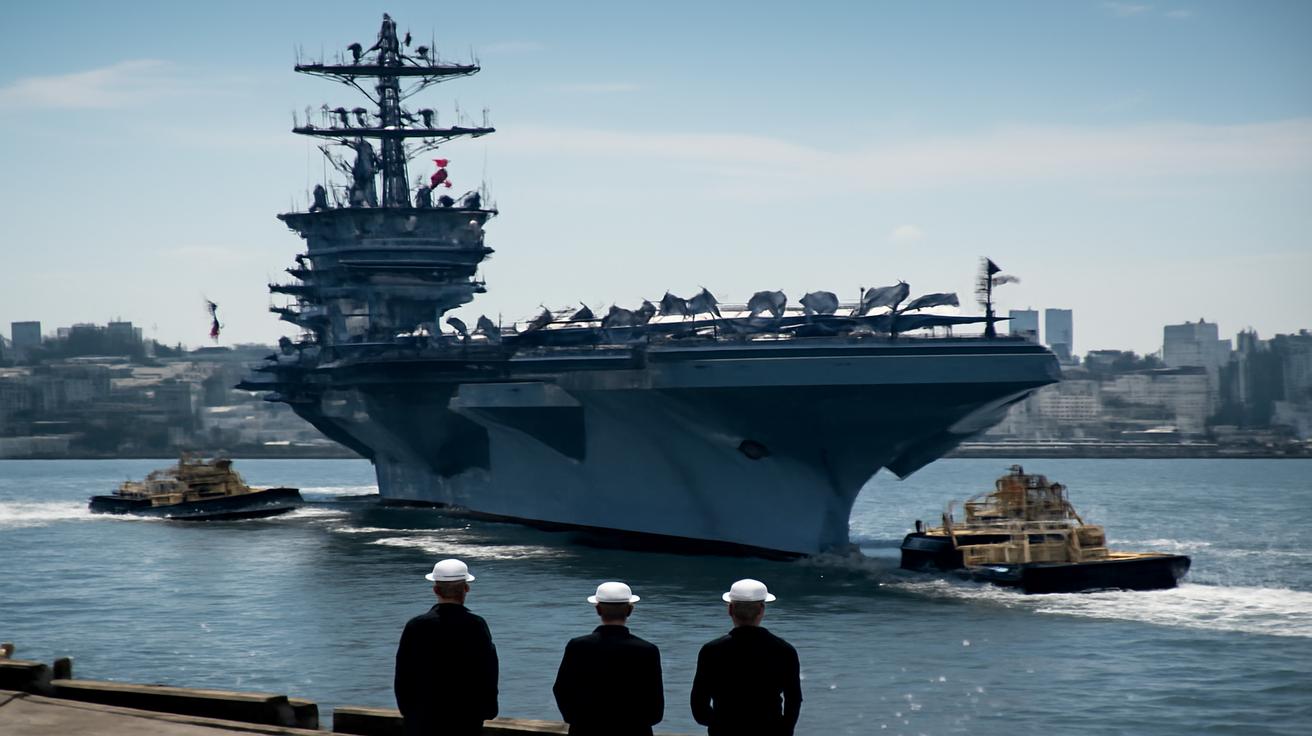
The first thing you notice is the smell. Salt and steel and a faint whisper of aviation fuel hang over the harbor as the gray silhouette of a floating city slides back toward home. It’s early morning in Japan, the kind of gentle, overcast light that softens everything except the sharp angles of a warship. Out in the distance, the USS George Washington—an American nuclear-powered aircraft carrier that has spent weeks cutting deliberate paths through the Pacific and Philippine Sea—moves past the breakwater, returning like some migrating creature to a familiar coastline.
After the Wide, Blue Silence
For weeks, the Pacific had been the carrier’s world: endless blue, the low hum of engines underfoot, and the constant choreography of aircraft cutting patterns in the sky. The USS George Washington didn’t just sail; it rehearsed, practiced, and refined. Every day at sea was a long sequence of exercises—air defense drills, flight deck operations, communications tests, joint maneuvers with Japanese and regional partners—each one a small stitch in the wider fabric of deterrence and security.
On deck, the air during those weeks tasted different: hotter, drier, thick with jet exhaust and ocean spray. Sailors moved in color-coded jerseys: yellow shirts signaling aircraft handlers, green for catapult and arresting gear crews, purple for fueling, blue for plane handlers and chock handlers. To an outsider, it looks like chaos. To the crew, it’s a living language. Every hand signal, every whistle blast, every shouted word competes with the scream of engines and the thump of rotor blades.
In the Pacific and Philippine Sea, the ship trained in wide arcs, meeting allied vessels in the early mornings when the horizon was still a soft line between slate-gray water and pale sky. Japanese Maritime Self-Defense Force destroyers appeared out of the mist, their flags lifting in the wind as both sides set up communication drills and coordinated maneuvers. There were days of anti-submarine warfare practice, when helicopters dipped sonar into dark water, listening for the echo of unseen hulls far below. There were nights of simulated attacks and responses, radar screens glowing dimly as crews traced imaginary threats slicing through the digital sea.
These were not headline-grabbing battles, but rehearsals—the kind that never make the news precisely because they’re meant to prevent real conflict. Each flight launched, each missile drill, each coordination call over secure channels formed a kind of story told without words: We are here. We have practiced this. We know how to move together.
Japan on the Horizon Again
Eventually, though, even the largest oceans narrow, and one morning, the gray smudge on the horizon became coastline again. Japan does not rush into view; it rises slowly out of the sea, first as a darker band beneath the sky, then as mountains, buildings, and finally small, recognizable details like cranes and harbor walls.
On the USS George Washington, that first sighting sets off its own internal tide. Sailors climb to weather decks during their off-hours just to watch the land coming closer. Some lean against the railings, headphones in, sharing playlists with friends. Others simply stand quiet, the wind pressing their uniforms against their backs as they squint toward the faint outlines of streets and homes they know are somewhere ahead.
Japan has long been more than a port of call for the George Washington. As a forward-deployed carrier, it has spent years homeported here, sharing a time zone—and often training routines—with Japanese forces. That relationship is both strategic and deeply human. Sailors know local bakeries and ramen shops. They remember certain train lines, temple paths, and small convenient stores where you can get a hot canned coffee late at night. To them, this isn’t just “returning to a base.” It’s coming back to a rhythm of life that blends shipboard duty and the distinct texture of Japanese towns and coastal cities.
From shore, the sight of the ship returning tells another kind of story. Families line fences and piers if they can get close enough, kids on shoulders, cameras ready. The ship’s bulk is so massive that it looks almost slow, almost gentle, as it glides in—yet beneath that calm, thousands of tons of machinery and the lives of thousands of people are shifting into a new phase: from ocean operations back to port routines.
The Sea as a Training Ground
In a world that often sees military hardware only in terms of threat or power, the weeks in the Pacific and Philippine Sea carried a quieter reality: practice, coordination, and a careful reading of nature. An aircraft carrier isn’t just moving through geopolitics; it’s moving through weather systems, ocean currents, and delicate ecosystems stretching for thousands of miles.
On the bridge and in the weather centers aboard, teams study swell height, wind direction, cloud cover. They read the sky the way sailors have done for centuries, but with satellites, sensors, and high-resolution models. Every launch and recovery of aircraft has to respect crosswinds and deck conditions. Storm cells grow and dissipate in the distance, their towers of cloud going violet in the afternoon light as the ship routines adjust around them.
From above, the carrier’s wake is a pale line of turbulence fading slowly behind it, a brief scar on the surface of a deep, living system. Below, schools of fish scatter as the hull approaches, and birds use the rising air currents over the deck to sweep across the ship before flaring away. Some days, dolphins race the bow, their gray bodies sliding through the water with casual speed, untouched by the human weight looming above.
Training exercises don’t happen in a vacuum; they are threaded into these natural patterns. Helicopters skim low over waves that have been rolling toward shore long before these drills existed and will continue long after. Night operations take place under constellations that ancient navigators once used to cross the same seas in wooden boats. The technology has changed beyond recognition—but the basic reality remains: the ocean is the arena, and the weather sets the terms.
Life Afloat: A Floating Town Returns
Inside the hull of the USS George Washington, the atmosphere is more like a small, bustling town than a single team. Corridors are narrow, painted in functional grays and whites. Stairways—“ladders” in ship speak—tilt steeply, and the constant low vibration of engines and systems is a kind of ever-present heartbeat. Here, during the exercises, days blur together in a cycle of watches, meals, drills, and scarce sleep.
There are no open fields, no trees, no rain directly on your skin—only the controlled environment of steel passageways and the occasional searing sunlight on deck. Sailors mark time by announcements over the intercom, the clatter of trays in the mess, the moment the ship’s clocks reset for another time zone. Letters and messages arrive in bursts when connectivity allows: a photo of a new pet back home, a short note from family, news headlines that shrink the distance just a bit.
Returning to Japan breaks that cycle. The day before arrival, there’s a subtle shift. Work continues—berthing areas cleaned, equipment stowed, decks checked and rechecked—but conversations start to orbit around shore leave. Someone dreams aloud of a bowl of hot udon; another talks about a particular street in Yokosuka or Sasebo, where the air smells of grilled fish and soy sauce, where lanterns swing gently outside small restaurants.
When the carrier finally eases into port, mooring lines become physical bridges between this self-contained world and the one on shore. The ship doesn’t shut down, of course—vital systems keep humming—but the tempo changes. Watch schedules adjust, duty rotations reorganize, and gradually, small streams of sailors in crisp uniforms step off the gangway onto solid ground.
Why These Exercises Matter
From a distance, an exercise is just a line in a press release: “The USS George Washington conducted operations in the Pacific and Philippine Sea before returning to Japan.” But inside that sentence are countless small, very human moments of learning and coordination—and a quiet but real effect on regional stability.
Modern security isn’t only about reacting to crises; it’s about prevention, about sending subtle signals that the systems needed to respond are in place and well-practiced. Joint exercises with Japan and other regional partners are part of that language. A carrier working side by side with allied ships demonstrates not only capability, but familiarity: the crews know each other’s procedures, radio habits, and even the small quirks of their equipment.
For countries that share the Pacific waters, that kind of familiarity can be calming. The sea can feel like a frontier—vast, contested, and sometimes tense. Seeing that the people operating in it can coordinate smoothly, that they train to manage emergencies and de-escalate misunderstandings, becomes a layer of reassurance that’s easy to miss if you only look at steel and numbers.
Those numbers, though, do tell part of the story. To understand the scale of a ship like the USS George Washington and its journey back to Japan, it helps to see it laid out simply:
| Aspect | Details |
|---|---|
| Ship Type | Nimitz-class nuclear-powered aircraft carrier |
| Length | Approximately 333 meters (1,092 feet) |
| Crew Size | Roughly 5,000+ personnel including ship’s company and air wing |
| Primary Operating Areas | Pacific Ocean, Philippine Sea, waters around Japan |
| Mission Focus During Recent Operations | Training exercises, joint operations with allies, readiness and deterrence |
Behind each of those neat rows is a living reality: long shifts in the engine rooms, radar operators tracking blips on green screens, pilots reviewing flight data, sailors cleaning and repairing and calibrating equipment so that it all works when needed.
Between Two Worlds: Sea and Shore
When the ship is finally tied fast and the engines shift down from the rhythms of long transit to the lower hum of pier-side life, there is a moment on deck that feels almost like a held breath. Out beyond the harbor, the Pacific keeps rolling restlessly, always ready to swallow steel hulls back into its expanse. In here, on the sheltered side of the breakwater, the water slaps gently against the concrete, and gulls wheel over parking lots and warehouses.
Sailors who have spent weeks measuring time in watches and drills now navigate train schedules, crosswalk signals, and the odd quiet of a room without the constant vibration of a ship’s machinery. The first steps on shore can feel almost surreal. Some walk slowly, as if relearning how ground feels underfoot when it doesn’t shift. Others move quickly, eager to pack as much as possible into their hours of freedom: favorite foods, favorite streets, phone calls made without checking bandwidth.
Japan meets them with small daily rituals that contrast sharply with the focus and intensity of sea operations. Vending machines glow in side streets, offering cold tea, sweet drinks, and steaming cans of coffee. Alleyways smell of grilled yakitori and frying oil. A light rain might fall—so different from the salt spray on an open deck—tapping softly on umbrellas as friends talk and laugh in small knots outside train stations. Lanterns sway over izakaya entrances, and for a while, conversations are about anything but radar tracks and fuel calculations.
Yet even in these moments, the sea is never far away. Some sailors find themselves drawn back toward the water on their days off, standing at railings above rocky shorelines, watching ships move like slow shadows in the distance. The carrier may be out of sight from many vantage points, but its presence shapes the local rhythm: businesses that cater to visiting crews, bilingual signs, the subtle intertwining of American and Japanese lives in port cities.
The Ocean Keeps Its Own Time
By the time the USS George Washington completes the cycle—training in the Pacific and Philippine Sea, returning to Japan, resupplying, and preparing for the next departure—the ocean has already changed. Currents have shifted subtly; weather patterns have rewritten the cloud lines. Migrating whales push along invisible highways underwater. Fishing boats go about their careful itineraries, chasing seasonal runs of tuna and mackerel. Life at sea doesn’t pause just because one ship has temporarily come home.
For all the weight and technology concentrated in a modern aircraft carrier, it is still a guest of the ocean. The waves decide how much the hull will roll. Storms decide whether flight operations can continue. Even the ship’s route bends and curves around reefs, shoals, and environmentally sensitive zones. There is power here, yes—but there is also deference to the elements, to the fact that this planet is overwhelmingly water, and that water has a logic of its own.
When the carrier heads out again, the cycle will repeat: the long, slow exit from harbor, the widening horizon, the return to the wide, blue silence of open water that is never truly silent. But for this moment, with mooring lines tight and gangways down, the ship and its crew rest in that rare in-between place—anchored between nations, between sea and shore, between the sharp discipline of drills and the softer, everyday life of the ports that host them.
Somewhere along the pier, the smell of salt and steel blends with something new: coffee drifting from a small shop near the base gate, the faint sweetness of a bakery opening its doors, the earthy scent after a brief rain on city pavement. Overhead, the gulls call, the same wild notes heard far out at sea—but here, mixed with the low murmur of traffic and the rustle of trees along the waterfront. The USS George Washington has returned to Japan, and with it, an entire floating world has momentarily folded into the fabric of the shore.
FAQ
Why was the USS George Washington operating in the Pacific and Philippine Sea?
The ship was conducting training and readiness exercises, including flight operations, joint drills with allied navies, and practice in air defense, communications, and coordinated maneuvers. These activities help ensure that the carrier and its crew are prepared for real-world missions and can work smoothly with regional partners.
Why is Japan such an important destination for the USS George Washington?
Japan hosts key ports and facilities that support forward-deployed U.S. Navy forces. Being based in or regularly returning to Japan allows the carrier to operate closer to important sea lanes and partners in the region, strengthening both deterrence and cooperation with the Japan Maritime Self-Defense Force and other allies.
How long do these exercises typically last?
Exercise durations vary, but operations in the Pacific and Philippine Sea can last from several days to multiple weeks, depending on the complexity of the drills, the number of participating units, and the specific training goals for the deployment.
What is daily life like for sailors during these operations?
Life at sea follows a strict routine of watches, work, training, and limited rest. Sailors stand duty in shifts, maintain equipment, support flight operations, and participate in drills. Space is tight, privacy is minimal, and the rhythm of the ship—announcements, alarms, and schedules—shapes every day.
Do these military activities affect the ocean environment?
Any large-scale human activity at sea has some environmental footprint. Modern navies work under regulations and guidelines designed to reduce impacts, such as routing considerations, protected areas, and safeguards around sonar use and waste handling. Balancing operational needs with environmental stewardship is an ongoing focus for maritime forces.