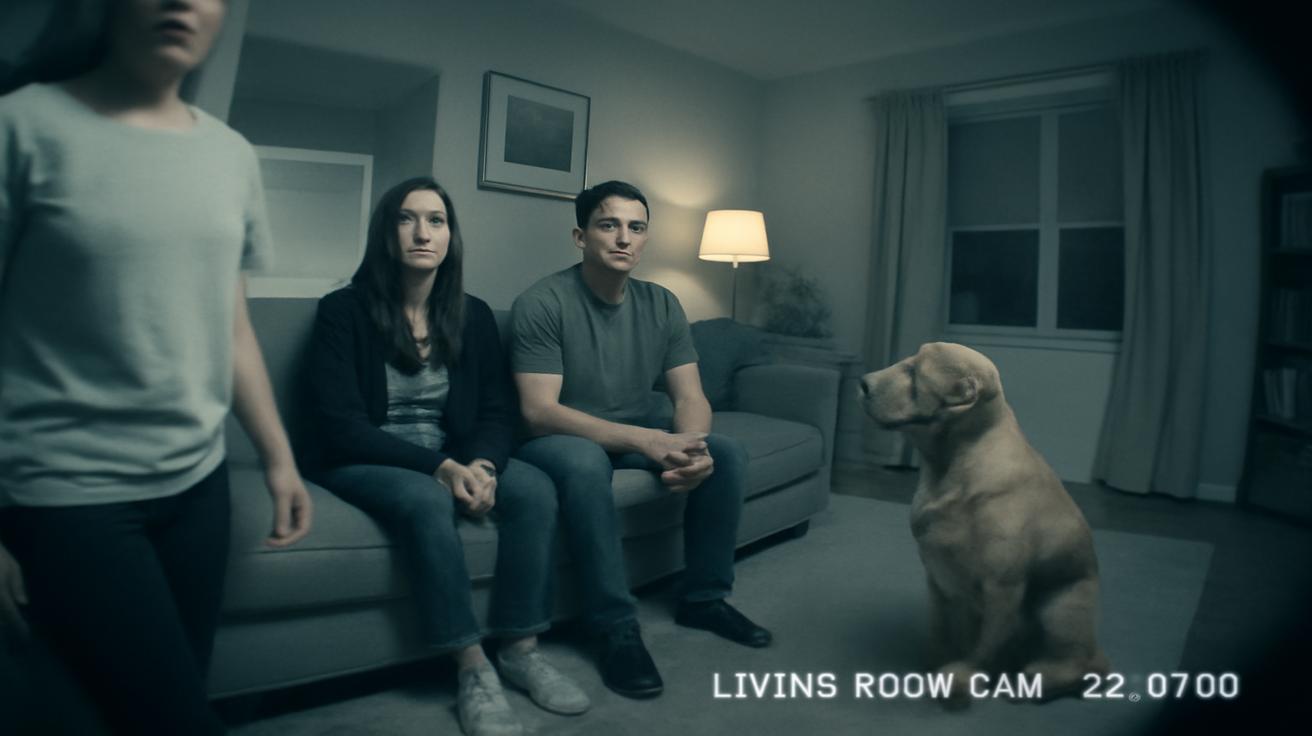
The first time he saw it, the video didn’t make sense. The grainy clip from his living room camera showed his golden retriever, Moose, prancing in delighted circles while a stranger in a red hoodie knelt to ruffle his ears. The dog sitter—quiet, soft-spoken Erin with the gentle smile—stood off to the side, laughing. Another person stepped into the frame, holding a fast-food bag. Music pulsed faintly through the tiny speakers of his phone. This wasn’t the peaceful, tidy dog-sitting shift he thought he’d hired. It looked like the beginning of a party.
When You Hand Over the Keys
Two weeks earlier, Liam had stood in his doorway with Moose dancing impatiently at his knees, leash looped around his wrist, suitcase open on the couch. The apartment smelled faintly of coffee and that wet, warm scent that always clung to Moose’s fur after a walk in the city rain. Outside, a taxi honked at nothing in particular, the way taxis always seemed to do in late afternoon.
He was leaving for four days—just long enough for guilt to dig in. Moose was a rescue, the kind of dog who flinched at sudden sounds and watched doors like they could vanish at any second. Boarding had never gone well. The last time Liam picked him up from a kennel, Moose came back with a raw patch of skin from stress licking and eyes that seemed to say, You left me with strangers and it felt like forever.
So this time, he’d done the “responsible dog parent” thing. He’d scrolled through profiles for days, reading reviews like sacred text. One sitter kept posting gym mirror selfies with dogs blurred in the background. Hard no. Another boasted about “guaranteed crate time” that felt more like dog jail than structure. Then there was Erin: a dozen five-star reviews, photos of her on hiking trails with happy dogs, a short bio about growing up with rescues and “treating your pup like my own.”
He messaged her, vetting with all the cautious attention he usually reserved for job interviews. Did she know how to handle dogs with separation anxiety? Could she manage Moose’s allergy meds? Was she okay with the apartment cameras?
“Totally fine with cameras,” she wrote back. “I get it. I’d be the same if someone watched my fur baby. I’ll probably forget they’re even there.”
They set up a meet-and-greet. Moose, notoriously suspicious of new people, trotted straight up to her and leaned his full, trusting weight against her leg. Liam watched, half relieved, half surprised. She moved around the apartment with a respectful distance, admiring the fiddle-leaf fig by the window, the small bookshelf under the wall-mounted TV, the row of neatly hung leashes and collars.
“I love that you have cameras,” she said, glancing up at the little black eye in the corner. “Shows you care.”
He explained the basics: the camera in the living room, another in the hallway by the front door. Nothing in the bedroom or bathroom. He emphasized the one rule that really mattered: “Just you and Moose, okay? No guests.”
She smiled and nodded, hand resting on Moose’s head. “Of course. This is your space. I completely respect that.”
That was the moment he handed over the keys—the literal metal ones and the invisible set that lives in your gut. Trust, once again extended to someone new.
The Quiet Glow of a Red Notification
The first night away, in the small hotel room that smelled faintly of industrial cleaner and filtered air, Liam lay on the too-firm mattress and opened the pet cam app without really meaning to. Habit. Curiosity. A thin ribbon of guilt.
The living room showed up in muted dusk light. Moose was sprawled on the rug, belly up, the way he only did when he felt completely safe. Erin sat cross-legged on the couch with a book in her lap, hair tied up, socked feet tucked under her. The image looked like something out of a cozy ad: Responsible Dog Sitter, Your Dog in Gentle Hands.
He watched for a few minutes, the soft hum of the hotel mini-fridge the only sound. Erin set the book aside and slid down onto the rug, rolling a ball toward Moose, laughing when he pounced with a playful growl. The sound came through the tiny speaker, warped but warm.
He slept well that night. His last fully easy sleep for a while.
The second night, the flight had been delayed, meetings had run over, and by the time he got back to the hotel, his head buzzed with that metallic fatigue that feels like a low-grade fever. The app notification blinked red: “Motion detected in Living Room.”
He almost ignored it. Motion in the living room meant Moose, usually. A stretch, a sigh, the shift of a tail. But he opened it anyway, thumb moving on autopilot.
This time, the angle caught something different.
The front door was open, a sliver of hallway light cutting into the warm glow of the apartment. Erin stood with her back to the camera, speaking to someone outside. Then a stranger stepped through—tall, wearing that red hoodie—looking around with casual curiosity, as if walking into a bar, not someone’s private home.
Moose, conflicted, wagged uncertainly from the couch. Erin turned and stroke his head. “It’s okay, buddy,” she said, voice small through the speakers. “He’s a friend.”
The word friend clanged in his head. The one rule. No guests.
On the screen, the stranger grinned as if invited and set a backpack down against the bookshelf. Erin shut the door.
The Living Room that Became a Stage
The first night with the red hoodie guy, nothing catastrophic happened. No shouting. No obvious damage. The two of them ordered food, ate on the couch, shared fries with Moose. At one point, the stranger lay full-length on the rug, letting Moose climb onto his chest, hands scratching big lazy circles behind his ears. Moose’s tail thudded happily. From the camera’s perspective, it looked like an alternate version of the life Liam had built with his dog—someone else dropped into his frame, his couch, his sanctuary.
He replayed the footage in bed, the glow of his phone painting his hotel sheets a flat, icy blue.
Was he overreacting? Was it really that bad? Moose clearly liked the guy. Erin seemed relaxed. Nothing was broken. Everyone was laughing. But the feeling in his chest had a distinct shape: someone was inside his shell, rattling around without permission.
The next notification came late afternoon the following day. “Motion detected in Living Room.” He opened it between sessions at the conference, the chatter of voices and the smell of burnt coffee spilling around him. This time, there were three people: Erin, Red Hoodie, and another woman with purple hair, sitting cross-legged on his rug, leaning against his coffee table like it was their regular hangout spot.
Music played from a speaker he didn’t recognize. Moose’s favorite rope toy passed from hand to hand while someone cooed, “Who’s a good boy?” A soda can rested on one of his coasters—small detail, but it stuck. They weren’t even pretending this was a work shift. It was a social call in a stranger’s apartment.
He zoomed in slightly with two fingers. The woman with purple hair reached up, lazily, and adjusted the camera angle just a bit. Not enough to turn it away, but enough that the room suddenly felt taller, more distant. She knew it was there.
He cut the feed. Turned his phone face down on the table. Tried to listen to the speaker onstage talk about “trust as a brand value” and almost laughed.
What the Camera Doesn’t Capture
For the rest of that day, he walked around with a quiet static in his chest. Anger, yes. But also something softer, and harder to name. Disappointment, maybe, or that small, familiar ache of realizing your boundaries are more permeable than you hoped. He kept thinking about Moose’s history—about the nights after the shelter, when the dog would whine and pace, pressing his body against the front door, certain he’d been left again.
Handing over the keys had been about protecting Moose from more upheaval. Finding someone kind, steady. Not someone who turned his home into a hangout spot.
Back at the hotel, he opened the app again. Another red notification. This time, the lights were low. The TV flickered in the background, muted. Erin and Red Hoodie were on the couch, bodies angled into each other in that unmistakable way that needs no dialogue. Moose lay on the far end of the couch, head on a pillow, eyes half closed but watchful. His tail thumped once when Erin shifted to scratch his chest absentmindedly, the way you would with your own dog in your own living room.
The intimacy of it stung. Not because he had claims on her private life, but because she’d brought it into his.
He watched long enough to feel like an intruder in his own space. Then he paused the feed, thumb hovering over the tiny digital image that had suddenly turned into something else entirely—a peephole into a version of his apartment he hadn’t consented to.
Beneath the anger, another quieter realization surfaced: he’d told her there were cameras. She knew. And still, she’d done this.
Drawing Lines in a Digital Age
The next morning, he sat at the tiny hotel desk, opened his laptop, and did what modern life trains you to do when something feels off: he made a table.
| Time | What Happened | How It Crossed a Line |
|---|---|---|
| Night 1 | Stranger in red hoodie enters, stays for hours. | Directly broke “no guests” rule. |
| Day 2 | Second guest arrives, casual hangout, music. | Turned paid job into social gathering. |
| Night 2 | Physical intimacy on couch while on duty. | Blurred professional and personal boundaries. |
| Throughout | Camera nudged, angles changed slightly. | Suggested awareness, not accident. |
Seeing it laid out like that solidified what his gut already knew: this wasn’t a small misstep. It was a pattern of disregard.
He typed a message he deleted three times before sending.
“Hey, Erin. I’ve been checking in on Moose through the cameras. I noticed you had guests over even though I was very clear about no visitors. I’m not okay with what I’ve seen. We’ll talk when I’m back, but for now, please make sure it’s just you and Moose there.”
He watched the three dots appear, disappear, then blink back again.
“Hey! I’m so, so sorry,” she wrote. “That was just my friend dropping by because he was in the area, and then another friend. It won’t happen again. Moose was totally fine and we were just hanging out. I didn’t think you’d mind since everything was under control.”
The phrasing snagged: I didn’t think you’d mind. As if the rule had been a suggestion, not a boundary.
He replied, slower this time. “I do mind. I was very clear about no guests. This is my home and my dog. That has to be respected.”
Her next response came minutes later. Shorter. A little sharper at the edges. “Understood.”
The rest of the day, no new notifications came through. The feed, when he peeked, showed only Moose and Erin moving through the apartment in careful, practiced motions: feeding, walking, dozing on opposite sides of the room. The warmth had drained from the image, replaced by something brittle.
Coming Home to the Shadow of Strangers
When he opened his front door three days later, Moose launched himself at him with such force that Liam staggered back against the hallway wall, laughing despite everything. That familiar dog smell, the joyful grunts, the frantic wagging tail—home crashed over him in a wave.
Behind Moose, the apartment looked mostly the same. Keys in the dish by the door. Shoes lined up neatly. The faint ghost of fast-food grease in the air, maybe, or was that his imagination? On the coffee table, his coasters sat slightly out of place, as if they’d hosted more than just water glasses.
Erin emerged from the kitchen, smile tight. “Hey! Your boy was great. Ate well, slept well, we had lots of walks. I left a note on the counter about his meds and schedule.”
Her voice was professional, the easy warmth from their first meeting replaced by a practiced neutrality. He thanked her, handed over the agreed payment, plus a tip he instantly regretted but couldn’t quite bring himself to withhold. Conflict had never been his favorite sport.
“Again, I’m really sorry about the guests,” she said at the door, hand resting on the knob. “It won’t be an issue in the future.”
He nodded, because what else was there to do in that moment? Surprise her with: There won’t be a future?
“Thanks,” he said instead. “Safe trip home.”
When the door clicked shut behind her, the apartment felt suddenly, sharply his again. And yet, as he moved through it, small details caught his eye like burrs on a sweater. A faint ring on the coffee table where a glass had sweated without a coaster. A subtle shift in the angle of the throw pillows. The camera in the corner tilted just a little more toward the ceiling.
He straightened it. The room snapped back into its usual frame—but the knowledge of those other frames, the ones that starred people he didn’t know on his couch, clung to the air.
Lessons from the Eye in the Corner
Over the next week, friends wanted the story.
“Wait, she had who over?” one gasped over drinks, eyes wide. “In your apartment? While you’re paying her?”
“Did you report her on the app?” another asked, more practical. “You have footage, right? You should totally leave a review.”
He did, eventually. Not a vengeful, scorched-earth review, but a measured one. He described her kindness with Moose, how clearly the dog had liked her. And he detailed, calmly, how she’d broken a clear, non-negotiable boundary by bringing multiple guests into his home without permission. “If you’re okay with that,” he wrote, “she’s probably a great fit. If you’re not, consider this carefully.”
The act of writing it out felt less like retaliation and more like adding a small, honest note to a community bulletin board. Here’s my experience. Do with it what you will.
Privately, the experience reshaped his sense of what it meant to leave. To travel. To surrender his space, his animals, his plants, to someone else’s care. The cameras, which he’d installed for peace of mind, had delivered something far messier: the truth.
Because at the heart of it, the story wasn’t really about Erin, or Red Hoodie, or the girl with purple hair. It was about the uncomfortable gap between the tidy narrative we tell ourselves—I left my dog with a trusted sitter who followed my instructions—and the chaos of what actually happens when we’re gone.
The camera had collapsed that gap. Turned suspicion into certainty. Turned trust into a series of pixelated betrayals.
But it had also done something more subtle. It forced him to articulate, with unusual clarity, what his boundaries actually were. Not the vague, “I’d prefer if…” kind, but the kind with teeth: “No guests. This matters. Violating it means we’re done.”
The next time he hired a sitter—because life, with its trips and emergencies and overbooked calendars, doesn’t stop for one bad experience—he laid those boundaries out with a new kind of precision. He chose someone recommended by a close friend, not just an app. They met twice. He talked not only about Moose’s needs, but about his own.
“I have cameras,” he said, as before. “They’re not to catch you doing something wrong. They’re to help me breathe when I’m away. And there’s one rule that’s non-negotiable: no guests. Not for a minute. If you’re lonely, feel free to call or FaceTime someone. But no one crosses this threshold without me here.”
The new sitter, an older woman named Denise who smelled faintly of lavender and dog treats, nodded slowly. “That’s reasonable,” she said. “And I’m glad you told me exactly what you need. It’s your home. Your dog. Your rules.”
The second time he left, the red motion notifications still arrived. But when he opened them, the scenes were unremarkable in the best possible way: Moose snoring on his side, paws twitching in dreams. Denise knitting on the couch, the muted flicker of some nature documentary on TV. The quiet choreography of two creatures coexisting in borrowed time.
The trust wasn’t blind anymore. It was informed. Earned. Watchful without being paranoid.
He still thought occasionally about Erin and those strangers in his living room, laughing among his books and plants, his dog weaving between their knees. The images no longer made his skin prickle with fury. Instead, they floated in his memory as a strange, necessary chapter in the ongoing story of learning how to share your life—your space, your animals, your vulnerability—with other humans.
Because in the end, hiring a dog sitter is never just about the dog. It’s about that small, radical act of trust: handing over your keys and hoping, with all the fragile faith you can muster, that the person who walks across your threshold will honor the invisible lines you’ve drawn. The camera in the corner can watch, record, archive. But the harder work—of naming those lines and defending them—will always be yours.
FAQ
Is it normal for a dog sitter to have guests over?
No. Unless you have explicitly given permission, it is generally considered unprofessional and inappropriate for a dog sitter to bring guests into your home. Most pet owners expect sitters to be alone with the animals they’re paid to care for, both for safety and privacy reasons.
Should I tell a sitter if I have cameras in my home?
Yes. Ethically and in many places legally, you should inform sitters if cameras are present, and where they are located. This should be part of your initial conversation, along with your expectations for privacy, areas of the home they can use, and any non-negotiable rules.
What should I do if a sitter breaks my rules?
Document what happened (including dates, times, and any relevant footage or messages), speak to the sitter calmly but clearly about the breach, and decide if you feel safe continuing the arrangement. If the sitter came through a platform, you can also report the behavior and leave an honest review so others are informed.
How can I better protect my home and pet when I travel?
Vet sitters carefully through references and in-person meetings, use written agreements that spell out rules (including guest policies), communicate clearly about expectations, and, if it helps you feel secure, use cameras in common areas. Trust your instincts; if someone seems casual about boundaries, look for another sitter.
Are cameras worth it for pet sitting peace of mind?
For many people, yes. Cameras can provide reassurance that pets are safe and being cared for. They can also reveal problems you’d otherwise never see. The trade-off is that you may witness things that challenge your assumptions. Ultimately, cameras work best when paired with clear communication and a sitter who respects your home as much as you do.