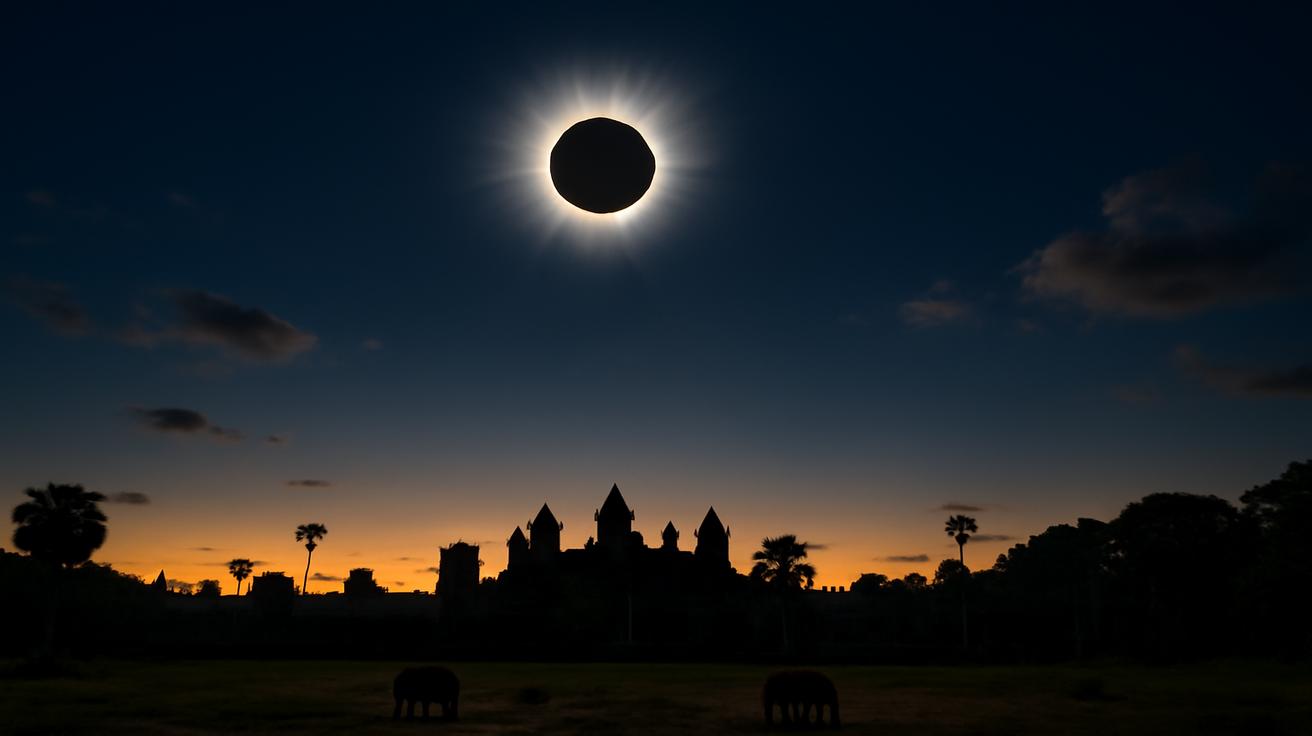
The first hint will not be darkness, but silence. Birds will cut their songs short mid-phrase. A midday breeze will falter as if the world has paused to inhale. The sun—so familiar, so constant that we barely look up to acknowledge it—will begin to fray at the edges. And across continents, from oceanside villages to glass-towered cities, millions of faces will turn skyward, wearing cardboard glasses and stunned expressions, to watch day surrender to night in the longest total solar eclipse of the century.
When the Sun Blinks
Imagine it: you’re standing in the middle of the afternoon, phone in your pocket for once, the air warm on your shoulders. Above you, the moon, that quiet white coin of the night sky, is slipping in front of the sun. At first, it feels like nothing more than a passing cloud, a slight dimming of light that your brain tries to explain away.
But this time is different. Clouds drift and soften, the light they filter turning milky and diffuse. Eclipse light, by contrast, goes sharp. Colors flatten, as though someone has turned the saturation dial down on the world. Shadows sharpen into hard outlines. Leaves throw strange double-edged silhouettes on the ground. The temperature drops—the kind of sudden, uncanny chill that raises goosebumps along your forearms.
Far above, the moon bites a clean, black notch out of the sun. Slowly, slowly, that notch grows, until the sun resembles a glowing crescent in a sky that looks wrong for the hour. You hear someone nearby whisper, It’s really happening. This is the threshold of totality, the brink of one of the most extraordinary natural spectacles the Earth and sky can produce.
The Longest Shadow of Our Century
Total solar eclipses are not rare on a cosmic scale; somewhere on Earth, one happens about every 18 months. But they are rare in human experience. Most pass over oceans or uninhabited stretches of land. And very few linger.
The coming eclipse is different. Astronomers have been talking about it for decades, marking it in charts and simulations long before most of us knew to care. This will be the longest total solar eclipse of the century, a carefully choreographed alignment of sun, moon, and Earth that grants us an unusually generous window of darkness in broad daylight.
For those standing in the center of its narrow path—known as the path of totality—the moon will fully cover the sun for several long, breathtaking minutes. Long enough to forget what day is supposed to feel like. Long enough to hear an entire landscape react. Long enough for memories to dig in deep and never let go.
Outside that path, in cities and towns where the alignment doesn’t quite line up, people will still see a partial eclipse: the sun transformed into a celestial crescent, light thinned and strange. But within that slim track etched across the planet, something closer to magic happens.
The Path Across the Planet
The total eclipse’s path is like a shadow-road painted across the globe, only about 100 to 200 kilometers wide, yet stretching thousands of kilometers in length. It begins as a whisper on the edge of the ocean, where the moon’s umbra—the darkest part of its shadow—first grazes the Earth. From there, it sweeps over islands and coastlines, inland plains and mountain ranges, cities buzzing with anticipation and remote valleys where only a handful of people may look up.
In some places, the totality will last just a couple of minutes. But in a sweet spot near the center of the path, observers will experience the longest duration of darkness—several minutes in which the sun is completely hidden, the corona blazing like a silver-white halo around the black disk of the moon.
Below is a simplified look at what observers can expect in different zones along the eclipse’s path:
| Location Zone | Eclipse Type Visible | Approx. Max Duration of Totality | What It Will Feel Like |
|---|---|---|---|
| Center of Path of Totality | Full total solar eclipse | Longest: several minutes of complete coverage | Sudden twilight at midday, stars and planets visible, dramatic temperature drop. |
| Edge of Path of Totality | Brief total eclipse (near-total coverage) | A minute or less | Rapid transition from near-daylight to eerie dusk and back again. |
| Nearby Regions (Partial Zone) | Partial solar eclipse | No totality | Sun appears as a crescent, light becomes dim and strange, but no full darkness. |
| Outside Main Eclipse Track | Very slight partial or none | Not applicable | Daylight remains normal, only professional instruments detect any change. |
Regardless of where you stand, the sky will be telling a story written in light and shadow—a narrative we share with people scattered over thousands of kilometers, all of us looking up at the same shrinking sun.
Darkness in the Middle of the Day
Totality is a peculiar kind of night. It arrives too quickly, at the wrong time, draped over familiar places: your neighborhood park, a city square, the rooftop where you’ve watched sunsets but never a simulated midnight. Streetlights that are used to following a schedule may flicker on in confusion. Automatic porch lights blink to life. Dogs bark, unsettled. Birds wheel, then disappear into trees. Crickets may begin a tentative chorus, uncertain but compelled by the fading light.
Just before the moon fully covers the sun, sunlight—now compressed into a narrow crescent—filters through mountain valleys along the moon’s edge and scatters into bright “beads” of light known as Baily’s beads. Then, suddenly, the last bead vanishes. The sky exhales. A collective gasp rises from the ground.
Where the sun once burned, there is now a void: a perfect black circle ringed by an ethereal crown of light. This is the solar corona, a million-degree halo of plasma that extends far into space but is normally washed out by the sun’s overwhelming glare. In totality, it hangs there like a ghostly wreath—threads and streamers of silver-white light reaching outward in delicate arcs, sometimes tinged with soft pink where solar prominences flare along the limb of the sun.
Around you, the horizon glows with a 360-degree twilight, as though every direction holds a distant sunset. Above, bright stars and planets emerge—a disorienting, dreamlike blend of day and night compressed into a single sky. Your body, tuned to patterns of light and dark over a lifetime, struggles to understand this sudden interruption. Many people find themselves unexpectedly emotional: eyes wet, throat tight, a laugh breaking into a sob and back again.
It is, in the truest sense, awe: the kind that humbles and expands you at once.
Science in the Shadow
To modern eyes, the eclipse is a spectacle; to scientists, it’s also an opportunity. For centuries, eclipses have helped us explore the sun, test the laws of physics, and refine our understanding of the cosmos.
In 1919, a total solar eclipse gave astronomers the chance to measure how starlight bends around the sun, offering one of the first major tests of Einstein’s general theory of relativity. The results—stars appearing slightly displaced from their usual positions—matched his predictions and changed our understanding of gravity.
Today, we have satellites constantly watching the sun, but eclipses still matter. They allow researchers to capture high-resolution observations of the corona from the ground, to study how its structure changes, and to better understand the solar wind that streams outward and shapes space weather around Earth. Amateur astronomers and citizen scientists also join in, deploying small telescopes and cameras to map temperature changes, observe wildlife behavior, and refine eclipse predictions.
Yet for most of us, science during the eclipse will look like something much simpler: putting on a pair of eclipse glasses, standing very still, and letting our attention stretch beyond daily concerns to encompass a dance of celestial bodies hundreds of thousands of kilometers away.
Preparing for the Longest Eclipse
There’s a quiet ritual forming in the weeks leading up to the event. People check maps to see whether their homes sit within the path of totality. Those who are close enough plan road trips: booking modest motels, camping in fields, arranging carpools. Others decide to settle for a partial view, content to stand in backyards and on office rooftops, sharing glasses between colleagues.
However you choose to watch, a little preparation transforms the experience from something you happen to glance at into a memory you carry for the rest of your life.
Watching Safely, Watching Deeply
The first rule of eclipses is simple and non-negotiable: never look directly at the sun without proper protection, except during the brief window of totality when the sun is fully covered. Ordinary sunglasses are not enough; you need eclipse glasses that meet established safety standards, or a handheld viewer designed for this purpose.
During the partial phases, as the moon slowly eats into the sun’s disk and again as it retreats, those glasses are your passport to the show. Only when the last sliver of sunlight disappears and totality begins can you safely remove them—and then, only if you are within the path of totality. The moment even a thin crescent of sun reemerges, the glasses must go back on.
If you don’t have access to eclipse glasses, there are indirect ways to watch. A simple pinhole projector—just a small hole in a piece of cardboard, with its image cast onto another surface—can show the sun’s changing shape safely. During deeper partial phases, even sunlight filtering through tree leaves will project dozens of tiny crescent suns onto the ground, turning sidewalks and walls into accidental art.
Beyond safety, think about presence. You might be tempted to watch the entire eclipse through your phone’s camera, but it’s a fleeting event. Photographs rarely capture the depth of your own eyes and senses. Take a few pictures, if you like, then let the device hang at your side. Listen to the world around you. Notice the temperature on your skin, the way the colors shift, the sounds of animals reacting. These are the details your future self will thank you for remembering.
What the Eclipse Reveals About Us
Long before telescopes or physics equations, eclipses were interpreted as omens, stories written in the sky. Across cultures, people imagined giant serpents or celestial wolves devouring the sun, gods warring in the heavens, the universe expressing anger or sorrow. Rituals blossomed: banging pots and drums to scare away the cosmic creatures, chanting prayers to coax the sun back from its vanishing act.
We know better now, in the sense that we understand the mechanics: the moon passes between Earth and sun, casting its shadow. The timing is predictable down to the second. There are no monsters in the sky—only a silent, graceful alignment of orbits and geometry.
And yet, when the world goes dim and the sun’s crown ignites, it’s hard not to feel that something mythic is unfolding. Children fall uncharacteristically silent. Adults who have read every scientific explanation stand there with hands pressed over their hearts. Time, for a few suspended minutes, feels thicker, more substantial.
This is the quiet gift of a total solar eclipse: it reminds us that we live on a moving world, spinning and circling through space. It reconnects us with a sky that is too often reduced to a backdrop for deadlines and notifications. For once, it’s not an app or a screen commanding our collective attention, but a shadow slipping across the sun.
In crowded parks, strangers share glasses and gasp together. On a remote hill, someone watches alone, feeling oddly less solitary than usual, knowing that along this same slender track across the globe, countless others are standing under the same sudden twilight. The eclipse draws a line across maps and, for a while, across human experience—a shared moment of wonder, stretched over oceans and time zones.
After the Shadow Passes
Totality ends not with a curtain closing, but with a piercing spark. The “diamond ring” effect—one brilliant point of sunlight leaking around the moon’s rugged limb while the corona still glows—flashes, and the spell is broken. Daylight returns with surprising speed. Colors flood back in. Birds resume their arguments. People blink, disoriented, as though waking from an unusually vivid dream.
Conversations begin at once. Did you see the stars? Did you feel how cold it got? I thought it would last longer. I can’t believe I almost didn’t come. A hundred small details are compared, assembled into a mosaic of collective memory.
And then, gradually, everyone goes home. Traffic thickens on highways leading out of eclipse country. City centers empty as office workers drift back under ordinary skies. The sun, steadfast as ever, climbs toward afternoon and then begins its normal slide toward evening.
It might be years—decades, even—before another total solar eclipse crosses your corner of the world. Some people will begin planning their next chase as soon as the last one ends, drawn to follow that wandering ribbon of darkness wherever it may fall next. Others will tuck the memory away, occasionally pulling it out like a treasured photograph in the mind.
Either way, the longest total solar eclipse of the century will have left its mark. Not on the sun, which burns on indifferent and unchanged, nor on the moon, which continues its placid orbit. But on us—on the way we remember that we are small and lucky and very much alive on a world that still has the power to surprise us.
Frequently Asked Questions
What exactly is a total solar eclipse?
A total solar eclipse happens when the moon passes directly between the Earth and the sun and completely covers the sun’s bright disk as seen from a narrow path on Earth. This allows the sun’s faint outer atmosphere, the corona, to become visible as a glowing halo around the darkened sun.
Why is this eclipse called the longest of the century?
Each total solar eclipse has a maximum possible duration of totality, which depends on the exact distances and alignments of the sun, moon, and Earth. In this case, the geometry is especially favorable, giving observers near the center of the path one of the longest stretches of totality seen in the 21st century. Other eclipses this century are either shorter or pass mostly over uninhabited areas.
Is it safe to look at the eclipse?
It is only safe to look at the sun without protection during the brief moments of totality when the sun is completely covered by the moon and only if you are within the path of totality. At all other times—including during partial phases—you must use certified eclipse glasses or a safe indirect viewing method, such as a pinhole projector.
What will I see if I’m not in the path of totality?
If you’re outside the narrow path where totality occurs, you’ll see a partial solar eclipse: the moon will take a “bite” out of the sun, turning it into a crescent. The daylight will dim and feel strange, but it will not become fully dark, and you will not see the full corona as you would during totality.
Do animals really behave differently during an eclipse?
Yes. Many animals respond primarily to changes in light. Birds often go quiet or fly to roost, nocturnal creatures may briefly stir, and domestic animals can appear unsettled or confused. These behaviors don’t harm them; they’re simply reacting to the sudden, unexpected twilight in the middle of the day.
How can I make the most of watching the eclipse?
Plan your location in advance, get proper eye protection, and arrive early so you’re not rushed. Consider keeping a simple journal of sensory details—sounds, temperature, emotions—as the eclipse unfolds. Take a few photos if you like, but spend most of totality looking with your own eyes and noticing how the world around you changes.
Will there be another eclipse like this soon?
The Earth experiences total solar eclipses regularly, but any given spot on the planet sees them rarely—often only once in many decades or even centuries. While there will be other eclipses in the coming years, this particular combination of path, visibility, and long duration will not repeat in our lifetimes. That’s part of what makes this event so special.