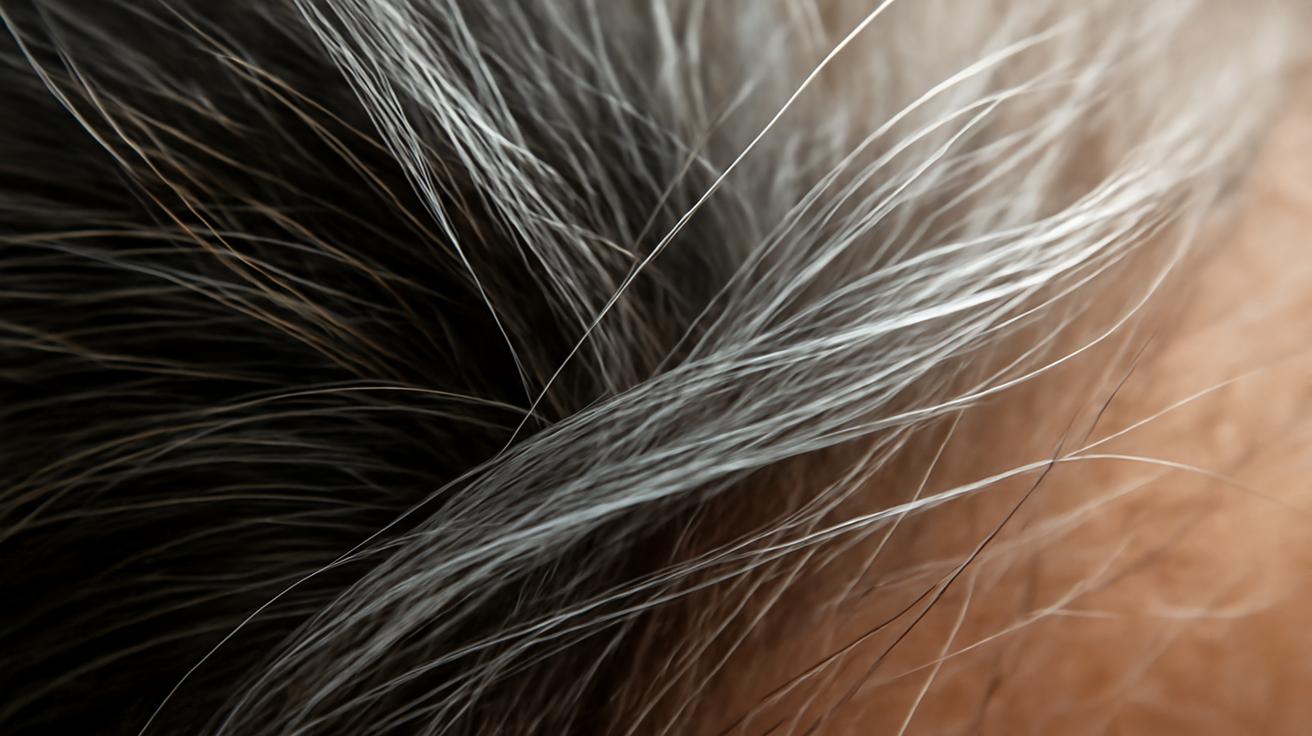
The first time you notice it, it’s almost always by accident. The bathroom light is a little too bright, the mirror a little too honest, and there it is: a single silver thread glinting among the familiar color of your hair. Maybe you pluck it out with quick, irritated fingers. Maybe you lean closer, curious. Maybe you feel that odd twinge—part vanity, part mortality—as if your body has quietly crossed an invisible threshold without asking permission.
We’ve been taught to see grey hair as a kind of slow betrayal. A sign of aging, stress, decline. Something to be hidden, dyed over, joked about. But what if that little silver filament isn’t a failure at all? What if it’s evidence of your body doing something quietly heroic—something protective?
In recent years, scientists poking around in the microscopic world of hair follicles and pigment cells have started to ask a daring question: could greying hair be a natural defense against cancer?
The secret life of a hair follicle
To understand why anyone would even ask that, you have to zoom in—way in—past the scalp, into the soft, living pocket of tissue where every hair is born. This is the hair follicle, a kind of tiny factory lodged in your skin, and like any factory, it runs on specialized workers. Among the most important workers are melanocyte stem cells, the cells responsible for creating pigment. They are the reason your hair is brown, black, blond, red, or anything in between.
These melanocyte stem cells sit in a little niche near the base of the follicle, usually quiet, almost contemplative. Then, with each new hair growth cycle, they wake up, divide, and send their pigment-making descendants into the shaft of the growing hair. That pigment—melanin—is what turns each strand into a colored fiber instead of a translucent ghost.
But these stem cells have another, darker side to their story. Like many stem cells in the body, they are potent, long-lived, and incredibly valuable, but that very power comes with risk. Cells that divide over and over again, for years, are more likely to pick up tiny errors in their DNA. Left unchecked, some of those errors can snowball into cancer.
Your body, however, is not naïve. It has evolved a library of internal safeguards, many of them ruthless. Topping that list: if a stem cell looks too damaged, the body can simply get rid of it.
The moment grey begins: a radical act of self-preservation?
Here’s where things get interesting. Several experiments in mice—especially a widely discussed study from 2018 involving DNA damage in melanocyte stem cells—found that when these pigment cells accumulate too much damage, they don’t just keep going and quietly malfunction. Instead, they bail.
Under stress, melanocyte stem cells may stop renewing themselves. Some appear to abandon their niche and migrate away. Others may self-destruct via programmed cell death, a process known as apoptosis. It’s like the factory workers realizing the assembly line is producing dangerous parts and choosing to shut the operation down rather than let something catastrophic slip through.
The result, at the scale you can actually see? Hair grows without pigment. It comes out grey. Or white. Or a salt-and-pepper mixture that tells a whole hidden story about which follicles still have healthy pigment stem cells, and which ones have sacrificed theirs.
This is the seed of a big hypothesis: maybe greying isn’t the body falling apart, but the body playing it safe. By eliminating or disabling pigment stem cells that carry too much DNA damage, your body might be reducing the chance that those cells turn into melanoma or other skin-related cancers in and around the follicle. In other words, grey hair could be a visible side effect of your built-in cancer defense system doing its job.
What the mouse experiments actually showed
In the lab, scientists exposed mice to DNA-damaging agents, like certain chemicals or radiation, and then watched what happened to their melanocyte stem cells. These cells showed signs of stress and damage, and many of them either stopped working properly or disappeared altogether. As the mice aged—or were stressed—their fur turned grey.
More intriguingly, when researchers manipulated certain genes known to protect against cancer, such as p53 (a famous tumor suppressor sometimes called the “guardian of the genome”), they noticed a pattern: stronger activation of these damage-response pathways seemed to speed up greying. When the body took DNA damage seriously and responded aggressively, pigment cells were lost faster.
This looks a lot like a trade-off. Protect the organism from cancer by sacrificing some pigment cells. The cost: grey hair. The benefit: fewer stem cells hanging around with risky DNA mutations.
Stress, fear, and turning grey overnight (almost)
Of course, there’s another cultural story braided tightly into our understanding of grey hair: the idea that a single terrible night, a season of brutal stress, or a relentless year of burnout can “turn you grey.” It has always sounded like folklore, but there’s a kernel of biology inside it.
In 2020, a striking study involving mice and acute stress found that activating the sympathetic nervous system—the same “fight-or-flight” network that speeds up your heart when you’re scared—can dramatically deplete melanocyte stem cells in hair follicles. The researchers triggered intense stress in the animals and watched the pigment reserves collapse. Afterwards, the mice’s fur grew back much whiter.
The culprit? Norepinephrine, a stress chemical that floods the body during high-alert moments. This chemical didn’t just make the mice feel wired; it pushed their pigment stem cells into an unsustainable overdrive. Those cells divided too fast, left their safe reservoir, and burned out. Once they were gone, new hairs emerged without color.
If something similar happens in humans—and there’s growing evidence that at least some forms of stress can influence greying—then grey hair might sometimes be the visible echo of internal emergency mode. Your body could be saying, “I had to spend my reserves to survive that. The pigment cells were a casualty.”
Is this always protective, or sometimes just collateral damage?
Here’s where nuance matters. Not all stress-induced greying is necessarily a neat cancer-prevention story. Some of it may be collateral damage: a messy side effect of your body reallocating resources to get you through intense danger, illness, or trauma. Melanocyte stem cells may simply be caught in the blast radius of fight-or-flight over-activation.
But the overall logic still has a protective flavor. Cells that are pushed into hyperactivity, drenched in stress signals, and dividing more often are at higher risk of DNA mistakes. If the body allows too many damaged pigment precursors to linger, the risk of cancer could climb. Whether by design or as a blunt instrument, losing them reduces that risk.
So once again, you have a trade-off: shorter-term resilience and cancer risk management versus long-term cosmetics. From an evolutionary standpoint, the choice is obvious. Genes that help you avoid deadly cancers during your reproductive years are likely to be favored, even if they mean you go grey earlier than your vanity would like.
Grey hair and cancer risk: what humans can actually tell us
It’s one thing to see these processes in mice. The next question is harder: do humans with early or rapid greying have less cancer? Or a different cancer pattern?
So far, the evidence is complicated and incomplete. A few observational studies have looked at early greying and heart disease, or greying and overall signs of aging, with mixed results. Some have suggested that early greying could be linked to higher cardiovascular risk, possibly as a marker of biological aging. Others have found no clear connection.
When it comes to cancer specifically, the picture is even murkier. There isn’t solid, large-scale evidence yet that people who go grey earlier are meaningfully protected from melanoma or other cancers. In fact, melanoma risk is more tightly linked to skin type, UV exposure, family history, and certain genetic variants than to the timing of your first silver hairs.
But absence of proof is not proof of absence. Many of the mechanisms seen in mice also exist in humans: DNA damage checks, tumor suppressor genes, stress pathways, and pigment stem cells that live for decades. The idea that the body uses greying as one of many subtle levers in cancer defense is plausible—it’s just not definitively proven in people yet.
What we do know is this: greying is strongly associated with time spent alive. And time spent alive is, by itself, one of the single biggest risk factors for cancer. Our cells accumulate mutations simply by existing. So when we look at a head of silver hair, we may be seeing, all at once, the shadow of risk and the trace of resistance.
A quick look at the science in context
| Aspect | What Happens | Possible Cancer Link |
|---|---|---|
| Melanocyte stem cells | Maintain hair color by producing pigment each growth cycle. | Long-lived, dividing cells are vulnerable to mutations that can lead to cancers like melanoma. |
| DNA damage response | Damaged cells may repair themselves, stop dividing, or self-destruct. | Aggressive responses (like cell death) remove cells before they turn cancerous. |
| Greying hair | Occurs when pigment cells are exhausted, lost, or no longer functioning. | May reflect the intentional loss of potentially risky cells, lowering local cancer risk. |
| Stress and hormones | Fight-or-flight chemicals can push pigment stem cells into burnout. | Reduces the number of vulnerable stem cells, but at the cost of faster greying. |
| Human evidence | Observational and still limited; clear causation is hard to prove. | Hypothesis remains plausible but not confirmed; more research is needed. |
Seeing grey differently: from flaw to feedback
Step out of the lab for a moment and back into the mirror. There is you, and there is that small scattering of grey at your temples, or maybe a full silver crown. Knowing what we know now, it becomes harder to see those hairs as simple cosmetic annoyances.
They are signs that your melanocyte stem cells have made a choice, or had a choice made for them. Maybe they endured years of sunlight, inflammation, metabolic stress, or sheer chronological time. Maybe your genes are wired to prioritize caution. Maybe your body hit thresholds of damage that tripped its internal alarms: better to retire these cells than risk them turning rogue.
There’s an almost tender logic in that. The same ruthless molecular decisions that can shut down pigment production may also be patrolling other tissues more quietly, cleaning up aging or damaged cells before they spiral into tumors. Greying is just the part we can see.
This framing doesn’t magically make anyone love their grey hair. But it can take the sting out of the story. Instead of, “My body is failing,” the narrative sounds more like, “My body is choosing caution. It’s signaling age, experience, and the traces of battles fought at a scale I’ll never quite see.”
Does dyeing grey hair interfere with this defense?
This is a common, anxious question: if grey hair might be protective, does covering it up with dye somehow mess with the body’s defense system? Based on current science, the answer is reassuring.
Hair dye mostly interacts with the dead, keratinized shaft of your hair, not the living stem cells buried deeper in the follicle. It changes the appearance of what has already grown out, not the internal logic of how pigment cells respond to DNA damage. The decision to self-destruct or retire happens long before the hair emerges from the scalp and meets a bottle of color.
That said, certain harsh chemical exposures and chronic scalp irritation are not ideal for skin health in general. But there’s no good evidence that coloring already-grey hair reverses, blocks, or “confuses” whatever protective pathways led those cells to stop making pigment in the first place. The internal choice has already been made; you’re just repainting the evidence.
Where the science goes from here
The idea that grey hair is a defense against cancer sits at a fascinating crossroads between evolutionary biology, dermatology, and aging research. To really test it, scientists will need years of careful human studies: tracking when and how people grey, analyzing their genetic variants, measuring their DNA damage responses, and mapping that against their lifetime cancer risk.
They’ll also need to disentangle a jungle of confounding factors: sun exposure, smoking, diet, ethnicity, chronic diseases, socioeconomic stress. Hair color changes are one tiny window into a massive, interconnected system.
Meanwhile, the story continues to grow richer. Some recent work suggests that, under certain conditions, small portions of greying can even reverse—particularly when stress is reduced or metabolic health improves. If that bears out in larger studies, it could mean the body’s pigment system is not a one-way road to depletion, but a more flexible, dynamic sensor of overall cellular well-being.
Imagine a future in which a detailed map of your hair’s pigment pattern, combined with molecular analysis, becomes another tool for assessing biological age or cancer risk. Not because grey is inherently dangerous, but because the way you grey—fast or slow, patchy or uniform, early or late—may hold a fingerprint of how your stem cells handle damage and repair.
Until then, we’re left with a hypothesis and a poetic possibility: that the silver slowly threading through your hair is not just time catching up with you, but time revealing the work your body has quietly done to keep you alive.
Living with the story your hair is telling
On a practical level, grey hair changes nothing and everything. You can still shade it, celebrate it, cut it close, or grow it wild. You can still resent it or embrace it, or swing between both in the span of a week. Appearance is personal, and there is no morally superior way to wear your age.
But knowing that those threads of silver might be connected—however indirectly—to deep protective decisions at the cellular level can change how you feel when you catch sight of them in a shop window or see them in an old photograph. They stop being mere markers of loss and become stories of survival.
We live in bodies that are negotiating with entropy every second. DNA breaks, proteins misfold, cells slip toward senescence. Cancer is the name we give to one set of negotiations that goes catastrophically wrong. But most of the time, on most days, our cells choose better. They repair, they pause, or they step aside.
Grey hair may be one of the few places where you can actually see that choosing written on the surface. A visible truce between risk and restraint. A reminder that biology often cares more about protection than perfection.
So the next time your fingers find a silver strand, you might still sigh, still twist it thoughtfully, maybe still reach for the dye. But somewhere beneath that instinctive reaction, you might also feel a quieter note: this is what it looks like when my body decides that being alive matters more than staying the same.
FAQ
Does having grey hair mean I’m less likely to get cancer?
Not necessarily. While some lab studies suggest that losing pigment cells may reduce the chance of certain cancers in and around hair follicles, there is no clear proof that people with grey hair have a lower overall cancer risk. Cancer risk is influenced by many factors, including genetics, lifestyle, environment, and age.
Can stress really make my hair turn grey faster?
Intense stress can accelerate greying in animals, and there is growing evidence it can influence greying in humans too. Stress chemicals can push pigment stem cells into overactivity and burnout. However, everyday stress is only one part of a much bigger picture that includes genetics and natural aging.
Is grey hair always permanent, or can it reverse?
Most greying is permanent, especially age-related greying. However, some small studies and case reports suggest that certain hairs can re-pigment when stress or illness improves. This seems to be the exception rather than the rule, and the mechanisms are still being studied.
Does dyeing my grey hair increase my cancer risk?
Modern hair dyes are regulated and generally considered safe when used as directed, though some ingredients can irritate the skin. Current evidence does not show a strong link between personal hair dye use and most cancers in the general population. If you have concerns, especially a history of skin sensitivity or allergies, talk with a dermatologist.
Why do some people go grey very early?
Early greying is often genetic. If your parents or grandparents went grey young, you may, too. Certain health conditions, nutrient deficiencies, or autoimmune processes can also accelerate greying, but in many people it’s simply inherited variation in how quickly pigment stem cells are lost or exhausted.
Is there anything I can do to prevent or slow down greying?
You can’t fully stop genetically programmed greying, but maintaining overall health may help your cells cope better with damage. Not smoking, protecting your skin from excessive sun, managing chronic stress, sleeping well, and eating a nutrient-rich diet support general cellular health. Still, even with perfect habits, most people will eventually go grey—it’s a normal part of being human.
Could future treatments stop or reverse grey hair safely?
Researchers are exploring ways to protect or restore pigment stem cells, but any treatment would need to be extremely careful not to increase cancer risk by keeping damaged cells alive. It’s possible that, someday, targeted therapies could safely tweak these pathways, but for now, the safest and most reliable options remain cosmetic: haircuts, colors, and the stories you choose to tell about your silver.