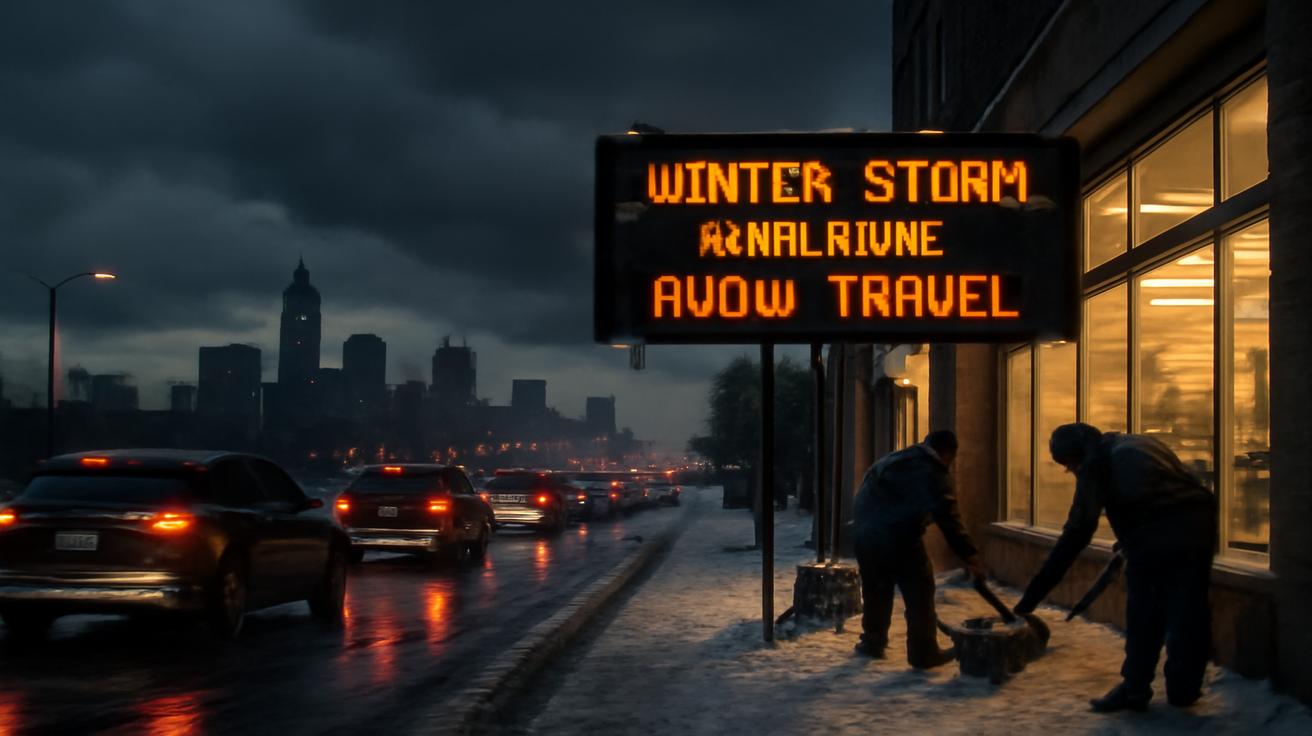
The first snowflake touches down on the windshield like a polite knock on a closed door. By the time you notice the second, the third, the tenth, it’s no longer a quiet arrival but a full conversation with the sky—a soft white insistence that tonight is not like other nights. The radio mutters about “historic totals” and “dangerous conditions,” the wiper blades carve brief tunnels through the growing blur, and somewhere between the grocery store parking lot and your driveway, you realize the storm isn’t just weather. It’s a decision point—for you, for the city, for every business with a glowing “Open” sign and every exhausted official pleading through microphones for people to please, just stay home.
When the Sky Turns into a Plan
It began like these things usually do—with a forecast that sounded almost routine. A chance of flurries by late afternoon. Light accumulation possible. Maybe a slick evening commute. The kind of language that barely ruffles anyone in a place where winter has a long memory and a thick file of previous storms.
But as the day went on, the numbers started to creep upward. Two inches became four. Four became eight. By lunchtime, the meteorologists on local TV leaned closer to their maps, voices a little more deliberate, as if they were choosing each word with care. “Heavy snow is expected to begin tonight,” they said, “with rates of one to two inches per hour possible at peak intensity.”
Behind those sterile phrases lived a very human scramble. City planners shuffled schedules. Road crews tried to get ahead of the storm, sending plows to trace familiar routes before the first bands arrived. Emergency managers refreshed their coffee and their contingency plans. On social media, the same message appeared again and again, from police departments, fire agencies, and transportation officials: If you don’t absolutely need to drive tonight, please stay home.
Still, on the other side of town, beneath fluorescent lights and corporate logos, phones were ringing for a different reason. Could the morning shift still come in? Would deliveries go out as scheduled? Could clients be reassured that, yes, normal operations would continue? Employees scrolled through emails and push notifications, caught between two instructions that felt like opposing weather systems: stay home, and keep everything running.
The Sound of a City Bracing
By late afternoon, that first shy flurry had grown bolder. Snow fell in visible curtains, slanting under streetlights, turning familiar intersections into softened, cinematic versions of themselves. The temperature slid down a couple of crucial degrees, sealing in the promise that what fell would stick.
In a quiet house at the end of a cul-de-sac, a teenager pressed her forehead to the window, watching the flakes thicken, mentally calculating the odds of a snow day. Across town, a nurse in navy scrubs packed an overnight bag—extra clothes, phone charger, protein bars—ready for the possibility that she might have to sleep at the hospital if the roads turned treacherous. A rideshare driver, phone buzzing insistently with new requests, checked the radar on his screen, tracing the blue-green mass crawling closer, debating whether this next trip was worth the risk.
Snow has a way of pulling us into the present. The usual city soundtrack—honking horns, distant sirens, clipped footsteps—slows under it. By early evening, the ambient noise was already changing. Tires whispered instead of growled. Footsteps pressed deep, then vanished, filled in by the next gust of flakes. Somewhere downtown, the last delivery truck of the evening rumbled away from a loading dock as a manager watched the taillights disappear into the white wash and wondered whether they’d be able to open on time in the morning.
At the transportation department’s operations center, giant wall screens glowed with live camera feeds from highways and major intersections. The view from each camera showed the same quiet transformation: asphalt turning first gray, then mottled, then white. Dispatchers traded updates with plow drivers over radios, voices calm but tight. Timing, in a storm like this, would matter more than anything. Start treatment too late and the snow would compact into ice under the weight of early evening traffic. Start too early and chemicals washed away by the first pass might leave roads unprotected at the peak of the storm.
Between Caution and Commerce
Inside a glass-front café near the financial district, the owner stood behind the counter, watching the snowfall intensify. She’d already fielded a half-dozen texts from staff: Are we still open tomorrow? She understood the tone behind the words—the mix of concern for safety and fear of lost wages. Closing meant protecting people from risky travel, but it also meant shrinking margins, rent still due, inventories paid for but not sold.
Across industries, the same tension hummed under fluorescent lights and on Zoom calls. Local officials urged: “Non-essential travel should be avoided.” Business owners heard: “Your customers may not come.” Some corporate offices sent employees home with laptops and the now-familiar line: Work remotely where possible. Others, bound to physical spaces and in-person services, weighed the math of staying open against the moral weight of asking people to cross slick roads and low-visibility highways.
At a logistics warehouse on the edge of town, a supervisor walked the aisles between stacked pallets, eyeing the outgoing orders scheduled for dawn pickup. Chains already clinked around the tires of some trucks in the lot. “Weather doesn’t stop deadlines,” one driver muttered, pulling on thick gloves. Yet the longer they talked, the more it became clear: the deadlines were abstract, the snow was not.
On the public side of the equation, the message stayed firm. Press conferences aired from city halls and emergency operations centers. Microphones captured the language of experience: “We’ve seen what happens when people underestimate storms like this.” Behind those statements lived the memory of pileups and stranded motorists, of ambulances delayed not by distance but by frozen hills and jackknifed trucks.
The Numbers Behind the Flakes
Storms like these are not just poetic spectacles; they are logistical puzzles measured in inches, plow routes, staffing rosters, and overtime budgets. Meteorologists broke the night into bands and hourly totals. Road crews mapped neighborhoods into loops and corridors of priority.
As the radar images updated every few minutes, a loose choreography emerged between nature and infrastructure. Would the heaviest snow bands arrive before or after the last evening commute? Could businesses delay opening by just a few hours and give plow teams the breathing room they needed? Would that single adjustment be the difference between manageable disruption and gridlocked chaos?
On the surface, two forces seemed to be at odds: public safety officials asking everyone to stay put and business interests pushing for continuity. But deep down, they were both responding to the same data—just from different angles. For the city, the focus was on reducing the number of cars on the road, on lowering the probability of collisions and stranded drivers. For businesses, the question was how to meet obligations without tipping people into those very risks.
| Perspective | Primary Concern | Typical Actions During Heavy Snow |
|---|---|---|
| Public Safety Officials | Reducing accidents and emergency calls | Issue travel advisories, coordinate plows, prepare emergency shelters |
| Businesses | Maintaining operations and revenue | Adjust hours, enable remote work, negotiate deliveries |
| Workers | Balancing safety and income | Request flexibility, carpool, prepare for potential overnight stays |
| Drivers & Commuters | Personal safety and obligations | Delay trips, stock vehicles, monitor road reports |
Look closely at those overlapping circles of concern and you see not a simple conflict, but a negotiation that plays out storm after storm: How do we keep people safe and keep life moving?
The Road at Eye Level
By early nightfall, the abstract question turned painfully concrete for anyone still behind the wheel. Headlights tunneled through dense, swirling flakes. Road markings disappeared under powder and slush, leaving drivers to guess the middle of the lane by habit and hope. Taillights ahead glowed like red smudges, closer and farther than they appeared.
The sound of driving in heavy snow is its own language—tires hissing over packed powder, the muffled crunch when you roll over a ridge left by a plow, the soft clunk of anti-lock brakes catching themselves. Every intersection requires new calculation. How long will it take to stop? Where’s the hidden ice? Is that glint a bare patch of asphalt or a slick of black ice waiting for the first confident brake tap?
On the shoulder of a long curve outside town, a sedan sat at an awkward angle, hazard lights blinking weakly against the dark. A tow truck inched toward it, chains rattling against its tires, the driver speaking into a two-way radio about delays and road conditions. Somewhere beyond that curve, a miles-long freight train rumbled on, indifferent to the weather, while power lines along the roadside collected their own thin crowns of snow.
Back in the city, bus drivers peered through windows fringed with frost, making judgment calls at each stop. Was it safe to pull closer to that curb buried under a ridge of plowed snow? Could the tires find enough traction to climb the subtle hill beyond the next light? Passengers, bundled and quiet, watched the slow-motion theater outside, each flake lit briefly in the yellow glow of the streetlamps.
Inside the Quiet Bubble of Home
For those who heeded the advice to stay home, the storm felt different. Instead of white-knuckling a steering wheel, they wrapped fingers around mugs of tea or hot chocolate. Instead of watching taillights blur ahead, they watched their own front yards transform into a new landscape—steps softening into mounds, car roofs disappearing under a white swell.
There is a peculiar intimacy in staying put during a storm while knowing that elsewhere, the world is still grinding on. From living room windows, people spotted the lone delivery van trudging up a side street, the last-minute grocery run, the plow sweeping past in orange and white. They texted photos to friends across town: “Look at this already!” “Can you believe it’s only been an hour?” “Stay safe if you have to go out.”
Inside, time seemed to stretch. Children, sensing the electricity in the air, stayed up later than usual, listening for updates about school closures. Adults did their own calculating, fingers on calendars: What meetings could be moved? What clients would understand a delay? What could truly be done from a laptop at a kitchen table while the world outside muffled under the weight of falling snow?
Yet even in the safety of a warm home, the storm’s gravity pressed in. Flickers in the lights hinted at power lines straining under ice. The distant whine of a siren reminded everyone that not all work could pause and not every trip could be postponed.
The People Who Can’t Stay Home
In the middle of the night, when the snowfall reached its fiercest tempo, the quiet streets were not entirely empty. Nurses changed shifts at hospitals that never close. Utility crews stood by to respond to downed wires and dark neighborhoods. Overnight clerks in 24-hour pharmacies restocked shelves while the storm pressed its face against the big glass windows.
For them, the official urging to “stay home” wasn’t an option but a wish they made for others. Every empty mile of road they saw meant fewer headlights to dodge, fewer potential crashes to respond to, fewer people spinning out and needing rescue. Safety, in this view, becomes a shared resource. If those who can stay home do, they clear space—literal and figurative—for those who must be out.
On a county plow route that curved through both suburbs and farmland, a veteran driver leaned forward over his steering wheel, eyes working hard to distinguish road from shoulder. He knew this route intimately in summer and autumn—the place where the pavement cracked, the spot where deer crossed at dusk, the bend near the creek that always iced first. But snow changed the script every time, rewriting the road’s edges and risks.
Inside his cab, the radio crackled: reports of heavier bands moving in, of accidents a few towns over, of another plow driver taking a brief break to knock the ice off his wiper blades. He thought of his own family at home, probably asleep, probably listening faintly to the wind press against the windows. The urge for everyone to stay home wasn’t abstract to him. Every nonessential car on the road tonight meant another variable in an equation he was trying very hard to solve.
Tomorrow’s Measure of the Storm
By dawn, the storm’s voice softened. The rate of snowfall slowed; the radar colors faded from deep blue to pale, like a bruise healing. Overnight, the city had been redrawn. Cars along residential streets looked like rounded loaves of bread. Sidewalks had vanished completely. Tree branches bowed under the new weight, some flexing back, others snapping and leaving raw, exposed wood.
This is the hour when the tally begins. How many inches, officially? How many calls for help? How many power outages, how many businesses delayed or closed entirely? At the same time, plows made their last passes on main arteries, pushing dirty ridges of snow to the edges, while side streets waited their turn in quieter cul-de-sacs.
Phones began their morning buzz: messages from employers, from schools, from city alerts systems. Some businesses announced, with a tone that tried to sound both apologetic and responsible, that they’d open late or remain closed for the day. Others declared, with a kind of rugged pride, that they were operating as usual. For workers, each notice carried its own weight. “Closed” might mean lost income, but also relief. “Open as normal” might mean a paycheck, but also anxiety, maps, and weather apps pulled up before breakfast.
In the background of all these decisions, the storm itself said nothing. It had already done its work. The rest was up to the people trying to knit their individual needs into a communal fabric that didn’t tear under pressure.
Learning the Language of Storms
Heavy snowstorms like this one leave more than drifts and plowed piles in their wake. They leave a series of questions echoing long after the last flake falls. Did we listen to the warnings in time? Did we protect the people who couldn’t stay home? Could we have balanced safety and continuity in a way that felt less like a tug-of-war and more like a shared agreement?
In the modern world, where much of our work travels invisibly through cables and fiber optics, storms are increasingly tests of flexibility as much as endurance. A company that can send half its workers home with laptops and still serve customers without putting everyone on the road might weather the next storm with less strain. A city that adjusts its travel advisories with hour-by-hour precision—urging delay rather than blanket defiance of movement—might keep just enough cars off the road to prevent the next chain-reaction crash.
And for individuals, learning to read the language of storms becomes its own quiet skill. Knowing when a forecast has shifted from “inconvenient” to “dangerous,” understanding that the difference between four inches and twelve isn’t just height on a ruler but visibility, traction, and the capacity of every plow driver and paramedic in the area.
Tonight’s heavy snow may be remembered in inches, in dramatic photos, in those shared stories about getting stuck or almost stuck. But it can also be remembered in the stories that never happened—the accident that didn’t occur because someone chose to cancel dinner plans, the overworked nurse who got to rest an extra hour because a business decided to wait until roads were clear before opening, the plow route that took half the usual time because side streets were mercifully quiet.
When the next forecast rolls in, with its measured language and shifting totals, those quiet decisions will matter again. The authorities may once more urge drivers to stay home. Some businesses will again push to keep the lights on and the orders flowing. Between those two poles lies the place where community actually lives: in the conversations, the compromises, and the shared understanding that sometimes, respecting the weather is the most productive thing any of us can do.
FAQ
Why do authorities urge drivers to stay home during heavy snow?
Authorities know that heavy snow reduces visibility, hides ice, and overwhelms road crews, especially during peak hours. Asking people to stay home lowers traffic volume, which in turn reduces accidents, frees emergency services to respond more quickly, and gives plows and salt trucks space to work effectively.
Are businesses wrong to try to keep normal operations running?
Not necessarily. Many businesses depend on daily revenue to survive and may feel pressure to remain open. The key is how they manage that pressure—offering remote work where possible, adjusting hours, and allowing employees to use judgment about travel can balance economic needs with safety.
What should I consider before deciding to drive in a heavy snowstorm?
Check updated forecasts and road conditions, evaluate whether your trip is truly essential, and consider your vehicle’s readiness—tires, fuel level, emergency kit. Ask yourself whether the risk to you and others is justified, or whether the trip can be delayed until conditions improve.
How can businesses prepare for storms without putting staff at risk?
They can develop clear weather policies, invest in remote-work tools, stagger shifts to avoid the worst hours of a storm, and communicate early about potential changes. Encouraging honest dialogue about commuting challenges helps employees make safer choices.
What role do individual choices play during major snow events?
Individual choices scale up quickly. Every person who chooses to stay off the road when travel isn’t essential reduces congestion and accident risk. That, in turn, helps emergency responders, utility crews, healthcare workers, and plow drivers do their jobs more safely and efficiently.