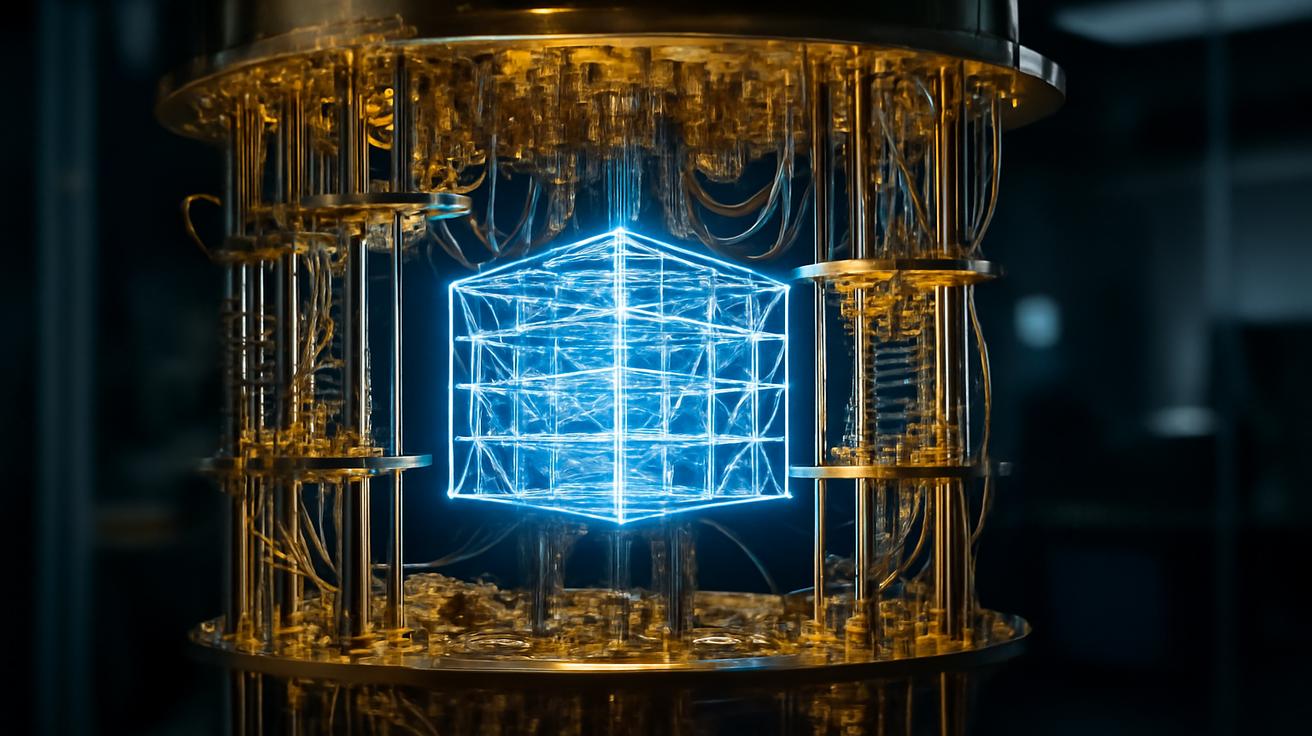
The lab is quieter than you would expect on the day a world record falls. No countdown clocks. No confetti. Just the faint whir of cryogenic coolers and the soft clicking of keyboards as a small group of physicists huddle in front of a screen, watching a wobbling line of data that could be mistaken for static to anyone else. Then a number stabilizes. Someone exhales a laugh that sounds almost like disbelief. One millisecond. In the quantum world, where information can vanish in the blink of a cosmic eye, this is not just another datapoint. It’s a stretch of time long enough to feel almost luxurious, like holding your breath under water and suddenly realizing your lungs are stronger than you thought.
The Moment the Qubit Stopped Rushing
Imagine trying to write a sentence on a page that evaporates as you press the pen down. That’s what working with qubits—the building blocks of quantum computers—has felt like for decades. They’re delicate, jittery things, easily scrambled by the tiniest nudge from the outside world: a stray photon, a vibration from the hallway, a whisper of heat.
So when a U.S. research team announces they’ve coaxed a qubit into holding its quantum state for a full millisecond, it doesn’t sound like much in everyday time. A blink takes about 100 milliseconds. A camera flash might fire in 10 milliseconds. But in the realm of quantum computing, where operations happen at gigahertz speeds, a millisecond is an eternity—a playground large enough to run useful algorithms, correct errors, and still have time left to spare.
In that lab, the celebration isn’t thunderous. It’s almost reverent. Because they all know what this means: the United States has not only set a world record; it has shoved open a door that, until now, seemed permanently wedged shut by physics and noise.
A Qubit Is Not Just a Tiny Bit
To understand why this record matters, you have to feel, at least for a moment, what a qubit really is. Strip away the jargon, and a qubit is a system that lives between worlds. Unlike a classical bit that is either 0 or 1, a qubit hovers in a shimmering superposition—a blend of 0 and 1 at the same time, like a coin caught eternally in mid-spin.
But this coin is shy. The instant you look too closely, superposition collapses. This collapse is tied to “decoherence,” the process by which a qubit’s fragile quantum state falls apart under the relentless pressure of its environment. The coherence time—the length of time it stays in its quantum state—is the qubit’s very life expectancy as useful information.
For years, that life has been brutally short. Nanoseconds. Microseconds. You could manipulate a qubit, but only at a frantic pace, layering operations like an overcaffeinated juggler tossing knives faster and faster because gravity is winning. Algorithms that looked beautiful on paper fell apart in practice because the qubits simply didn’t stay coherent long enough to finish their work.
This is why that one millisecond, that single shimmering slice of time, is so important. It’s not just about going from a fraction of a heartbeat to something barely perceptible. It’s about changing the entire rhythm of what’s possible.
When a Millisecond Feels Like a Meadow
Think of coherence time as the size of your workspace. If it’s too small, you’re cramped, knocking your elbows on the walls, rushing every move. You can’t build anything intricate; you can barely stack blocks before they topple. But give yourself a bit more room—stretch the walls outward—and suddenly the same hands can weave, carve, and compose.
That’s what this U.S. milestone has done. One millisecond of coherence transforms a narrow, panicked hallway of operations into a small but real meadow. Not infinite. Not effortless. But open enough to try new things: more complex quantum gates, deeper error correction cycles, experimental algorithms that once seemed purely theoretical.
The physicists talk about this in abstract numbers, but you can hear the emotion beneath the equations. This is years of trial and error, of cooling systems down to near absolute zero, of redesigning chips and rewiring control electronics because a handful of extra microseconds in coherence time once felt like a miracle. And now—now they’ve crossed into the millisecond range.
| Era | Typical Qubit Coherence | What Could Be Done |
|---|---|---|
| Early experiments | Nanoseconds (10⁻⁹ s) | Proving qubits exist at all |
| First quantum processors | Microseconds (10⁻⁶ s) | Simple algorithms, fragile demos |
| Current leading devices | Tens to hundreds of microseconds | More gates, noisy intermediate-scale quantum (NISQ) era |
| New U.S. record | ~1 millisecond (10⁻³ s) | Room for error correction and useful depth |
The Art of Keeping Quantum Still
If coherence is life, then decoherence is the slow, invisible erosion that kills it. The researchers who achieved this feat haven’t discovered a magical pause button. They’ve become artists of stillness, carving away sources of noise the way a sculptor chips at stone to reveal the figure inside.
The qubit they used is not floating in empty space. It’s etched into a chip, tangled in a jungle of microwires and control electronics, cooled down to temperatures colder than deep space so that thermal vibrations don’t jostle it out of its quantum state. But cooling alone isn’t enough. The team has to purify its environment—cleaner materials so fewer stray atoms act like tiny saboteurs, smoother metal surfaces so fewer microscopic defects lurk in the background, more precise control pulses so that every “poke” of the qubit is a caress, not a shove.
They deploy elaborate shielding to block out stray electromagnetic waves. They redesign the architecture so neighboring qubits might whisper instead of shout at each other. And perhaps most importantly, they refine the mathematics guiding their control sequences, shaping microwave pulses that nudge the qubit’s delicate state instead of hammering it.
None of this is glamorous. It’s painstaking work in the margins—finding the invisible drafts in a house built at the edge of reality and sealing them one by one.
Quantum Patience in a Culture of Speed
There’s an irony in this triumph of stillness happening in a country so obsessed with speed. The United States has raced to showcase faster supercomputers, denser chips, more powerful AI models. But quantum coherence is a different kind of race. Here, winning isn’t about going faster; it’s about lasting longer. It’s about waiting.
The researchers who pushed their qubit to one millisecond did it not by slamming down the accelerator but by asking: How gentle can we be? How quiet can this room become? How carefully can we listen to what the qubit is telling us when it falters?
In a way, this milestone is a lesson in patience. The algorithms that may one day simulate new drugs, optimize vast logistics networks, or crack problems in materials science are not powered just by raw brilliance. They’re powered by an ability to hold a quantum whisper steady long enough for it to speak.
What a Millisecond Unlocks
So what can you do with a millisecond of quantum coherence? To grasp this, picture a conductor standing before an orchestra that can only play together for a few seconds before their instruments fall out of tune. You could still manage a melody, perhaps, but nothing symphonic. That’s where many quantum processors have lived until now.
Extend that harmony to a millisecond, and suddenly the score lengthens. You can layer more “notes”—more quantum gates, more entangling operations between qubits, more loops of error correction that ensure the music doesn’t disintegrate mid-performance.
This doesn’t mean the next iPhone will have a quantum chip next year, or that your passwords will evaporate overnight. But it does mean the field is crossing a psychological and practical threshold. A millisecond isn’t just a technical trophy; it’s a signal that error-corrected quantum computing—a regime where we can tame noise well enough to run long, reliable computations—might be closer than it looked even a few years ago.
From Record to Real-World Impact
Consider a few of the areas that stand to benefit if coherence times keep stretching:
- Materials and chemistry: Longer coherence lets quantum simulators more accurately model complex molecules and exotic materials, potentially leading to better batteries, more efficient fertilizers, or new superconductors.
- Optimization problems: Supply chains, traffic flows, and financial portfolios may one day be tuned with quantum algorithms that explore enormous solution spaces in ways classical systems struggle to match.
- Fundamental physics: High-fidelity, long-lived qubits are not just tools; they’re also probes, letting us test subtle questions about quantum theory itself.
Each of these dreams has been written about for years, sometimes overhyped, sometimes prematurely declared imminent. The difference now is that the underlying hardware is beginning to grow the stamina those dreams require. A millisecond does not complete the journey, but it widens the trail.
The Global Race, Reframed
In the geopolitical theater, quantum computing is often framed as a contest: the U.S. versus other nations, a scramble for advantage in cybersecurity, defense, and economic leverage. There is truth in that framing; funding announcements and national strategies make it clear that governments see quantum technologies as strategic assets.
But look more closely at the lab where this record was set and you see something more nuanced. Collaborations crisscross borders—researchers carry ideas from European universities, Asian institutes, and American tech companies. They publish their work so others can test it, challenge it, improve it. The world record belongs to the United States, yes, but also to a global web of knowledge that made it possible.
Still, milestones like a one-millisecond qubit do more than win headlines. They attract talent and investment. They reassure policymakers that their bets on quantum research are paying off. They encourage private companies to move from cautious pilots to more ambitious projects, knowing the hardware is catching up to the hype.
Beyond Bragging Rights
In a world increasingly defined by invisible infrastructure—cloud servers, undersea cables, satellite swarms—quantum computing represents a different kind of power: the power to ask harder questions. A millisecond of coherence does not by itself crack encryption or redraw economic maps, but it thickens the air with possibility.
It suggests a future where having access to robust quantum hardware might be as fundamental as having a fiber-optic network today. And it underscores the importance of not just building bigger clusters of classical machines but nurturing the slow, careful craft of coherence—of making quantum states last long enough to matter.
The Human Side of a Quantum Second
Step away from the equations and you’re left with people. Graduate students who have spent nights in the lab babysitting dilution refrigerators. Engineers who have stared down oscilloscope traces until the tiny wiggles began to look like handwriting. Senior scientists who remember when even the notion of a controllable qubit was controversial.
For them, this millisecond is not just data; it’s a memory: the moment a graph on a monitor stopped plummeting and flattened out, the lab suddenly thick with the knowledge that something historic had just happened. Someone likely took a blurry photo of the screen, even though the real record is etched in log files and preprint drafts.
There will be more records. Someone, somewhere, is already working on surpassing this one—chasing ten milliseconds, a hundred, a second. But there is something singular about the first time a barrier you’ve been pressing against finally cracks. Like a climber reaching a new ledge, you look back for a moment at the cliff below, then turn your eyes up again.
That is where the U.S. quantum effort stands now: on a narrow ledge that felt impossibly high not long ago, catching its breath, feeling the wind, realizing the wall continues on above—but also that it can be climbed.
Frequently Asked Questions
What exactly is qubit coherence time?
Qubit coherence time is the length of time a qubit maintains its quantum state (superposition and entanglement) before interactions with the environment cause it to lose that state. Longer coherence times allow more quantum operations to be performed reliably.
Why is a one-millisecond coherence time such a big deal?
In quantum computing, operations happen extremely quickly, but qubits have historically lost their quantum properties in microseconds or less. Reaching about one millisecond dramatically expands the number of operations and error-correction cycles that can occur before the qubit decoheres, making more complex and useful computations feasible.
Does this mean practical quantum computers are here now?
Not yet. A millisecond of coherence is a crucial milestone, but practical, large-scale quantum computers also need many high-quality qubits, efficient error correction, and robust control systems. This result marks strong progress toward that goal rather than its completion.
Will this affect everyday technology soon?
In the short term, most people will not notice direct changes. The impact will first be felt in specialized areas such as research, cryptography, materials science, and industrial optimization. Over time, advances rooted in quantum computing may filter down into everyday technologies.
Is the United States leading the quantum computing race?
The United States is a major leader, with strong contributions from universities, national labs, and private companies. However, Europe, China, Canada, and other regions are also investing heavily and achieving their own milestones. The field is both competitive and highly collaborative across borders.