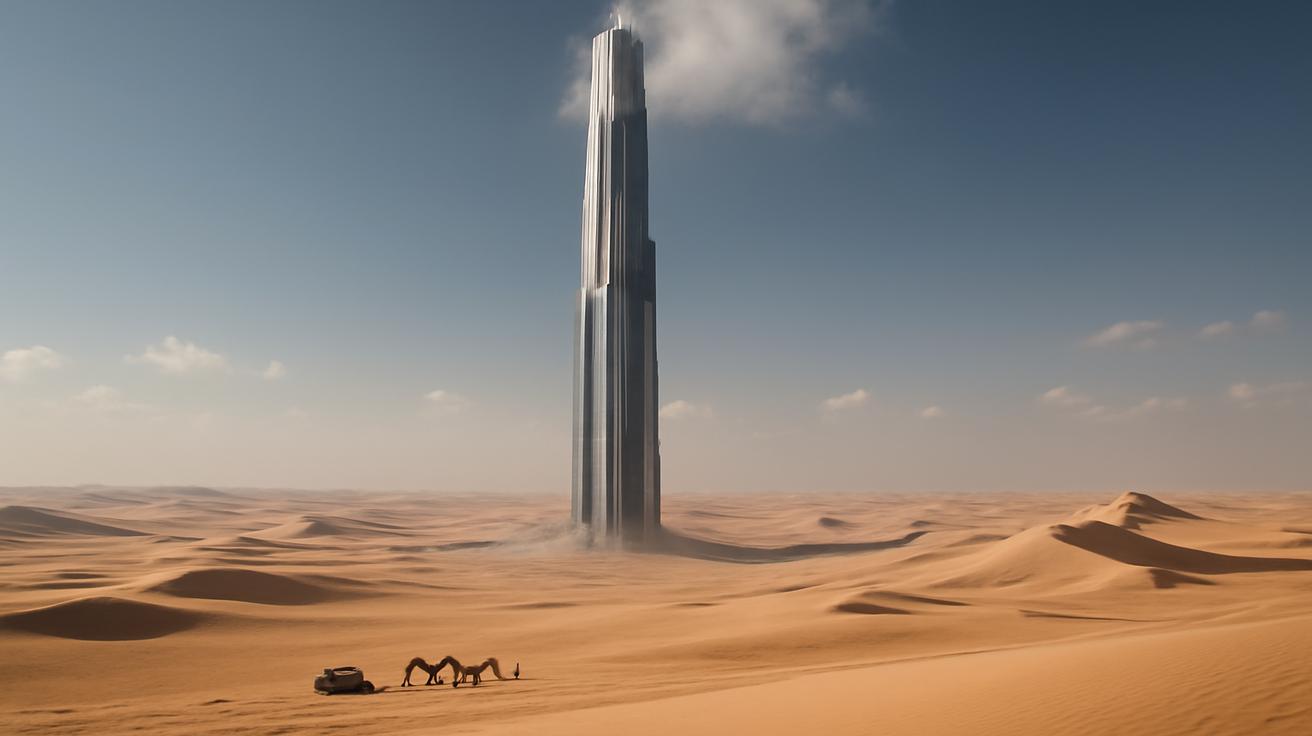
The dust arrives first. It drifts over the highway in tired curls, softening the sharp line where asphalt gives up and desert begins again. The sun hangs low and swollen, bleaching color from the sky until everything is some version of gold, or bone, or rust. Up ahead, through the shimmer of heat, something interrupts the horizon—a thin, metallic punctuation mark rising out of the sand. You squint. It looks unreal, like a glitch in a video game or a misplaced graphic in an architecture magazine. A one-kilometer needle of glass and steel, stabbed into a landscape that has survived everything except our certainty that we can improve on it.
A Monument to “Because We Can”
If you listen to the marketing videos, the tower is a promise. The future, they say, will live up there, above the dust and the traffic and the inconvenience of actual ground. Up there are sky gardens and cloud pools, restaurants balanced in the upper atmosphere, observation decks where people will gather to watch the sunset as if they own it. The word “iconic” appears every few seconds. “Visionary” too. And of course, “sustainable.”
We are told this 1 km tower in the desert is progress. Evidence of ambition. A landmark of human ingenuity. It’s the architectural equivalent of shouting into the void: “Look what we can do!”
But the longer you sit with the idea—the more you imagine its shadow dragging across the dunes, the more you picture the air conditioners working like frantic lungs just to keep the polished lobbies cold—the more it starts to feel less like a triumph and more like a farewell letter to common sense.
It’s not that humans shouldn’t build tall. We always have. From cathedral spires to mountain-top monasteries to the high-rise apartment where someone is right now microwaving leftovers and scrolling through their phone on the 42nd floor. Verticality isn’t the villain. The problem is what we’re willing to ignore to make this particular monument happen, and where we’re choosing to put it.
The Desert Was Never Empty
Stand in the desert long enough, and the word “empty” begins to feel like an insult. The air is alive with the smallest movements: a beetle dragging its glossy body between grains of sand, a lizard making invisible zigzags from shade to shade. Heat warps the horizon into a trembling ocean of glass. Nothing here is accidental. Every living thing is a tight equation of risk and efficiency, honed by centuries of scarcity.
The silence is not actually silence. It’s a low, vast hush—a kind of breathing. If you listen closely, you can hear the scrape of wind along the dunes, the brief rattle of dry shrubs, the far-off cough of an engine on the highway. Even the light has texture: harsh at noon, tender and pink in the last half hour before dark, like the world exhaling.
Into this slow, deliberate place, we now propose to drop a one-kilometer spear of climate-controlled opulence. A tower with elevators racing 10 meters a second, refrigerated glass, desalinated water pumped and filtered and pushed upward through pipes as if gravity is just a rumor. Nothing about it belongs here; everything about it will be forced to.
To understand what that means, you have to remember that the desert is not blank land waiting for a purpose. It’s not a screensaver for bored drones and real estate investors. People have lived in these landscapes for millennia, following the logic of the land, not trying to overwrite it. Nomadic routes tracked water, wind, and shade. Settlements grew where underground aquifers held out. Architecture responded to sun and sand with thick walls, small windows, courtyards, and clever alignments that welcomed wind and rejected noon.
Now, instead of listening to that accumulated wisdom, we’re drawing a straight line upward and saying: here, at the top of this glass spear, is where civilization happens. The land below becomes scenery; the sky above, a brand asset.
When the Air-Conditioner Becomes a Life Support Machine
In theory, we can make almost any idea survivable. We can pipe cold into hot places, hoist water into dry ones, tune glass so it rejects sunlight while still showing off a skyline. But there’s a difference between survival and sense.
Imagine the tower on a day in August. Temperatures outside flirt with 48°C. The sun is a white disk in a sky that refuses to turn blue. Inside, the building hums with the low, steady roar of climate control—tens of thousands of square meters of air kept at 22°C. Office workers sip iced coffee, twenty-somethings take mirrored elevator selfies on their way to a rooftop bar, and someone on the 150th floor is deciding whether the view is better on the east or west side of the restaurant.
Outside, the air is too bright to look directly at for long. Inside, it feels like an airport terminal that never ends. Once you step through those tinted doors, your life is pinned to the building’s ability to out-muscle the climate: power for cooling, power for pumps, power for lights, for fresh water, for elevators that must not fail.
Sooner or later, that kind of building stops being a structure and turns into an organism. It needs to eat—electricity, resources, maintenance crews, imported materials. It needs to drink—vast quantities of water for people, plants, and cooling systems. It needs constant, hidden care. The desert doesn’t ask for any of this. But the building does, and it will never stop.
Progress, According to a Spreadsheet
It’s tempting to believe we’ve thought it all through. Planners present numbers in cool, reassuring fonts. Diagrams promise high efficiency. Phrases like “district cooling,” “greywater recycling,” and “optimized energy envelope” are deployed like amulets against doubt.
On paper, the tower is economical. Impressive even. One tall building can house more people or companies per square meter of land than sprawling suburbs. We’re told density is good: fewer cars, more shared systems, less land used up by low-rise boxes and parking lots. All true—sometimes. But here, in the open mouth of a desert, the equation changes.
| Factor | 1km Desert Tower | Climate-Smart Low/Mid-Rise |
|---|---|---|
| Heat Management | Massive reliance on mechanical cooling, reflective glass, sealed interiors | Shading, courtyards, natural ventilation, cooler materials, smaller exposure |
| Water Demand | High, concentrated, vertically pumped; dependent on energy-intensive desalination | Distributed use, more scope for local harvesting, reuse, and landscape buffering |
| Resilience | Single point of failure; power or system disruptions affect thousands at once | Modular; failures are localized, easier to adapt or repair |
| Ecological Fit | Imposed on landscape; microclimate disruption; visual and light pollution | Can follow contours, wind, and shade; less intrusive silhouette |
| Symbolic Message | Spectacle, status, technological bravado | Livability, adaptation, cooperation with climate |
On a spreadsheet, the tower earns its keep through rent, luxury brands, tourism, and prestige. In the real world, it earns its fragility. It concentrates risk in a single, shining point. If a sandstorm shutters the highway or a heatwave strains the grid, the whole vertical city feels it at once. This is not so much a community as a wager: we bet that our machines will not fail us.
And when we call this “progress,” we reveal something deep about what we value. Not cooler streets for workers. Not robust local agriculture. Not public transit that runs even in brutal temperatures. Instead, we value a shape in the sky—something we can photograph from an airplane window and caption with the word “future.”
The Seduction of the Unreasonable
A 1km desert tower pulls at people’s imaginations for the same reason a tightrope across a canyon does: it’s unnecessary, and therefore irresistible. “Why?” is the wrong question; the real question is “Can we?” Once we prove that we can, we call it advancement. But not every demonstration of power moves us forward.
Think of the world we’ve already built. In many cities, sewage systems leak and creak under outdated pipes. Coastal neighborhoods watch high tides inch closer each year. Farmers measure droughts not in months but in seasons. In this context, is the highest and shiniest building really a step ahead—or is it a kind of denial, like buying a sports car as the forest burns on the other side of town?
The seduction is aesthetic and psychological. There is a thrill in outrageous scale. The renderings glimmer; the sunsets are always perfect. No one in the promotional videos is ever stuck in traffic or worrying about rent. No one is sweeping dust from a balcony on the 12th floor, wondering how the 160th looks today. These images are not depictions of daily life so much as fantasies of escape—from heat, from crowds, from the mess and compromise of ordinary cities.
But real progress doesn’t look like escape. It looks like staying, and making things better. It looks like shade structures and bus routes and boring but crucial insulation upgrades. It looks like planting trees in the right places and listening to the people who already know how to build for this climate because their ancestors had to.
The Shadow on the Ground
Walk around the base of a super-tall tower and you feel, more than see, the distortion it creates. Wind does strange things around its edges, curling and accelerating. The scale dwarfs people until they blur into the pavement. Turn your back to the structure and the sunlight feels different, patched and interrupted.
In the desert, shadows are precious. A single scraggly tree can be the difference between tolerable and impossible. A rock ledge can harbor a little pocket of coolness where seeds germinate or insects rest. The shade of a one-kilometer tower isn’t gentle like that. It’s a bruising, blunt instrument dragging across the landscape as the day turns, erasing and recreating pools of light and dark on a planetary scale.
Within that shadow, the ground will change. Temperatures and wind patterns will shift. Birds navigating by sightlines will have a new obstacle; nocturnal animals will encounter yet another zone of light pollution and human noise. Every night, the tower will glow like a vertical city of fireflies, throwing back the starfield in a bright denial of darkness.
We rarely talk about this when we talk about progress—the way our grand gestures make tiny, relentless edits to the lives of everything else around us. To the beetle beneath the dune, to the lizard, to the seed waiting for a rare, perfect set of conditions to crack open. To the people living in modest homes farther out, who now know that the skyline belongs to someone else’s dream.
What Could We Build Instead?
It’s not enough to say “this is absurd” without imagining alternatives. If the money, steel, engineering hours, and political energy earmarked for a single desert megatower were redirected, what could they become?
You could blanket entire districts in shaded walkways and solar canopies, softening the heat for pedestrians while harvesting power. You could retrofit thousands of existing buildings with better insulation, reflective roofs, and efficient cooling systems that cut emissions and energy bills at the same time. You could build mid-rise, human-scaled neighborhoods designed around public transit, with ground floors that belong to markets and clinics and schools, not just lobby marble and security desks.
You could restore and protect the fragile desert ecosystems at the city’s edge so that they continue to act as buffers and teachers, reminding us that this is not just “available land” but a living system with its own logic. You could invest in water recycling at the neighborhood scale, in rooftop gardens shrouded by light screens instead of floor 180 fountains that lose half their water to evaporation before it even reaches the glass barrier.
None of that will win a competition for “world’s tallest.” None of it will drape a city in instant prestige. But all of it would be the sort of quiet, accumulative progress that actually stands a chance of being useful fifty years from now, when the climate will be hotter, the water dearer, and the demands on our grids and infrastructures even heavier.
A Farewell Letter to Common Sense
So why call a one-kilometer tower in the desert a farewell letter to common sense? Because it is a statement that, in the face of every warning we have—about climate, about resources, about inequality—we still choose spectacle over sanity.
Common sense says: work with your environment, not against it. The tower says: the environment is a backdrop for our brilliance.
Common sense says: don’t anchor your daily life to systems that must not fail in a world where systems do, routinely, fail. The tower says: failure is not an option, because we paid too much for the view.
Common sense says: invest in the many, not the few; in durable comfort, not precarious luxury. The tower says: if you’re not invited to the upper floors, that’s a problem for you, not for progress.
In that way, the building becomes more than a project. It’s a story we’re telling about ourselves—a story in which we believe our cleverness can always outrun the consequences of our appetites. It’s the same story that underwrites private jets in a burning world, oceanside golf courses in drought-stricken regions, and air-conditioned stadiums in climates where simple outdoor shade once did the job.
There’s a strange, almost tender irony in it: this vast, fragile totem to human power, utterly dependent on an uninterrupted flow of energy and cool air. The higher it climbs, the more tightly it’s leashed to the infrastructure below. That is not freedom. It’s a high-altitude tether.
Relearning What Impressive Means
As evening comes, the desert starts to feel almost kind. The heat lifts, replaced by a hesitant cool that moves across the ground in waves. The tower, if it exists, glows now—a vertical constellation of office floors, hotel suites, and observation decks. Cars snake toward it along the highway, headlights blinking like insects drawn to a distant flame.
From far enough away, it’s beautiful. Human beings are very good at building things that look beautiful from far away. Up close, the service corridors and loading docks and trash chutes tell another story—one of constant effort just to keep the illusion spinning. The desert hums on, mostly indifferent.
Maybe real progress, in a time like ours, would be learning to be impressed by different things. By a city that gets cooler as it grows because of the way it’s planned. By neighborhoods where elders can walk to everything they need under continuous shade. By buildings that stay habitable when the power fails because they are designed to breathe, not to suffocate without machines.
Building like that doesn’t produce a single, breathtaking photo. It produces millions of small, unphotogenic moments of ease: someone waiting for a bus in deep, cool shade; a child playing on a street that does not radiate stored heat at 11 p.m.; a farmer using treated greywater to keep a patch of green alive at the city’s edge.
Those are humble images. They don’t trend. But they’re the opposite of a farewell letter to common sense. They’re an invitation—to stay, to adapt, and to belong to a place instead of conquering it from a great and gleaming height.
Someday, people might stand in the desert and look toward the horizon and see not a single arrow of glass, but a low, shimmering tapestry of structures tuned to the sun and the wind, half-shadowed courtyards, modest towers rising just high enough to see the line where sand meets sky. The landmark won’t be a number—800, 900, 1000 meters—but a feeling: that we finally remembered the difference between what is possible, and what is wise.
Frequently Asked Questions
Why is a 1km tower in the desert considered problematic?
Because it demands enormous, continuous resources—energy, water, maintenance—to function in an extreme climate, while offering mostly symbolic benefits like prestige and spectacle. It concentrates risk, ignores local ecological logic, and diverts attention and investment from more resilient, human-scaled solutions.
Isn’t vertical density better for the environment than sprawl?
Density can reduce land use and transportation emissions, but in a harsh desert climate, a super-tall glass tower becomes an energy-intensive machine that must fight heat and dryness 24/7. Mid-rise, climate-responsive buildings often offer a better balance between density, comfort, and resource use.
Can advanced technology make such towers sustainable?
Technology can mitigate some impacts, but it can’t erase the fundamental mismatch between an ultra-tall, sealed tower and an extreme desert environment. Highly complex systems are also vulnerable: when something goes wrong, the consequences affect many people at once.
What would a more sensible form of progress look like in the desert?
It would emphasize climate-adapted architecture (thick walls, shading, courtyards), distributed mid-rise buildings, shaded public spaces, efficient public transit, local water recycling, and protection of surrounding ecosystems. Progress would be measured in comfort, resilience, and equity—not in meters of height.
Are tall buildings always a bad idea?
No. Tall buildings can make sense in certain climates and contexts, especially when integrated into a broader plan for sustainable transport and infrastructure. The critique here is specific: placing an ultra-tall, resource-hungry tower in a fragile desert and calling it “the future” ignores both common sense and the realities of a warming world.