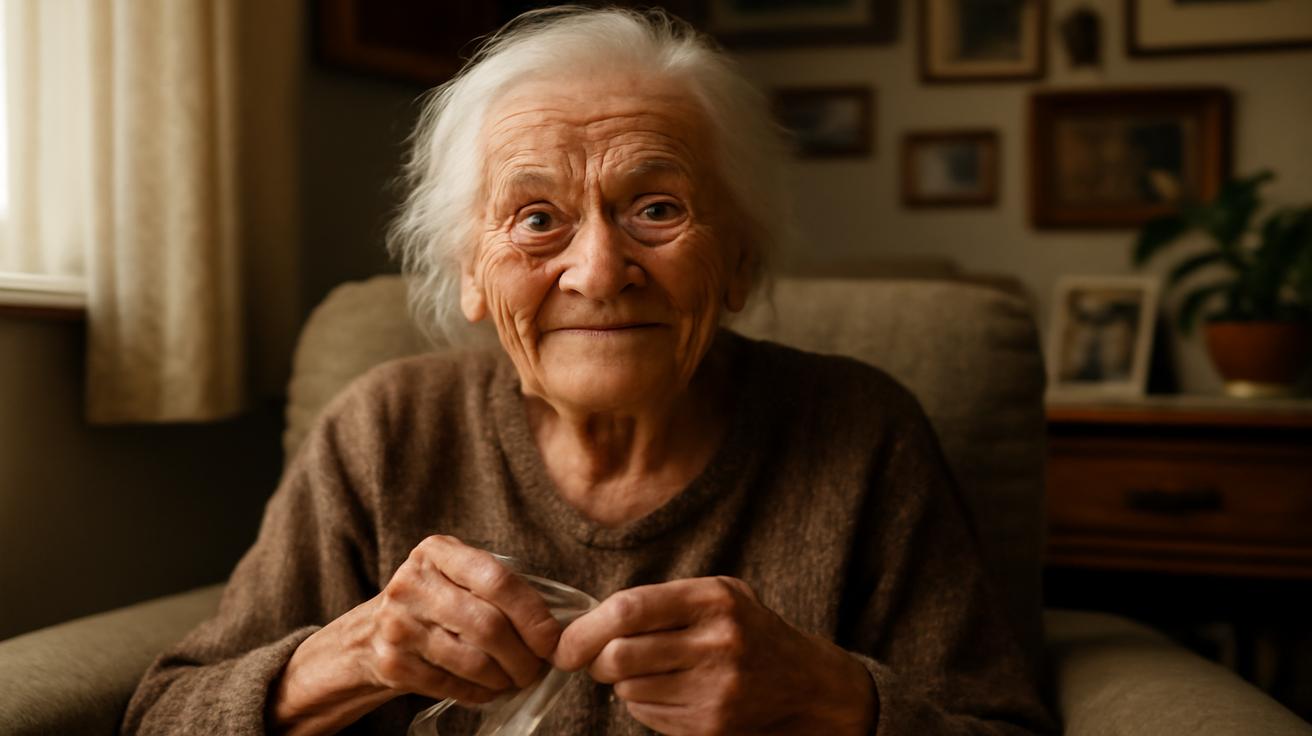
The first thing you notice about Edith is the way she walks: not quickly, not powerfully, but with a sort of deliberate grace, as if each step is a small vote in favor of staying alive. The second thing you notice is that she will absolutely out‑stare you if you try to carry her shopping. “I’ve carried my own bag for a hundred years,” she tells me, clutching a canvas tote stuffed with carrots, oats, and a single bar of dark chocolate. “I’m not about to stop now and end up in care.”
The morning ritual that keeps her out of the armchair
Edith lives in a snug, sunlit bungalow at the edge of a small village, the kind where the road narrows into hedgerows and the bus comes when it feels like it. Her birthday card from the King is pinned crookedly to the mantelpiece, half-hidden behind an old photograph of her as a young woman perched on a bicycle. The house smells faintly of beeswax, tea, and the lavender oil she dabs on her wrists at night “for good dreams.”
“People imagine a very dramatic secret,” she says, watching the kettle steam. “Some special berry from the Himalayas, or a gene the rest of you don’t have.” She smiles, deepening the fan of wrinkles at the corners of her eyes. “They’re always disappointed when I tell them my habits are as boring as porridge.”
Her day begins at 6:30 a.m., without an alarm. “If I need a machine to drag me out of bed, I’ve gone wrong somewhere,” she says. She sits on the edge of the mattress—firm, no pillows piled high—placing both feet flat on the floor. Before standing, she wiggles her toes, rolls her ankles, flexes her knees. It looks almost like she’s listening to her body, asking, “Are we good to go?”
In the kitchen, the ritual continues. She fills a jug with cold water from the tap and leaves it on the counter to warm slightly. “Ice-cold water shocks my stomach,” she explains. She drinks a glass slowly, standing at the window, watching the light creep over her small back garden. No phone, no news, no radio. “The day needs to say hello to you before the world shouts at you,” she says.
Breakfast is nearly always the same: oats cooked slowly on the stove, not in the microwave. “Things that take time to cook are usually kinder to you,” she murmurs. Into the pot go chopped apple, a small handful of walnuts, a sprinkling of cinnamon, and a spoonful of plain yogurt on top once it’s in the bowl. Sugar is for guests. She has a pot of tea—real leaves in a strainer, strong enough “to stand a spoon in,” but always with a splash of milk. She eats at the table, not on the sofa, always sitting upright. “I refuse to start the day slumped,” she says. “Chairs can swallow you whole if you’re not paying attention.”
While the tea cools, she stands at the counter, gently stretching her arms up toward the ceiling, then out to each side. “Reaching for what you want is a habit,” she says, fingers trembling slightly in the air. “If you don’t do it with your body, you’ll forget how to do it with your life.”
The quiet discipline of moving on purpose
By 8:00 a.m., Edith is already in her walking shoes. They are light, well-worn, laced with careful double knots. She takes a walking stick “for company, not for leaning,” and steps out into the lane, closing the door with a firm click that sounds like a promise.
“I’ve watched people my age stop moving,” she says, walking steadily along the verge, the stick ticking lightly on the tarmac. “They sit down ‘for a bit of a rest’ and twenty years later they’re still there, with someone putting their socks on for them.” She shakes her head. “That’s my nightmare. I refuse to end up in care. So I walk.”
Her route is almost always the same: past the old schoolhouse, down to the brook, up the gentle hill where the hedges break just enough to offer a sliver of valley view. She pauses there, every day, to look at the fields. Not to catch her breath, she insists, though a faint flush colors her cheeks.
“Being outside reminds me I’m part of something still moving,” she says. She points out small things with the delight of a child: the tight fists of hawthorn buds, the sudden scuttle of a field mouse, the clean, metallic smell that rides on the wind before rain. “If you stop noticing, you start disappearing,” she adds.
She doesn’t track her steps, doesn’t own a smartwatch. “I tried one,” she admits. “It kept telling me to stand up while I was already making soup. Bossy little thing.” Instead, she trusts her body and the simple test she’s used for decades: “If I can walk to the brook, up the hill, and back without stopping in the middle to mutter ‘oh dear,’ I’m doing all right.”
Back home, she doesn’t collapse into a chair. She puts the kettle on again, wipes down the kitchen counter, and does ten slow sit-to-stands from her dining chair. “I saw it on the television once,” she says. “They said it keeps your legs strong. Legs are your license to live in your own house. Take care of them.”
| Daily Habit | What Edith Actually Does | Why She Says It Matters |
|---|---|---|
| Morning Start | Wakes at 6:30, drinks water, slow breakfast at table | “The day must not rush you out of bed.” |
| Movement | Daily walk to the brook and hill, chair exercises | “Strong legs mean I stay in my own home.” |
| Food | Simple cooked meals, mostly plants, small portions | “I leave the table a little bit wanting.” |
| Social Life | Daily chats, letters, invites, saying “yes” often | “Loneliness stiffens the soul before the joints.” |
| Mind & Sleep | Crosswords, reading, strict bedtime, no screens | “A rested brain makes fewer silly decisions.” |
The fierce gentleness of eating to live
Lunch in Edith’s house is a quiet, methodical affair. There is no stack of plastic containers in the fridge, no diet books on the counter. Just a chopping board, a small sharp knife, and a rhythm she’s repeated for years.
“I grew up in rationing,” she says, slicing a carrot into neat coins. The sound of blade against wood is steady, unhurried. “You learned quickly that food is fuel, not entertainment. If you ate all the sugar on Monday, there was none left for Friday. The body is the same.”
Her plate is a seasonal collage: boiled potatoes dressed in a glisten of olive oil and parsley, steamed greens still bright and crisp, half a fillet of fish or a small piece of chicken. If there’s bread, it’s dense and brown. If there’s dessert, it’s fruit. She eats slowly, pausing between bites. “I like to arrive at the end of the meal, not crash into it,” she says.
There are rules, but they’re framed as kindness, not punishment. Edith does not eat standing up. “It confuses your body,” she insists. She rarely snacks. “If I’m hungry between meals, I ask myself: am I bored, or actually hungry?” she says. “Most of the time, it’s boredom.” When it is hunger, she has a handful of nuts, a slice of cheese, an apple. “Not a feast.”
Once a week, usually Saturdays, she makes her single concession to her sweet tooth: a small square of dark chocolate with her afternoon tea. “I put it on a saucer, I sit down, and I pay attention to it,” she explains. “If you’re going to have a treat, marry it, don’t speed-date it.”
Her relationship with alcohol is similarly restrained. “I like a little sherry at Christmas, at other people’s houses,” she says. “At home, I don’t miss it.” She looks genuinely puzzled when I ask if she’s ever been drunk. “Why would I want my legs and my tongue not to cooperate?”
There are no banned foods, no scrolling through lists of “good” and “bad” ingredients. What she practices instead is something older, simpler: portion wisdom and quiet satisfaction.
“I always leave the table a little bit wanting,” she says, patting her stomach lightly. “Not hungry, just aware there’s space left. It keeps me light on my feet. People think fullness is comfort, but it just makes you sleepy. Sleep belongs to the night, not the afternoon.”
The art of refusing loneliness
In the early afternoon, the doorbell begins its soft punctuation of Edith’s day. The postman with a parcel. A neighbor returning a borrowed dish. A teenager fundraising for the local football club. To each, she gives her full attention, as if they are chapters in the same endlessly interesting book.
“People say they don’t want to bother the old,” she tells me, settling into the chair by the window—the one concession she makes to comfort, with its worn floral cushions and knitted throw. “But being bothered keeps you alive.”
On the small table beside her chair is a neat stack of envelopes, a ballpoint pen, and a pair of reading glasses. Most afternoons, she writes at least one letter. Sometimes it’s to an old friend in another county, sometimes to a grandchild at university, sometimes to the woman who runs the village bakery. The letters are short, unremarkable—details about the weather, the blackbird that keeps stealing her cherries, the way the moon looked “like a chipped plate” last night. But they are threads, and she tends them carefully.
“Loneliness,” she says quietly, “stiffens the soul before it stiffens the joints. If I let the days pass without spoken words, I’d be in a home by now, wilted in a chair. I refuse that. So I say yes.”
She says yes to the village hall coffee mornings, though she doesn’t drink the instant coffee (“I bring my own in a flask”). She says yes when the neighbor’s little girl invites her to a toy tea party. She says yes to sitting on a picnic blanket in the park, even if getting up again is a minor drama. She says yes to the doctor’s suggestion of a seniors’ exercise class, then laughs with wicked delight when she realizes she is the only one who doesn’t need help with the floor exercises.
“Connection is not an app,” she tells me. “It’s eye contact, it’s someone knowing how you take your tea, it’s being missed if you don’t show up.”
Of course, there are quiet days. On those, she talks to the radio. “I argue with it, mostly,” she says. She hums along to old songs. She sings “Happy Birthday” to people on the local station who’ve sent their ages in. “They like a chorus,” she insists. Sometimes she sits in the garden and simply listens: the buzz of bees, the scratch of a robin in the dry leaves, the faint hum of distant traffic like a seashell held to the ear.
“Being alone and being lonely are different countries,” she says. “I visit one, but I refuse to emigrate to the other.”
The quiet rebellion against fear and fuss
One of the most striking things about Edith is how little time she spends worrying about the future. Not because she assumes it will all be fine, but because she has made peace with the fact that it might not be—and that fussing won’t change much.
“People talk to me in whispers about ‘going into care,’” she says, her voice sharpening slightly on the last word. “As if it’s something that happens overnight, like being struck by lightning. It’s not. It’s often a long series of small surrenders.”
She counts them off on her fingers: the day you stop cooking because “it’s too much bother,” the day you stop walking anywhere that doesn’t feel strictly necessary, the day you stop inviting people over because the house is “not tidy enough,” the day you stop learning how to use that new washing machine or the remote control because “someone else can do it for me.”
“Care begins,” she says, “when you decide life is something that happens to you, instead of something you are still making.”
Her rebellion is quiet but relentless. She insists on doing her own laundry, even if the basket looks comically small. She still washes dishes by hand. “I like knowing where everything is, and that it’s clean because I cleaned it,” she says. She makes her own doctor’s appointments. She keeps a simple notebook with phone numbers and important dates, written in her clear, looping script.
When she fell in the garden three years ago—“my fault, I was trying to out-weed a thistle”—the paramedics suggested a care assessment. She thanked them, then politely refused. “I said, ‘Give me six weeks and a good physio, and if I’m still crawling, we’ll talk.’”
For six weeks, she did the exercises, cursing under her breath, sometimes crying in private. She accepted help carrying heavy shopping, but not with dressing or washing. “The day someone has to put my cardigan on for me is the day I’ll know it’s time to reconsider,” she says. “Until then, I button my own life.”
This does not mean she pretends she is invincible. Her walking stick is evidence of that. So is the medical alert pendant she wears, tucked discreetly under her blouse. “It’s not denial,” she says. “It’s partnership. I work with my age, not against it, but I don’t hand over the reins unless I must.”
She has a clear, calmly written plan with her family about what happens if she can no longer live alone. She doesn’t hide from it. “But I live today as if that day is not inevitable,” she says firmly. “Because it isn’t for everyone. And the more I do for myself now, the later that day comes, if it comes at all.”
The small, stubborn rituals that add up to a century
As the afternoon leans into evening, Edith’s house changes tempo. The light slants across the hallway, catching dust motes that hang like tiny planets. The radio switches from chatty presenters to softer music. She moves a little slower, but the pattern of her habits holds steady.
Before dinner, she does a quick tidy of the day: cup in the sink, letters stacked, throw folded on the sofa. “I don’t leave chaos for the morning,” she says. “Waking up to yesterday’s mess makes you feel older than any birthday.”
Dinner is lighter than lunch: soup made on Sundays and stretched over a few days, or an omelette with mushrooms and herbs from the small pots on her windowsill. Always vegetables, always color. She sets the table, even if it’s just for herself. Plate, cutlery, glass, napkin. “I am company,” she says simply. “I deserve a laid table.”
After washing up, she allows herself her true luxury: reading. Stacks of books line the low shelf in her sitting room—novels, nature writing, a collection of poems with a cracked spine. She rarely reads about “healthy aging.” “I’m already doing it,” she laughs. “Why would I want homework on being myself?”
Instead, she escapes into other lives, other landscapes. As she reads, the room fills with smells: the faint sweetness of the lavender oil she’s dabbed on the lampshade, the reassuring starch of clean curtains, the ghost of onion and thyme from earlier cooking. Outside, an owl begins its low, questioning call.
By 9:30 p.m., she is preparing for bed. No screens; she doesn’t own a television in her bedroom, and her mobile phone is an old flip model that lives downstairs. “Nothing important arrives after nine,” she says. “If it’s truly urgent, they can knock on my door.”
She washes her face with warm water and simple soap, applies a thin layer of cold cream the way her mother taught her, and brushes her hair one hundred times. “Not because it does anything magical,” she says, “but because it gives me time to think kindly about the day.”
In bed by ten, she lies flat, hands resting on her stomach, taking three slow breaths. “I thank my body for today and promise it I’ll try not to be foolish tomorrow,” she says. “Then I let it sleep.”
Before she switches off the lamp, she turns to me with a look that is part challenge, part invitation. “None of this is glamorous,” she says. “It’s just refusing to drift. Drifting is how you end up where you never meant to go—into care, into loneliness, into a life where everyone else makes the decisions.”
Outside, the village is settling: last cars pulling into driveways, dogs called in, one final clatter of dishes from a neighbor’s kitchen. Inside, Edith arranges her pillows, smooths the sheet, and closes her eyes on her hundredth year with the same quiet insistence she’s carried through every other: that as long as she can choose, she will choose to live, not simply be kept.
Frequently Asked Questions
What are the main daily habits that support Edith’s long life?
Her habits are simple but consistent: waking early without an alarm, drinking water first thing, eating plain and mostly home-cooked food, walking outside every day, doing basic strength movements like chair sit-to-stands, staying socially connected, and keeping a regular sleep schedule without screens at night.
Does she follow any specific diet or restrictive eating plan?
No. She doesn’t label her way of eating. She focuses on cooked, simple meals, plenty of vegetables, modest portions, very little sugar, and almost no alcohol. She allows herself small pleasures—like a square of dark chocolate once a week—but enjoys them slowly and mindfully.
How does she avoid ending up in a care home?
Her strategy is to keep as much independence as possible for as long as possible. That means maintaining leg strength through walking and simple exercises, managing her own household tasks, staying mentally and socially active, and only accepting help where it truly protects her safety, not where it simply offers convenience.
What role does social life play in her longevity?
A huge one. She deliberately avoids loneliness by writing letters, attending local events, inviting and accepting invitations, chatting with neighbors, and even talking back to the radio. She believes feeling “known and missed” is as vital as food and exercise.
Can younger people adopt her habits, or are they only for older adults?
Most of her habits can be started at any age: walking daily, eating simply, keeping regular sleep hours, nurturing friendships, and doing small acts of self-care and tidiness. She often says that the earlier you start these “boring” habits, the more natural they feel when you’re older—and the longer you can stay in charge of your own life.