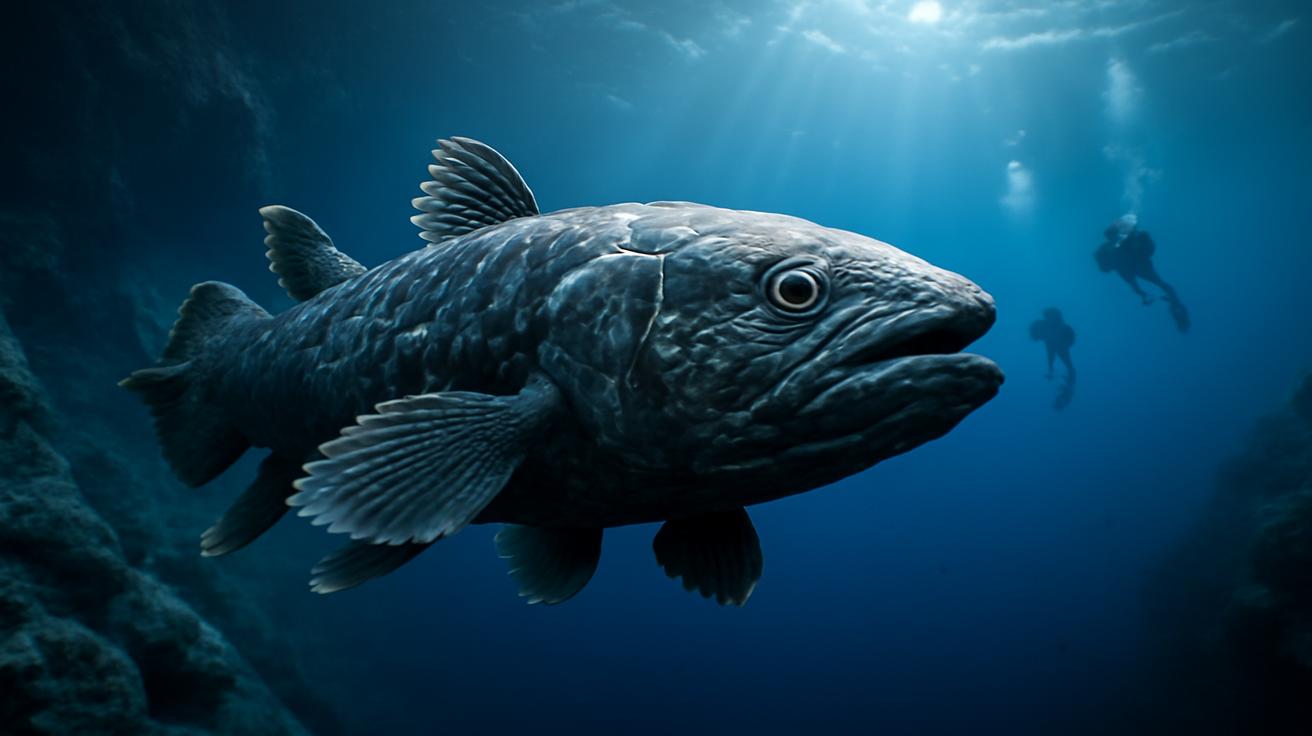
The first thing they saw were the eyes—two unblinking silver marbles floating in the beam of a dive light, far deeper than most visitors to Indonesia’s tropical waters ever dare to go. The creature hovered vertically, head down, its blue-silver scales glinting like old coins at the bottom of a well. For a long second, no one remembered to breathe. Then someone’s regulator hissed, a camera shutter clicked, and a moment millions of years in the making was captured by human eyes and lenses for the very first time in this part of the world.
What the French divers had found was not just a rare fish. It was a time traveler—a living fossil that had slipped almost unchanged through the ages while entire mountain ranges rose and crumbled above it. And there, in the midnight-blue waters of Indonesia, far from its famous African haunts, it floated in the glow of their lamps like a ghost from another Earth.
The Slow-Fin Drifter from Deep Time
Imagine a fish that remembers, in its bones and blood, a world before birds, before flowers, before the continents settled into anything like the shapes we know. That is what scientists mean when they call this animal a “living fossil.” The term is imperfect, but the feeling it inspires is not: you look at this fish, and you are not seeing evolution’s latest innovation. You’re seeing one of its earliest drafts, stubbornly still in circulation.
The coelacanth—let’s finally name it—belongs to a lineage that swam Earth’s oceans at least 400 million years ago. For most of modern science, coelacanths were believed to have vanished alongside the dinosaurs, their story ending in the fading light of the Cretaceous. Then, in 1938, a trawler off South Africa hauled up something so bizarre, so unmistakably archaic, that the young museum curator who received it could only think: this shouldn’t exist.
Yet it did—and still does. Its thick, lobed fins resemble the stumpy legs of some half-curious, half-committed fish that’s just starting to wonder about land. Its scales are not the sleek, flexible armor of modern reef fish but heavy, cosmoid plates, more like stone than skin. Its movements are slow, deliberate, almost mathematical, as if every gesture had been calculated over ages rather than milliseconds.
Most famously, coelacanths were first thought to be restricted to the deep canyons off the African coast, and later around parts of Madagascar and the Comoros Islands. Then another species turned up in the waters off Sulawesi, Indonesia—an evolutionary cousin hiding in the labyrinth of the Indo-Pacific. But to see one alive there, in the inky layers far below the colorful coral postcards—this was something else entirely.
The Night Descent
The French team had come to Indonesia for many of the same reasons most divers do: warm seas, coral walls buzzing with life, and the promise of adventure you can feel on your skin as the boat rocks over clear depths. But these were not casual vacation divers. Among them were deep specialists, technical divers used to the unnerving silence of decompression stops and the claustrophobic comfort of redundant air systems and mixed gases.
They had heard rumors. A strange fish taken in a deep net. A shadow on a sonar scan that moved against the current. Whispers from local fishers, handed down like ghost stories: a blue fish from the bottom, with eyes like stones and fins that moved like hands.
On the evening of their dive, the sea was a dull sheet of pewter beneath a sinking sun. The surface wind dropped as if someone had turned down the volume on the world. Gear clinked softly as they suited up: rebreathers checked, lights tested, redundant systems cross-checked. They weren’t heading for the familiar 20 or 30 meters where reef scenes play out in tropical technicolor. Their target lay deeper than the range of most tourists—dark water, heavy and compressing, where colors drain away and time stretches between breaths.
The descent was a slow fall through layers of fading light. At first, the water was a turquoise haze, alive with plankton and stray jellies pulsing past. Then the background dimmed to cobalt, then navy, then something like thick night with pressure. The soundscape reduced to the rasp of inhalations, the soft sigh of gas release, and the occasional metallic ping of equipment adjusting to the squeeze.
At around 100 meters, their lamps carved tunnels through the blackness. The reef face they followed was less a wall than a series of ledges and caves, carved by millennia of currents and landslides. Here and there, pale, wary shapes retreated into holes—deep-dwelling snappers, crustaceans, unwary squid caught in the shock of artificial daylight.
Then one diver’s beam swept over something that did not move like anything else around it.
A Ghost in Blue Scales
It hovered near the cliff face, head toward the rock, body vertical. A fish the color of deep water and dying stars: midnight blue with specks of white and silver scattered across its flanks like spilled salt. Each of its thick fins flexed independently, slow and steady, not flapping like a normal fish’s but describing silent arcs that looked eerily like the gait of a four-legged animal.
For a long, disbelieving moment, no one advanced. The creature showed no sign of panic, no darting flight. It rotated, almost lazily, and the lights picked out more details: the heavy, armored scales overlapping like roof tiles; the strange three-lobed tail; the mouth set in a permanent, prehistoric frown.
A hand signal: camera. Another: careful, slow. The divers knew how delicate encounters at that depth could be, both for them and for the animal. Sudden movement could send it bolting into the darkness and kick up silt that might turn the scene into a milky fog. Worse, any mistake in buoyancy control or gas management at this depth could be life-threatening.
So they floated, breath measured, hearts hammering. One diver, the photographer, inched closer. Framing the shot in such gloom was like composing a portrait by candlelight. Too much flash, and the scales would flare back as unreadable glare. Too little, and this living shard of deep time would retreat, unrecorded except in the wobble of human memory.
The shutter fired once. Twice. A third time. The coelacanth rolled slightly in the beam, its odd eyes reflecting a dull glow like burnished steel. For an instant, it seemed to consider these bubble-blowing intruders, creatures of compressed gas and curious lights. Then, with a few deliberate strokes of its lobe-fins, it slid away into the black, vanishing as if a page of history had been turned over and gently closed.
Why This Sighting Matters
Plenty of divers come back from the depths with tales of strange beings and moments of wonder. But this wasn’t just another rare fish check-marked on a life list. This encounter in Indonesian waters represents a scientific and symbolic milestone.
To appreciate why, it helps to see the coelacanth not just as an oddity but as a vital clue to Earth’s own biography. Paleontologists long suspected that creatures very much like coelacanths once played a starring role in one of the greatest transitions in natural history: the move from sea to land. Those fleshy fins? They resemble the budding bones of limbs. Inside them: structures not entirely unlike the early architecture of arms and legs.
When scientists finally studied modern coelacanths, they found an animal strangely unchanged, at least on the surface, from its ancient relatives. It doesn’t breathe air. It doesn’t walk out of the shallows. It lives deep, slow, and secret in submarine caves and under overhangs, far from sunlight’s reach. Yet it carries in its body a map of evolutionary experiments that led, ultimately, to the skeletons of salamanders, lizards, birds—and us.
The discovery of living coelacanths off Africa shattered assumptions about extinction and survival. The discovery of a second species in Indonesia did something more subtle: it showed that this lineage wasn’t hanging on by a single geographic thread. It had managed, in its stubborn, time-resistant way, to persist in widely separated oceans, holding fast in pockets of suitable habitat.
What makes the French divers’ photographs so remarkable is that they add a crucial layer of evidence. Until now, much of what we knew about Indonesian coelacanths came from accidental by-catches, dead specimens hauled up by deep nets. Those fish told us that their species existed. But they couldn’t show us how they moved, how they hovered, how they owned their deep, stone-walled homes.
Underwater photographs taken in situ change that. Suddenly we can see posture, behavior, and context. We can map where along a reef face the fish prefers to linger, what other species share that twilight zone, how close it dares approach beams of artificial light. Those images are not just trophies. They are data points—living snapshots of a creature that spends most of its life off our map of the world.
A Tiny Window into a Hidden Life
Life at the edge of darkness runs on a different clock. Coelacanths are thought to be slow in every sense: slow to move, slow to grow, slow to reproduce. Some estimates suggest they may live for many decades, maturing late and producing few offspring. In a fast-heating, fast-changing ocean, that pace is both a strength and a peril.
It’s a strength because these fish have ridden out previous climate shifts by staying put in stable deep-water refuges. It’s a peril because their populations cannot rebound from disturbance the way a fast-breeding shoal fish might. Too much by-catch, too much deep reef damage, and the numbers could sink in a way that would take centuries—if ever—to recover.
For all these reasons, direct documentation of living coelacanths in Indonesia is priceless. It helps conservationists argue not from abstract principle but from vivid, visible truth: look, this is who lives here, in these deep, unseen corners. This is what we stand to lose if we treat the ocean as a warehouse rather than a home.
Charting a Time Traveler: At a Glance
It’s one thing to be moved by the story of a living fossil; it’s another to see its facts laid out clearly. This simple overview helps anchor that sense of awe in a bit of grounded knowledge.
| Common Name | Coelacanth (often called a “living fossil” fish) |
| Known Modern Species | Two – one in the western Indian Ocean, one in Indonesia |
| Ancient Lineage Age | Over 400 million years |
| Typical Depth Range | Roughly 100–300 meters, in deep reef caves and slopes |
| Body Length | Up to about 2 meters |
| Key Features | Lobed fins, heavy scales, three-lobed tail, slow, hovering movement |
| Conservation Concerns | By-catch in deep nets, habitat disturbance, slow reproduction |
Deep-Sea Tourism vs. Deep-Time Guardianship
Stories like the French divers’ encounter spread quickly. Images of the coelacanth in that shadowy Indonesian canyon are irresistible: they appeal to our love of rarity, mystery, and records broken. But with attention comes a thorny question—what happens when more people want to go looking?
Technical diving is not for the casual enthusiast. Descending to 100 meters or beyond requires specialized training, equipment that looks more like a space suit than a holiday kit, and a cool head that can calculate decompression obligations even when adrenaline surges. The margin for error is slim. Oxygen becomes toxic at the wrong partial pressures; nitrogen can muddle the mind; ascent must be choreographed like a ballet with physics.
Beyond human risk lies another: the risk to the very creatures we’re so desperate to meet. Repeated disturbance at a favored cave or overhang could push coelacanths out of crucial refuges. Bright lights and sudden flashes may alter their behavior in ways we barely understand. Worse, word of precise locations, once shared, can rarely be un-shared. What begins as a rare scientific encounter can slide toward niche adventure tourism, with all its pressures and footprints.
So the narrative that grows around this sighting matters. Do we tell it as a treasure map, pointing to coordinates and methods? Or as a parable about restraint: proof that some wonders are real—and should remain, for their own survival, mostly out of easy reach?
Many scientists and conservationists argue for the latter. Share the images, the awe, the knowledge—but blur the map. Treat coelacanth habitat as we might treat a fragile cave of ancient paintings: documented, revered, and carefully kept from casual intrusion. We can marvel at their existence without turning their homes into destinations.
Why “Living Fossil” Still Captures Our Imagination
Biologists will tell you, with some justification, that the phrase “living fossil” is misleading. No species is truly frozen in time. Even coelacanths have been evolving all along, adapting in quiet ways we may not yet see. And yet the phrase persists, because it captures a visceral feeling: standing in front of such a creature, you sense a membrane thinning between your brief, flickering life and a vast, indifferent past.
The sight of a coelacanth framed in a dive light is proof that evolution is not a straight ladder but a branching, looping, wandering thing. Some branches explode with colorful novelties and then wither. Others, like this one, find a quiet corner of the world and keep doing what works, age after age, ignoring the fashion of the times.
There is something humbling about that. Our species is so young, so impatient, and yet we carry the same ancient blueprint of bones that once pulsed in lobed fins like these. We build submersibles and dive computers and cameras to go find these animals, and they, unhurried, simply go on being themselves in the dark, as they have done since before our kind had a name.
Meeting the Past, Choosing the Future
When the French team finally surfaced, the sky over Indonesia had shifted to a thin wash of stars. Their gear came off in clumsy, elated motions. They spoke all at once, then not at all, listening to the patter of water on the boat’s deck and the distant thrum of the sea. Only when the camera housing was safely opened and the first image flickered to life on a tiny screen did the moment crystallize into something undeniable.
There it was: a blue body freckled with pale constellations, suspended against a rock wall that could have been yesterday or a hundred million years ago. In that frame, time folded. The bulk of human history—our fires, our languages, our wars—compressed into a thin layer resting on something far older and far more patient.
The photograph will travel the world, reproduced in journals and on screens, each pixel a tiny window into depths most of us will never enter. But its meaning is not that we conquered a new frontier. It is that we were briefly admitted as witnesses.
In the end, the coelacanth does not need us. It does not need our awe or our cameras or our names for it. It has outlived catastrophes we can barely imagine. The question is whether it can outlive us—our nets, our noise, our heat—and whether we are willing to shape our choices so that this slow, glimmering thread of deep time continues, unbroken, in the dark.
Somewhere off Indonesia, in canyons where sunlight never falls, that fish still hovers, fins rowing the water in patient circles. Above it, storms cross the surface, boats come and go, nations argue, children grow. The living fossil drifts on, unaware of the headlines it briefly inspired. For it, there is only the rock, the current, the quiet. For us, there is something else: the chance, once in a rare while, to look directly into the ancient, beating heart of the ocean and decide what kind of ancestors we want to be.
Frequently Asked Questions
What exactly is a “living fossil”?
A “living fossil” is an informal term for a modern species that closely resembles ancient relatives known from the fossil record and appears to have changed relatively little in external form over very long periods of evolutionary time. It doesn’t mean the species has stopped evolving, only that its body plan has remained remarkably stable.
Why is photographing a coelacanth in Indonesian waters such a big deal?
Most early modern coelacanth discoveries came from the western Indian Ocean, mainly as dead specimens caught in deep nets. Capturing live images of an Indonesian coelacanth in its natural deep-reef habitat provides rare behavioral and ecological information and confirms that these fish are actively using specific deep zones in this region.
Can regular divers hope to see a coelacanth?
Almost certainly not. Coelacanths usually live at depths around 100–300 meters, far beyond normal recreational diving limits. Reaching them safely requires advanced technical training, specialized equipment, and careful planning. Even then, sightings are rare and unpredictable.
Are coelacanths endangered?
Coelacanths are considered vulnerable and are at risk due to their limited distribution, slow reproduction, and susceptibility to being caught accidentally in deep nets. Their deep habitats protect them from some threats, but human impacts on the ocean—especially fishing practices and habitat disturbance—remain a concern.
How do scientists use these new photographs?
Researchers analyze images to study posture, movement, preferred microhabitats, and possible interactions with other species. Combined with depth and location data, photographs help refine maps of coelacanth distribution and guide conservation measures to protect critical deep-reef areas.
Are there other examples of “living fossil” animals?
Yes. Horseshoe crabs, the nautilus, and some species of lungfish are often described as “living fossils” because their basic body forms resemble ancient fossil relatives. As with coelacanths, they continue to evolve but retain an outward appearance that closely echoes deep evolutionary history.
Will this discovery increase deep-sea tourism to coelacanth habitats?
It may fuel interest, but responsible scientists and dive operators typically avoid sharing precise locations and encourage strict limits on deep dives targeting such species. The priority is to protect coelacanths and their habitats rather than turn them into attractions, given their vulnerability and ecological significance.