The first thing you notice is the sound. Not the clip-clop of orthopedic shoes on a sidewalk, not the whir of a treadmill belt, but a soft, irregular music: shuffling, a gentle thud, a laugh, the rasp of breath, the creak of wood. A circle of people—none younger than seventy—are moving together in the pale morning light of a community hall. One woman is tracing a slow arc with her arms, fingers spread like she’s feeling the texture of the air. A man with a shock of white hair is stepping sideways, then back, then turning, his eyes fixed on a spot on the floor as if he’s learning a secret path only he can see.
No one here is “working out.” No one checks a smartwatch. There is no loud countdown, no relentless beat. And yet, every joint, every tendon, every small stabilizing muscle is being quietly invited back into the conversation of the body. This isn’t a daily walk. It isn’t a weekly gym session. It’s something older and, in a strange way, more futuristic: a pattern of movement designed for a long healthspan, not just a long life.
The Myth of “Just Keep Moving”
We’ve been told the same story for decades: as long as you keep moving, you’ll be fine. Take your 10,000 steps. Hit the gym twice a week. Stay “active.” But past 70, the edges of that story begin to fray.
Ask anyone who’s crossed that invisible line. You can walk every day and still struggle with stairs. You can hit the gym faithfully and still feel your world shrinking as getting off the floor becomes a negotiation, not a given. The problem isn’t that we aren’t moving enough. It’s that we’re not moving right.
Walking is wonderful—but it’s repetitive. The same joint angles, the same plane of motion, over and over. Gym sessions can be helpful—but often they isolate big muscles and ignore balance, agility, reaction, and all the little movements that make real life possible: twisting to reach the back seat, catching yourself on a curb, turning your head quickly when someone calls your name.
Healthspan—the years you live with the freedom to do what matters to you—isn’t upgraded by one-dimensional motion. It’s upgraded by movement that is varied, playful, multi-directional, and noisy with complexity. The kind of movement we did as children, then slowly abandoned as we settled into chairs, cars, and screens.
The Movement Pattern That Changes Everything
Imagine a pattern of movement you don’t do on Monday at 10 a.m. and then forget. Instead, this pattern threads quietly through your whole week, like a soft melody repeating in different instruments. It isn’t a class or a program so much as a new agreement between you and your own body.
At its core, this pattern has four elements: variability, ground contact, dynamic balance, and gentle strength. Think of them as four directions on a compass you keep turning toward, a way of stacking the odds in favor of a body that can keep saying “yes” for years longer than it was expected to.
1. Variability: Move in More Directions Than You Think You Need
If you stand in your living room and notice how you move in a normal day, you’ll see it quickly: forward and back, maybe a little side to side. Rarely twisting, rarely reaching diagonally, rarely exploring the “edges” of your joint comfort zones.
After 70, variability is not a bonus; it’s your insurance policy. Every time you rotate, bend, lean, and shift your weight in a new way, you’re feeding your nervous system information: This is safe. This is possible. We can do this. Lose that information, and your balance, coordination, and confidence begin to leak away like a slow drip.
In that community hall, the class isn’t marching in straight lines. They’re stepping in arcs, reaching across the body, pivoting on the balls of their feet, tracing invisible figure-eights with their hips. The instructor never says “We’re doing fall-prevention work now,” but that’s exactly what’s happening. By exploring many directions in a controlled way, they’re rehearsing for the unpredictable directions of real life.
2. Ground Contact: The Quiet Power of Getting Down and Up
Somewhere between middle age and later life, many people quietly stop going all the way down. They sit on chairs, not on the floor. They lean instead of kneel. They avoid crouching to tie a shoe or pick up a dropped fork. It feels minor at first—just a preference. But over the years, this “no more floor” rule robs the body of one of its most powerful patterns: transitioning between levels.
The movement pattern that truly extends healthspan always, in some gentle way, keeps your relationship with the ground alive. That might mean spending a few minutes each day sitting on a low stool or cushion and returning to standing. It might mean practicing getting down to one knee and back up, using a chair for support. For some, it’s simply lying down on a bed and practicing rolling, bridging the hips, or turning from back to side with ease.
In the hall, a few people are kneeling with pads under their knees. One woman, who used to be terrified of falling, is practicing the smallest of dances: from kneeling to one foot to standing and back again. Her hands rest lightly on a chair, like a safety rope she barely needs anymore. She’s not training for an event; she’s rehearsing for every possible version of her future self.
3. Dynamic Balance: Letting Yourself Almost, But Not Quite, Fall
Static balance—standing on one foot in perfect stillness—is valuable, but life rarely asks for that. Life throws you a slightly moving bus, a grandchild leaning suddenly on your arm, a dog underfoot, a wobble on a curb. What your brain and body truly need is dynamic balance: the ability to sway, adjust, and catch yourself fluidly.
The pattern that upgrades healthspan deliberately includes controlled wobble. It allows you to almost, but not quite, fall. Think of stepping over imaginary roots on a forest floor, shifting your weight onto one leg as you reach for something, turning your head while walking, or stepping onto and off small steps with an easy rhythm.
In our hall, pairs of participants are gently pushing each other’s shoulders, feet planted wide, laughing when their bodies sway and self-correct. They’re teaching their ankles, hips, and spine to stay online in moments of surprise. They’re building the kind of balance that doesn’t just prevent falls, but dissolves the fear of movement itself.
Building a Week Around Movement, Not “Workouts”
Instead of thinking in “sessions,” imagine your week like a landscape dotted with different movement flavors. Short, frequent, varied exposures—not heroic bursts—are what reshape the aging brain and body.
Here’s how a simple week might look when built around this pattern:
| Day | Focus | Example Movements (10–25 minutes) |
|---|---|---|
| Monday | Variability | Gentle twisting, side steps, arm circles, diagonal reaches around the room. |
| Tuesday | Ground contact | Practice getting down to a low surface and back up, light floor-based stretches or rolling. |
| Wednesday | Dynamic balance | Heel-to-toe walking, head turns while walking, gentle step-ups, partner balance play. |
| Thursday | Gentle strength | Sit-to-stands, wall push-ups, supported hip hinges, light resistance bands. |
| Friday | Mixed practice | Short sequence combining all elements in a playful routine. |
| Weekend | Active life | Gardening, walking in varied terrain, playing with grandkids, slow dancing in the kitchen. |
Notice what’s missing: there’s no “must walk 5 km” command, no “push heavy weights on Saturday.” Those things aren’t wrong; they’re simply not the main character of this story. The main character is adaptability.
4. Gentle Strength: The Kind That Serves You at 3 a.m.
When you picture strength training, perhaps you imagine clanking metal, strained faces, numbers on a barbell. But the kind of strength that matters most after 70 looks different. It’s the strength to push yourself out of a deep chair, to carry a basket of laundry, to climb three flights of stairs without thinking about it.
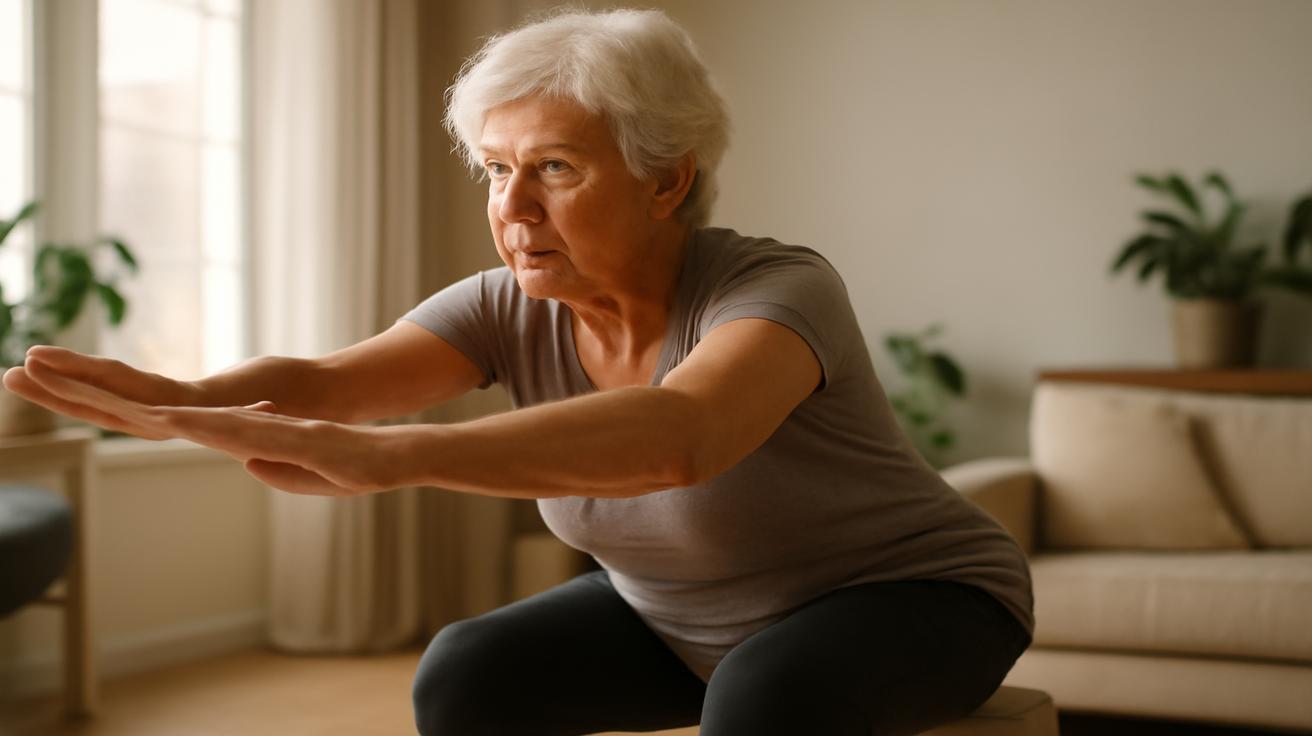
This pattern of movement asks you to keep strength intimately connected to daily life. Instead of isolated biceps curls, you practice standing up and sitting down slowly, feeling every inch of the movement. Instead of a leg press machine, you hinge at the hips to pick up a bag of groceries, using your glutes and hamstrings, teaching them they are still very much needed.
In the hall, chairs line one side of the room. A man with a cane is doing sit-to-stands, arms crossed over his chest. He counts quietly, but what matters isn’t the number; it’s the confidence blooming in his posture as he discovers he can, in fact, stand up from that chair with less help than last month.
5. Threading Movement Into the Seams of the Day
The real magic happens when this pattern leaks out of “exercise time” and stains the rest of your day in small, almost invisible ways. Waiting for the kettle to boil? You shift your weight from one foot to the other, gently turning your head side to side, feeding your brain new balance data. Watching the news? You sit on the edge of the couch, rising halfway and lowering again, slow-motion squats disguised as fidgeting.
You don’t need longer sessions. You need more invitations—tiny, frequent invitations that whisper to your muscles and joints, Stay in the game. A 5-minute “movement snack” three or four times a day is more potent for your healthspan than one 60-minute heroic effort that leaves you exhausted and sore.
Most of all, this pattern is built on conversation, not command. You listen: What feels stuck today? What feels curious? You move just enough to wake things up, not so much that you shut them down with pain or fear. Over weeks, something subtle shifts: your world starts to feel bigger again, not because your body is what it was at thirty, but because it remembers how to be fully itself at seventy, eighty, ninety.
Beyond Longevity: The Texture of Your Remaining Days
There’s a phrase often whispered in geriatric clinics: “She’s still independent.” On paper that means she can dress herself, feed herself, use the toilet, maybe manage the stairs. But independence is a low bar for a human life. Healthspan asks a better question: What can you still enjoy?
The movement pattern we’ve been sketching here isn’t about squeezing extra years on the calendar. It’s about preserving the texture of your days: the coolness of soil between your fingers in the garden, the able-bodiedness of walking down to the water at sunrise, the silly, spinning joy of slow-dancing with your grandchild in the living room without worrying you’ll topple over.
One woman from that hall class, 78 years old, used to measure her life by doctor appointments and lab results. Now she measures it by something else: “I can still get on the floor to play with my great-grandson,” she says, “and more importantly, I can get back up without needing three adults to haul me.” Her blood pressure is better. Her labs have improved. But the real triumph is simpler: her world feels bigger, not smaller.
After 70, not all declines are inevitable. Many are simply the cost of a body that has been asked, for too long, to move in narrow, predictable, easy ways. Walks are fine. Gyms can be wonderful. But the upgrade to your healthspan begins the moment you decide to become a little wild again in how you move—to twist, reach, kneel, sway, and rise as if your body is still a place worth exploring.
Frequently Asked Questions
Is it safe to start this kind of movement after 70 if I haven’t exercised in years?
Yes, but start small and slow. Begin with very gentle versions of each element—tiny twists, brief balance practice holding onto a chair, partial sit-to-stands. If you have medical conditions, pain, or a history of falls, consult your healthcare provider and, if possible, work with a qualified physical therapist or trainer experienced with older adults.
How much time do I need each day to see benefits?
Even 10–15 minutes a day, broken into shorter “movement snacks,” can make a real difference over time. Consistency matters more than duration. Aim for a few minutes, several times a day, rather than a single long session once in a while.
What if I have knee or hip replacements?
You can still follow the same movement pattern, but with modifications. Avoid deep bends beyond your comfort, keep ranges of motion smaller, and use chairs, walls, or railings for support. A physical therapist familiar with your surgery can help you design safe versions of floor transitions, balance work, and gentle strength movements.
I’m afraid of falling. How can I work on balance without making things worse?
Start with very safe setups: stand near a sturdy counter or corner where you can hold on with both hands if needed. Practice tiny weight shifts, marching in place while holding on, or turning your head slowly while standing. As your confidence grows, you can gradually reduce the amount of support you use, but there’s no rush.
Do I have to give up my daily walks or gym sessions?
No. Think of walks and gym time as part of a larger ecosystem of movement. Keep them if you enjoy them, but add variety: change your walking route to include gentle hills or different surfaces, incorporate more multi-directional movements before or after the gym, and weave floor work and balance practice into your week. The goal isn’t replacement, but expansion.
Can this really make a difference if I’m already in my eighties?
Yes. Research and real-world experience consistently show that older adults—even in their late eighties and nineties—can improve strength, balance, and confidence with appropriately scaled movement. You may progress more slowly, and your ceiling may be different from someone younger, but meaningful gains in healthspan are possible at almost any age.
What’s the best way to start today?
Pick one tiny, gentle practice you can do right now: stand up and sit down from your chair five times, slowly; or stand holding the back of the chair and shift your weight from one leg to the other for a minute; or lie down on your bed and gently roll from side to side. Let it be easy and curious. Then, tomorrow, do it again—and add one small variation. That’s how the new pattern begins.