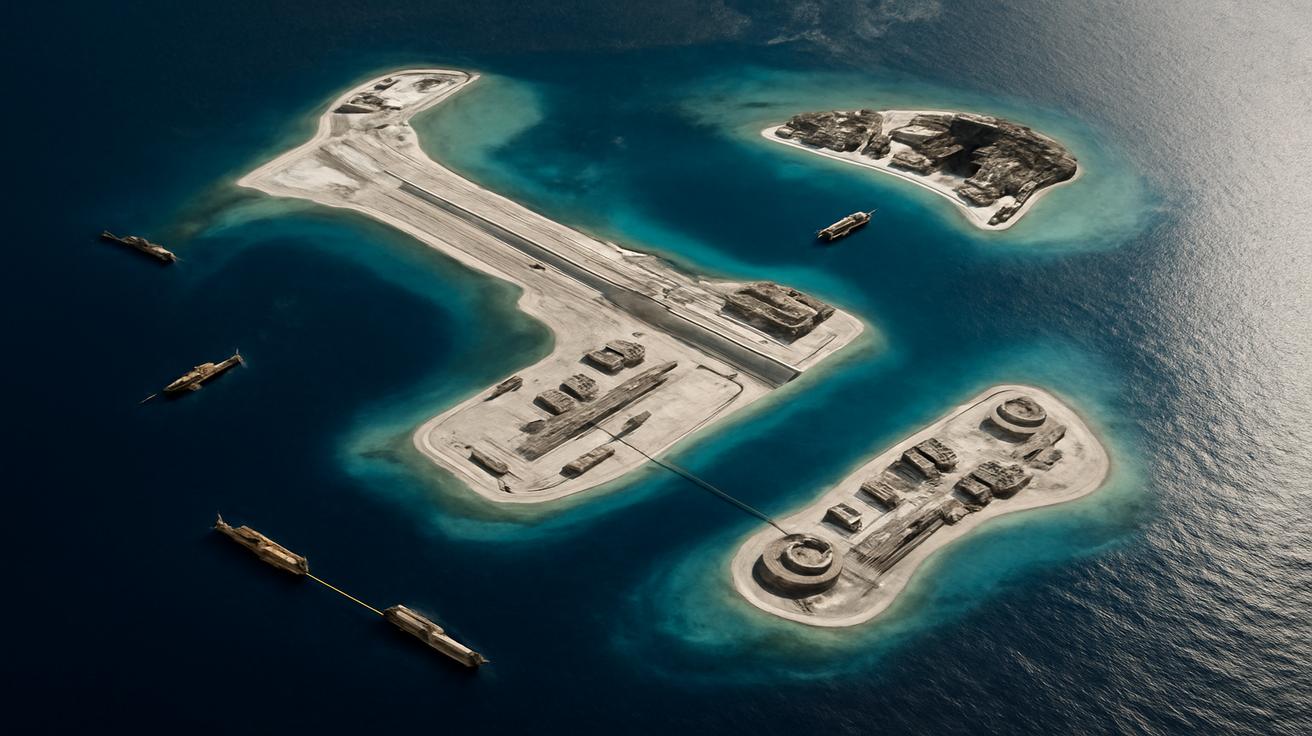
The helicopter flies low over the sea, and for a moment there is nothing—just blue stretching out in every direction, broken only by the faint white scratch of waves. Then, like a mirage sharpening into focus, the islands appear. Not the soft green humps that rise from old volcanic bones or coral reefs. These are sharp-edged, geometric, impossibly pale—like someone dropped shards of a man-made continent into the middle of the ocean. At their heart, behind seawalls and runways and radar domes, lies a story that began with sand. Billions of grains, hauled from the seabed and poured, day after day, year after year, into a restless sea.
How to Build an Island from Nothing
It sounds like a fable: a country decides it needs new land, looks out at the ocean, and begins to build. But this is exactly what China has been doing in the South China Sea for more than a decade, pouring millions of tonnes of sand and rock into disputed waters tucked between the Philippines, Vietnam, Malaysia, Brunei, and Taiwan.
Sailors in the region began reporting strange sights around 2012: dredgers the size of apartment blocks, sucking up seabed sediment through long, metal proboscises and spitting it out in thick, pale plumes. Shoals and reefs that once appeared only at low tide began to rise, staying stubbornly above the waves. By the middle of the decade, satellite images showed a chain of artificial islands where there had once been little more than rock, coral, and contested nautical charts.
Creating land from the sea is not a new human trick. Cities like Singapore, Hong Kong, and Dubai have expanded their coastlines using land reclamation, filling shallow bays with sand retrieved from nearby seabeds. But what China has been doing in the South China Sea is reclamation with an entirely different ambition and scale: starting with remote reefs and submerged features, far from any mainland shore, and turning them into militarized outposts and miniature cities.
From the air, you can see the logic of their engineering. First come the dredgers, carving trenches into the ocean floor, vacuuming up sand and silt. Then come the barges, pouring this slurry over coral structures that, for millennia, only barnacles and clownfish cared about. Bulldozers and excavators rumble across the newborn ground, packing it down, shaping it into runways and harbors. Concrete seawalls rise, encasing the infant islands in a hard shell to keep the sea at bay.
The Sea That Everyone Wants
To understand why someone would build islands in the middle of nowhere, you have to understand that the South China Sea is not nowhere at all. It is a blue crossroads, a liquid highway through which an enormous share of the world’s trade flows—a place where oil tankers and container ships slide between archipelagos, carrying fuel, electronics, grain, and everything in between.
Under that glossy surface lie suspected reserves of oil and natural gas, as well as rich fishing grounds that have sustained coastal communities for generations. The sea is ringed by nations that each look out at its waters and see something vital—a source of food, a strategic buffer, a route to global markets, a promise of future wealth.
China calls almost the entire area its own, drawing a sweeping “nine-dash line” on the map that curves deep into waters claimed by other countries. To many of its neighbors, and to courts and maritime lawyers, that line is more fantasy than fact. But on the water, power is not only drawn in ink, it is built in steel and concrete and sand.
By creating new islands on reefs like Fiery Cross, Subi, and Mischief—names that already sound like trouble—China wasn’t just sculpting the seafloor. It was planting stakes, saying: this is land; this land is ours; and where that land exists, so too does a claim to the surrounding sea.
| Island / Reef | Approx. Land Area Created | Key Features |
|---|---|---|
| Fiery Cross Reef | ~2.7 sq km | Runway, harbor, radar domes, housing blocks |
| Subi Reef | ~4.0 sq km | Long runway, shelters, storage facilities |
| Mischief Reef | ~5.5 sq km | Extensive harbor, administrative and military buildings |
This move didn’t go unnoticed. Neighboring countries watched as their maps grew more complicated. Far-off nations that rely on these waters for trade, like the United States and Japan, worried about what stronger Chinese control might mean for freedom of navigation. And environmental scientists—who had been cataloging the reefs of the Spratly and Paracel Islands as some of the most biodiverse marine habitats on Earth—saw something else: destruction unfolding almost in real time.
The Sound of a Reef Being Buried
If you could sit on the seafloor while an island is being made above you, it would not feel like engineering. It would feel like catastrophe. There would be a growing darkness, a dimming of the light that has fed corals and seagrasses for centuries. Then, the sound: the grinding roar of suction dredgers tearing at the seabed, the gritty avalanche of sand raining down, the rumble of machinery transmitted through the water.
Coral reefs are living cities. They are built slowly, polyp by polyp, skeleton by skeleton. A single reef might nurture thousands of species of fish, crustaceans, mollusks, and sea turtles. For coastal communities, these reefs can be nurseries for the fish they catch, natural breakwaters that soften storms, and spiritual landscapes layered with stories and names.
When dredgers start their work, that complexity is no match for the brute force of steel and suction. Sediment clouds the water, smothering gills and clogging delicate coral polyps. Entire reef structures can be scraped away, crushed under the weight of new fill. Recovery, if it happens at all, stretches over decades, and only if the water remains clear and calm—conditions that large-scale construction rarely allows.
On the newborn islands themselves, any trace of preexisting life is stripped out and replaced with a different kind of ecosystem: one of concrete aprons, desalination plants, fuel tanks, and antenna arrays. Palm trees are sometimes planted, their roots snagging in imported soil, offering a photograph-friendly veneer of tropical normalcy. But under the surface, the old reef—fractured, buried, or reshaped into seawalls—remembers what it used to be.
For people living along the South China Sea’s rim, the ecological damage is not abstract. Fisherfolk who used to anchor near these reefs now speak of restricted zones, warning calls from patrol boats, nets that come up strangely empty. An underwater landscape that once hummed with parrotfish and snapper now pulses to a different rhythm: patrol craft, radar sweeps, helicopter blades chopping the salty air.
Sand, Power, and the Politics of Scale
There is something almost unsettlingly simple about the raw mechanics of island-building. Take sand from one place, dump it in another, and repeat until you have land. But the simplicity is deceptive. The ability to do this at a massive scale, thousands of kilometers from one’s own shores, is a kind of quiet power in itself.
Sand may seem like the most ordinary substance on Earth, but in the twenty-first century it has become one of the world’s most extracted resources, second only to water. It is the basic ingredient of concrete, glass, and asphalt—the skeleton of cities and infrastructure. In coastal and marine environments, it is both building material and habitat, a cushion that absorbs waves and a home for countless organisms.
China’s state-owned dredging fleets are among the largest on the planet, built up over years of domestic land reclamation along crowded coasts. In the South China Sea, this industrial muscle has been redirected into geopolitics. While other nations in the region also occupy and modify reefs, the scale and speed of China’s transformations stand apart. It is one thing to add a small pier or outpost on a rocky islet; it is another to raise entire air bases from the waves in a matter of months.
Once these islands exist in physical form—concrete underfoot, radars turning slowly above—they reshape not just the sea, but the debates around it. Maps can be redrawn. Patrol routes can be extended. New baselines for territorial claims can be argued, even if contested by courts or rivals. Land, even artificial land, anchors political narratives in a way that lines on water never quite can.
From the deck of a passing ship, the scale of it is hard to ignore. A place that, a decade ago, might have been nothing more than a name on a nautical chart is now a fully lit installation, humming with generators, its pier stacked with containers and patrol boats. The transformation is stark enough that some sailors will tell you they feel like time travelers, moving between eras in a single voyage.
The Human Texture of New Islands
It is easy to talk about these islands in terms of strategy and engineering, but there are also the people who live and work on them, far from any natural shore. Imagine arriving for a posting on one of these platforms-soon-to-be-islands a few years back—just concrete pads and half-finished buildings, waves slapping against temporary breakwaters, a landscape of dust, rebar, and salt spray.
Workers describe the air as a strange blend of marine freshness and grinding construction: diesel fumes mixing with the sharp, metallic tang of cutting tools and the slightly sweet odor of wet concrete curing in tropical heat. On some days, the wind carries the calls of seabirds circling overhead, confused, perhaps, by this sudden appearance of vertical angles and glass where once there was only sea.
Life on an artificial island follows a rhythm of its own. Supplies arrive by ship, every bag of rice and coil of wire logged and stacked. Freshwater is rationed, spun from desalination units that turn seawater into something drinkable. At night, the stars shine with a brightness that most city dwellers no longer know—until a military exercise or emergency floods the island with artificial daylight, erasing the constellations under sodium and LED glare.
On a quiet evening, standing at the edge of a newly built seawall, someone might look down and see small fish already cruising the shadows, finding new crevices between the rocks. Nature, opportunistic and stubborn, tries to adapt. Algae clings to breakwaters. Barnacles test out the hulls of anchored vessels. Even here, in the most manufactured of seascapes, a new ecology begins to assemble itself, layered awkwardly over the ruins of the old.
Fragile Foundations in a Rising Sea
There is an irony in this great, sandy enterprise. These artificial islands were built to project control and permanence in a region defined by change. But the South China Sea, like all the world’s oceans, is rising. Storms are getting stronger. Tides are shifting. The very element that these islands were carved from—water—will spend the coming decades testing the edges of their seawalls.
Engineers have tried to account for this, raising island elevations, thickening their defenses with rock and reinforced concrete. Yet anyone who has watched a typhoon tear apart a coastline knows there are limits. Waves can undercut foundations. Subsurface sand can shift. The towering structures that sit atop these bases—communications towers, storage tanks, runways—depend on the quiet obedience of the ground beneath them.
Natural islands, born of volcanism and tectonic uplift, have deep roots. Coral atolls, though low, are flexible, sometimes able to adjust to changes in sea level by growing new limestone skeletons. Artificial islands, by contrast, are rigid and finite. If the sea rises faster than anticipated or storms grow stronger than modeled, maintaining them will require an endless choreography of repairs and reinforcements, more barges, more rock, more sand.
Some coastal planners look at all this and wonder if we are rehearsing for a future that will come to many more places. As sea levels rise, other nations are considering walls, barriers, and even their own artificial platforms to hold back the tides or create new safe ground. The South China Sea islands, controversial as they are, may be early, dramatic examples of a much wider human impulse: to engineer our way out of an encroaching ocean.
Lessons in Sand and Saltwater
Stories about new islands tend to attract the imagination. They evoke myths of Atlantis rising, or fantasy tales of countries building floating cities to escape crowded continents. But what has unfolded over more than a decade in the South China Sea is not fantasy. It is something harder to categorize: part geopolitics, part ecological upheaval, part preview of how far we are willing to go to redraw the line where land meets water.
Walk, if you could, along the edge of one of these islands at dawn. The air would be heavy and warm, carrying both the mineral smell of drying concrete and the deep, organic breath of the ocean. Waves would slap steadily against the armor of the seawall, searching for a weakness. A few early workers might trudge past in orange vests, boots leaving prints in imported soil, while somewhere behind them, in low, blocky buildings, banks of screens glow with radar sweeps and weather data.
Out beyond the shadow of the island, fish still move through blue corridors, following routes older than any human chart. Migratory birds, tired from long flights, may circle once, twice, before deciding whether to rest on this strange new landing pad thrust into their sky. Below, where the original reef used to rise in intricate masonry, the seafloor now bears the scars of dredging and dumping, mixed with patches of life in stubborn recovery.
After twelve years and millions of tonnes of sand, China has proven that it can, in a very literal sense, make its own land in the South China Sea. The islands exist. Runways and lighthouses and harbors have been built where once only coral broke the surface. But the deeper question lingers in the water around them: what will the long-term costs be—for ecosystems, for regional peace, for the delicate balance between human ambition and a shifting, rising sea?
In that question lies the uneasy heart of this story. It is not just about one country or one ocean. It is about how far, in an age of ecological strain and geopolitical tension, we are willing to push the boundaries of the possible—and whose worlds, above and below the waterline, will be rearranged in the process.
FAQ
Are China’s artificial islands natural landforms?
No. They began as reefs, shoals, or submerged features that were then heavily modified through dredging and land reclamation. Large volumes of sand and rock were added to create permanent, above-water islands.
Why did China build these islands?
Multiple reasons are cited: to strengthen territorial and maritime claims, extend military reach, support fishing and coast guard operations, and improve logistical and surveillance capacity across the South China Sea.
How long did it take to create the islands?
The intensive phase of construction unfolded over roughly a decade, with some reefs transformed into substantial islands in just a few years thanks to large-scale dredging and engineering equipment.
What is the environmental impact of this island-building?
The impacts include destruction of coral reefs, increased sedimentation that harms marine life, loss of fish habitat, and long-term degradation of local ecosystems. Recovery, if possible, may take decades.
Are these islands at risk from climate change and sea-level rise?
Yes. Although many have been built with raised elevations and strong seawalls, they remain vulnerable to stronger storms, erosion, and rising seas, which may demand continual reinforcement and maintenance.
Do other countries also build artificial islands in the South China Sea?
Some neighboring countries have engaged in smaller-scale reclamation and construction on existing outposts, but China’s activities have been the most extensive in area, speed, and infrastructure complexity.
Can artificial islands legally extend maritime claims?
Under international law, artificial islands generally do not enjoy the same status as natural islands and cannot generate full territorial seas or exclusive economic zones on their own. However, their existence can complicate disputes and enforcement on the water.