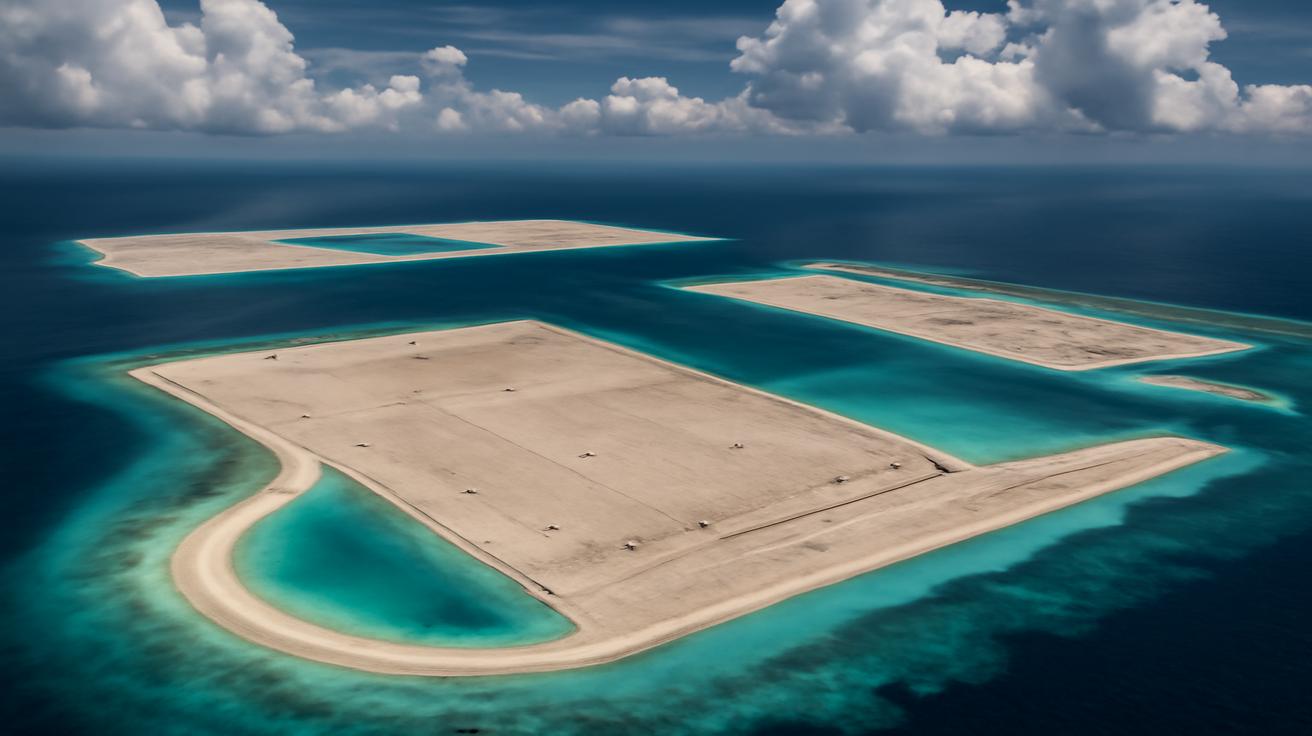
The first time you see them on a satellite map, they look almost innocent—tiny freckles of pale sand scattered across the deep blue of the South China Sea. Zoom in and the freckles sharpen into familiar shapes: runways, harbors, radars, power lines. Islands, where fifteen years ago there was only water and reef and the slow, steady work of coral polyps. You blink, refresh the map, and they’re still there. Concrete where there was once current. Asphalt where once a sea turtle might have surfaced for air.
Islands From Nowhere
Picture the scene from sea level instead of space. The sun is merciless. The horizon shimmers. A convoy of dredging ships moves slowly, almost lazily, their hulking silhouettes framed against the sky. Pumps hum—a low, industrial heartbeat. Steel arms plunge into the turquoise shallows, stirring up plumes of sand and coral rubble from the seafloor. That slurry is then blasted through floating pipes, arcing like muddy rainbows onto the exposed skeleton of a reef.
Day after day, month after month, year after year, the same ritual continues: suck, blast, flatten, repeat. From a distance it feels surreal, like watching a time-lapse of geology on fast-forward. What tides and tectonic plates do over millennia, here is compressed into a decade and a half of engineering, stubborn political intention, and hundreds of millions of cubic meters of sand.
After dumping tonnes upon tonnes of that sand—along with rock, concrete, and steel—China has done something that seems, at first, like myth: created whole new islands in the ocean from almost nothing. In the contested heart of the South China Sea, shallow reefs have been aggressively bulked up into artificial land, large enough to hold airstrips, radar domes, and solar arrays. In human terms, it feels as if the map of the world has been quietly edited while no one was looking.
How to Build an Island Where No Island Stood
It’s tempting to imagine some fantastical machine dropping ready‑made islands from the sky, but island-making is less magic and more mud. The foundations of China’s new outposts—names like Fiery Cross Reef, Subi Reef, Mischief Reef—once barely broke the surface at low tide. Some were little more than submerged shoals, dangerous to ships but invisible to the untrained eye.
Enter the cutter-suction dredger, an industrial beast the size of a small town block. At its prow, a rotating cutter head chews into the seabed, grinding coral, sand, and rock into a thick slurry. This mixture is sucked up and pushed through kilometers of pipeline to the “construction site” on top of the reef. Bulldozers and excavators, their tracks clanking on steel mats, crawl across the emerging land, shaping it like children with toy trucks on a beach—only here the stakes are measured in geopolitics, not sandcastles.
Bit by bit, the reef’s contour changes. Low-tide sandbars rise above high tide and keep going, lifted into permanent visibility. Engineers compact the fill, driving enormous piles deep into the unstable base. Seawalls of boulders and concrete blocks encircle the new land like armored collars, designed to hold it in place against typhoons and the ocean’s relentless tug. On top of this skeletal frame come layers of gravel and asphalt, followed by the familiar signatures of human ambition: long, pale airstrips, neat grids of housing, storage tanks, helipads, lighthouses, communication towers.
From the deck of a passing fishing boat, the sensory shift is jarring. Where you once heard only waves slapping against hulls and the far-off rattle of rigging, now there are generators rumbling, construction cranes squealing, the sharp bark of radios. The night sky, once stitched with stars, competes with electric glare. These are not just islands—they are projections of intent made solid.
Why Build Sandcastles in a Stormy Sea?
On a map, the South China Sea looks almost gentle, its waters cupped like a shallow bowl by the coasts of China, Vietnam, the Philippines, Malaysia, Brunei, and Indonesia. In reality, it is one of the world’s most intensively contested maritime spaces. Beneath its waves lie oil and gas reserves. Across its surface crawl more than a third of global shipping traffic. In its shoals and reefs, fish breed and feed, sustaining millions of people who live along its coasts.
For decades, countries surrounding this sea have staked claims that overlap like tangled fishing lines. China’s version is the most sweeping—its famous “nine-dash line” arcs deep into the heart of the sea, cutting across the exclusive economic zones of several neighbors. To turn its lines on a map into something harder to dispute, China chose an audacious method: build.
Islands, even artificial ones, can be made to anchor territorial claims. A runway suggests permanence. A harbor suggests purpose. Radar towers and military garrisons whisper a different message altogether: this is not simply about fish or oil—it is about presence and control.
On the surface, these outposts also wear more benign costumes. There are weather stations to track typhoons, lighthouses to guide ships, solar panels shimmering in the tropical sun. Some Chinese officials speak of “improving navigation safety” and “providing public goods” to the region. And in fairness, a lighthouse beam doesn’t ask who you are before helping you steer clear of danger.
Yet to sailors from neighboring countries, the silhouettes of anti-aircraft guns and radar arrays are hard to ignore. From their vantage point, these islands look less like guardians of safe passage and more like sentries watching every move, reshaping not only the sea’s physical contours but its psychological ones as well.
The Ocean Pays the First Price
Beneath all this human drama plays out a quieter, slower tragedy—one measured in broken coral branches and silenced reefs. If you could dive into the water as a dredger approaches, you’d see visibility drop from crystal to milky brown in minutes. Sediment blooms into clouds, smothering everything. Fish vanish into the murk. Sea cucumbers, starfish, and clams disappear under a thick, suffocating blanket.
Coral reefs are not just pretty underwater gardens; they are living fortresses built grain by grain by tiny animals. They form nurseries where juvenile fish hide and feed, their bright bodies flickering like confetti among branching corals. These structures also act as natural breakwaters, softening the worst of the waves before they reach coastlines. To dynamite or grind them up is to strip away both biodiversity and a line of defense.
Studies by marine scientists surveying the Spratly Islands and nearby reefs have documented stark losses: once-vibrant reef flats turned into rubble, seagrass meadows torn up, clam beds obliterated. Sediment plumes can drift for kilometers, affecting far more than just the dredged site. Some species can’t simply swim elsewhere; they are tied to specific types of reef, specific water depths, particular patterns of current and light.
Once an artificial island is in place, the environmental story doesn’t end. Waste from human habitation—sewage, fuel leaks, discarded materials—seeps into the surrounding water. Noise from generators and boats hums constantly through what was once an acoustic wilderness, where snapping shrimp and whale calls dominated. The reef’s ancient tempo is replaced by the 24/7 heartbeat of infrastructure.
A New Kind of Archipelago
To understand the scale of this transformation, it helps to see the islands side by side. Not as isolated marvels, but as pieces of a deliberate, sprawling pattern.
| Feature | Approx. Size of Built Land | Notable Structures | Original Formation |
|---|---|---|---|
| Fiery Cross Reef | ~2.7 sq km | Runway, harbor, radar domes | Low-tide reef |
| Subi Reef | ~4 sq km | Airstrip, large harbor | Submerged reef |
| Mischief Reef | ~5.5 sq km | Runway, docks, hangars | Low-tide elevation |
Viewed on a smartphone screen, that table is just tidy rows of data. But if you were flying over these features in a small prop plane, what you’d see would feel almost disorienting: long, gleaming strips of land placed like exclamation marks on the sea, organized in a sort of chain. Each has its own harbor. Each can host patrol boats, aircraft, supply ships. Together, they form a de facto network of waypoints across a once-difficult expanse of open water.
For Chinese vessels—coast guard cutters, fishing fleets, survey ships—these outposts are like stepping stones. For other countries’ navies and fishermen, they’re more like a series of checkpoints. Where there were once only shoals to navigate around, there are now places to be watched from, challenged from, radioed from: “Identify yourself. State your intentions.”
In peacetime, such a network alters the psychology of the sea. Mariners begin to think less of open water and more of zones—areas of quiet permission and areas of wary caution. The intangible, timeless idea of the high seas as “global commons” is nudged aside by something more ringed, hedged, parceled.
Sand, Time, and Rising Seas
There is a paradox buried in all this construction: even as humans assert their power over the ocean by raising islands, the ocean itself is rising. Sea level increase, driven by melting ice and warming waters, is already measurable in the South China Sea. Storms are growing fiercer, storm surges thicker with energy. From one angle, these artificial outposts are engineering triumphs. From another, they are castles made not of stone but of carefully balanced sand in an age of deepening tides.
The more land is piled up, the heavier it becomes, pressing down on the soft sediments beneath. Some engineers warn of subsidence—slow sinking that could, over years or decades, compete with any height advantage gained. Seawalls must be maintained, reinforced, rebuilt. Runways will need resurfacing. Corrosion gnaws at everything metal. Salt spray is an unrelenting enemy.
While satellite photos show impressive airstrips, they don’t show the maintenance crews, the constant stream of barges bringing cement, steel, fresh water, fuel. These islands demand a steady drip of resources simply to stay useful. They’re like distant, demanding outposts in a science fiction story, except this one is unfolding in real time, on real seas.
Alongside this physical precariousness is a quieter, more subtle cost: what these islands normalize. Once one country builds on a reef, others may feel compelled to do the same, or to harden their own existing features—replacing wooden stilts and simple piers with reclaimed land and concrete. The ocean, once left mostly to waves and reefs in its shallower corners, starts to resemble a chessboard of hardened points.
A Sea That Remembers
Yet the sea has its own way of registering our actions. Long after the dredgers leave, scars remain. An artificial island is like a rock dropped in a still pond, its wake rippling outward—only here the ripples are ecological and political, and the pond is shared by nations with long memories.
Fishermen from the Philippines, Vietnam, and other neighboring states tell of being pushed away from grounds their families have used for generations. They describe distant lights where there were once only stars. Some recall being intercepted by white-hulled coast guard vessels, their bows looming, loudspeakers crackling through the tropical night. In these stories, the new islands are not abstract legal arguments; they are concrete presences that alter the everyday pattern of nets, tides, and risk.
Marine biologists, too, are taking notes. They catalog coral species lost and displaced, shifts in fish populations, changes in sedimentation patterns. Each artificial island is a new variable in a complex, delicately tuned system. The South China Sea is not just one big bowl of interchangeable water; it’s a mosaic of microhabitats, currents, and migratory routes. Disrupt enough of those and the whole picture starts to blur.
It’s easy, from a distance, to view China’s island-building as a singular phenomenon, a spectacle of national willpower. But look more closely and it becomes a mirror reflecting back something broader about our relationship with the planet. Around the world, we are doing versions of the same thing: pushing coastlines outward with reclaimed land in Dubai, Singapore, the Netherlands; armoring shorelines against erosion; building higher and closer to waters that are clearly on the move.
China’s islands simply do what so much modern development does—only more dramatically, more visibly, in a place already fraught with disputes. It’s as if the world were handed a vivid illustration of our era’s tendencies: speed over slowness, construction over conservation, lines on maps over lives under water.
Listening to the Water
Stand on the edge of one of these new islands on a windless evening, and you’ll still hear it: the sea, muttering against the rocks, slapping the concrete, running its fingers along the hulls in the harbor. For all the power expressed in turning blue water into beige land, the ocean refuses to be entirely rewritten. Waves snipe at seawalls. Salt creeps in. Over time, barnacles and algae colonize the pilings, a quiet, persistent reclaiming.
The question is not whether humans can build islands—we clearly can, and at remarkable scale. The more interesting question is whether we can learn to account for all the consequences: the broken reefs, the shifting politics, the maintenance burdens in a warming world. To recognize that these new pieces of land are not just feats of engineering or instruments of strategy, but part of a larger, living system that will react, adapt, and remember.
Somewhere under these grains of sand lie the bones of ancient corals that grew in clear, undisturbed water long before our ships arrived. Above them fly jets that can cross the sea in minutes. Between those two layers—ancient reef and modern runway—sits a story about how quickly we can remake the face of the Earth, and how slowly the Earth responds.
The next time you open a satellite map and your fingers zoom across that wedge of ocean between Southeast Asia and China, pause for a moment over those pale smudges. Think of the dredgers grinding through tropical nights, the coral dust swirling through water, the watchful radar sweeping the horizon, the fishermen turned back from familiar grounds. Think of the quiet, unhurried persistence of waves pressing against brand-new shorelines.
We have learned to create islands from scratch. Whether we have learned to live wisely with what we build is a different kind of test—one that will be graded, ultimately, not by courts or conferences, but by the sea itself.
Frequently Asked Questions
Are China’s new islands natural or completely artificial?
They are built on top of existing reefs and shoals, but the land itself is artificial. Engineers dredged sand, coral, and rock from the seabed and piled it onto these formations, then reinforced the new land with seawalls, concrete, and infrastructure.
How long did it take China to build these islands?
The most intense phase of construction occurred over roughly a decade, but the broader effort has stretched beyond 12 years. Even now, work continues in the form of expansion, maintenance, and the addition of new facilities.
Why did China build these islands in the South China Sea?
Strategic control, resource access, and political influence all play a role. The South China Sea is rich in fisheries and energy resources and is a crucial shipping corridor. Artificial islands help China solidify its territorial claims and extend its operational reach.
What is the environmental impact of this island-building?
The impact is severe. Dredging destroys coral reefs, stirs up sediment that smothers marine life, and alters local ecosystems. Long-term habitation adds pollution, noise, and ongoing stress to already fragile environments.
Are other countries also building artificial islands in the region?
Several neighboring states have expanded or reinforced existing reefs and features, though on a smaller scale and with fewer fully artificial islands than China. Still, China’s campaign has accelerated a broader trend of hardening and developing contested maritime spaces.